
AI Generated American End-User License Agreement (EULA)
PDF & Word - 2026 Updated
Docaro Pricing
When Do You Need an End-User License Agreement (EULA) in the United States?
American Legal Rules for an End-User License Agreement (EULA)
Using an inappropriate structure for an EULA may fail to adequately protect intellectual property rights or limit liability as intended under U.S. law.
What a Proper End-User License Agreement (EULA) Should Include
- License GrantThis section specifies that the user gets permission to use the software under certain conditions, like for personal or business purposes.
- Restrictions on UseIt outlines what users cannot do, such as copying the software, modifying it, or using it for illegal activities.
- Ownership RightsThis clarifies that the company owns the software and all related rights, while the user only has limited access.
- Payment TermsIt details any fees required for the license, including how and when payments must be made.
- Termination RulesThis explains when the license can end, like if payments stop or rules are broken, and what happens next.
- Warranty InformationIt states any guarantees about the software's performance and limits the company's responsibility for issues.
- Liability LimitsThis protects the company by capping their responsibility for any damages caused by using the software.
- Governing LawIt specifies which U.S. state's laws apply to the agreement and where disputes will be handled.
Generate Your Document in 4 Easy Steps
Why Use Docaro?
 United States
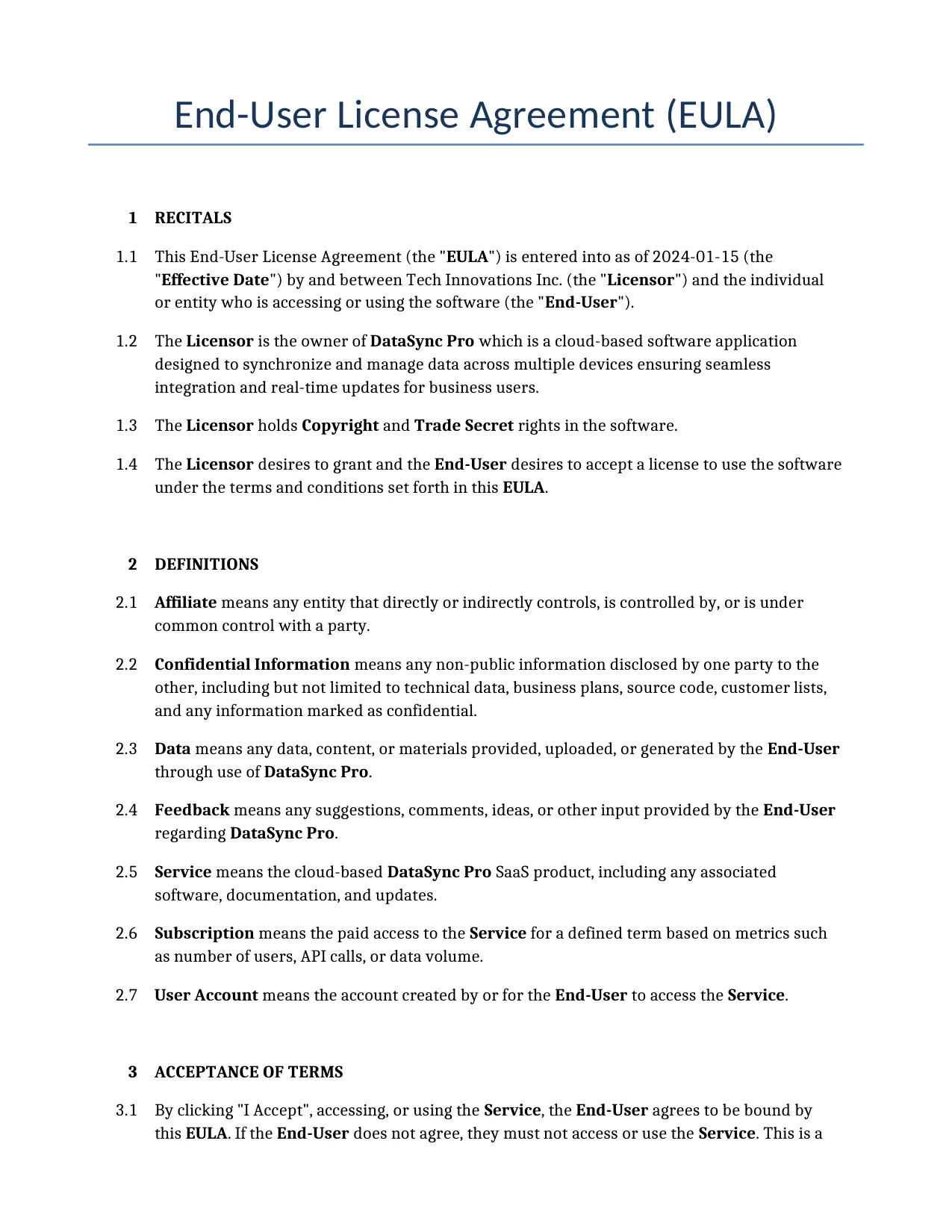
Free Example End-User License Agreement (EULA) Template
Below is a free template example of a End-User License Agreement (EULA) for use in the United States generated by our AI model.
The clauses in your actual End-User License Agreement (EULA) will vary from this example as they will be entirely bespoke to your requirements as set out in the questionnaire you complete.
End-User License Agreement
1RECITALS
This End-User License Agreement (the "EULA") is entered into as of 2024-01-15 (the "Effective Date") by and between Tech Innovations Inc. (the "Licensor") and the individual or entity who is accessing or using the software (the "End-User").
The Licensor is the owner of DataSync Pro which is a cloud-based software application designed to synchronize and manage data across multiple devices ensuring seamless integration and real-time updates for business users.
The Licensor holds Copyright and Trade Secret rights in the software.
The Licensor desires to grant and the End-User desires to accept a license to use the software under the terms and conditions set forth in this EULA.
2DEFINITIONS
Affiliate means any entity that directly or indirectly controls, is controlled by, or is under common control with a party.
Confidential Information means any non-public information disclosed by one party to the other, including but not limited to technical data, business plans, source code, customer lists, and any information marked as confidential.
Data means any data, content, or materials provided, uploaded, or generated by the End-User through use of DataSync Pro.
Feedback means any suggestions, comments, ideas, or other input provided by the End-User regarding DataSync Pro.
Service means the cloud-based DataSync Pro SaaS product, including any associated software, documentation, and updates.
Subscription means the paid access to the Service for a defined term based on metrics such as number of users, API calls, or data volume.
User Account means the account created by or for the End-User to access the Service.
3ACCEPTANCE OF TERMS
By clicking "I Accept", accessing, or using the Service, the End-User agrees to be bound by this EULA. If the End-User does not agree, they must not access or use the Service. This is a clickwrap agreement enforceable under the Uniform Electronic Transactions Act and applicable US law.
4GRANT OF LICENSE
Subject to the terms and conditions of this EULA, including payment of all applicable Subscription fees and compliance with Subscription metrics, the Licensor hereby grants to the End-User a non-exclusive, non-transferable, non-sublicensable, revocable license during the Subscription term to access and use the Service solely for the End-User's internal business purposes (if commercial) or personal use (if an individual consumer), as applicable based on the End-User's account type.
The license is granted on a per-authorized-user basis. The number of permitted simultaneous users and devices is limited to the quantity specified in the End-User's Subscription plan. Concurrent use beyond licensed metrics (e.g., exceeding API limits or user counts) is prohibited without additional fees.
The license granted herein is for a Subscription term and shall automatically renew for successive terms of equal length unless canceled as provided herein. The license continues only for the duration of the active Subscription period subject to payment of applicable fees and compliance with this EULA.
5LICENSE RESTRICTIONS
The End-User shall not sublicense the licensed product to others.
The End-User shall not modify or create derivative works from the licensed product.
The End-User shall not reverse engineer the licensed product.
The End-User shall not distribute sell or otherwise transfer the software to third parties.
The End-User shall not rent lease or lend the software to others.
The End-User shall not remove or alter any copyright trademark or proprietary rights notices in the software.
The End-User shall not use the Service to develop, create, or offer a competing product or service, including but not limited to using the Service for benchmarking, performance testing, or competitive analysis.
The End-User shall not scrape, crawl, or otherwise automatically extract data from the Service except as expressly permitted by the Licensor through documented APIs.
All rights not expressly granted herein are reserved by the Licensor. The End-User shall not use the Service for any purpose other than as expressly permitted under this EULA.
6OWNERSHIP
The Licensor retains all ownership and intellectual property rights in DataSync Pro.
The software is protected by the Copyright Act of 1976 and the Licensor asserts copyright ownership commencing in 2023.
The Licensor retains all intellectual property rights including copyrights patents trademarks and trade secrets in the software.
No title to or ownership of the software or any intellectual property rights therein is transferred to the End-User.
The End-User retains ownership of their Data. However, the End-User grants the Licensor a worldwide, royalty-free, non-exclusive license to use, host, reproduce, modify, and distribute the Data solely as necessary to provide, maintain, and improve the Service.
Any Feedback provided by the End-User is assigned to the Licensor, and the Licensor shall own all right, title, and interest in such Feedback, including any intellectual property rights therein. The End-User waives any moral rights in such Feedback.
7USER ACCOUNT RESPONSIBILITIES
The End-User is responsible for maintaining the confidentiality of their User Account credentials and for all activities conducted under their User Account. The End-User agrees to notify the Licensor immediately of any unauthorized use of their User Account.
The End-User shall be responsible for all Data uploaded or generated through their User Account and warrants that such Data does not infringe any third-party rights or violate applicable laws.
8ACCEPTABLE USE POLICY
The End-User shall not use the Service to transmit any unlawful, infringing, defamatory, or harmful content. The End-User shall comply with all applicable laws and shall not use the Service in violation of any third-party rights.
Violation of this Acceptable Use Policy may result in immediate suspension or termination of the End-User's access to the Service.
9PAYMENT TERMS
The End-User shall pay the Licensor the Subscription fees for the license granted under this EULA in advance according to the billing cycle selected at purchase (monthly or annual). The End-User authorizes the Licensor to charge the provided payment method for all fees.
The End-User shall be responsible for paying all applicable sales taxes in addition to the subscription fee.
The Licensor may increase prices upon thirty (30) days' notice. Continued use after the increase constitutes acceptance. Failure to pay the subscription fee in a timely manner may result in suspension or termination of the license granted hereunder. There are no refunds for Subscription fees paid, except as required by applicable law.
10AUTOMATIC RENEWAL AND CANCELLATION
Subscriptions automatically renew at the end of each term for the same length unless the End-User cancels at least thirty (30) days prior to renewal via their account settings or by contacting support. Cancellation stops future billing but does not provide refunds for the current term.
11UPDATES AND MAINTENANCE
The Licensor shall provide software updates to the End-User on a quarterly basis as a best effort only. Updates may include bug fixes, patches, and new features at the Licensor's sole discretion.
The Licensor shall provide patches for bugs or security vulnerabilities to the End-User as soon as reasonably practicable.
The Licensor offers technical support limited to email responses within 48 business hours for paid Subscriptions. No uptime SLA is provided beyond commercially reasonable efforts to maintain 99% availability. The Licensor disclaims liability for any downtime.
12DATA OWNERSHIP, PRIVACY, AND PROCESSING
The Licensor collects personal identifiers usage data and device information from End-Users via user interactions within the app such as form submissions and app usage logs to personalize user experiences and improve service functionality. The Licensor acts as a data processor with respect to End-User Data; the End-User is the data controller.
The Licensor uses the collected data for service provision analytics and improvement and legal compliance. The End-User consents to such processing by using the Service. For California residents, rights under the CCPA/CPRA (including opt-out of data sales, which the Licensor does not engage in) apply as described in the privacy policy. For international users, data may be transferred to the US with appropriate safeguards.
The Licensor does not share End-User data with third parties except as necessary for service delivery (with data processing agreements) or as required by law. The Licensor implements specific security measures to protect collected End-User data consistent with industry standards.
End-Users can exercise their privacy rights by emailing the support team at privacy@examplecompany.com with their request including verification details and the Licensor will process it within 30 days as required by law. Upon request, the Licensor will delete Data subject to legal retention requirements.
The Licensor's privacy practices are described in the privacy policy available at https://www.examplecompany.com/privacy-policy, which is incorporated herein by reference. In the event of conflict, this EULA governs.
13BETA SOFTWARE
If the End-User is provided access to beta or pre-release features of the Service, such use is at the End-User's sole risk. Beta features are provided "as is" without any warranty and may contain errors. The Licensor may discontinue beta features at any time without notice.
14AUDIT RIGHTS
The Licensor may audit the End-User's use of the Service upon reasonable notice to ensure compliance with this EULA and Subscription metrics. The End-User shall cooperate with any such audit.
15ANTI-PIRACY AND DMCA
The End-User shall not circumvent any technical protection measures in the Service. Any violations may be reported under the DMCA. The Licensor reserves the right to terminate accounts for repeat infringers.
16WARRANTY DISCLAIMERS
The software is provided on an "as is" and "as available" basis.
The Licensor disclaims all implied warranties including the implied warranty of merchantability and the implied warranty of fitness for a particular purpose. The Licensor makes no warranty regarding the accuracy, completeness, compatibility, or reliability of the Service or any Data processed thereby. No oral or written information shall create a warranty.
The Licensor does not warrant that the software will meet the End-User's requirements or that the operation of the software will be uninterrupted or error-free. This disclaimer complies with the UCC, UCITA, and applicable consumer protection laws and is intended to be as broad as permitted.
17LIMITATION OF LIABILITY
In no event shall the Licensor be liable for any consequential damages incidental damages or punitive damages arising out of or related to this EULA or the use of the software, including but not limited to data loss, loss of profits, or business interruption, even if advised of the possibility.
The total liability of the Licensor to the End-User for all claims shall not exceed the amount of the fees paid by the End-User to the Licensor during the twelve months preceding the claim. This cap applies to all claims regardless of theory of liability.
The limitations of liability set forth herein shall not apply to liability arising from the Licensor's gross negligence, willful misconduct, or as otherwise prohibited by applicable law (e.g., bodily injury or death). These limitations are enforceable under Delaware and California law and are not unconscionable.
18INDEMNIFICATION
The End-User shall indemnify defend and hold harmless the Licensor from and against any claims losses damages liabilities and expenses including reasonable attorneys' fees arising from the End-User's misuse of the Service, violation of this EULA, or claims related to the End-User's Data (including IP or privacy claims).
The Licensor shall indemnify the End-User against claims that the Service infringes third-party US intellectual property rights, subject to the End-User providing prompt notice and cooperation. The Licensor may, at its option, procure a license or modify the Service. This section is mutual to the extent applicable and balanced per US contract principles.
The indemnified party shall have the right to control the defense and settlement of any indemnified claim and the indemnifying party shall cooperate with the indemnified party in the defense of any such claim.
19CONFIDENTIALITY
Confidential Information means any non-public information disclosed by one party to the other including but not limited to technical data business plans source code and customer lists whether oral written or electronic. This section is mutual.
Each party shall protect the other's Confidential Information with at least reasonable care and shall not disclose it except as required by law or to professional advisors under a duty of confidentiality. Each party shall notify the other promptly of any unauthorized disclosure.
The parties' confidentiality obligations shall survive for 5 years after the EULA ends. Upon termination each party shall return or destroy all Confidential Information and certify compliance.
Each party shall be entitled to seek injunctive relief in the event of any breach or threatened breach of this confidentiality section without the necessity of proving actual damages.
20TERMINATION
The license granted hereunder shall terminate automatically if the End-User materially breaches any terms of this EULA.
The Licensor shall provide the End-User with a cure period of thirty days to remedy any breach before termination can occur.
The Licensor shall provide written notice to the End-User before terminating the license for breach with such notice delivered by email to the registered address.
Upon termination the End-User shall immediately cease all use of the software. The Licensor will provide thirty (30) days to export Data after which access may be revoked. The End-User shall destroy all copies of the software and related data in their possession.
The provisions of this EULA that by their nature are intended to survive termination including but not limited to ownership warranty disclaimers limitation of liability indemnification confidentiality and governing law shall survive any termination of this EULA.
21POST-TERMINATION OBLIGATIONS
Upon termination of this EULA the End-User shall delete all user data in their possession except as legally required to retain.
Upon termination of this EULA the End-User shall return any proprietary materials provided under this EULA.
The End-User shall provide a written certification of compliance with all post-termination obligations within thirty days of termination.
22GOVERNING LAW AND DISPUTE RESOLUTION
This EULA shall be governed by and construed in accordance with the laws of the State of Delaware without regard to its choice of law rules, to the extent not preempted by federal law.
This EULA shall be interpreted in accordance with the Uniform Commercial Code Article 2 the Copyright Act of 1976 the Digital Millennium Copyright Act the Uniform Computer Information Transactions Act the California Consumer Privacy Act and the Uniform Electronic Transactions Act to the extent applicable. Any reference to California-specific statutes applies only where mandated for California residents.
Any dispute arising out of or relating to this EULA shall first attempt informal resolution. If unresolved, it shall be resolved by binding arbitration administered by the American Arbitration Association in accordance with its Commercial Arbitration Rules, in Austin, Texas. Arbitration shall be mandatory and the End-User hereby waives any right to litigate in court (except for small claims) or to participate in a class action. This complies with the Federal Arbitration Act. Either party may seek equitable relief in court without arbitration.
The End-User shall provide notice of any dispute to the Licensor within one (1) year of the date the dispute arises, after which it is waived.
23FORCE MAJEURE
Neither party shall be liable for any delay or failure to perform its obligations under this EULA if such delay or failure results from acts of God war terrorism pandemics natural disasters such as earthquakes or floods supply chain disruptions or government regulations or restrictions.
The party affected by a force majeure event shall provide notice to the other party within 5 business days of the occurrence of such event.
The Licensor shall use reasonable efforts to mitigate the effects of the force majeure event including seeking alternative means to perform its obligations and resuming performance as soon as practicable.
24EXPORT CONTROLS AND ANTI-CORRUPTION
The End-User shall comply with all United States export laws and regulations including those under the Export Administration Regulations. The End-User certifies that it is not a resident of any embargoed country and is not on any US prohibited list.
The software is classified as EAR99 under United States export control regulations.
The End-User shall not export or distribute the software to embargoed or sanctioned countries.
The End-User shall not distribute the software to Denied Persons or Entity List Members.
The End-User shall not use or distribute the software for prohibited end-uses such as weapons development.
The End-User represents that it will comply with the US Foreign Corrupt Practices Act and will not offer bribes in connection with its use of the Service.
25THIRD-PARTY SOFTWARE
The software includes third-party components consisting of open source software and proprietary third party libraries specifically React.js lodash library and jQuery. A complete list of all third-party software and licenses is available in the documentation or an attached schedule.
React.js is licensed under the MIT License which requires notice and attribution lodash is licensed under the MIT License which is permissive with attribution and jQuery is licensed under the MIT License which allows commercial use with notice. No copyleft open source licenses (e.g., GPL) are incorporated that would require source code disclosure.
The Licensor shall provide notice and attribution to comply with third-party license obligations. The End-User must comply with all such licenses.
The Licensor disclaims all warranties for third-party software.
26ASSIGNMENT
The End-User shall not assign its rights under this EULA without the prior written consent of the Licensor.
The Licensor may assign its rights under this EULA without the consent of the End-User in the event of a merger or acquisition.
27SEVERABILITY
If any provision of this EULA is held to be invalid or unenforceable such provision shall be reformed only to the extent necessary to make it enforceable and the remainder of this EULA shall remain in full force and effect.
The court shall have the authority to blue pencil any provision to render it valid and enforceable to the maximum extent permitted by law, but only to the minimum extent necessary.
28ENTIRE AGREEMENT
This EULA, together with the privacy policy and any order form, constitutes the complete and exclusive understanding between the Licensor and the End-User and supersedes all prior oral or written agreements between the Licensor and the End-User. There are no other agreements, representations, or warranties except as expressly set forth herein.
29AMENDMENTS
The Licensor may amend this EULA by providing notice (including via email or in-app) at least thirty (30) days prior to the effective date. Continued use after the effective date constitutes acceptance. Amendments to material terms require mutual written consent if mandated by law; otherwise, this provision complies with US contract law.
30NOTICES
All notices under this EULA shall be in writing and may be delivered by email or by postal mail to the registered office address of the recipient. Notices to the Licensor shall be sent to 123 Tech Street, Austin, TX 78701, legal@techinnovations.com.
A notice sent by postal mail shall be deemed delivered 5 days after mailing. Electronic notices are effective upon transmission if no bounce-back is received.
31MISCELLANEOUS
Electronic signatures shall be accepted as binding under this EULA in accordance with the Uniform Electronic Transactions Act.
No waiver of any breach of this EULA shall constitute a waiver of any prior subsequent or other breach.
This EULA may be executed in counterparts each of which shall be deemed an original and all of which together shall constitute one and the same instrument.
32SIGNATURE SECTION
IN WITNESS WHEREOF the parties have executed this EULA as of the Effective Date.
Licensor: Tech Innovations Inc. By: _______________________________ Name: _______________________________ Title: _______________________________ Date: _______________________________
End-User: By: _______________________________ Name: _______________________________ Date: _______________________________
This example shows approximately 70% of a typical document and is provided for illustrative purposes only. The remaining content has been omitted.
Every document generated by Docaro is tailored to your specific circumstances, jurisdiction and the information you provide. The completed document includes all applicable clauses and provisions required for your situation.
To generate the full, personalised document, answer a short series of questions and your document will be created instantly.