
AI Generated American Prenuptial Agreement
PDF & Word - 2026 Updated
Docaro Pricing
When Do You Need a Prenuptial Agreement in the United States?
American Legal Rules for a Prenuptial Agreement
Using the wrong type or structure of prenuptial agreement can render it unenforceable or fail to protect intended assets.
What a Proper Prenuptial Agreement Should Include
- Asset and Debt DivisionClearly list all separate and shared assets and debts to specify how they will be divided if the marriage ends.
- Spousal SupportOutline any agreements on financial support for one spouse after separation or divorce.
- Protection of Inherited PropertyProtect family heirlooms, inheritances, or gifts that should remain with one spouse.
- Business InterestsSafeguard ownership and value of businesses started before or during the marriage.
- Lifestyle and Expense AgreementsSet expectations for how money will be spent during the marriage, like household budgets.
- Full Financial DisclosureRequire both parties to honestly share all financial information to ensure fairness.
- Legal Validity and ReviewInclude steps to make the agreement enforceable, such as independent legal advice for both sides.
Generate Your Document in 4 Easy Steps
Why Use Docaro?
 United States
Free Example Prenuptial Agreement Template
Below is a free template example of a Prenuptial Agreement for use in the United States generated by our AI model.
The clauses in your actual Prenuptial Agreement will vary from this example as they will be entirely bespoke to your requirements as set out in the questionnaire you complete.
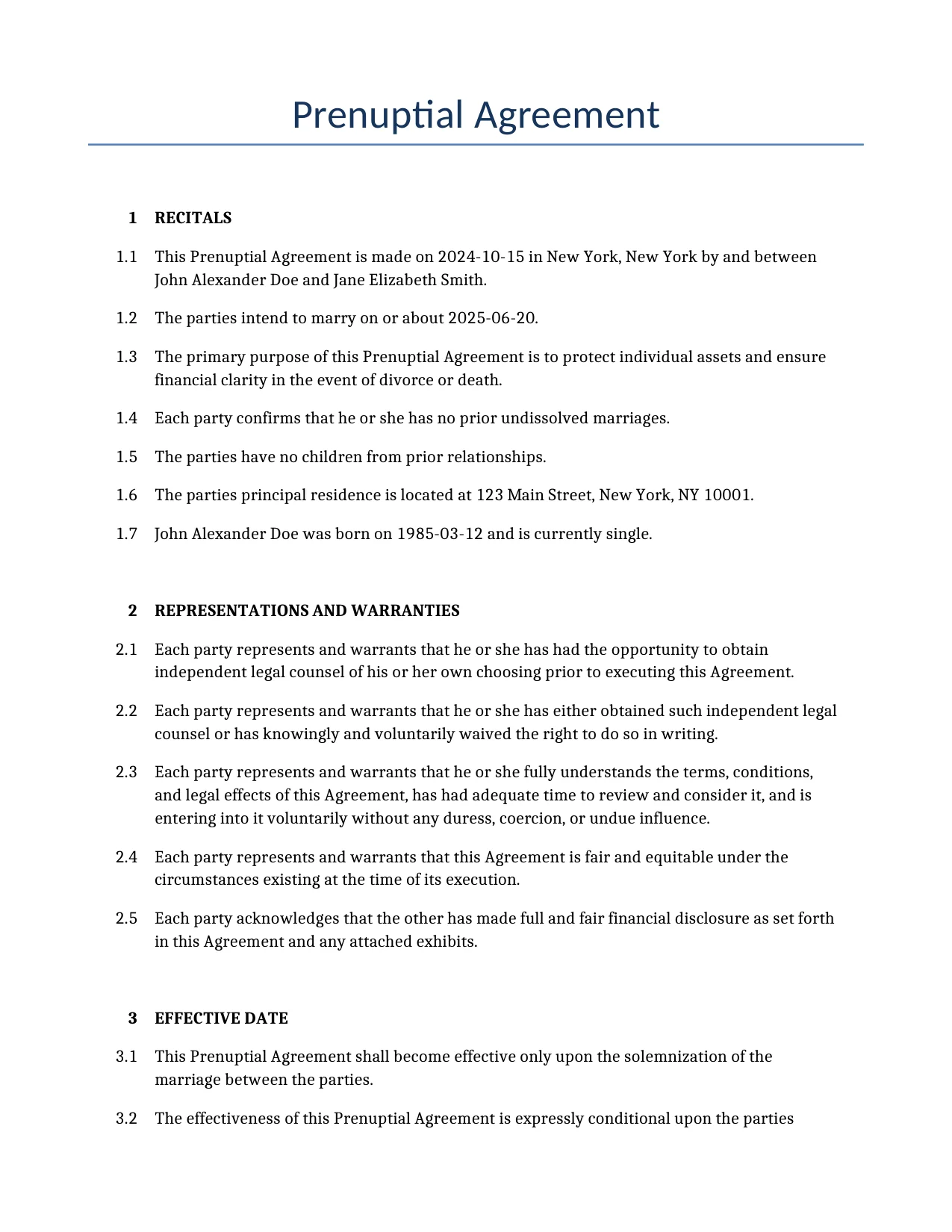
Prenuptial Agreement
1RECITALS
This Prenuptial Agreement is made on 2024-10-15 in New York, New York by and between John Alexander Doe and Jane Elizabeth Smith.
The parties intend to marry on or about 2025-06-20.
The primary purpose of this Prenuptial Agreement is to protect individual assets and ensure financial clarity in the event of divorce or death.
Each party confirms that he or she has no prior undissolved marriages.
The parties have no children from prior relationships.
The parties principal residence is located at 123 Main Street, New York, NY 10001.
John Alexander Doe was born on 1985-03-12 and is currently single.
2REPRESENTATIONS AND WARRANTIES
Each party represents and warrants that he or she has had the opportunity to obtain independent legal counsel of his or her own choosing prior to executing this Agreement.
Each party represents and warrants that he or she has either obtained such independent legal counsel or has knowingly and voluntarily waived the right to do so in writing.
Each party represents and warrants that he or she fully understands the terms, conditions, and legal effects of this Agreement, has had adequate time to review and consider it, and is entering into it voluntarily without any duress, coercion, or undue influence.
Each party represents and warrants that this Agreement is fair and equitable under the circumstances existing at the time of its execution.
Each party acknowledges that the other has made full and fair financial disclosure as set forth in this Agreement and any attached exhibits.
3EFFECTIVE DATE
This Prenuptial Agreement shall become effective only upon the solemnization of the marriage between the parties.
The effectiveness of this Prenuptial Agreement is expressly conditional upon the parties entering into a valid marriage. In the event the marriage does not occur, this Agreement shall be null and void and of no force or effect.
For the avoidance of doubt, this Agreement shall have no legal effect prior to the date of marriage, notwithstanding the date of its execution.
4GOVERNING LAW
This Prenuptial Agreement shall be governed by, interpreted, and enforced in accordance with the laws of the State of New York, without regard to its conflict of laws principles. The parties acknowledge that this Agreement is executed and to be performed in New York, and that both parties are and will be residents of New York. This Agreement is intended to be in full compliance with the New York Domestic Relations Law, including but not limited to Sections 236 and 248 thereof, and the Estates, Powers and Trusts Law (EPTL), including but not limited to Section 5-1.1-A regarding the right of election. Any action or proceeding relating to this Agreement shall be brought exclusively in the courts of the State of New York located in New York County.
5DEFINITIONS
Separate Property shall include premarital assets, gifts and inheritances.
Marital Property shall include jointly acquired assets, joint income and earnings.
6FINANCIAL DISCLOSURES
John Alexander Doe has a current annual gross income of $75,000.00 and is employed full-time.
John Alexander Doe has no pending lawsuits or legal claims against him.
The current total balance in all bank accounts of John Alexander Doe is $15,000.50.
The current total value of the investment accounts of John Alexander Doe is $25,000.00.
The estimated total market value of all real estate owned by John Alexander Doe is $300,000.00.
The estimated total value of the personal property such as vehicles, jewelry, and collectibles owned by John Alexander Doe is $20,000.00.
The total estimated net worth of John Alexander Doe (assets minus liabilities) is $350,000.00.
The total outstanding balance on the credit cards of John Alexander Doe is $5,000.00.
The total estimated liabilities of John Alexander Doe are $150,000.00.
John Alexander Doe has no ongoing child support obligations from prior relationships.
John Alexander Doe has no ongoing alimony or spousal support obligations from prior relationships.
John Alexander Doe has life insurance policies.
John Alexander Doe is not a beneficiary of any trusts.
John Alexander Doe does not expect to receive any significant inheritance in the near future.
John Alexander Doe has no outstanding tax liens or unpaid taxes.
John Alexander Doe has disclosed all of his assets, liabilities, income, and financial obligations to the best of his knowledge.
Jane Elizabeth Smith has a current annual gross income of $85,000.00 and is employed full-time.
Jane Elizabeth Smith has no pending lawsuits or legal claims against her.
The current total balance in all bank accounts of Jane Elizabeth Smith is $22,000.00.
The current total value of the investment accounts of Jane Elizabeth Smith is $45,000.00.
The estimated total market value of all real estate owned by Jane Elizabeth Smith is $0.00.
The estimated total value of the personal property such as vehicles, jewelry, and collectibles owned by Jane Elizabeth Smith is $15,000.00.
The total estimated net worth of Jane Elizabeth Smith (assets minus liabilities) is $75,000.00.
The total outstanding balance on the credit cards of Jane Elizabeth Smith is $3,000.00.
The total estimated liabilities of Jane Elizabeth Smith are $10,000.00.
Jane Elizabeth Smith has no ongoing child support obligations from prior relationships.
Jane Elizabeth Smith has no ongoing alimony or spousal support obligations from prior relationships.
Jane Elizabeth Smith has life insurance policies.
Jane Elizabeth Smith is not a beneficiary of any trusts.
Jane Elizabeth Smith does not expect to receive any significant inheritance in the near future.
Jane Elizabeth Smith has no outstanding tax liens or unpaid taxes.
Jane Elizabeth Smith has disclosed all of her assets, liabilities, income, and financial obligations to the best of her knowledge.
The parties acknowledge that each has made full and fair disclosure of their respective financial circumstances to the other, including but not limited to income, assets, liabilities, and financial obligations. Each party has had the opportunity to review the other's disclosures and is satisfied with their completeness and accuracy.
Detailed financial schedules and exhibits for both parties are attached hereto as Exhibit A (Financial Disclosure of John Alexander Doe) and Exhibit B (Financial Disclosure of Jane Elizabeth Smith) and are incorporated by reference into this Agreement. These exhibits contain complete inventories of all assets, liabilities, income, and expenses. The parties agree that failure to make full and fair disclosure may result in the invalidation of this Agreement.
7SEPARATE PROPERTY
The parties designate the following real estate properties as the Separate Property of John Alexander Doe: Primary Residence and Vacation Home.
The primary residence is a single-family home located at 123 Main Street, Anytown, USA, and the vacation home is a cabin at 456 Lake Road, Lakeside, USA.
John Alexander Doe acquired this real estate property on 2015-03-15.
The parties designate the following bank accounts as the Separate Property of John Alexander Doe: Savings Account and Checking Account.
The Savings Account is at First National Bank, Account Number: 123456789, and the Checking Account is at First National Bank, Account Number: 987654321.
This bank account was opened on 2010-06-20.
The parties designate the following investments as the Separate Property of John Alexander Doe: Stocks and Retirement Accounts.
The investments consist of stocks in Tech Company Inc., 500 shares, and a Retirement Account with Vanguard, IRA number 111222333.
John Alexander Doe acquired this investment on 2018-09-10.
John Alexander Doe expects to receive inheritances that shall be designated as his Separate Property.
John Alexander Doe has not received any gifts that shall be designated as his Separate Property.
Property acquired before the marriage shall be treated as Separate Property that remains the sole ownership of the acquiring party.
Inheritances received during the marriage shall be classified as Separate Property.
Gifts received by a party during the marriage shall be treated as Separate Property.
The appreciation or increase in value of Separate Property during the marriage shall remain Separate Property.
Income generated from Separate Property, such as dividends or rents, shall remain Separate Property.
Commingled Separate Property and marital property shall be treated by tracing to Separate Property if mixed in a joint account or asset.
8MARITAL PROPERTY
Business interests acquired or started during the marriage shall be treated as marital property.
The marriage shall be effective for property classification purposes on the date of marriage.
9DIVISION OF PROPERTY UPON DIVORCE
The division of property upon divorce shall follow equitable distribution under New York law.
Commingled Separate Property shall not be treated as marital property for division.
Marital debts shall be divided equitably upon divorce.
10SPOUSAL SUPPORT AND ALIMONY
Each party hereby knowingly, intelligently, and voluntarily waives any and all rights to spousal maintenance, alimony, or spousal support from the other party, whether temporary or permanent, under New York Domestic Relations Law Section 236(B). Each party acknowledges that he or she has been advised of his or her rights under New York law to seek spousal support and has had the opportunity to consult with independent counsel regarding this waiver. This waiver is made with full knowledge of the financial circumstances of the other party and is fair and reasonable under the circumstances. In the event of divorce, neither party shall seek or receive any spousal support from the other, regardless of the length of the marriage, health, income disparity, or any other factor.
11DEBTS AND LIABILITIES
The creditor for this debt is Visa Credit Card Company.
This debt is personal credit card debt used for individual purchases.
This debt was incurred on 2020-05-15.
The current outstanding balance of this debt is $2,500.75.
This debt was incurred before marriage.
For pre-marital debts, the incurring spouse shall be solely responsible for repayment.
For debts incurred during the marriage, each spouse shall be responsible for their own debts and debts shall be allocated based on who benefited.
This debt is not secured by any collateral.
12INHERITANCE AND ESTATE RIGHTS
Each party hereby expressly waives any and all rights in the estate of the other, including but not limited to the right of election under EPTL Section 5-1.1-A, any right to take against the will of the other, any right to an intestate share under EPTL, any right to spousal support or maintenance from the estate of the other, and any claim as a surviving spouse under any provision of New York law. This waiver applies whether the other party dies testate or intestate. Each party shall have the right to dispose of his or her estate by will without any restriction or claim from the other party. Notwithstanding the foregoing, nothing in this Agreement shall be construed to waive or limit the rights of any children born of the marriage or any rights to benefits under retirement plans or life insurance policies where the other party is designated as beneficiary.
13LIFE INSURANCE
This Prenuptial Agreement includes provisions requiring either party to maintain a life insurance policy during the marriage.
Both the husband and the wife shall be obligated to maintain life insurance policies.
The minimum face value amount of life insurance coverage that the obligated party must maintain is $500,000.
The spouse and children shall be designated as the primary beneficiaries of the life insurance policies.
The parties have existing life insurance policies that are disclosed and incorporated into this agreement.
The obligation to maintain life insurance begins on the date of marriage.
The obligated party shall provide annual proof of maintained life insurance coverage.
This Prenuptial Agreement includes penalties or remedies for failure to maintain life insurance as required.
14TAXES
The parties prefer the tax filing status of Married Filing Jointly for joint returns during the marriage.
The parties shall share responsibility for any joint tax liabilities arising from returns filed during the marriage.
John Alexander Doe has an outstanding IRS debt of $5,000 from 2022 related to unreported freelance income, which is currently under a payment plan.
The parties shall file separate tax returns for the year of separation or divorce.
The parties shall prepare joint tax returns during the marriage jointly.
If one party pays the other's separate tax obligations from marital funds, the paying party shall be reimbursed.
15CHILDREN AND CUSTODY
The parties currently have no children from prior relationships.
The parties anticipate that they may have children together during the marriage.
This Agreement is not intended to and does not address or determine issues of child custody, visitation, or child support. The parties agree that any future children shall have all rights provided under New York law, and this Agreement shall not limit or affect the rights of any child born of the marriage. Any issues regarding children shall be determined by the courts based on the best interests of the child at the time such issues arise, in accordance with New York law.
16CONFIDENTIALITY
This Prenuptial Agreement includes a confidentiality clause.
The confidentiality obligation shall be mutual between the parties.
17FULL DISCLOSURE ACKNOWLEDGMENT
Each party confirms that he or she has fully and accurately disclosed all of his or her assets, liabilities, income, and expenses to the prospective spouse.
Each party confirms that he or she is entering into this Prenuptial Agreement entirely of his or her own free will, without any external pressure.
Each party confirms that no one is forcing or pressuring him or her to sign this Prenuptial Agreement.
Each party confirms that he or she has had the opportunity to consult with independent legal counsel regarding this Prenuptial Agreement.
Each party confirms that all financial information he or she has provided is true, complete, and accurate as of the date of this agreement.
Each party provided full disclosure of his or her financial information to the prospective spouse on 2023-10-15.
Each party fully understands the terms and implications of this Prenuptial Agreement.
Each party has fully disclosed all of his or her financial assets, liabilities, income, and expenses to the prospective spouse.
Each party has received and reviewed the full financial disclosures from the prospective spouse.
Each party had sufficient opportunity to consult with his or her attorney regarding the financial disclosures and the prenuptial agreement.
Each party is fully satisfied with the completeness and accuracy of the financial disclosure process.
Each party provided his or her full financial disclosures to the prospective spouse on 2023-10-15.
Each party received the prospective spouse's full financial disclosures on 2023-10-16.
18INDEPENDENT LEGAL COUNSEL
Each party consulted with independent legal counsel before signing the Prenuptial Agreement.
19ENTIRE AGREEMENT
Any future modifications to this Prenuptial Agreement must be in writing and signed by both parties.
This Agreement, including all exhibits attached hereto, constitutes the entire agreement between the parties regarding the subject matter hereof and supersedes all prior understandings, whether written or oral.
There are no existing written or oral agreements between the parties regarding marital property or finances that have not been disclosed and incorporated into this Prenuptial Agreement.
20AMENDMENTS
All amendments to the Prenuptial Agreement must be notarized.
Both spouses must provide consent for amendments to the Prenuptial Agreement.
Amendments to the Prenuptial Agreement are allowed after the marriage ceremony.
21SEVERABILITY
This Prenuptial Agreement includes a severability clause.
If any provision of this Prenuptial Agreement is held to be invalid or unenforceable, the remainder of this Prenuptial Agreement shall remain in full force and effect.
22WAIVER OF RIGHTS
This Prenuptial Agreement includes the Waiver provision.
The failure by either party to enforce any provision of this Agreement shall not be construed as a waiver of that provision or of any other rights under this Agreement.
The Waiver provision covers all provisions of this Prenuptial Agreement.
23BINDING EFFECT
This Prenuptial Agreement shall be binding on the heirs of the parties.
This Prenuptial Agreement shall be binding on the executors of the parties.
This Prenuptial Agreement shall be binding on the assigns of the parties.
24DISPUTE RESOLUTION
The parties shall resolve disputes through mediation and arbitration before proceeding to litigation.
Dispute resolution methods shall be mandatory before any party can initiate litigation.
Dispute resolution proceedings shall take place in the State of New York.
The laws of the State of New York shall govern the dispute resolution process in this Prenuptial Agreement.
All dispute resolution proceedings in this Prenuptial Agreement shall be confidential.
25COUNTERPARTS
This Prenuptial Agreement may be executed in any number of counterparts, each of which shall be deemed an original and all of which together shall constitute one and the same instrument.
26NOTICES
All legal notices between the parties shall be sent by certified mail.
The mailing address designated for receiving legal notices is 123 Main Street, New York, NY 10001.
Notices sent by mail shall be deemed delivered after a certain number of days.
All notices must be in the English language.
27HEADINGS
The headings in this Prenuptial Agreement are for convenience only and shall not affect the interpretation of this Prenuptial Agreement.
28VOLUNTARINESS AND INDEPENDENT COUNSEL
Each party acknowledges that he or she has been advised, in writing, to obtain independent legal counsel of his or her own choosing prior to executing this Agreement.
Each party has either consulted with such independent legal counsel or has knowingly and voluntarily waived the right to do so in a separate written waiver attached hereto.
Each party represents and warrants that he or she is signing this Agreement freely and voluntarily, without any duress, coercion, fraud, or undue influence of any kind whatsoever.
If either party has been represented by an attorney, that attorney shall execute a certification below confirming that he or she has fully advised the party of his or her rights under New York law and the terms and effects of this Agreement.
Attorney for John Alexander Doe: _______________________________ Date: _______________ I have advised John Alexander Doe of his rights under New York law and the terms and legal effects of this Agreement, and he has signed it voluntarily.
Attorney for Jane Elizabeth Smith: _______________________________ Date: _______________ I have advised Jane Elizabeth Smith of her rights under New York law and the terms and legal effects of this Agreement, and she has signed it voluntarily.
29EXECUTION
IN WITNESS WHEREOF, the parties have executed this Prenuptial Agreement on the date first above written.
John Alexander Doe: _______________________________ Date: _______________
Jane Elizabeth Smith: _______________________________ Date: _______________
Notary Acknowledgment: The foregoing instrument was acknowledged before me this _____ day of _______________, 20_____, by John Alexander Doe and Jane Elizabeth Smith.
Notary Public: _______________________________ My Commission Expires: _______________
30EXHIBITS AND SCHEDULES
The following exhibits are attached to and form a part of this Prenuptial Agreement: Exhibit A - Detailed Financial Disclosure Statement and Asset Schedule for John Alexander Doe; Exhibit B - Detailed Financial Disclosure Statement and Asset Schedule for Jane Elizabeth Smith; Exhibit C - Waiver of Independent Counsel (if applicable).
Each exhibit contains a complete inventory of assets, liabilities, income sources, and expenses for the respective party as of the date hereof. The parties affirm that these disclosures are full and fair. The parties agree that any material omission or misrepresentation in these exhibits may render this Agreement unenforceable.
This example shows approximately 70% of a typical document and is provided for illustrative purposes only. The remaining content has been omitted.
Every document generated by Docaro is tailored to your specific circumstances, jurisdiction and the information you provide. The completed document includes all applicable clauses and provisions required for your situation.
To generate the full, personalised document, answer a short series of questions and your document will be created instantly.