
AI Generated American Loan Agreement
PDF & Word - 2026 Updated
Docaro Pricing
When Do You Need a Loan Agreement in the United States?
American Legal Rules for a Loan Agreement
Using the wrong type or structure of loan agreement can expose lenders to unenforceable terms or unintended borrower protections.
What a Proper Loan Agreement Should Include
- Loan AmountSpecifies the exact amount of money being lent to the borrower.
- Repayment TermsDetails how and when the borrower must pay back the loan, including the schedule and method.
- Interest RateStates the interest rate applied to the loan and how it's calculated.
- CollateralDescribes any assets the borrower pledges as security for the loan, if applicable.
- Default ConditionsOutlines what happens if the borrower fails to make payments or breaches the agreement.
- SignaturesRequires signatures from both the lender and borrower to make the agreement legally binding.
Generate Your Document in 4 Easy Steps
Why Use Docaro?
 United States
Free Example Loan Agreement Template
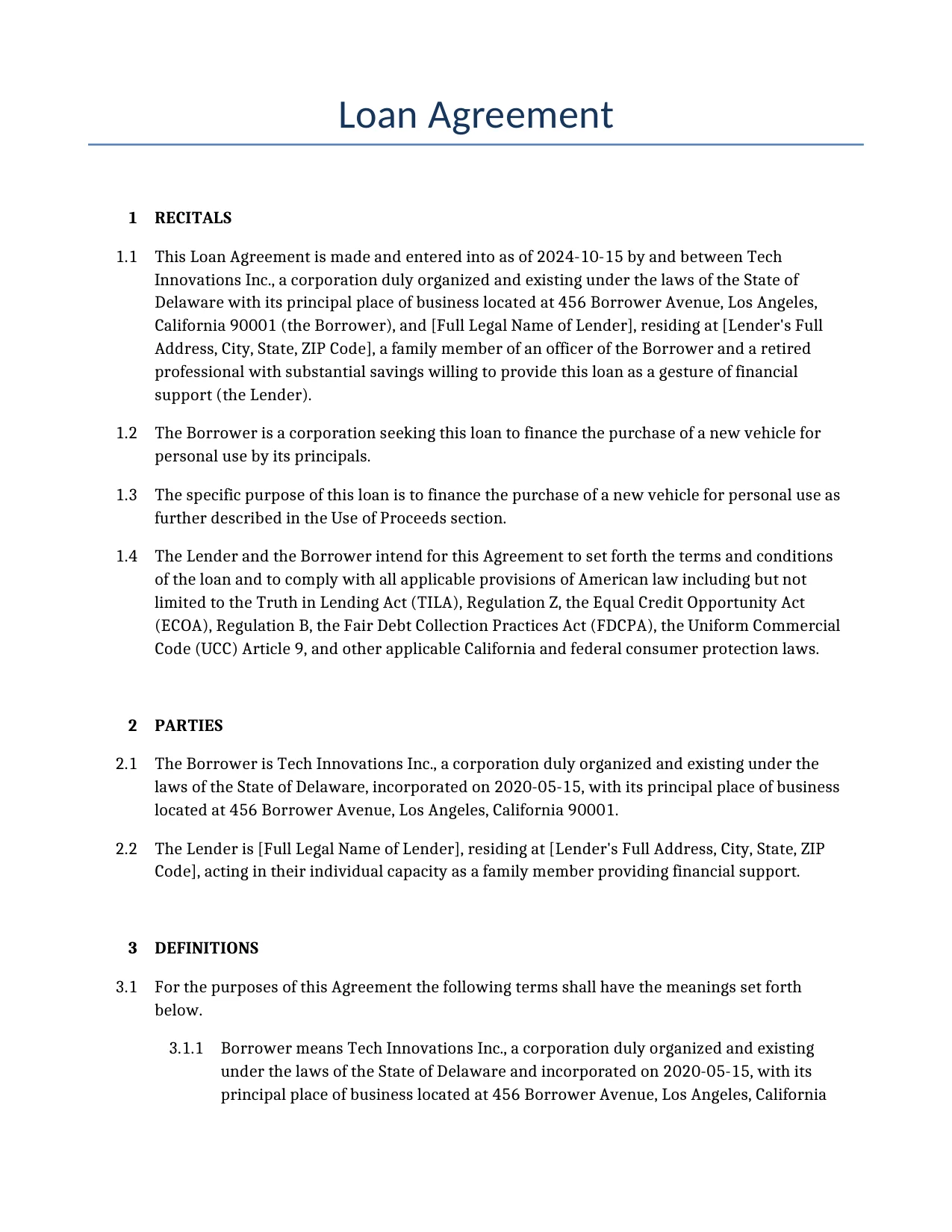
Below is a free template example of a Loan Agreement for use in the United States generated by our AI model.
The clauses in your actual Loan Agreement will vary from this example as they will be entirely bespoke to your requirements as set out in the questionnaire you complete.
Loan Agreement
1RECITALS
This Loan Agreement is made and entered into as of 2024-10-15 by and between Tech Innovations Inc., a corporation duly organized and existing under the laws of the State of Delaware with its principal place of business located at 456 Borrower Avenue, Los Angeles, California 90001 (the Borrower), and [Full Legal Name of Lender], residing at [Lender's Full Address, City, State, ZIP Code], a family member of an officer of the Borrower and a retired professional with substantial savings willing to provide this loan as a gesture of financial support (the Lender).
The Borrower is a corporation seeking this loan to finance the purchase of a new vehicle for personal use by its principals.
The specific purpose of this loan is to finance the purchase of a new vehicle for personal use as further described in the Use of Proceeds section.
The Lender and the Borrower intend for this Agreement to set forth the terms and conditions of the loan and to comply with all applicable provisions of American law including but not limited to the Truth in Lending Act (TILA), Regulation Z, the Equal Credit Opportunity Act (ECOA), Regulation B, the Fair Debt Collection Practices Act (FDCPA), the Uniform Commercial Code (UCC) Article 9, and other applicable California and federal consumer protection laws.
2PARTIES
The Borrower is Tech Innovations Inc., a corporation duly organized and existing under the laws of the State of Delaware, incorporated on 2020-05-15, with its principal place of business located at 456 Borrower Avenue, Los Angeles, California 90001.
The Lender is [Full Legal Name of Lender], residing at [Lender's Full Address, City, State, ZIP Code], acting in their individual capacity as a family member providing financial support.
3DEFINITIONS
For the purposes of this Agreement the following terms shall have the meanings set forth below.
Borrower means Tech Innovations Inc., a corporation duly organized and existing under the laws of the State of Delaware and incorporated on 2020-05-15, with its principal place of business located at 456 Borrower Avenue, Los Angeles, California 90001.
Lender means [Full Legal Name of Lender], residing at [Lender's Full Address, City, State, ZIP Code].
Loan means the principal amount of $10000 disbursed by the Lender to the Borrower pursuant to this Agreement.
Maturity Date means 2025-10-15.
Collateral means the 2019 Ford F-150 pickup truck VIN 1FTFW1E59KFA12345 currently registered in the Borrower\’s name in California with an estimated fair market value of 25000.00.
Business Day means any day other than a Saturday, Sunday, or a day on which commercial banks in Los Angeles, California are authorized or required by law to close.
Default Rate means a rate of interest equal to 9.75% per annum, which shall not exceed the maximum rate permitted under applicable California usury law.
Event of Default has the meaning set forth in Section 10 of this Agreement.
Obligations means all debts, liabilities, and obligations of the Borrower to the Lender under this Agreement, the Promissory Note, the Security Agreement, or any other Loan Document, whether now existing or hereafter arising.
Permitted Liens means liens for taxes not yet due, liens in favor of the Lender, and other liens expressly agreed to in writing by the Lender.
Person means any individual, corporation, partnership, limited liability company, trust, or other legal entity.
UCC means the Uniform Commercial Code as in effect in the State of California.
TILA means the federal Truth in Lending Act and Regulation Z promulgated thereunder.
Additional terms used in this Agreement shall have the meanings ascribed to them in the context of their usage or as defined in the UCC or other applicable law.
4LOAN AMOUNT AND DISBURSEMENT
The Lender agrees to lend to the Borrower and the Borrower agrees to borrow from the Lender the principal sum of $10000 upon the terms and subject to the conditions set forth in this Agreement.
The Loan funds shall be disbursed by the Lender to the Borrower on 2024-10-15 by means of ACH Transfer to the Borrower\’s account at Chase Bank Account Number 123456789 Routing Number 021000021.
The Loan shall be disbursed in a single lump sum and not in multiple installments.
The disbursement of the Loan funds is subject to the satisfaction of the conditions precedent set forth in Section 12 of this Agreement.
5USE OF PROCEEDS
The Borrower shall use the Loan proceeds solely for the purchase of the new vehicle as described in the Recitals. Misuse of the Loan proceeds shall constitute an Event of Default under this Agreement.
6INTEREST RATE AND PAYMENTS
The Loan shall bear interest at a fixed annual rate of 4.75 percent calculated on the basis of a 365-day year and actual days elapsed.
Interest shall begin to accrue on the Loan on the date of disbursement, which is 2024-10-15.
The term of the Loan shall be 12 months from the date of disbursement, and the Borrower shall repay the Loan in full on or before the Maturity Date of 2025-10-15. The Loan shall be fully amortizing over 12 months with monthly payments of principal and interest.
Payments shall be made monthly on the first day of each month, commencing on 2024-11-01.
Each payment shall be applied first to accrued interest and then to the reduction of principal.
All payments shall be made in lawful money of the United States of America.
TILA Disclosures: The following disclosures are provided in accordance with the Truth in Lending Act and Regulation Z. This is a consumer-purpose loan. Amount Financed: $10,000.00. Annual Percentage Rate (APR): 4.75%. Finance Charge: $492.58 (calculated as total interest over the term). Total of Payments: $10,492.58. Monthly Payment Amount: $874.38 (for 12 months). These calculations assume no prepayments and are based on standard amortization formulas. A detailed amortization schedule is available upon request.
7PREPAYMENTS
The Borrower may prepay the Loan in whole or in part at any time before the Maturity Date without penalty and without prior notice.
Partial prepayments shall be permitted without penalty and there shall be no frequency limit on the number of prepayments the Borrower may make.
Any prepayment shall be applied first to accrued interest and then to the reduction of principal. Partial prepayments will not change the amount of the monthly payment unless the Lender and Borrower agree otherwise in writing.
8REPRESENTATIONS AND WARRANTIES
The Borrower represents and warrants to the Lender that the Borrower is in good standing in its state of incorporation.
The Borrower has been duly organized and is validly existing under applicable laws.
The Borrower has full power and authority to enter into this Agreement and to incur the obligations hereunder.
The execution and delivery of this Agreement will not conflict with the Borrower\’s organizational documents or any material agreements to which the Borrower is a party.
No governmental approvals or consents are required for the Borrower to enter into this Agreement.
There are no pending or threatened litigations against the Borrower that could materially affect its financial condition.
As of the most recent financial statements dated 2023-12-31, the Borrower has assets with a total value of 500000.00 and liabilities with a total value of 200000.00.
The Borrower owns the Collateral free and clear of all liens, claims, and encumbrances other than Permitted Liens. The Collateral is properly insured, maintained in good condition, and complies with all applicable laws including vehicle registration and title requirements in California.
The Loan proceeds will be used solely for the purchase of the vehicle as described in the Recitals and Use of Proceeds section.
The Borrower has read and understands the terms of this Agreement, the Promissory Note, the Security Agreement, and all other Loan Documents.
The Borrower has paid all taxes due and has filed all required tax returns.
There has been no material adverse change in the Borrower\’s financial condition since the date of the most recent financial statements.
9COVENANTS OF THE BORROWER
The Borrower covenants and agrees that it shall provide annual financial statements or tax returns to the Lender within 120 days after the end of each fiscal year.
The Borrower shall deliver a compliance certificate with each annual financial report provided to the Lender in the form attached as Exhibit D.
The Borrower shall maintain adequate insurance coverage on the Collateral and all of its properties and operations, with the Lender named as loss payee on policies related to the Collateral.
The Borrower shall not sell, transfer, or encumber the Collateral without the prior written consent of the Lender.
10FINANCIAL INFORMATION AND REPORTING
In addition to the covenants set forth in Section 9, the Borrower shall provide the Lender with annual tax returns or other simplified financial updates within 120 days after the end of each fiscal year. For this loan size and relationship, quarterly audited statements are not required.
11EVENTS OF DEFAULT
Each of the following shall constitute an Event of Default under this Agreement.
The Borrower fails to pay any principal or interest when due.
The Borrower breaches any covenant contained in this Agreement.
The Borrower becomes subject to insolvency or bankruptcy proceedings.
The Borrower fails to provide required notices, maintain insurance on the Collateral, or permit inspection of the Collateral upon reasonable request.
There occurs a material adverse change in the Borrower\’s financial condition or ability to repay the Loan.
Misuse of Loan proceeds in violation of the Use of Proceeds section.
Upon an Event of Default, the Default Rate shall apply to all outstanding Obligations. The Default Rate is 9.75% per annum and has been set to comply with California usury limits (generally 10% for non-exempt loans; this Loan to a corporation may qualify for exemption but the rate is set conservatively below 10%).
The Borrower shall have a cure period of 10 calendar days for payment defaults and 30 days for other covenant breaches.
12REMEDIES
Upon the occurrence of an Event of Default and expiration of any applicable cure period, the Lender may accelerate the entire Loan balance and declare it immediately due and payable without further notice.
The Lender shall have the right to seize and sell the Collateral in accordance with the provisions of the California Uniform Commercial Code (UCC Article 9), including requirements for commercially reasonable disposition, reasonable notification to the Borrower of the time and place of any public sale or the time after which any private sale will occur, and accounting for any surplus or deficiency as required by law. The Lender shall not be entitled to a deficiency judgment to the extent prohibited by the Rees-Levering Act or other applicable California law for consumer vehicle loans.
The Lender may impose a late fee of $25.00 on overdue payments provided that the total interest and fees do not exceed California usury limits. The Lender shall be entitled to recover reasonable attorney fees and costs incurred in exercising remedies for default from the Borrower, to the extent permitted by law.
The remedies set forth in this Section 12 are cumulative and in addition to any other remedies available under the Loan Documents, the UCC, or applicable law.
13CONDITIONS PRECEDENT
The obligation of the Lender to disburse the Loan is subject to the satisfaction of the following conditions on or before the closing date of 2024-10-15.
This Agreement and the Promissory Note shall have been duly executed by the Borrower.
The Borrower shall have provided a certificate of good standing from the State of Delaware and evidence of authority to enter into this transaction.
The Borrower shall have provided evidence of insurance on the Collateral with the Lender named as loss payee.
The Security Agreement and UCC-1 Financing Statement shall have been duly executed by the Borrower, and all necessary filings to perfect the Lender\’s security interest (including notation on the vehicle title with the California DMV) shall have been completed or arranged.
The Borrower shall have certified that the Collateral is free of liens other than the security interest granted to the Lender and that there has been no material adverse change in its financial condition.
14COLLATERAL AND SECURITY
To secure the repayment of the Loan and the performance of all Obligations under this Agreement, the Borrower grants to the Lender a first-priority security interest in the Collateral consisting of the vehicle described in the Definitions section of this Agreement. A separate Security Agreement (Exhibit B) will be executed concurrently herewith, and a UCC-1 Financing Statement (Exhibit C) will be filed. For the vehicle, the Lender\’s security interest will be noted on the California certificate of title.
The Borrower represents that there are no existing liens or security interests on the Collateral other than Permitted Liens.
The Borrower shall maintain the Collateral in good condition, provide proof of registration and title to the Lender upon request, keep the Collateral insured as required in Section 16, and shall not sell, transfer, or further encumber the Collateral without the Lender\’s prior written consent. Misuse, improper maintenance, or unauthorized transfer of the Collateral shall constitute an Event of Default.
15GUARANTEES
No third-party guarantee is required for this Loan. This section is intentionally omitted as the Loan is provided by a family member based on the existing relationship with the Borrower.
16INSURANCE
The Borrower shall maintain comprehensive and collision insurance on the Collateral and liability insurance as required by California law, with the Lender named as additional insured and loss payee. The Borrower shall provide evidence of such insurance to the Lender at closing and upon each renewal. Failure to maintain insurance shall be an Event of Default.
17TAXES AND EXPENSES
The Borrower shall be responsible for paying all taxes, title fees, registration fees, and expenses incurred in connection with the Loan and the perfection of the security interest in the Collateral.
Such amounts shall be paid by the Borrower directly or upon the Lender\’s demand.
18INDEMNIFICATION
The Borrower shall indemnify the Lender against any losses, claims, damages, or liabilities arising from the Borrower\’s breach of this Agreement or misuse of the Collateral, except to the extent caused by the Lender\’s gross negligence or willful misconduct. This provision shall survive repayment of the Loan.
19GOVERNING LAW
This Agreement shall be governed by and construed in accordance with the laws of the State of California without regard to its conflict of laws principles. This Loan is intended to comply with California usury law. For corporate borrowers such as Tech Innovations Inc., certain exemptions may apply, but the interest rate has been set at 4.75% to remain well below the general 10% limit for non-exempt loans.
20JURISDICTION AND VENUE
Any litigation arising out of or relating to this Agreement (if arbitration is not used or to enforce an arbitration award) shall be brought exclusively in the state or federal courts located in the County of Los Angeles, State of California. The parties hereby consent to the personal jurisdiction of such courts and waive any objection based on venue or inconvenient forum.
21DISPUTE RESOLUTION
Any dispute arising out of or relating to this Agreement shall be resolved first by good-faith negotiation. If not resolved, the dispute shall be submitted to binding arbitration under the rules of the American Arbitration Association (AAA) in Los Angeles, California. The arbitration shall be conducted by a single arbitrator, and the award shall be final and enforceable in any court of competent jurisdiction. The parties acknowledge that this agreement to arbitrate may be subject to limitations under federal law for certain consumer disputes.
22NOTICES
All notices under this Agreement shall be in writing and shall be delivered by personal delivery, certified mail (return receipt requested), or electronic mail to the following addresses and emails. Notices are effective upon receipt. For mail, receipt is deemed 3 Business Days after mailing. For email, receipt is deemed upon sender\’s receipt of a read receipt or reply email; however, a hard copy shall also be sent by mail if the email notice concerns a default or acceleration.
Notices to the Lender shall be sent to [Lender\’s Full Address] or [lender@email.com].
Notices to the Borrower shall be sent to 456 Borrower Avenue, Los Angeles, CA 90001 or [borrower@techinnovations.com].
23ASSIGNMENT AND TRANSFER
The Borrower shall not assign its rights or delegate its obligations under this Agreement without the prior written consent of the Lender.
The Lender may assign its rights under this Agreement upon prior written notice to the Borrower; however, as this is a consumer-purpose loan, any assignment is subject to applicable law including disclosure requirements under TILA and California law. The Borrower\’s consent shall not be unreasonably withheld for permitted transfers.
Any permitted assignment shall bind the successors and assigns of the parties.
24AMENDMENTS AND WAIVERS
All amendments to this Agreement must be in writing and signed by both the Lender and the Borrower.
All waivers of any provision of this Agreement must be in writing and signed by the Lender and the Borrower. A waiver of one provision shall not constitute a waiver of any other provision or of any future breach.
25NO ORAL AGREEMENTS
This Agreement, together with the exhibits and other Loan Documents, contains the entire agreement between the parties. There are no oral agreements, understandings, or representations relied upon by the parties. No oral modifications or agreements are binding. This provision is intended to protect against claims under state law including the parol evidence rule.
26SEVERABILITY
If any provision of this Agreement is held to be invalid or unenforceable, the remaining provisions shall remain in full force and effect.
27ENTIRE AGREEMENT
This Agreement including any attached exhibits, schedules, or appendices and the other Loan Documents constitutes the entire agreement between the Borrower and the Lender and supersedes all prior agreements, understandings, or representations. Any future modifications must be in writing and signed by both parties.
28COUNTERPARTS
This Agreement may be executed in multiple counterparts, each of which shall be deemed an original, and all of which together shall constitute one and the same instrument. Electronic signatures shall be permitted and counterparts may be delivered by electronic mail.
29WAIVER OF JURY TRIAL
The Borrower and the Lender each waive their right to a jury trial in any legal proceeding arising out of or relating to this Agreement to the fullest extent permitted by law. The parties acknowledge that this waiver means disputes will be decided by a judge alone.
30CONFIDENTIALITY
The parties agree to keep the loan terms, financial statements, and personal identifiers confidential and not to disclose such information to third parties without the prior written consent of the other party, except as required by law or in connection with enforcement of this Agreement.
31FORCE MAJEURE
Neither party shall be liable for any delay or failure to perform its obligations under this Agreement (other than payment obligations) if such delay or failure is caused by acts of God, war, pandemics, or other events beyond the reasonable control of the parties, provided that the affected party gives prompt notice thereof. Financial inability shall not constitute force majeure.
32USURY SAVINGS CLAUSE
Notwithstanding any provision in this Agreement, the total interest and fees charged under this Loan shall not exceed the maximum rate permitted under the usury laws of the State of California. The general usury limit is 10% per annum for non-exempt loans. Because the Borrower is a corporation, this Loan may qualify for an exemption under California law for certain business loans; however, the stated rate of 4.75% is set conservatively. If any interest or fee is determined to be usurious, any excess shall be applied to the principal or refunded to the Borrower as required by applicable law. The maximum default rate is set at 9.75% to remain in compliance.
33COMPLIANCE WITH APPLICABLE LAW
Both parties shall comply with all applicable laws in connection with this Loan, including but not limited to the Rees-Levering Act (California Civil Code \§\§ 2981 et seq.) if applicable to this vehicle-secured consumer loan, the California Financial Code, TILA, ECOA, FDCPA, and the UCC. The Borrower shall have all rights to notice, cure, and redemption as provided under the Rees-Levering Act and UCC, including the right to reinstate the Loan after repossession in certain circumstances and limitations on deficiency judgments for consumer vehicle loans. Required notices regarding repossession rights shall be provided in the Security Agreement or separately if mandated.
34SECURITY AGREEMENT
Simultaneously with the execution of this Agreement, the Borrower and Lender shall execute a separate Security Agreement (Exhibit B) granting the Lender a security interest in the Collateral. A UCC Financing Statement (Exhibit C) will be filed with the appropriate California authorities, and the Lender\’s lien will be noted on the vehicle\’s certificate of title with the DMV as required for perfection of security interests in motor vehicles under California law. The Security Agreement shall contain additional terms regarding repossession rights, notices, and compliance with the Rees-Levering Act where applicable.
35ADVICE OF COUNSEL
Each party has been advised to seek independent legal counsel before executing this Agreement, has had the opportunity to do so, and is entering into this Agreement voluntarily with full understanding of its terms and consequences.
36PROMISSORY NOTE
The Borrower unconditionally promises to pay to the order of the Lender the principal sum of $10,000.00 together with interest at 4.75% per annum in accordance with the payment terms set forth in Section 6 of this Agreement. This Promissory Note is issued pursuant to the Loan Agreement dated 2024-10-15 and is secured by the Collateral described therein. All TILA disclosures are contained in Section 6.7 of the Loan Agreement. This Note shall be governed by the Loan Agreement and California law. [Remainder of Note to be executed as a separate document or exhibit as applicable.]
37EXHIBITS
The following exhibits are attached to and form a part of this Agreement: Exhibit A - Promissory Note; Exhibit B - Security Agreement; Exhibit C - UCC Financing Statement; Exhibit D - Form of Compliance Certificate. Additional exhibits may include any Rees-Levering Act notices or amortization schedule as required.
38SIGNATURE SECTION
IN WITNESS WHEREOF the parties have executed this Loan Agreement as of the date first above written.
Lender: _______________________________ Date: _______________
Borrower: Tech Innovations Inc. By: _______________________________ Title: _______________ Date: _______________
This example shows approximately 70% of a typical document and is provided for illustrative purposes only. The remaining content has been omitted.
Every document generated by Docaro is tailored to your specific circumstances, jurisdiction and the information you provide. The completed document includes all applicable clauses and provisions required for your situation.
To generate the full, personalised document, answer a short series of questions and your document will be created instantly.