
AI Generated American Power of Attorney
PDF & Word - 2026 Updated
Docaro Pricing
When Do You Need a Power of Attorney in the United States?
American Legal Rules for a Power of Attorney
Using the incorrect type or structure of power of attorney may fail to grant the intended authority or comply with state-specific requirements.
What a Proper Power of Attorney Should Include
- Your Personal InformationInclude your full name, address, and date of birth to clearly identify you as the person granting the authority.
- Agent's DetailsProvide the full name and contact information of the trusted person you are appointing to act on your behalf.
- Specific Powers GrantedList the exact tasks or decisions the agent can handle, such as managing finances or making healthcare choices.
- Duration of AuthorityState whether the power starts immediately, only if you become unable to act, or ends on a specific date.
- Revocation InstructionsExplain how and when you can cancel the power of attorney if your circumstances change.
- Signatures and WitnessesInclude your signature, the date, and signatures from witnesses or a notary to make the document legally valid.
Generate Your Document in 4 Easy Steps
Why Use Docaro?
 United States
Free Example Power of Attorney Template
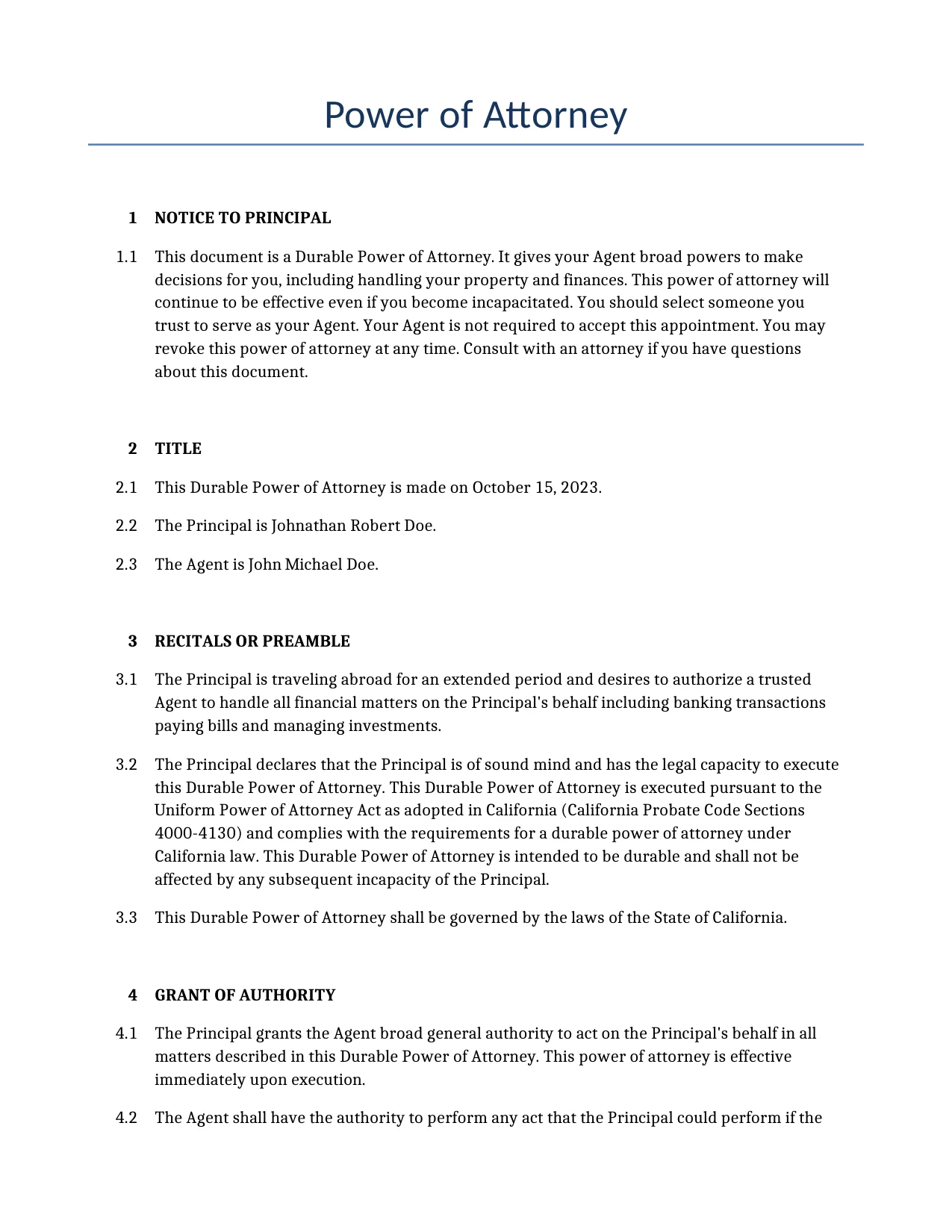
Below is a free template example of a Power of Attorney for use in the United States generated by our AI model.
The clauses in your actual Power of Attorney will vary from this example as they will be entirely bespoke to your requirements as set out in the questionnaire you complete.
Durable Power of Attorney
1NOTICE TO PRINCIPAL
This document is a Durable Power of Attorney. It gives your Agent broad powers to make decisions for you, including handling your property and finances. This power of attorney will continue to be effective even if you become incapacitated. You should select someone you trust to serve as your Agent. Your Agent is not required to accept this appointment. You may revoke this power of attorney at any time. Consult with an attorney if you have questions about this document.
2TITLE
This Durable Power of Attorney is made on October 15, 2023.
The Principal is Johnathan Robert Doe.
The Agent is John Michael Doe.
3RECITALS OR PREAMBLE
The Principal is traveling abroad for an extended period and desires to authorize a trusted Agent to handle all financial matters on the Principal's behalf including banking transactions paying bills and managing investments.
The Principal declares that the Principal is of sound mind and has the legal capacity to execute this Durable Power of Attorney. This Durable Power of Attorney is executed pursuant to the Uniform Power of Attorney Act as adopted in California (California Probate Code Sections 4000-4130) and complies with the requirements for a durable power of attorney under California law. This Durable Power of Attorney is intended to be durable and shall not be affected by any subsequent incapacity of the Principal.
This Durable Power of Attorney shall be governed by the laws of the State of California.
4GRANT OF AUTHORITY
The Principal grants the Agent broad general authority to act on the Principal's behalf in all matters described in this Durable Power of Attorney. This power of attorney is effective immediately upon execution.
The Agent shall have the authority to perform any act that the Principal could perform if the Principal were personally present and able to act. The Agent is authorized to delegate authority to others where appropriate and in the Principal's best interest.
5POWERS REGARDING REAL PROPERTY
The Agent is authorized to purchase real property on behalf of the Principal.
The Agent is authorized to sell real property on behalf of the Principal.
The Agent is authorized to mortgage real property on behalf of the Principal.
The Agent is authorized to execute deeds affidavits and other instruments necessary for real estate transactions. This power of attorney may be recorded in any county where real property owned by the Principal is located to facilitate such transactions.
6POWERS REGARDING TANGIBLE PERSONAL PROPERTY
The Agent is authorized to manage the Principal's tangible personal property on behalf of the Principal.
7POWERS REGARDING STOCKS, BONDS, AND FINANCIAL INSTRUMENTS
The Agent is authorized to manage investments including buying selling or exchanging stocks bonds and other financial instruments on behalf of the Principal.
The Agent is authorized to close existing financial accounts holding the Principal's stocks bonds or other instruments.
The Agent is authorized to vote shares of stock or participate in corporate actions regarding the Principal's investments.
8POWERS REGARDING BANKING AND FINANCIAL TRANSACTIONS
The Agent is authorized to handle banking matters such as opening closing and managing bank accounts on behalf of the Principal.
The Agent is authorized to access and manage the contents of safe deposit boxes on behalf of the Principal.
The Agent's authority shall extend to checking accounts and savings accounts.
9POWERS REGARDING BUSINESS OPERATING TRANSACTIONS
The Agent is authorized to manage business operating transactions on behalf of the Principal.
The Agent is authorized to enter into contracts on behalf of the Principal.
The Agent is authorized to manage bank accounts related to the Principal's business interests.
The Agent is authorized to hire and fire employees on behalf of the Principal's business interests.
10POWERS REGARDING INSURANCE AND ANNUITIES
The Agent is authorized to manage the Principal's insurance policies including buying selling or canceling them.
The Agent is authorized to enter into modify or terminate annuity contracts on behalf of the Principal.
The Agent is authorized to file claims and receive benefits from insurance policies or annuities on behalf of the Principal.
The Agent is authorized to change the beneficiaries on the Principal's insurance policies and annuities only as expressly directed in writing by the Principal.
The Agent's authority shall extend to life insurance health insurance and property and casualty insurance.
The Agent is authorized to surrender annuities for their cash value.
11POWERS REGARDING ESTATES, TRUSTS, AND BENEFICIARY RIGHTS
The Agent is authorized to manage or distribute assets held in any trust where the Principal is a beneficiary but is not authorized to create or amend trusts without express written direction from the Principal.
The Agent is authorized to change beneficiary designations on the Principal's life insurance policies retirement accounts or other financial instruments only as expressly directed in writing by the Principal.
12POWERS REGARDING CLAIMS AND LITIGATION
The Agent is authorized to initiate lawsuits on behalf of the Principal.
The Agent is authorized to defend against claims or lawsuits brought against the Principal.
The Agent is authorized to settle any lawsuits or claims on behalf of the Principal.
The Agent is authorized to pursue or agree to arbitration for claims instead of court litigation.
13POWERS REGARDING PERSONAL AND FAMILY MAINTENANCE
The Agent is authorized to make decisions regarding the Principal's personal care such as living arrangements and daily needs.
The Agent is authorized to provide support and maintenance for the Principal's family members consistent with the Principal's known wishes.
14POWERS REGARDING BENEFITS FROM GOVERNMENTAL PROGRAMS
The Agent is authorized to apply for Social Security benefits on behalf of the Principal.
The Agent is authorized to manage existing Social Security benefits such as receiving payments or reporting changes.
The Agent is authorized to manage the Principal's Medicare benefits including selecting plans or appealing decisions.
The Agent is authorized to apply for Medicaid benefits on behalf of the Principal.
15POWERS REGARDING TAX MATTERS
The Agent is authorized to prepare the Principal's federal and state tax returns.
The Agent is authorized to file the Principal's tax returns with the appropriate tax authorities.
The Agent is authorized to pay any taxes owed from the Principal's accounts or assets.
The Agent is authorized to receive and deposit tax refunds into the Principal's accounts.
The Agent is authorized to request information from and represent the Principal in audits before tax authorities such as the IRS.
16POWERS REGARDING RETIREMENT PLANS
The Agent is authorized to handle the Principal's retirement plans including Individual Retirement Accounts (IRAs) employer-sponsored plans and pension plans.
The Agent is authorized to make or adjust contributions to the Principal's retirement plans.
The Agent is authorized to make withdrawals or distributions from the Principal's retirement plans.
The Agent is authorized to perform rollovers between the Principal's retirement accounts.
17POWERS REGARDING HEALTH CARE
The Principal designates the Spouse as the primary health care agent for making health care decisions on the Principal's behalf. This designation is separate from but complementary to any Advance Health Care Directive executed by the Principal.
The Agent is authorized to access the Principal's medical records.
18EFFECTIVE DATE AND DURABILITY
This Durable Power of Attorney shall become effective immediately upon execution on October 15, 2023.
This Durable Power of Attorney shall not be affected by the subsequent incapacity of the Principal and shall remain effective notwithstanding any subsequent incapacity of the Principal as provided under the Uniform Durable Power of Attorney Act and California Probate Code Sections 4000-4130.
19AGENT'S FIDUCIARY DUTIES
The Agent must act in the Principal's best interest, with loyalty, care, and in accordance with the Principal's known wishes. The Agent acknowledges the fiduciary duties owed to the Principal under California law and the Uniform Power of Attorney Act, including the duty to act with prudence, honesty, and solely for the benefit of the Principal. The Agent shall keep records of all transactions and provide an accounting to the Principal or the Principal's successors upon request.
20SUCCESSOR AGENTS
If the primary Agent, John Michael Doe, is unable or unwilling to serve, the following successor Agents shall serve in the order named: (1) Jane Elizabeth Doe, (2) Robert Alan Smith. Each successor Agent shall have all the authority granted to the primary Agent under this Durable Power of Attorney.
21AGENT RESIGNATION
An Agent may resign by giving written notice to the Principal, if the Principal is not incapacitated, or to all successor Agents and any persons or entities known to be relying on the power of attorney. The resignation becomes effective upon delivery of the notice unless the notice specifies a later effective date.
22LIMITS ON AUTHORITY
The Agent has no authority to make gifts of the Principal's property to any person, including the Agent or the Agent's family members, unless the Principal provides express written authorization for a specific gift. The Agent is prohibited from engaging in any self-dealing transactions without prior written approval from the Principal or a court of competent jurisdiction.
23REVOCATION
The Principal may revoke this Durable Power of Attorney at any time by providing written notice to the Agent.
The revocation of this Durable Power of Attorney shall take effect immediately upon the Principal's execution of the revocation notice.
Written notice of revocation shall be provided to the Agent before the revocation takes effect.
Notice of revocation shall be provided to third parties who may rely on the Agent's authority.
24TERMINATION
This Durable Power of Attorney shall terminate upon the death of the Principal.
This Durable Power of Attorney shall terminate upon revocation by the Principal.
25COMPENSATION OF AGENT
The Agent shall be entitled to reasonable compensation for services rendered under this Durable Power of Attorney or no compensation unless otherwise agreed in writing between the Principal and the Agent. Any compensation shall be paid from the Principal's assets.
26INDEMNIFICATION OF AGENT
The Agent shall be reimbursed for all reasonable expenses incurred while acting under this Durable Power of Attorney.
The Principal shall indemnify the Agent for any liability incurred while acting in good faith and with reasonable care under this Durable Power of Attorney.
27GOVERNING LAW
This Durable Power of Attorney shall be governed by and construed in accordance with the laws of the State of California, including but not limited to the Uniform Power of Attorney Act (California Probate Code Sections 4000-4130).
28SEVERABILITY
If any provision of this Durable Power of Attorney is held to be invalid or unenforceable such invalidity or unenforceability shall not affect the other provisions of this Durable Power of Attorney which shall remain in full force and effect.
29BINDING EFFECT
This Durable Power of Attorney shall be binding upon the Principal's heirs successors and assigns.
30NOTICES
All notices under this Durable Power of Attorney shall be given in writing.
Notices shall be delivered by certified mail or electronic mail.
Notices to the Principal shall be sent to 123 Main Street Anytown CA 12345.
Notices to the Agent shall be sent to 456 Oak Avenue Anytown CA 12345.
31ENTIRE AGREEMENT
This Durable Power of Attorney constitutes the entire agreement between the Principal and the Agent regarding the subject matter hereof and supersedes all prior understandings and agreements whether written or oral.
32VARIATION
This Durable Power of Attorney may not be varied except by a written instrument signed by the Principal.
33ACKNOWLEDGMENT OF PRINCIPAL
The Principal Johnathan Robert Doe signs this Durable Power of Attorney as Johnathan R. Doe on October 15, 2023.
The Principal confirms that the Principal is signing this Durable Power of Attorney willingly and without any duress.
34AGENT'S ACCEPTANCE
The Agent John Michael Doe accepts the appointment as Agent under this Durable Power of Attorney and agrees to act in accordance with its terms and the fiduciary duties imposed by law.
The Agent signs this acceptance as John M. Doe on October 15, 2023.
35NOTARY ACKNOWLEDGMENT
A notary public or other officer completing this certificate verifies only the identity of the individual who signed the document to which this certificate is attached, and not the truthfulness, accuracy, or validity of that document.
On October 15, 2023, before me, a Notary Public, personally appeared Johnathan Robert Doe, known to me to be the person whose name is subscribed to the foregoing instrument and acknowledged that he executed the same for the purposes therein contained.
The Principal presented a Government Issued Photo ID for verification.
In witness whereof I hereunto set my hand and official seal.
36SIGNATURE SECTION
Principal: _______________________________ Date: _______________ Johnathan R. Doe
Agent: _______________________________ Date: _______________ John M. Doe
Notary Public: _______________________________ Date: _______________ Seal
This example shows approximately 70% of a typical document and is provided for illustrative purposes only. The remaining content has been omitted.
Every document generated by Docaro is tailored to your specific circumstances, jurisdiction and the information you provide. The completed document includes all applicable clauses and provisions required for your situation.
To generate the full, personalised document, answer a short series of questions and your document will be created instantly.