
AI Generated Landlord Reference Letter for use in the United States
PDF & Word - 2026 Updated
Docaro Pricing
When Do You Need a Landlord Reference Letter in the United States?
American Legal Rules for a Landlord Reference Letter
Using the incorrect structure for a landlord reference letter may inadvertently disclose sensitive information or expose you to liability claims.
What a Proper Landlord Reference Letter Should Include
- Tenant's Name and Rental PeriodState the full name of the tenant and the exact dates they rented from you to confirm their identity and history.
- Rental Address and TermsProvide the property address and details like monthly rent amount and lease duration to describe the rental agreement.
- Payment HistoryDescribe if the tenant paid rent on time, any late payments, or outstanding amounts to show their reliability.
- Property MaintenanceNote how well the tenant kept the property, including any damage or cleanliness issues during their stay.
- Compliance with RulesMention if the tenant followed community rules, such as noise limits or pet policies, and any complaints received.
- Overall RecommendationGive a clear opinion on whether you would rent to the tenant again and why, to help future landlords decide.
- Contact InformationInclude your name, position, contact details, and date to verify the letter's authenticity.
Generate Your Document in 4 Easy Steps
Why Use Docaro?
 United States
Free Example Landlord Reference Letter Template
Below is a free template example of a Landlord Reference Letter for use in the United States generated by our AI model.
The clauses in your actual Landlord Reference Letter will vary from this example as they will be entirely bespoke to your requirements as set out in the questionnaire you complete.
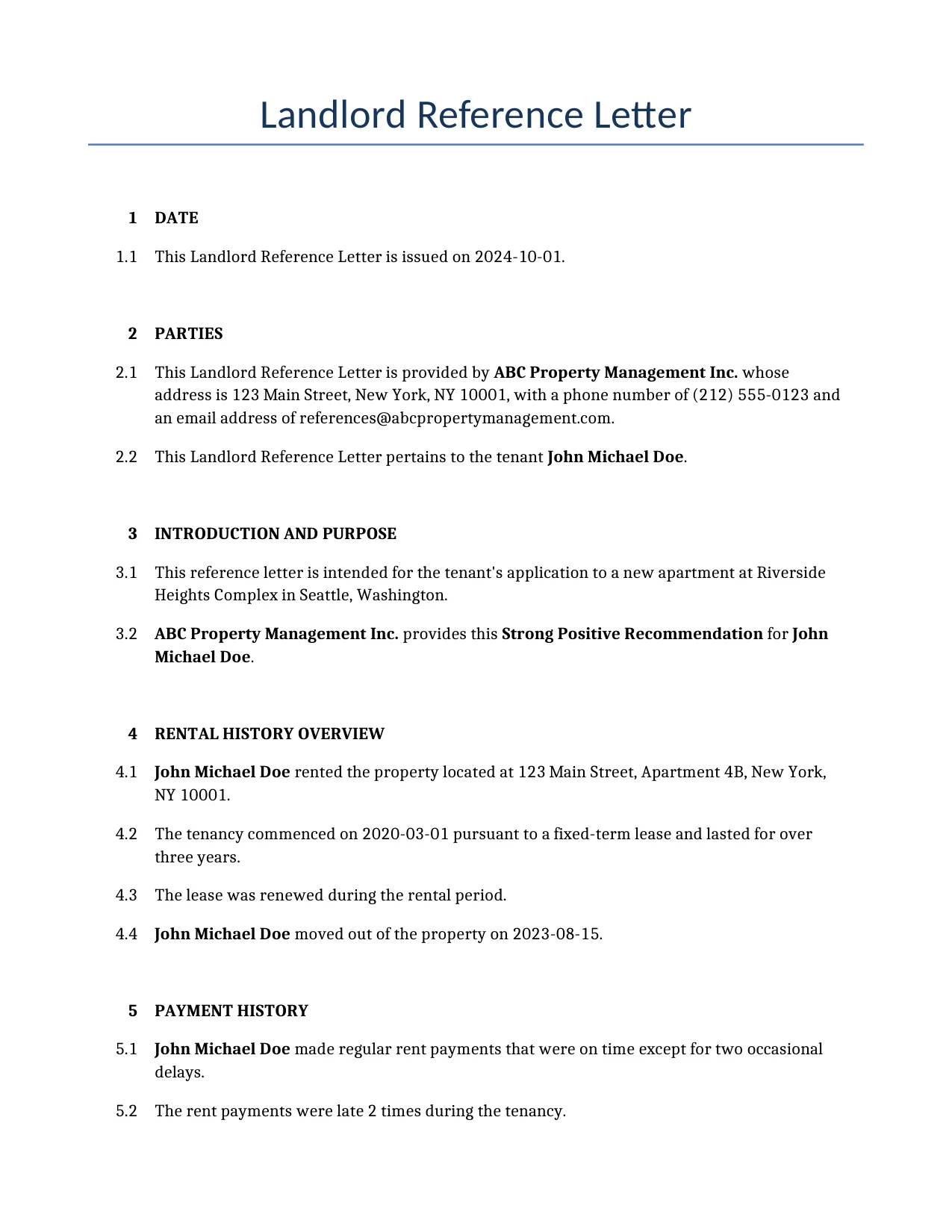
Landlord Reference Letter
1DATE
This Landlord Reference Letter is issued on 2024-10-01.
2PARTIES
This Landlord Reference Letter is provided by ABC Property Management Inc. whose address is 123 Main Street, New York, NY 10001, with a phone number of (212) 555-0123 and an email address of references@abcpropertymanagement.com.
This Landlord Reference Letter pertains to the tenant John Michael Doe.
3INTRODUCTION AND PURPOSE
This reference letter is intended for the tenant's application to a new apartment at Riverside Heights Complex in Seattle, Washington.
ABC Property Management Inc. provides this Strong Positive Recommendation for John Michael Doe.
4RENTAL HISTORY OVERVIEW
John Michael Doe rented the property located at 123 Main Street, Apartment 4B, New York, NY 10001.
The tenancy commenced on 2020-03-01 pursuant to a fixed-term lease and lasted for over three years.
The lease was renewed during the rental period.
John Michael Doe moved out of the property on 2023-08-15.
5PAYMENT HISTORY
John Michael Doe made regular rent payments that were on time except for two occasional delays.
The rent payments were late 2 times during the tenancy.
The total outstanding rent balance is 0 USD.
All outstanding rent balances have been fully resolved.
Rent was typically due on the 1st day of the month.
The security deposit was returned in full with no deductions.
6PROPERTY MAINTENANCE AND CARE
The tenant maintained the property exceptionally well throughout their tenancy.
John Michael Doe regularly cleaned common areas and ensured that minor issues were addressed promptly without requiring landlord intervention.
The overall level of cleanliness maintained by the tenant in the property was excellent and always spotless.
The kitchen and bathrooms were consistently kept immaculate, with no signs of grease buildup or mold.
Floors were vacuumed and mopped regularly, and there were no odors or clutter in any rooms.
No repairs were needed upon move-out.
The overall condition of the property upon the tenant's move-out was excellent.
The tenant's move-out did not necessitate hiring professional cleaning services.
7LEASE COMPLIANCE AND ADDITIONAL DETAILS
John Michael Doe did not engage in any unauthorized subletting during the lease term.
John Michael Doe had pets in the property and they were permitted under the lease terms.
There were no noise complaints regarding the tenant during the lease period.
The tenant consistently maintained the property in excellent condition, promptly reporting any issues and keeping the unit clean and undamaged throughout the lease term.
The tenant provided proper notice to vacate in accordance with the lease.
There were no lease violations during the tenancy.
The overall rating of the tenant's compliance with all lease terms is excellent.
8COMMUNICATION AND RESPONSIVENESS
The frequency of communication from the tenant during the tenancy was frequent and proactive.
The primary methods used by the tenant for communication with the landlord were email and phone calls.
John Michael Doe generally responded to the landlord's requests in a timely manner.
The overall cooperation of the tenant during the tenancy was highly cooperative.
The tenant's communication with the landlord was generally clear and professional.
9OVERALL RECOMMENDATION
ABC Property Management Inc. strongly recommends John Michael Doe to future landlords.
ABC Property Management Inc. welcomes John Michael Doe back as a renter in the future.
The overall rating assigned to the tenant is excellent (5/5).
10DISCLAIMER
The information provided in this Landlord Reference Letter is based on the records and observations of ABC Property Management Inc. as of 2024-10-01. This reference is provided in good faith for informational purposes only and without any obligation. The recipient should independently verify all information. ABC Property Management Inc. disclaims any liability arising from the use of this Landlord Reference Letter.
11COMPLIANCE WITH APPLICABLE LAW
This Landlord Reference Letter is provided in compliance with the federal Fair Housing Act, Title VII of the Civil Rights Act of 1964, the New York Real Property Law, and other relevant New York landlord-tenant laws, as well as applicable Washington state laws regarding tenant references and fair housing.
Nothing in this Landlord Reference Letter shall be construed as discriminating against any protected class under applicable federal, New York, or Washington law.
12GOVERNING LAW
This informational Landlord Reference Letter relates to a tenancy in New York and is provided in connection with a prospective tenancy in Washington. As a non-contractual document, no governing law clause is strictly necessary; however, any questions regarding this letter shall be interpreted in accordance with the laws of the State of New York.
13ADDITIONAL STATEMENT
This letter is provided for informational purposes only and does not create any contractual relationship between the parties.
14SIGNATURES
This Landlord Reference Letter is provided by the authorized representative of ABC Property Management Inc.
Signature: _______________________________ Date: _______________
Printed Name: Jane Smith
Title: Property Manager, ABC Property Management Inc.
This example shows approximately 70% of a typical document and is provided for illustrative purposes only. The remaining content has been omitted.
Every document generated by Docaro is tailored to your specific circumstances, jurisdiction and the information you provide. The completed document includes all applicable clauses and provisions required for your situation.
To generate the full, personalised document, answer a short series of questions and your document will be created instantly.