
AI Generated American Child Support Agreement
PDF & Word - 2026 Updated
Docaro Pricing
When Do You Need a Child Support Agreement in the United States?
American Legal Rules for a Child Support Agreement
Using the wrong structure for a child support agreement can lead to unenforceable terms or disputes over parental obligations.
What a Proper Child Support Agreement Should Include
- Basic Child InformationInclude the full names, birth dates, and current living arrangements of the children to clearly identify who the support is for.
- Parent DetailsList the names, contact information, and roles (like custodial or non-custodial parent) of both parents involved.
- Support AmountSpecify the exact monthly or periodic amount of child support, including how it was calculated based on incomes and needs.
- Payment ScheduleOutline when and how payments will be made, such as monthly on a specific date via direct deposit or check.
- Expenses CoveredDetail what the support money will cover, like daily needs, healthcare, education, and any extras like extracurricular activities.
- Healthcare and InsuranceState who provides health insurance for the children and how medical costs not covered by insurance will be shared.
- Changes and ReviewsDescribe the conditions under which the support amount can be adjusted, such as changes in income or the child's needs.
- Duration of SupportIndicate how long support will continue, typically until the child reaches a certain age or completes education.
- Dispute ResolutionExplain steps for resolving disagreements, like mediation before going to court.
- Signatures and DatesRequire both parents to sign and date the agreement to make it official and binding.
Generate Your Document in 4 Easy Steps
Why Use Docaro?
 United States
Free Example Child Support Agreement Template
Below is a free template example of a Child Support Agreement for use in the United States generated by our AI model.
The clauses in your actual Child Support Agreement will vary from this example as they will be entirely bespoke to your requirements as set out in the questionnaire you complete.
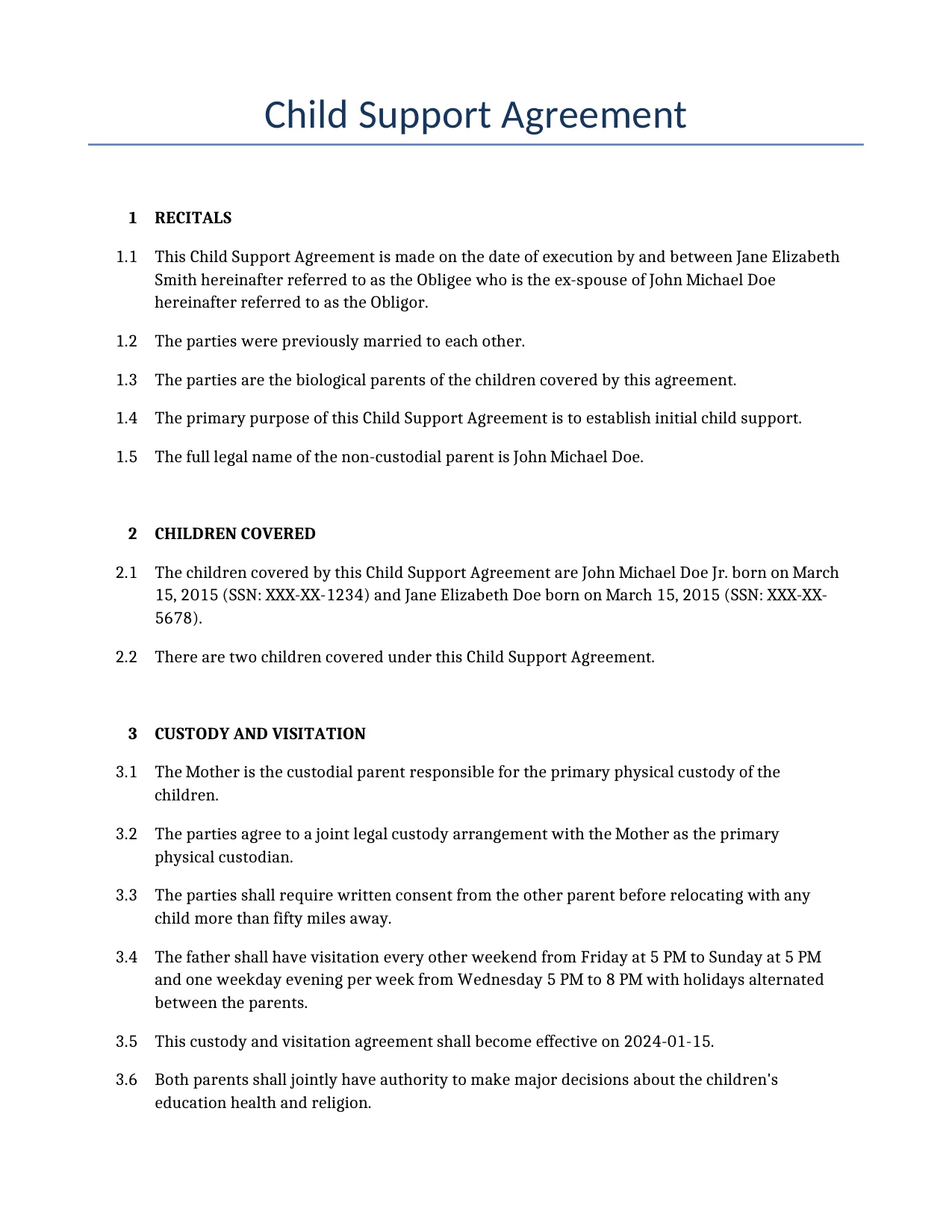
Child Support Agreement
1RECITALS
This Child Support Agreement is made on the date of execution by and between Jane Elizabeth Smith hereinafter referred to as the Obligee who is the ex-spouse of John Michael Doe hereinafter referred to as the Obligor.
The parties were previously married to each other.
The parties are the biological parents of the children covered by this agreement.
The primary purpose of this Child Support Agreement is to establish initial child support.
The full legal name of the non-custodial parent is John Michael Doe.
2CHILDREN COVERED
The children covered by this Child Support Agreement are John Michael Doe Jr. born on March 15, 2015 (SSN: XXX-XX-1234) and Jane Elizabeth Doe born on March 15, 2015 (SSN: XXX-XX-5678).
There are two children covered under this Child Support Agreement.
3CUSTODY AND VISITATION
The Mother is the custodial parent responsible for the primary physical custody of the children.
The parties agree to a joint legal custody arrangement with the Mother as the primary physical custodian.
The parties shall require written consent from the other parent before relocating with any child more than fifty miles away.
The father shall have visitation every other weekend from Friday at 5 PM to Sunday at 5 PM and one weekday evening per week from Wednesday 5 PM to 8 PM with holidays alternated between the parents.
This custody and visitation agreement shall become effective on 2024-01-15.
Both parents shall jointly have authority to make major decisions about the children's education health and religion.
4BASIC CHILD SUPPORT OBLIGATION
The parties agree that the monthly child support payment amount from the Obligor to the Obligee shall be 1800.00 USD.
The selected state's child support guidelines follow the Income Shares Model.
5INCOME AND FINANCIAL INFORMATION
The gross monthly income of the Obligor is 5500.0 USD.
The gross monthly income of the Obligee is 3000.0 USD.
The Obligor does not currently receive public assistance such as TANF SSI or SNAP.
The Obligee does not currently receive public assistance such as TANF SSI or SNAP.
The Obligor is employed full-time.
The Obligee is employed part-time.
The gross annual income from employment or self-employment for the Obligor is 66000.0 USD.
The annual income from investments such as dividends interest or rental properties is 5000.0 USD for the Obligor.
The annual income from other sources such as alimony pensions or government benefits is 2000.0 USD for the Obligor.
The Obligor is not self-employed.
Overtime pay shall be included in the income calculation for child support.
Bonuses shall be included in the income calculation for child support.
The average monthly alimony or spousal support payment to an ex-spouse is 0.0 USD.
The current employer of the Obligor is Tech Solutions Inc.
The current job title of the Obligor is Software Engineer.
The Obligor is willing to provide additional financial disclosures such as bank statements or tax returns if requested by the court.
The current monthly gross income from all sources for the Obligor is 5500.0 USD.
The Obligor owns significant assets such as real estate and vehicles that are noted in the financial disclosures.
The date of the most recent financial statement or tax return provided to the other party is 2023-04-15.
6DEVIATIONS FROM GUIDELINES
One or more children covered by this agreement have special medical educational or other needs that require additional support beyond the basic obligation. The parties have been advised of their rights under the California child support guidelines and agree that the deviation is in the best interest of the children.
The parties agree to include deviations from the state child support guidelines in this agreement.
The primary reason for requesting a deviation from the child support guidelines is the special needs of the child.
The child has autism spectrum disorder requiring ongoing therapy sessions costing 800 USD per month which exceeds the standard guideline provisions.
The calculated child support amount under the state guidelines is 1200.00 USD.
The agreed-upon child support amount after deviation is 1800.00 USD.
This deviation is not intended to be temporary. The parties acknowledge that this deviation complies with California Family Code § 4057 and 42 U.S.C. § 666.
7ADDITIONAL EXPENSES
The average monthly child care expenses for the children covered by this agreement are 450.0 USD.
The average monthly unreimbursed medical dental or vision expenses for the children are 120.5 USD.
The additional expenses such as medical educational and extracurricular costs beyond basic support shall be allocated proportional to income (approximately 65% Obligor and 35% Obligee).
This agreement includes provisions for unreimbursed medical expenses in the additional expenses section.
Private school tuition is not included as an additional educational expense.
Extracurricular activities such as sports or arts are included as additional expenses.
The additional expenses provisions shall become effective on 2024-01-01.
All additional expenses (including childcare, unreimbursed medical, dental, vision, and extracurricular) shall be paid as follows: The incurring parent shall provide documentation and receipts to the other parent within 30 days of payment. The other parent shall reimburse their proportional share within 15 days of receipt of documentation. Uninsured medical costs shall be calculated as the full amount billed after insurance payment, and the parties shall confer in good faith on elective procedures. Failure to provide documentation may result in denial of reimbursement. This complies with California Family Code provisions for add-on expenses.
8MEDICAL AND HEALTH INSURANCE
The Obligor will provide health insurance coverage for the children as required by California law and 42 U.S.C. § 666.
The monthly cost for health insurance premiums covering the children is 250.0 USD.
The entity that provides the health insurance for the children is the Obligor's employer plan.
The start date for the health insurance coverage for the children is 2024-01-01.
The parties shall split the responsibility for paying the health insurance premiums proportional to their incomes.
This agreement includes provisions for reimbursing the other parent for health insurance premiums within 15 days of receipt of proof of payment.
Uninsured medical expenses for the children shall be split proportional to income after the first $100 per child per year which shall be paid by the Obligee as the custodial parent.
The agreement requires coverage for dental and vision care for the children.
The parties shall make joint decisions regarding the children's non-emergency medical care.
The parties agree to share copies of the children's medical records and bills with the other parent within 10 days.
9PAYMENT TERMS AND SCHEDULE
The child support payments shall begin on 2024-01-01.
The child support payments shall be made monthly.
The start date for the child support payments is 2024-01-01.
Payments shall be made on the 1st day of each month.
This agreement includes a grace period of five days for late payments.
Payments shall be made payable to the Obligee, Jane Elizabeth Smith, and if routed through the California State Disbursement Unit, shall comply with all applicable federal and state requirements under the Uniform Interstate Family Support Act.
10PAYMENT METHODS
The method for making child support payments shall be direct bank transfer to the Obligee's designated account or through the California State Disbursement Unit if required by the court or agency.
The Obligor consents to wage withholding by the employer for child support payments as mandated by 42 U.S.C. § 666.
11ADJUSTMENTS AND MODIFICATIONS
This agreement includes a provision for automatic adjustments to the child support amount based on changes in income or cost of living every three years or upon significant change as defined herein, consistent with California Family Code.
The events that shall trigger a review or modification of the child support amount are a significant change in income of either parent a change in the child's educational or medical needs or a change in custody or parenting time arrangement.
A percentage change in income of 20 percent or more shall be considered significant enough to trigger a modification request per California guidelines.
This Child Support Agreement shall become effective for purposes of adjustments and modifications on 2024-01-01.
12TERMINATION OF SUPPORT
The child support obligation shall automatically terminate or be subject to modification upon the child reaching the age of majority under California law, the child becoming emancipated, the child attaining a specified higher education milestone, the death of the child, the death of the payee parent, or the death of the payer parent. Support for each child shall continue until the child reaches 18 years of age, or 19 if still in high school, or up to age 23 if the child is a full-time student in an accredited institution of higher education living with the custodial parent, or longer if the child has special needs rendering them unable to be self-supporting. Emancipation occurs upon marriage, military service, or court order. Any arrears shall survive termination of the current support obligation and remain enforceable.
The support obligation shall terminate when the child reaches the age of majority under California law, subject to the extensions described above.
The age of majority for termination of support is 18 years, subject to extensions for education or special needs.
The support obligation shall terminate upon the child's emancipation.
The support obligation shall terminate upon the child's completion of education or upon reaching age 23, whichever is earlier, if the higher education extension applies.
The support obligation shall terminate upon the death of the child.
The support obligation shall terminate upon the death of the payee parent, at which time support may be redirected by court order.
The support obligation shall terminate upon the death of the payer parent, provided that any arrears survive and may be collected from the estate.
13ENFORCEMENT PROVISIONS
This agreement includes a provision for late fees in the event of non-payment of child support.
This agreement includes interest charges on accumulated child support arrears at the legal rate under California law.
This agreement includes a provision allowing recovery of attorney fees incurred in enforcing the child support agreement by the prevailing party.
The primary court enforcement mechanism for non-payment shall be wage garnishment, and may also include contempt of court proceedings, license suspension, tax refund intercepts, liens on property, and other remedies available under California law and federal requirements.
The enforcement provisions shall become effective on 2024-01-01.
14ARREARAGES
The parties have no existing child support arrears addressed in this agreement. Any future arrears shall be paid in addition to current support at a rate of at least 20% of the current obligation until satisfied.
15TAX CONSIDERATIONS
The custodial parent (Obligee) shall claim the dependency exemptions for the children unless modified by court order or IRS Form 8332.
The parties shall claim the Child Tax Credit for All Children and the Additional Child Tax Credit consistent with IRS rules and this agreement.
The custodial parent shall qualify for Head of Household filing status related to the children.
The custodial parent shall sign IRS Form 8332 to release the dependency exemption to the non-custodial parent only if the parties agree in writing or by court order for that tax year.
The tax considerations period in the agreement shall start on 2024-01-01 and shall comply with all applicable federal tax laws.
16COMMUNICATION BETWEEN PARTIES
The parties shall use email as the primary method for communication regarding the children's welfare and support matters.
The parties shall provide updates on the children's welfare monthly.
The parties shall respond to communications regarding support matters within 48 hours.
Both parties shall share school records and communications from the children's school.
The parties shall share medical records and updates about the children's health.
The ongoing communication requirements shall start on 2024-01-01.
17DISPUTE RESOLUTION
The parties shall use mediation for resolving disputes before going to court.
The parties shall require mediation as the first step in dispute resolution.
The parties shall include binding arbitration as an option after mediation fails only to the extent permitted by California law for child support matters.
Unresolved disputes shall go to the Superior Court of the county in which the children reside.
The laws of the State of California shall govern the dispute resolution process.
18GOVERNING LAW
This Child Support Agreement shall be enforced in the State of California.
The governing law of this Child Support Agreement shall be based on the laws of the State of California and this agreement shall explicitly comply with American law including but not limited to the Full Faith and Credit for Child Support Orders Act (FFCCSOA) the Uniform Child Custody Jurisdiction and Enforcement Act (UCCJEA) the Uniform Interstate Family Support Act (UIFSA) and 42 U.S.C. § 666.
The parties acknowledge that in addition to the selected state law this agreement must comply with all applicable federal child support requirements.
19VOLUNTARINESS AND BEST INTERESTS
The parties affirm that this agreement is made voluntarily and is in the best interests of the children. Each party acknowledges that they have had the opportunity to seek independent legal advice before signing. This agreement is not enforceable until approved by a court of competent jurisdiction in California. By entering into this agreement, the parties are aware that they may be waiving certain rights under California Family Code and federal law, including but not limited to the right to seek a different support amount under the guidelines, and they do so knowingly.
20ENTIRE AGREEMENT
This agreement represents the full and complete agreement between the parties regarding child support and supersedes all prior understandings whether written or oral.
The parties have no prior written agreements or contracts with the other party regarding child support.
There are no prior written agreements or contracts regarding child support.
The parties have had no prior oral discussions or verbal understandings with the other party about child support that are not documented in writing.
The parties confirm that there are no additional terms or conditions outside this agreement that they intend to rely on for child support.
21SEVERABILITY
If any provision of this Child Support Agreement is held to be invalid or unenforceable under California law, the remaining provisions shall remain in full force and effect. The parties agree that the court may modify any invalid provision to the minimum extent necessary to make it enforceable while preserving the intent of the parties.
The parties agree to standard severability for this clause.
22WAIVER
The failure of either party to enforce any provision of this agreement shall not constitute a waiver of the right to enforce that provision or any other provision in the future.
The parties agree to a waiver clause regarding failure to enforce provisions that applies to the entire agreement.
23AMENDMENTS
Any future modifications to this Child Support Agreement shall be handled only in writing, signed by both parties, and approved by the court. No oral modification shall be effective.
24NOTICES
All formal notices between the parties shall be delivered by personal delivery certified mail or email.
The address designated for receiving notices as the Obligor is 123 Main Street Anytown CA 90210.
The address designated for receiving notices as the Obligee is 456 Oak Avenue Anytown CA 90210.
Notices sent by mail shall be deemed received three days after mailing.
Notices delivered personally shall be deemed received immediately upon delivery.
The parties shall allow ten days for responding to formal notices.
25CONFIDENTIALITY
The parties agree to keep all sensitive financial and personal information shared under this Child Support Agreement confidential.
Disclosure of confidential information is permitted in court proceedings to legal advisors and to government agencies.
The confidentiality obligations shall survive indefinitely after the termination of the Child Support Agreement.
In the event of a suspected breach of confidentiality the parties shall provide written notice within seven days.
Injunctive relief shall be included as a remedy for breach of confidentiality in addition to monetary damages.
26REPRESENTATIONS AND WARRANTIES
Each party has made a full and accurate disclosure of all financial information to the other party.
There are no pending or threatened legal actions related to either party's finances such as bankruptcy or debt collection that could affect the ability to pay child support.
Each party has the full legal authority to enter into this Child Support Agreement without any restrictions or consents required from third parties.
Each party fully understands and agrees that the child support obligations in this agreement are in the best interest of the child and based on accurate financial representations.
27INDEMNIFICATION
This agreement includes an indemnification clause to protect each party from liabilities arising from the other's actions related to child support.
The indemnification shall be mutual meaning both parties indemnify each other for liabilities arising from their respective actions related to child support.
The scope of the indemnification clause regarding liabilities related to child support shall include third-party claims.
Any claims under the indemnification clause shall be notified to the indemnifying party within 30 days of receipt.
28FORCE MAJEURE
The paying parent shall provide written notice of a Force Majeure event.
The paying parent shall provide notice to the receiving parent within seven days after a Force Majeure event.
The method of notice for Force Majeure events shall be certified mail or email.
The paying parent shall take reasonable steps to mitigate the effects of a Force Majeure event on child support obligations. This clause shall be interpreted consistent with California law and shall not relieve the Obligor of the duty to seek modification from a court if the inability to pay is expected to be long-term.
The Force Majeure excuse for child support non-performance shall terminate upon resolution of the event.
29COUNTERPARTS
This Child Support Agreement may be executed in multiple counterparts each of which shall be deemed an original and all of which together shall constitute one and the same instrument.
The parties authorize three counterpart copies for the Child Support Agreement.
30ENFORCEMENT AND REMEDIES
In the event of a breach of this Agreement, the non-breaching party may seek all available remedies under California law, including but not limited to contempt of court proceedings, wage assignment or garnishment through the California State Disbursement Unit, suspension of driver's or professional licenses, interception of tax refunds, placement of liens on real or personal property, and reporting to credit bureaus as permitted by state and federal law including 42 U.S.C. § 666. The parties agree that payments may be made through a state child support agency if ordered by the court or if either party applies for services. The prevailing party in any enforcement action shall be entitled to recover reasonable attorney fees and costs. This section is intended to comply fully with California Family Code and Uniform Interstate Family Support Act requirements.
31NO ORAL MODIFICATION
This Agreement may not be amended, modified, or terminated except by a written instrument signed by both parties and approved by the court. No oral agreement or course of conduct shall be effective to modify any term of this Agreement.
32JURISDICTION AND VENUE
The parties agree that the courts of the State of California shall have exclusive jurisdiction over any matters arising from or related to this Agreement. Venue shall be proper only in the Superior Court of the county in which the children primarily reside at the time of filing.
33ACKNOWLEDGMENT
Each party acknowledges that they have read this Agreement in its entirety, understand all of its terms and consequences, have had the opportunity to consult with independent legal counsel, and enter into this Agreement voluntarily and without duress.
34SIGNATURE SECTION
IN WITNESS WHEREOF the parties have executed this Child Support Agreement on the dates indicated below.
Obligor: _______________________________ Date: _______________ John Michael Doe
Obligee: _______________________________ Date: _______________ Jane Elizabeth Smith
Notary Acknowledgment: This document was acknowledged before me on _______________ by the above-named parties. This Agreement is not effective until approved by the appropriate California court.
This example shows approximately 70% of a typical document and is provided for illustrative purposes only. The remaining content has been omitted.
Every document generated by Docaro is tailored to your specific circumstances, jurisdiction and the information you provide. The completed document includes all applicable clauses and provisions required for your situation.
To generate the full, personalised document, answer a short series of questions and your document will be created instantly.