
AI Generated American Notice to Vacate
PDF & Word - 2026 Updated
Docaro Pricing
When Do You Need a Notice to Vacate in the United States?
American Legal Rules for a Notice to Vacate
Using the wrong type of end-of-tenancy notice may fail to properly terminate the tenancy or comply with state-specific requirements.
What a Proper Notice to Vacate Should Include
- Your Name and AddressInclude your full name and current address to clearly identify you as the person sending the notice.
- Landlord's Name and AddressProvide the landlord's full name and address so they know exactly who the notice is for.
- Rental Property AddressSpecify the full address of the rental property to avoid any confusion about which tenancy this applies to.
- Date of the NoticeState the date you are sending the notice to establish when the notice period starts.
- Move-Out DateClearly state the exact date by which you plan to vacate the property, based on your lease terms or local laws.
- Reason for Leaving (If Required)Mention the reason for vacating if your lease or state laws require it, such as lease expiration or personal circumstances.
- Your SignatureSign the notice to make it official and show that you are committed to the terms stated.
- Delivery InstructionsIndicate how the notice will be delivered, like by certified mail, to prove it was sent properly.
Generate Your Document in 4 Easy Steps
Why Use Docaro?
 United States
Free Example Notice to Vacate Template
Below is a free template example of a Notice to Vacate for use in the United States generated by our AI model.
The clauses in your actual Notice to Vacate will vary from this example as they will be entirely bespoke to your requirements as set out in the questionnaire you complete.
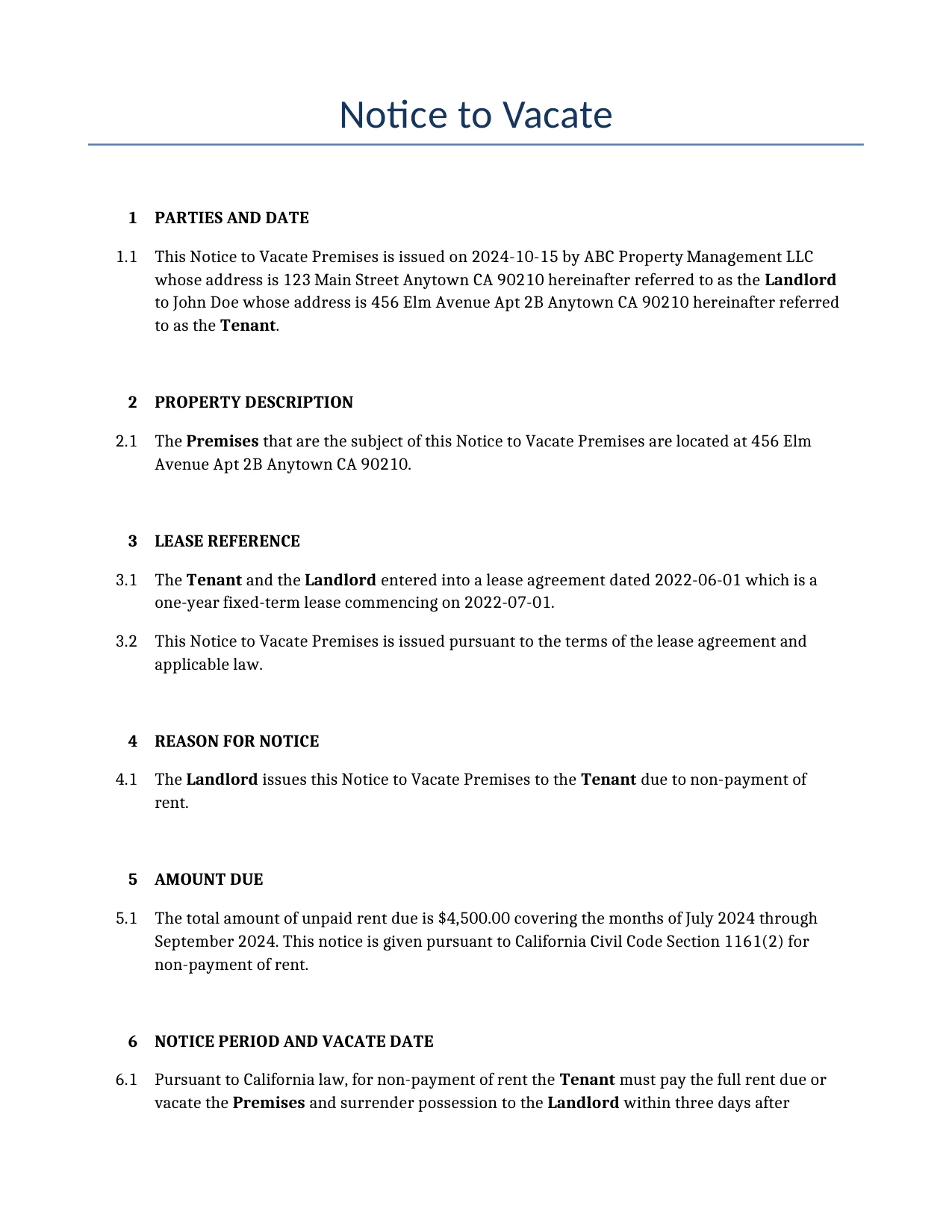
Notice to Vacate Premises
1PARTIES AND DATE
This Notice to Vacate Premises is issued on 2024-10-15 by ABC Property Management LLC whose address is 123 Main Street Anytown CA 90210 hereinafter referred to as the Landlord to John Doe whose address is 456 Elm Avenue Apt 2B Anytown CA 90210 hereinafter referred to as the Tenant.
2PROPERTY DESCRIPTION
The Premises that are the subject of this Notice to Vacate Premises are located at 456 Elm Avenue Apt 2B Anytown CA 90210.
3LEASE REFERENCE
The Tenant and the Landlord entered into a lease agreement dated 2022-06-01 which is a one-year fixed-term lease commencing on 2022-07-01.
This Notice to Vacate Premises is issued pursuant to the terms of the lease agreement and applicable law.
4REASON FOR NOTICE
The Landlord issues this Notice to Vacate Premises to the Tenant due to non-payment of rent.
5AMOUNT DUE
The total amount of unpaid rent due is $4,500.00 covering the months of July 2024 through September 2024. This notice is given pursuant to California Civil Code Section 1161(2) for non-payment of rent.
6NOTICE PERIOD AND VACATE DATE
Pursuant to California law, for non-payment of rent the Tenant must pay the full rent due or vacate the Premises and surrender possession to the Landlord within three days after service of this notice.
The Tenant shall vacate the Premises no later than 2024-10-18 if the rent is not paid.
The Landlord has confirmed compliance with all applicable local laws and ordinances that may affect the vacate date including any local rent control or just cause eviction ordinances.
7RIGHT TO CURE
The Tenant has the right to cure the non-payment by paying the full amount of rent due of $4,500.00 within the three-day notice period to avoid eviction proceedings.
8LEGAL BASIS
This Notice to Vacate Premises is issued pursuant to California Civil Code Section 1161(2).
9TENANT OBLIGATIONS DURING NOTICE PERIOD
The Tenant shall maintain the Premises in good condition and repair during the notice period.
If the Tenant vacates as required rent must be paid only up to the date of vacating. This notice is subject to any local rent control or just cause eviction ordinances that may apply in the city or county where the Premises are located.
The Tenant shall provide the Landlord with a forwarding address in writing for the purpose of returning the security deposit.
The Tenant shall return all keys and access devices to the Premises to the Landlord upon vacating the Premises.
10SECURITY DEPOSIT
The Tenant provided a security deposit in the amount of 1500.00 to the Landlord.
The Landlord shall refund the security deposit in full if the Premises are returned in the same condition as when the Tenant moved in with no damage beyond normal wear and tear and all rent is paid up to date.
Pursuant to California Civil Code Section 1950.5 the Landlord shall return the security deposit or provide an itemized statement of any deductions within 21 days after the Tenant vacates the Premises.
11REQUIRED DISCLOSURES
This notice includes all mandatory statements under California law. The Landlord confirms that the lead-based paint disclosure has been provided as required. No bed bug infestation has been reported at the Premises.
12MOVE-OUT PROCEDURES
The Tenant and the Landlord shall conduct a joint move-out inspection of the Premises.
The Tenant shall contact the Landlord to schedule the joint move-out inspection at a mutually convenient time prior to vacating the Premises.
13CONSEQUENCES OF NON-COMPLIANCE
If the Tenant fails to pay the rent due or vacate the Premises by the date specified in this Notice to Vacate Premises the Landlord may commence an unlawful detainer action pursuant to California Code of Civil Procedure Section 1161 et seq.
The Landlord may seek recovery of attorneys fees only if provided for in the lease.
14CONTACT INFORMATION
All communications regarding this Notice to Vacate Premises shall be directed to ABC Property Management LLC at 123 Main Street Anytown CA 90210 or by phone at (555) 555-5555.
15GOVERNING LAW
This Notice to Vacate Premises shall be governed exclusively by the laws of the State of California and the specific city and county where the property is located.
16ENTIRE AGREEMENT
This Notice to Vacate Premises constitutes the entire agreement between the Landlord and the Tenant with respect to the subject matter hereof and supersedes all prior understandings and agreements whether written or oral.
17SEVERABILITY
If any provision of this Notice to Vacate Premises is held to be invalid or unenforceable such invalidity or unenforceability shall not affect the other provisions of this Notice to Vacate Premises which shall remain in full force and effect.
18NOTICES
All notices required or permitted under this Notice to Vacate Premises shall be in writing and shall be deemed duly given if delivered personally or sent by certified mail return receipt requested to the addresses set forth above.
19VARIATION
No variation of this Notice to Vacate Premises shall be effective unless it is in writing and signed by both the Landlord and the Tenant.
20PROOF OF SERVICE
I the undersigned declare under penalty of perjury under the laws of the State of California that I served this Notice to Vacate Premises on the Tenant as follows: ( ) Personal delivery to the Tenant on 2024-10-15 at the Premises. ( ) Substituted service by leaving a copy with a person of suitable age and discretion at the Premises on 2024-10-15 and mailing a copy thereafter. ( ) Posting a copy in a conspicuous place at the Premises on 2024-10-15 and mailing a copy thereafter as allowed under California Code of Civil Procedure Section 1162.
Executed on 2024-10-15 at Anytown California.
Server's Signature: _______________________________
Printed Name: _____________________________
21SIGNATURES
| LANDLORD | |
| Signature: | |
| Print Name: | |
| Date: |
ABC Property Management LLC
By: _______________________________
Name: _____________________________
Title: _____________________________
Date: _____________________________
| TENANT | |
| Signature: | |
| Print Name: | |
| Date: |
John Doe
By: _______________________________
Date: _____________________________
This example shows approximately 70% of a typical document and is provided for illustrative purposes only. The remaining content has been omitted.
Every document generated by Docaro is tailored to your specific circumstances, jurisdiction and the information you provide. The completed document includes all applicable clauses and provisions required for your situation.
To generate the full, personalised document, answer a short series of questions and your document will be created instantly.