
AI Generated American Commercial Lease Agreement
PDF & Word - 2026 Updated
Docaro Pricing
When Do You Need an Office Lease Agreement in the United States?
Key American Legal Rules for Office Lease Agreements
Using the wrong structure for an office space rental agreement can inadvertently trigger unintended lease protections or commercial tenancy laws.
What a Proper Office Lease Agreement Should Include
- Parties InvolvedClearly identifies the landlord and tenant, including their full names and contact information.
- Property DescriptionDetails the exact location, size, and features of the office space being leased.
- Lease TermSpecifies the start and end dates of the lease, along with any renewal options.
- Rent Amount and PaymentOutlines the monthly rent, due dates, accepted payment methods, and any late fees.
- Security DepositDescribes the amount of the deposit, how it will be held, and conditions for its return.
- Maintenance and RepairsDefines who is responsible for upkeep, repairs, and utilities in the office space.
- Use of SpaceStates the permitted business activities and any restrictions on how the space can be used.
- Insurance and LiabilityRequires both parties to carry appropriate insurance and outlines liability protections.
- Termination ConditionsExplains how the lease can end early, including notice periods and penalties.
- SignaturesIncludes spaces for both parties to sign and date, making the agreement legally binding.
Generate Your Document in 4 Easy Steps
Why Use Docaro?
 United States
Free Example Office Lease Agreement Template
Below is a free template example of a Office Lease Agreement for use in the United States generated by our AI model.
The clauses in your actual Office Lease Agreement will vary from this example as they will be entirely bespoke to your requirements as set out in the questionnaire you complete.
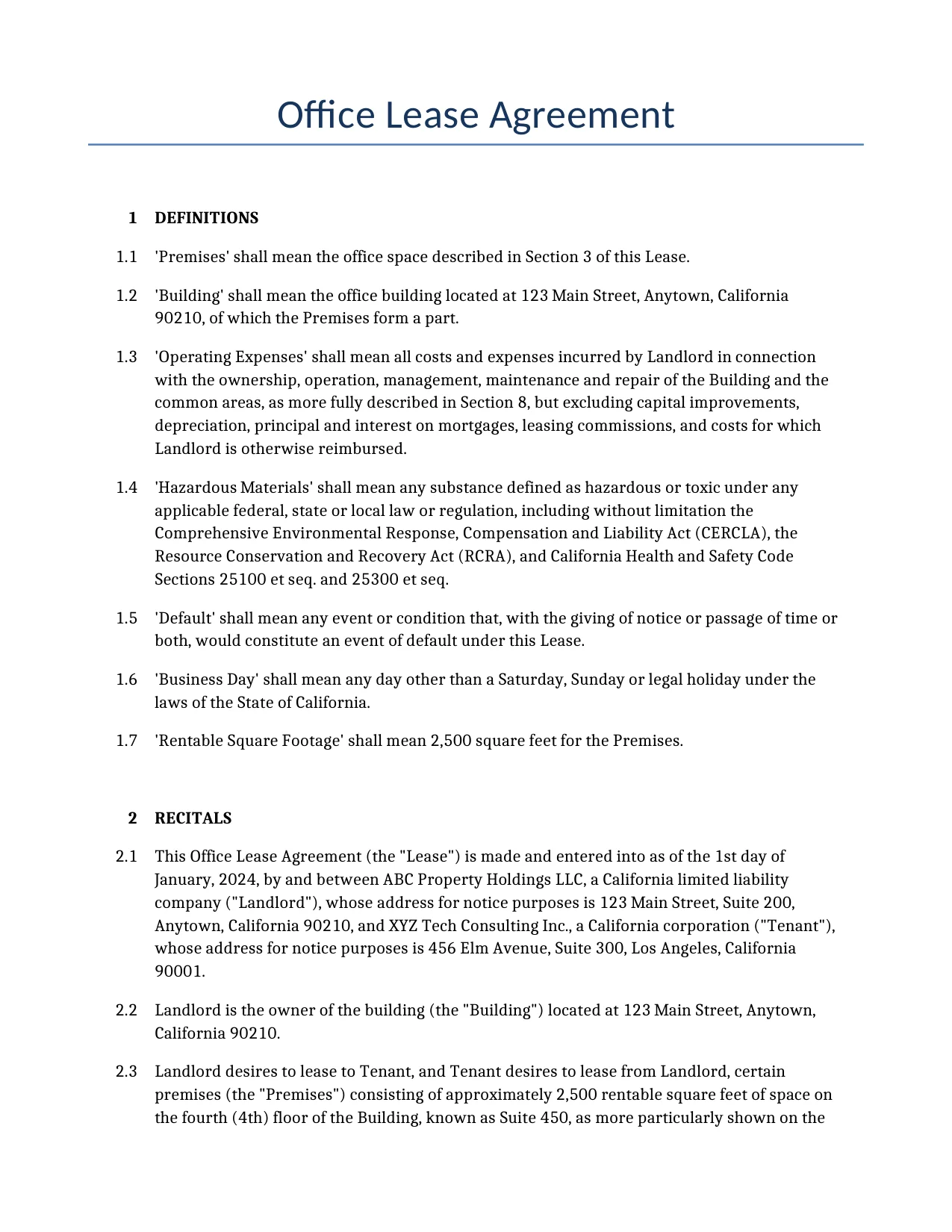
Office Lease Agreement
1DEFINITIONS
'Premises' shall mean the office space described in Section 3 of this Lease.
'Building' shall mean the office building located at 123 Main Street, Anytown, California 90210, of which the Premises form a part.
'Operating Expenses' shall mean all costs and expenses incurred by Landlord in connection with the ownership, operation, management, maintenance and repair of the Building and the common areas, as more fully described in Section 8, but excluding capital improvements, depreciation, principal and interest on mortgages, leasing commissions, and costs for which Landlord is otherwise reimbursed.
'Hazardous Materials' shall mean any substance defined as hazardous or toxic under any applicable federal, state or local law or regulation, including without limitation the Comprehensive Environmental Response, Compensation and Liability Act (CERCLA), the Resource Conservation and Recovery Act (RCRA), and California Health and Safety Code Sections 25100 et seq. and 25300 et seq.
'Default' shall mean any event or condition that, with the giving of notice or passage of time or both, would constitute an event of default under this Lease.
'Business Day' shall mean any day other than a Saturday, Sunday or legal holiday under the laws of the State of California.
'Rentable Square Footage' shall mean 2,500 square feet for the Premises.
2RECITALS
This Office Lease Agreement (the "Lease") is made and entered into as of the 1st day of January, 2024, by and between ABC Property Holdings LLC, a California limited liability company ("Landlord"), whose address for notice purposes is 123 Main Street, Suite 200, Anytown, California 90210, and XYZ Tech Consulting Inc., a California corporation ("Tenant"), whose address for notice purposes is 456 Elm Avenue, Suite 300, Los Angeles, California 90001.
Landlord is the owner of the building (the "Building") located at 123 Main Street, Anytown, California 90210.
Landlord desires to lease to Tenant, and Tenant desires to lease from Landlord, certain premises (the "Premises") consisting of approximately 2,500 rentable square feet of space on the fourth (4th) floor of the Building, known as Suite 450, as more particularly shown on the floor plan attached hereto as Exhibit B, for the purpose of conducting general office use only.
The parties wish to set forth the terms and conditions of their agreement in this Lease.
3LEASE GRANT
Landlord hereby leases to Tenant, and Tenant hereby leases from Landlord, the Premises known as Suite 450 on the fourth (4th) floor of the Building located at 123 Main Street, Anytown, California 90210, consisting of approximately 2,500 rentable square feet of open office space, two private offices, a conference room, and a kitchenette area, as depicted on the floor plan attached as Exhibit B.
The rentable square footage of the Premises is 2,500 square feet.
The Premises shall be used solely for general office purposes and for no other purpose whatsoever. Tenant shall not use the Premises for any retail, manufacturing, or other non-office use.
Tenant shall have the exclusive right to occupy the Premises during the Term of this Lease, subject to the terms and conditions herein.
4TERM
The initial term of this Lease (the "Initial Term") shall commence on January 1, 2024 (the "Commencement Date") and shall expire on December 31, 2026, unless sooner terminated or extended pursuant to the provisions of this Lease.
If the Commencement Date is other than the first day of a calendar month, the Commencement Date shall be confirmed by a certificate executed by both parties. Landlord shall deliver the Premises to Tenant on the Commencement Date in the condition required by this Lease.
Tenant shall have one (1) option to renew the term of this Lease for an additional period of three (3) years (the "Renewal Term") upon the same terms and conditions, except that the Base Rent shall be adjusted to the then-prevailing market rate. Tenant must exercise such renewal option by providing written notice to Landlord no later than one hundred eighty (180) days prior to the expiration of the Initial Term.
Either party may terminate this Lease prior to the expiration of the Term in the event of a material default by the other party that remains uncured after applicable notice and cure periods. In addition, Tenant may terminate this Lease early upon payment of an early termination fee equal to six (6) months of then-current Base Rent plus any unamortized Tenant Improvement costs.
5RENT
The annual Base Rent for the Premises shall be calculated at the rate of $25.50 per rentable square foot per year for the 2,500 square feet of the Premises, resulting in an annual Base Rent of $63,750.00, payable in equal monthly installments of $5,312.50.
Rent shall be due and payable on the first (1st) day of each month, commencing on the Commencement Date. Acceptable payment methods include electronic funds transfer via ACH, wire transfer, or check delivered to Landlord's designated address.
In addition to Base Rent, Tenant shall pay Tenant's pro-rata share of Operating Expenses and Taxes as set forth in Section 8, which shall be considered Additional Rent. All payments shall be made without deduction, offset, or abatement except as expressly provided herein.
The Base Rent shall be subject to annual escalations of three percent (3\%) during the Term as specified in Exhibit C attached hereto.
If Tenant fails to pay Rent when due, Tenant shall have a grace period of five (5) days before a late fee of five percent (5\%) of the overdue amount shall apply. Further late charges of one and one-half percent (1.5\%) per month (or the maximum rate permitted by California usury laws, whichever is less) shall accrue on any unpaid amounts. This Lease is intended to be a modified gross lease.
6SECURITY DEPOSIT
Tenant shall deposit with Landlord upon execution of this Lease the sum of Twelve Thousand Seven Hundred Fifty and 00/100 Dollars ($12,750.00), which is equal to two (2) months of Base Rent, as security for the full and faithful performance by Tenant of all terms, covenants and conditions of this Lease (the "Security Deposit"). This amount does not exceed the maximum allowable under California Civil Code Section 1950.7 for commercial leases.
Landlord shall hold the Security Deposit in a separate, interest-bearing account in a California bank and shall not commingle it with Landlord's other funds. Interest shall accrue to Landlord as permitted by California law.
Within thirty (30) days after the later of (i) the expiration or termination of this Lease, (ii) Tenant's surrender of the Premises, and (iii) Landlord's receipt of Tenant's forwarding address, Landlord shall return the Security Deposit or any balance thereof to Tenant, together with an itemized statement of any deductions.
Landlord may deduct from the Security Deposit any unpaid Rent, damages beyond normal wear and tear, cleaning costs, costs to repair damage caused by Tenant, and costs for unreturned keys or access devices. Any remaining balance shall be returned to Tenant.
7USE OF PREMISES
Tenant shall use the Premises solely for general office purposes consisting of administrative, professional, and technology consulting services, and for no other purpose. Tenant shall not conduct any illegal activities, create any nuisance, or generate excessive noise, odors, vibrations, or other emissions that disturb other tenants or occupants of the Building.
Tenant shall comply with all applicable laws, the Building rules and regulations attached as Exhibit A, and all requirements of its insurance policies. Tenant shall continuously operate its business during normal business hours (8:00 a.m. to 6:00 p.m., Monday through Friday) unless otherwise approved by Landlord.
Tenant shall not use or permit the use of any Hazardous Materials in, on, or about the Premises except in compliance with all applicable environmental laws.
8OPERATING EXPENSES AND TAXES
This is a modified gross lease. In addition to Base Rent, Tenant shall pay Tenant's pro-rata share (2,500 / total rentable square feet of the Building) of Operating Expenses and real property taxes for the Building during the Term in excess of the amounts incurred during the Base Year of 2024.
"Operating Expenses" shall include all reasonable costs of operating, maintaining, and repairing the Building and common areas, including utilities for common areas, insurance, management fees (not to exceed 5\%), and maintenance, but shall exclude capital improvements (except amortized over useful life with interest), Landlord's marketing costs, legal fees for leasing, depreciation, and costs reimbursed by insurance or other tenants.
Landlord shall provide Tenant with annual estimates of Operating Expenses and monthly billings. Within one hundred twenty (120) days after the end of each calendar year, Landlord shall furnish a statement of actual Operating Expenses. Tenant shall have the right to audit Landlord's books and records upon reasonable notice and at Tenant's expense. If the audit reveals an overcharge exceeding five percent (5\%), Landlord shall reimburse Tenant for the audit costs and the overpayment with interest at ten percent (10\%) per annum. This Section is intended to comply with standard California commercial lease practices for modified gross leases.
9UTILITIES AND SERVICES
Tenant shall be responsible for arranging and paying directly for all utilities serving the Premises, including electricity, internet, telecommunications, and trash removal, which shall be separately metered at Tenant's expense.
Landlord shall provide and maintain heating, ventilation, and air conditioning (HVAC) to the Premises during Building Hours (8:00 a.m. to 6:00 p.m., Monday-Friday), common area maintenance, and building security. Landlord shall maintain backup generators or services during outages to the extent reasonably practicable.
If any utility or service is interrupted for reasons within Landlord's reasonable control for more than three (3) consecutive Business Days, Rent shall abate proportionately until service is restored. Landlord shall use commercially reasonable efforts to restore services promptly and in a workmanlike manner.
10MAINTENANCE AND REPAIRS
Tenant shall, at its sole cost, maintain the interior, non-structural portions of the Premises in good condition, including routine cleaning, minor repairs, and maintenance of fixtures, and shall perform all such work promptly and in a good and workmanlike manner.
Landlord shall maintain the exterior, structural elements, roof, foundation, and building systems (HVAC, plumbing, electrical) serving the common areas and Premises (except to the extent separately metered and paid by Tenant), in compliance with applicable laws.
Tenant shall be responsible for the repair of any damage to the Building or Premises caused by Tenant, its agents, employees, or invitees, except to the extent covered by Landlord's insurance. Tenant shall give Landlord prompt notice of any needed repairs.
Both parties shall comply with the Americans with Disabilities Act (ADA) (Landlord for common areas, Tenant for the Premises) and all environmental laws. All maintenance shall be performed in accordance with applicable laws, including California Civil Code provisions for commercial leases.
11ALTERATIONS AND IMPROVEMENTS
Tenant may make cosmetic, non-structural alterations (such as painting or carpet replacement) without Landlord's consent provided they cost less than $5,000 and do not affect building systems. All other alterations, additions, or improvements require Landlord's prior written consent, which shall not be unreasonably withheld, conditioned, or delayed. Landlord shall respond to any request within ten (10) Business Days.
Tenant shall bear all costs of alterations and shall require its contractors to carry adequate insurance and provide lien waivers in accordance with California Civil Code Sections 8000 et seq. (including preliminary and unconditional final lien releases). Tenant shall keep the Premises free of liens.
At the end of the Term, Tenant shall remove all alterations unless Landlord notifies Tenant in writing that they may remain. Any removal shall be performed in a workmanlike manner with repair of any damage. Landlord shall own all affixed improvements at lease end unless otherwise agreed.
12ASSIGNMENT AND SUBLETTING
Tenant shall not assign this Lease or sublet all or any part of the Premises without Landlord's prior written consent, which shall not be unreasonably withheld, conditioned or delayed, subject to the criteria set forth in California Civil Code Sections 1995.010 et seq.
Landlord may consider the proposed transferee's financial responsibility, business reputation, intended use, and compatibility with the Building. If Landlord consents to an assignment, Tenant shall not be released from liability unless Landlord expressly agrees in writing. Landlord shall be entitled to fifty percent (50\%) of any profit realized by Tenant from a sublease after deducting reasonable costs.
Tenant shall provide at least thirty (30) days' prior written notice and all relevant information. Tenant shall pay Landlord's reasonable costs (not to exceed $1,500) for reviewing any request.
13INSURANCE
Tenant shall maintain, at its sole cost: (i) commercial general liability insurance with limits of not less than $1,000,000 per occurrence and $2,000,000 annual aggregate on an ISO occurrence form; (ii) property insurance covering Tenant's improvements, furniture, and personal property in an amount equal to full replacement cost; (iii) workers' compensation as required by law; and (iv) such other insurance as may be reasonably required by Landlord.
Landlord shall maintain property insurance on the Building (excluding Tenant's property) with limits sufficient to comply with any mortgagee requirements and California law. All policies shall be with insurers rated A-VII or better by A.M. Best.
Tenant shall name Landlord and any mortgagee as additional insureds on its liability policies. Certificates of insurance shall be delivered to Landlord at least ten (10) days prior to the Commencement Date and upon renewal. Both parties shall include mutual waivers of subrogation in their policies.
14INDEMNIFICATION
Each party shall indemnify, defend, and hold harmless the other party from and against any claims, damages, losses, and expenses (including reasonable attorneys' fees) arising out of its own negligence or willful misconduct in connection with this Lease, subject to the limitations of California Civil Code Section 2782 and anti-indemnity statutes.
The indemnified party shall provide prompt notice of any claim. The indemnifying party shall have the right to control the defense, provided it does so diligently with competent counsel. This Section shall survive termination of the Lease.
15DAMAGE AND DESTRUCTION
If the Premises or Building are damaged by fire or other casualty, Landlord shall, within thirty (30) days after the casualty, notify Tenant of the estimated time to repair. If repairs cannot be substantially completed within one hundred eighty (180) days, either party may terminate this Lease upon written notice.
"Substantial damage" shall mean damage exceeding fifty percent (50\%) of the replacement cost of the Building. Rent shall abate proportionately during the period the Premises are untenantable. Landlord shall apply insurance proceeds to repair the Building and Premises (excluding Tenant's property) and shall commence repairs within sixty (60) days after adjustment of the insurance claim.
If the damage is not repaired within the time specified, Tenant may terminate the Lease. This Section shall be subject to the rights of any mortgagee.
16CONDEMNATION
If all or a substantial part of the Premises or Building is taken by condemnation (permanent or temporary), this Lease shall terminate as of the date of taking. For partial takings that do not substantially interfere with Tenant's use, Rent shall be equitably abated.
The condemnation award shall be allocated as follows: Landlord shall receive amounts for its interest in the real property and Building; Tenant shall receive amounts for its leasehold interest, moving costs, loss of business, and value of improvements paid for by Tenant, in accordance with California law (Code of Civil Procedure Sections 1265.110 et seq.).
17DEFAULT AND REMEDIES
The following shall constitute events of default by Tenant: (i) failure to pay Rent or any other sum when due (3-day cure after notice); (ii) failure to perform any other covenant (15-day cure after notice, or longer if cure cannot reasonably be completed within 15 days); (iii) abandonment of the Premises; or (iv) bankruptcy or insolvency proceedings.
Upon Tenant's default, Landlord may, in compliance with California law (including Civil Code Sections 1951.2 and 1951.4): (i) terminate the Lease; (ii) re-enter and repossess the Premises; (iii) sue for Rent as it becomes due; or (iv) continue the Lease in effect and relet the Premises, with Tenant liable for any deficiency. Landlord shall use commercially reasonable efforts to mitigate damages. All remaining Rent shall not automatically accelerate but may be recovered as permitted by law.
Landlord shall have similar cure periods for its defaults. The prevailing party in any action to enforce this Lease shall be entitled to recover its reasonable attorneys' fees and costs. The parties hereby waive trial by jury in any action arising out of this Lease.
18SUBORDINATION, ATTORNMENT, AND ESTOPPEL
This Lease shall be subordinate to any ground lease, mortgage, or deed of trust encumbering the Building, provided Landlord obtains a commercially reasonable subordination, non-disturbance, and attornment (SNDA) agreement from the holder thereof in the form attached as Exhibit D, which provides that Tenant's possession will not be disturbed so long as Tenant is not in default.
Tenant shall attorn to any successor owner. Within ten (10) Business Days after request, Tenant shall execute and deliver an estoppel certificate certifying the status of the Lease, Rent payments, defaults (if any), and other reasonable matters. Failure to deliver within such period shall be deemed confirmation of the statements as drafted by Landlord.
19HOLDING OVER
If Tenant remains in possession after expiration or termination of this Lease without Landlord's consent, such holdover shall be on a month-to-month basis at a rent equal to one hundred fifty percent (150\%) of the Base Rent then in effect, plus all Additional Rent. Such holdover shall not constitute a renewal or extension of the Lease.
Landlord may elect to evict Tenant and recover damages, including consequential damages. Tenant shall indemnify Landlord against all claims arising from the holdover.
20QUIET ENJOYMENT
Landlord covenants that, so long as Tenant is not in default, Tenant shall have quiet enjoyment and peaceful possession of the Premises, subject only to the terms of this Lease and any superior interests.
Landlord or its agents may enter the Premises upon at least twenty-four (24) hours' prior written or oral notice (except in emergencies, where no notice is required) for inspections, repairs, or showings. Landlord shall minimize interference with Tenant's business operations. Breach of this covenant shall entitle Tenant to remedies at law, including injunctive relief.
21NOTICES
All notices, demands, or communications required under this Lease shall be in writing and shall be delivered by certified mail (return receipt requested), overnight courier (such as FedEx), or hand delivery. Notices may also be sent by email with confirmation of receipt, but must be followed by one of the foregoing methods.
Notices to Landlord shall be sent to: ABC Property Holdings LLC, 123 Main Street, Suite 200, Anytown, CA 90210, with a copy to its attorney at [Attorney Address]. Notices to Tenant shall be sent to: XYZ Tech Consulting Inc., 456 Elm Avenue, Suite 300, Los Angeles, CA 90001, with a copy to its attorney at [Attorney Address].
Notices shall be deemed delivered upon receipt or, if by certified mail, three (3) Business Days after mailing in accordance with California standards.
22BROKERS
Landlord and Tenant represent that they have dealt with no brokers in connection with this Lease other than Jones Lang LaSalle (representing Landlord) and CBRE (representing Tenant). Landlord shall pay all commissions due to said brokers pursuant to separate agreements.
Each party shall indemnify, defend, and hold the other harmless from any claims for commissions or fees by any undisclosed broker or finder, including reasonable attorneys' fees, in accordance with California law.
23REPRESENTATIONS AND WARRANTIES
Each party represents and warrants that it has full power and authority to enter into this Lease, that the execution and performance will not violate any law or agreement, and that this Lease is a valid and binding obligation.
Tenant represents that its use complies with all zoning and other laws. Tenant accepts the Premises in "as-is" condition, subject to completion of any punchlist items identified in Exhibit E (Work Letter). Landlord represents that, to its knowledge, there are no Hazardous Materials on the Premises in violation of law and no pending litigation affecting the Premises. All representations shall survive execution and delivery of this Lease.
24TENANT IMPROVEMENTS
Landlord shall provide Tenant with a Tenant Improvement Allowance of $25.00 per rentable square foot ($62,500.00 total) to be used for the design and construction of improvements to the Premises in accordance with the Work Letter attached as Exhibit E. All improvements shall be performed by licensed contractors approved by Landlord. Timelines, approvals, and responsibility for costs in excess of the allowance shall be as set forth in Exhibit E.
25MISCELLANEOUS
This Lease may be executed in counterparts, each of which shall be an original, and electronic signatures (including DocuSign) shall be deemed original signatures. Time is of the essence with respect to all provisions.
Nothing in this Lease shall be construed to create a partnership or joint venture. This Lease shall be binding upon and inure to the benefit of the parties and their respective successors and permitted assigns. Tenant shall not record this Lease or any memorandum thereof.
The parties acknowledge compliance with the California Radon Disclosure (if applicable) and OFAC sanctions regulations; neither party is a prohibited person. This Section and all boilerplate provisions shall survive.
26DISPUTE RESOLUTION
This Lease shall be governed exclusively by the laws of the State of California, without regard to conflict of laws principles. Venue for any action shall be in the Superior Court of the county in which the Premises are located.
The parties hereby waive any right to a jury trial in any action arising out of or relating to this Lease. The prevailing party in any litigation or arbitration shall be entitled to recover its reasonable attorneys' fees and costs. Arbitration is optional at the election of either party; if elected, it shall be administered by JAMS under its commercial rules in the county where the Premises are located.
27FORCE MAJEURE
Neither party shall be liable for delays or failures to perform (except for payment obligations, which are never excused) caused by events beyond its reasonable control, including acts of God, pandemics, strikes, governmental orders, or utility failures ("Force Majeure Events"), provided that written notice is given within ten (10) days after the event and the affected party uses reasonable efforts to mitigate and resume performance.
If a Force Majeure Event prevents performance for more than ninety (90) days, the other party may terminate this Lease upon written notice. This Section shall be interpreted in accordance with California law.
28HAZARDOUS MATERIALS
Tenant shall not use, generate, store, or dispose of any Hazardous Materials in, on, or about the Premises or Building except in strict compliance with all federal, state, and local laws, including CERCLA, RCRA, and California Health & Safety Code. Tenant shall promptly notify Landlord of any release or suspected release and shall be solely responsible for remediation of any contamination caused by Tenant, at Tenant's sole cost.
Tenant shall provide all required reports to governmental authorities and copies to Landlord. Landlord shall have the right to inspect the Premises for compliance upon reasonable notice. Tenant shall indemnify, defend, and hold Landlord harmless from all claims, costs, and liabilities arising from Tenant's violation of this Section. Landlord represents that, to its knowledge, the Premises are free of Hazardous Materials as of the Commencement Date. This Section shall survive termination of the Lease.
29COMPLIANCE WITH LAWS
Each party shall comply with all applicable federal, state, and local laws, regulations, and ordinances, including environmental laws and the Americans with Disabilities Act (ADA). Landlord shall be responsible for ADA compliance in the common areas (subject to reimbursement as an Operating Expense if not capital in nature); Tenant shall be responsible for ADA compliance within the Premises.
Costs of compliance shall be allocated in accordance with the maintenance and Operating Expenses provisions of this Lease. Each party shall indemnify the other for losses resulting from its failure to comply.
30ENTRY BY LANDLORD
Landlord and its agents may enter the Premises at reasonable times (generally during Business Hours) upon at least twenty-four (24) hours' prior notice (except in emergencies, where entry may be made without notice) to inspect, make repairs, show the Premises to prospective purchasers, lenders, or tenants, or for any other reasonable purpose. Tenant shall have the right to have a representative accompany Landlord except in emergencies. Landlord shall minimize interference with Tenant's business operations.
31SURRENDER OF PREMISES
At the expiration or earlier termination of this Lease, Tenant shall surrender the Premises broom-clean, in good condition and repair (reasonable wear and tear excepted), with all debris and Tenant's property removed, and all keys and access devices returned to Landlord. Any alterations not approved to remain shall be removed and the Premises restored.
Landlord and Tenant shall conduct a joint final inspection. Landlord's acceptance of the Premises or keys shall not constitute a waiver of claims for damages or unpaid obligations. Tenant shall remain liable for any breaches discovered post-surrender.
32PARKING
Tenant and its employees and invitees shall have the non-exclusive right to use four (4) unreserved parking spaces in the surface parking lot adjacent to the Building at no additional charge during the Term. Spaces are unreserved unless specifically designated. Landlord may relocate the parking areas upon reasonable notice. Landlord shall have no liability for theft, damage, or loss occurring in the parking areas except to the extent caused by Landlord's gross negligence.
33SIGNAGE
Tenant shall have the right to install identification signage in the Building directory and at the entrance to the Premises, subject to Landlord's prior written approval (not to be unreasonably withheld) and compliance with all applicable Building standards, local sign ordinances, zoning laws, and the ADA. All signage shall be professionally designed and installed.
Tenant shall maintain its signage in good condition and shall remove all signage and restore the affected areas to their original condition upon expiration or termination of this Lease, at Tenant's expense. Tenant shall obtain all necessary permits.
34EXHIBITS AND ATTACHMENTS
The following exhibits are attached hereto and incorporated by reference: Exhibit A - Building Rules and Regulations; Exhibit B - Floor Plan of the Premises; Exhibit C - Rent Schedule and Escalations; Exhibit D - Form of SNDA Agreement; Exhibit E - Work Letter for Tenant Improvements.
35GOVERNING LAW
This Lease shall be governed by and construed in accordance with the laws of the State of California. Any reference to federal statutes such as the Uniform Commercial Code Article 2A or IRC Section 467 is hereby deleted as inapplicable to this real property office lease.
36SIGNATURES
| LANDLORD | |
| Signature: | |
| Print Name: | |
| Date: |
| TENANT | |
| Signature: | |
| Print Name: | |
| Date: |
This example shows approximately 70% of a typical document and is provided for illustrative purposes only. The remaining content has been omitted.
Every document generated by Docaro is tailored to your specific circumstances, jurisdiction and the information you provide. The completed document includes all applicable clauses and provisions required for your situation.
To generate the full, personalised document, answer a short series of questions and your document will be created instantly.