
AI Generated American Telecommuting Agreement
PDF & Word - 2026 Updated
Docaro Pricing
When Do You Need a Remote Work Agreement in the United States?
American Legal Rules for a Remote Work Agreement
Using the wrong structure for a remote work agreement can inadvertently create misclassification issues under US labor laws.
What a Proper Remote Work Agreement Should Include
- Work ExpectationsClearly define the employee's job duties, performance standards, and how work will be monitored remotely.
- Hours and ScheduleSpecify the expected working hours, flexibility options, and any requirements for availability during core business times.
- Compensation and BenefitsOutline the salary, payment schedule, and any remote-specific benefits like home office reimbursements.
- Equipment and SuppliesDetail what tools, software, or equipment the company will provide or reimburse for remote use.
- Home Office SetupDescribe the requirements for a safe and suitable workspace at the employee's home.
- Communication GuidelinesSet rules for how and when the employee should communicate with the team and report progress.
- Data Security and ConfidentialityExplain measures to protect company information and maintain privacy when working from home.
- Expense ReimbursementsList eligible expenses like internet or utilities that the company will cover for remote work.
- Termination and DurationState the agreement's length, renewal terms, and conditions for ending the remote work arrangement.
- Compliance with LawsEnsure the agreement follows federal, state, and local rules on employment and remote work.
Generate Your Document in 4 Easy Steps
Why Use Docaro?
 United States
Free Example Remote Work Agreement Template
Below is a free template example of a Remote Work Agreement for use in the United States generated by our AI model.
The clauses in your actual Remote Work Agreement will vary from this example as they will be entirely bespoke to your requirements as set out in the questionnaire you complete.
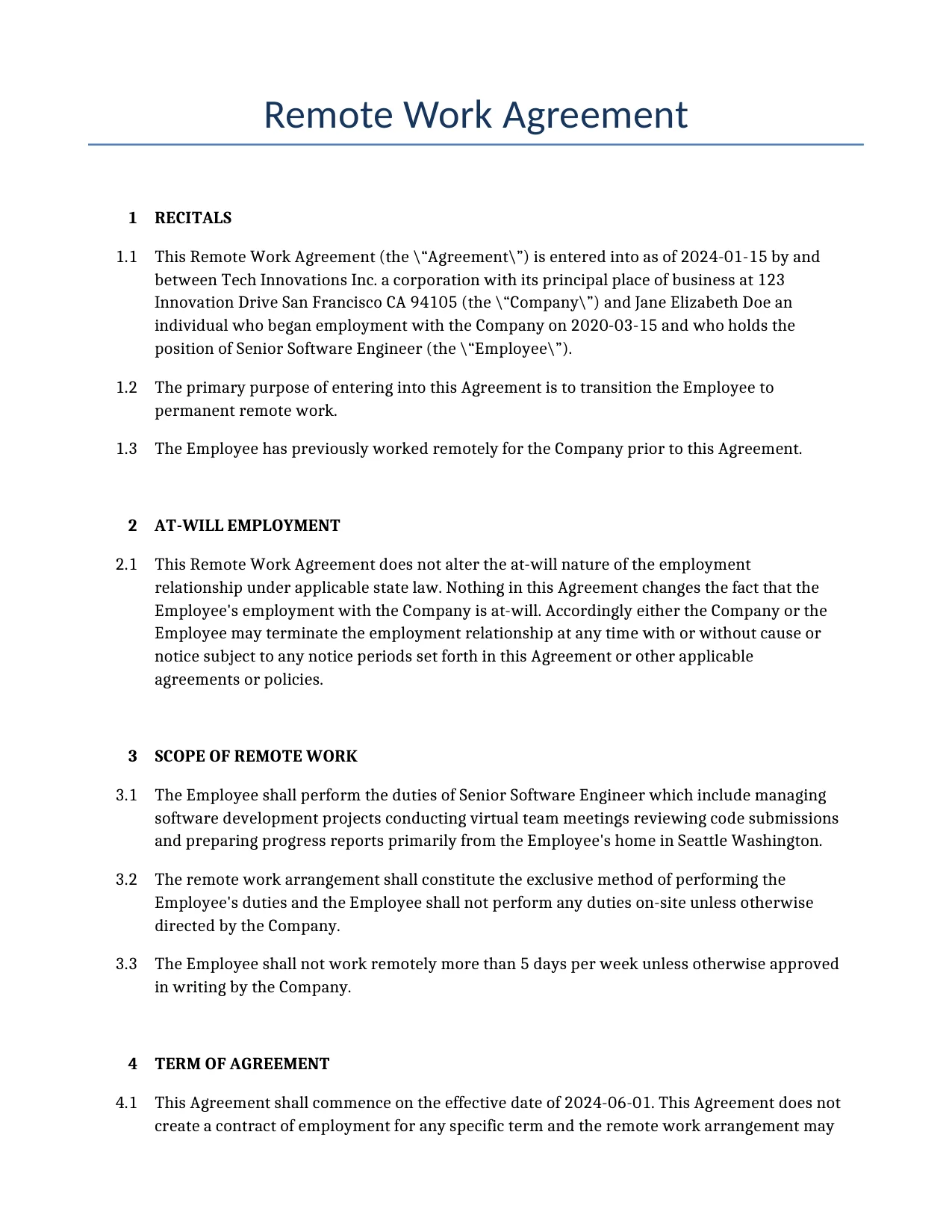
Remote Work Agreement
1RECITALS
This Remote Work Agreement (the \“Agreement\”) is entered into as of 2024-01-15 by and between Tech Innovations Inc. a corporation with its principal place of business at 123 Innovation Drive San Francisco CA 94105 (the \“Company\”) and Jane Elizabeth Doe an individual who began employment with the Company on 2020-03-15 and who holds the position of Senior Software Engineer (the \“Employee\”).
The primary purpose of entering into this Agreement is to transition the Employee to permanent remote work.
The Employee has previously worked remotely for the Company prior to this Agreement.
2AT-WILL EMPLOYMENT
This Remote Work Agreement does not alter the at-will nature of the employment relationship under applicable state law. Nothing in this Agreement changes the fact that the Employee's employment with the Company is at-will. Accordingly either the Company or the Employee may terminate the employment relationship at any time with or without cause or notice subject to any notice periods set forth in this Agreement or other applicable agreements or policies.
3SCOPE OF REMOTE WORK
The Employee shall perform the duties of Senior Software Engineer which include managing software development projects conducting virtual team meetings reviewing code submissions and preparing progress reports primarily from the Employee's home in Seattle Washington.
The remote work arrangement shall constitute the exclusive method of performing the Employee's duties and the Employee shall not perform any duties on-site unless otherwise directed by the Company.
The Employee shall not work remotely more than 5 days per week unless otherwise approved in writing by the Company.
4TERM OF AGREEMENT
This Agreement shall commence on the effective date of 2024-06-01. This Agreement does not create a contract of employment for any specific term and the remote work arrangement may be terminated separately from the underlying at-will employment relationship as set forth in the Termination section below.
Either party may terminate this remote work arrangement upon 30 days' written notice to the other party. This Agreement shall not automatically renew.
5COMPENSATION
The Company shall pay the Employee an annual base salary of $75,000.00 USD which shall be paid bi-weekly in accordance with the Company's standard payroll practices.
6OVERTIME AND FLSA COMPLIANCE
The Senior Software Engineer role is classified as exempt under the Fair Labor Standards Act (FLSA) and applicable state laws including those of California and Washington. As an exempt employee the Employee is not eligible for overtime pay. The Employee is expected to perform all duties without regard to the number of hours worked per week provided that the Employee meets all performance expectations and completes assigned tasks.
Nothing in this Agreement waives any rights the Employee may have under the FLSA or any other applicable federal or state wage and hour law. The Company complies with all requirements of the FLSA including proper classification of exempt employees. If the Employee believes they are performing non-exempt duties or working hours that may require reclassification they must promptly notify the Company in writing.
7BENEFITS
The Employee shall be eligible for comprehensive health insurance coverage including medical dental and vision plans with the Company contributing 80 percent of the premium costs effective as of 2024-06-01.
The Employee shall be eligible to participate in a 401(k) retirement plan with employer matching up to 4 percent of the Employee's salary effective as of 2024-06-01.
The Employee shall also be eligible for paid time off remote work stipends for home office setup and access to wellness programs such as virtual fitness classes and mental health support while working remotely. The Employee is eligible for leave under the Family and Medical Leave Act (FMLA) and applicable state leave laws including those of California and Washington.
8WORK SCHEDULE AND HOURS
The Employee's core working hours shall be from 9:00 AM to 5:00 PM based on Pacific Time (PT).
The Employee is expected to work 40 hours per week.
The Employee shall have flexibility in arranging the daily schedule outside of core hours provided that the Employee remains available during core hours for meetings and responds to emails within 2 business hours during core hours. Performance metrics and communication requirements are intended to be reasonable and not overly burdensome.
9REMOTE WORK LOCATION
The Employee's primary remote work location shall be in Seattle Washington 98101.
The Employee must obtain prior approval for any additional remote work locations besides the primary one by submitting a written email to the Employee's supervisor.
The Employee shall provide the Company with 14 days' advance notice before changing the remote work location and shall follow the process of submitting a written email to the supervisor to request approval for such change. The Employee must notify the Company of any changes in work location that could affect tax withholding workers' compensation or other legal obligations.
The Employee may work temporarily from a different location for short periods such as during travel provided that all other terms of this Agreement are complied with.
10EQUIPMENT AND SUPPLIES
The Company shall provide the Employee with a Dell Inspiron laptop computer and a 24-inch external monitor for performing remote work tasks and the Employee shall not be required to contribute financially to the cost of such equipment.
The Company shall be responsible for the maintenance and repairs of the provided equipment. The Company shall maintain appropriate insurance covering the provided equipment while in the Employee's remote use.
Upon termination of employment the Employee must return the equipment to the Company within 14 days in good working condition subject to normal wear and tear.
11EXPENSES AND REIMBURSEMENTS
The Employee shall submit requests for reimbursement of remote work expenses such as internet and home office setup costs to the Company within 30 days after incurring such expense and shall include receipts for all such requests. The Company shall comply with all applicable state reimbursement laws including those of California and Washington.
12CONFIDENTIALITY
Confidential Information includes any non-public information disclosed by the Company such as trade secrets business plans customer lists financial data and technical specifications whether oral written or electronic and proprietary information includes source code algorithms marketing strategies employee records and any intellectual property developed during employment.
The Employee shall protect all Confidential Information and shall acknowledge in writing that the Employee understands the confidentiality obligations under this Agreement.
The Employee may disclose Confidential Information only in the event of a legal requirement with the Company's consent or to professional advisors bound by similar confidentiality obligations.
The Employee shall return all confidential materials to the Company upon termination of employment.
13DATA SECURITY AND PRIVACY
The Employee shall complete mandatory data security training prior to commencing remote work.
The Employee shall use only company-approved equipment for handling company data during remote work and shall not store company data on personal devices.
The Employee shall control access to company data using multi-factor authentication (MFA) and encryption for data in transit and at rest and shall use only secure encrypted internet connections for accessing company data.
The primary remote work location where the Employee will handle company data is a dedicated home office in a secure private residence in Seattle Washington with no shared access to the workspace.
The Employee shall report any data security incidents to the Company within 24 hours.
14DATA PRIVACY AND COMPLIANCE
The Company complies with the California Consumer Privacy Act (CCPA) as amended by the California Privacy Rights Act (CPRA) to the extent applicable if the Company handles personal information of California residents. The Employee's personal data will be handled in accordance with applicable privacy laws.
By signing this Agreement the Employee consents to the Company's monitoring of Company-provided devices and accounts used for remote work in accordance with applicable law including the monitoring of emails internet usage and other activity on Company systems.
The Employee agrees to handle all personal data and Company data securely in the remote environment and to follow all Company policies regarding data privacy and security. To the extent the Company engages in international data transfers it shall comply with applicable requirements such as the GDPR if relevant.
15PERFORMANCE STANDARDS
The Employee is expected to maintain a standard 40-hour workweek complete assigned tasks by their deadlines participate actively in daily virtual stand-up meetings adhere to core working hours and use project management tools like Asana to track progress. These requirements are reasonable and designed to support effective remote collaboration without being overly burdensome.
The Employee's performance shall be evaluated using key metrics including task completion rate with a target of 95 percent on time customer satisfaction scores from feedback surveys with a minimum average of 4 out of 5 and weekly output reports measured against set goals.
Performance evaluations for the Employee in the remote setting shall occur quarterly.
16COMMUNICATION AND REPORTING
The Employee shall use instant messaging as the primary method of communication for regular interactions with the Company and team and shall check or respond to such communications during core working hours.
The Employee shall submit a weekly status report to the Company as a mandatory requirement.
The Employee shall follow a specific protocol for urgent communications with the Company and shall respond to non-urgent communications from the Company or team within 24 hours.
17HEALTH AND SAFETY
The Employee acknowledges responsibility for maintaining an ergonomic workstation setup to prevent health issues like repetitive strain injuries and guarantees that the remote work environment is free from hazards that could endanger the Employee's health or safety. The Company complies with the Occupational Safety and Health Act (OSHA) and applicable state laws. The Employee is encouraged to report any safety concerns to the Company.
The Employee confirms understanding of and agreement to follow the Company's emergency procedures while working remotely and agrees to comply with all applicable local state and federal health and safety regulations in the remote work location.
The Employee agrees to take responsibility for regular inspection and cleaning of provided equipment reporting any equipment defects or safety issues to the Company and using equipment in a manner that complies with manufacturer safety guidelines.
18ANTI-DISCRIMINATION AND HARASSMENT
All federal state and local anti-discrimination and anti-harassment laws apply to the remote work arrangement including but not limited to Title VII of the Civil Rights Act the Americans with Disabilities Act (ADA) the Age Discrimination in Employment Act and applicable state laws such as California's Fair Employment and Housing Act and Washington's Law Against Discrimination. The Company prohibits discrimination or harassment on any protected basis.
The Employee has rights to reasonable accommodations for disabilities under the ADA and applicable state laws. The Employee should contact Human Resources to request accommodations.
The Employee may report any harassment or discrimination in the remote setting by contacting their supervisor Human Resources or using the Company's anonymous reporting hotline. All complaints will be promptly and thoroughly investigated in accordance with Company policy.
19INSURANCE
The Company shall maintain appropriate workers' compensation insurance covering the Employee while working remotely in Washington in accordance with applicable laws. The Employee is not required to maintain their own workers' compensation insurance. In the event of a work-related injury or illness the Employee must promptly report it to the Company.
The Company shall maintain appropriate liability insurance covering the remote work arrangement to the extent required by law. The Employee shall confirm adequate coverage under the Employee's homeowners or renters insurance for remote work equipment and shall provide the Company with an annual certificate of insurance as proof if requested.
The Company is responsible for insuring the equipment it provides to the Employee for use during remote work against loss damage or theft subject to the terms of the Company's insurance policy. The Employee must take reasonable steps to safeguard the equipment.
20TAXES
The Employee currently resides in Washington for tax purposes and will primarily perform remote work in Washington.
The Employee shall comply with all applicable tax obligations including those arising under the laws of Washington California New York and Texas as applicable and shall be responsible for any additional tax liabilities resulting from the remote work arrangement.
21TAX OBLIGATIONS AND WITHHOLDING
The Company will withhold federal state and local taxes based on the Employee's primary work location and residence in Washington in compliance with applicable laws. Due to the multi-state nature of remote work (including references to California New York and Texas) the Company may be required to withhold taxes for multiple jurisdictions depending on the time spent working in each state.
The Employee is responsible for any additional state taxes filings or obligations arising from multi-state remote work including but not limited to compliance with tax laws in California Washington New York and Texas. The Employee must promptly notify the Company in writing of any changes in their work location or residence that could affect tax withholding or reporting obligations. The Company does not provide tax advice and the Employee is encouraged to consult with a qualified tax professional.
22INTELLECTUAL PROPERTY
The Employee shall assign to the Company all right title and interest in any work product created during remote employment effective as of 2024-06-01 and such assignment shall occur automatically upon creation of the work product.
The Employee shall disclose any pre-existing intellectual property that might relate to the remote work and warrants that the assigned work product does not infringe any third-party rights.
23TERMINATION
This remote work arrangement may be terminated by either party upon 30 days' written notice. Termination of the remote work arrangement does not terminate the underlying at-will employment relationship. The Company may terminate the remote work arrangement or the employment for cause without notice. Post-termination obligations shall include the return of company property.
In the event of a mass layoff the Company shall comply with the Worker Adjustment and Retraining Notification (WARN) Act and any applicable state laws. This section does not apply to individual terminations which are governed by the at-will employment doctrine.
24RETURN TO OFFICE
The Company may require the Employee to return to the office in the event of business reorganization or company emergency and shall provide the Employee with 30 days' notice prior to such requirement.
The Employee may be granted exceptions to the return requirement for medical reasons in accordance with the Family and Medical Leave Act (FMLA) the Americans with Disabilities Act or applicable state laws.
25NON-COMPETE AND NON-SOLICITATION
The Employee agrees not to solicit the Company's customers or employees for a period of one year following termination of employment. This restriction is limited to customers and employees with whom the Employee had material contact during the last 12 months of employment. The geographic scope is limited to the United States. There is no non-compete restriction. These restrictions apply only to the extent they are enforceable under the laws of the Employee's state of residence (Washington) California Business and Professions Code Section 16600 California Labor Code Section 925 or other applicable law. The Company and Employee agree that if any restriction is found unenforceable it shall be reformed to the maximum extent permitted by law.
26DISPUTE RESOLUTION
Any disputes arising under this Agreement shall be resolved through arbitration in San Francisco California and the outcome of such arbitration shall be final and binding on both the Company and the Employee. Arbitration shall be administered by JAMS under its employment arbitration rules. This section does not apply to claims that cannot be arbitrated under applicable law including claims under the Sarbanes-Oxley Act or certain discrimination claims.
27GOVERNING LAW
This Agreement shall be governed by and construed in accordance with the laws of the State of California without regard to its conflict of laws principles to the extent permitted by law including California Labor Code Section 925.
The courts of the State of California or the arbitration forum specified above shall have jurisdiction over any disputes arising from this Agreement to the extent permitted by applicable law.
28ENTIRE AGREEMENT
This Agreement constitutes the entire agreement between the Company and the Employee regarding the remote work arrangement and supersedes all prior written contracts oral discussions and email exchanges.
Any future modifications to this Agreement must be made in writing and signed by both parties and there are no prior written agreements or understandings with the Employee regarding the remote work arrangement.
29SEVERABILITY
If any provision of this Agreement is held to be invalid or unenforceable the remaining provisions shall remain in full force and effect.
30AMENDMENTS
All amendments to this Agreement must be in writing and signed by both the Employee and the Company.
31NOTICES
All formal notices under this Agreement shall be sent by hand delivery certified mail or email and shall be deemed delivered upon receipt or if sent by mail 3 days after sending.
Oral notices are not permitted under this Agreement.
32WAIVER
The failure of either party to enforce any provision of this Agreement shall not constitute a waiver of such provision or any other provision.
33ASSIGNMENT
The Employee shall not assign this Agreement without the Company's prior written consent which shall not be unreasonably withheld.
34FORCE MAJEURE
Neither party shall be liable for any delay or failure to perform its obligations under this Agreement if such delay or failure is due to natural disasters pandemics or epidemics or cyber attacks or IT failures provided that the affected party gives written notice to the other party within 5 business days of the event.
If a force majeure event continues for more than 30 days either party may terminate this Agreement upon written notice to the other party.
35COMPLIANCE WITH LAWS
Both parties agree to comply with all applicable federal state and local laws while working remotely including the Fair Labor Standards Act (FLSA) the Family and Medical Leave Act (FMLA) the Occupational Safety and Health Act (OSHA) the Worker Adjustment and Retraining Notification (WARN) Act California Labor Code Sections 925 and 16600 and other applicable laws of California Washington New York and Texas. The WARN Act applies only to mass layoffs and not to individual terminations.
The Employee shall promptly report any changes in the remote work location that may affect legal compliance to the Company.
36ACKNOWLEDGMENT OF UNDERSTANDING
By signing below the Employee acknowledges that they have read and understand this Agreement agree to comply with all remote work policies have had the opportunity to seek legal advice and that this Agreement is not a contract of employment for a specific term. The Employee further acknowledges that their employment remains at-will as described in Section 2.
37SIGNATURES
IN WITNESS WHEREOF the parties have executed this Agreement as of the date first above written.
Tech Innovations Inc. By: _______________________________ Name: Title: Date: ________________
Employee: _______________________________ Jane Elizabeth Doe Date: ________________
This example shows approximately 70% of a typical document and is provided for illustrative purposes only. The remaining content has been omitted.
Every document generated by Docaro is tailored to your specific circumstances, jurisdiction and the information you provide. The completed document includes all applicable clauses and provisions required for your situation.
To generate the full, personalised document, answer a short series of questions and your document will be created instantly.