
AI Generated American Cohabitation Agreement
PDF & Word - 2026 Updated
Docaro Pricing
When Do You Need a Cohabitation Agreement in the United States?
American Legal Rules for a Cohabitation Agreement
Using the wrong type of agreement for cohabitation can inadvertently create legal rights or obligations akin to marriage or tenancy.
What a Proper Cohabitation Agreement Should Include
- Shared ExpensesDetails how couples will split costs like rent, utilities, and groceries to avoid money disputes.
- Property OwnershipSpecifies who owns what items bought together or separately, making it clear if something is joint or individual.
- Debt ResponsibilityOutlines each person's role in handling shared or personal debts to prevent one partner from being stuck with the other's bills.
- End of Relationship RulesDescribes how to divide belongings and handle finances if the couple breaks up, reducing conflict during separation.
- Household DutiesAssigns chores and responsibilities around the home to keep things fair and organized.
- Personal BoundariesSets expectations for privacy, space, and individual habits to respect each partner's needs.
- Future PlanningCovers topics like what happens if one partner wants to move out or if the relationship leads to marriage.
Generate Your Document in 4 Easy Steps
Why Use Docaro?
 United States
Free Example Cohabitation Agreement Template
Below is a free template example of a Cohabitation Agreement for use in the United States generated by our AI model.
The clauses in your actual Cohabitation Agreement will vary from this example as they will be entirely bespoke to your requirements as set out in the questionnaire you complete.
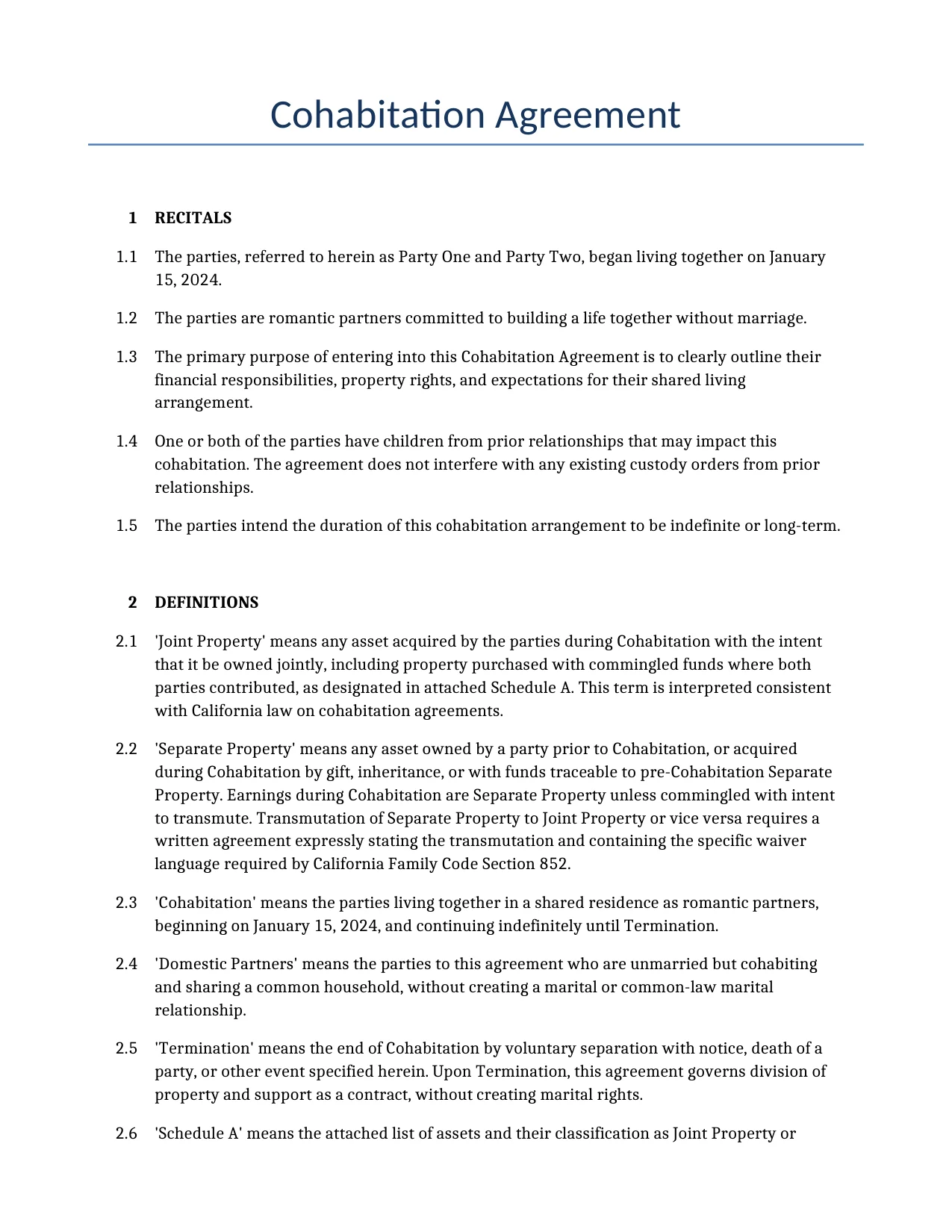
Cohabitation Agreement
1RECITALS
The parties, referred to herein as Party One and Party Two, began living together on January 15, 2024.
The parties are romantic partners committed to building a life together without marriage.
The primary purpose of entering into this Cohabitation Agreement is to clearly outline their financial responsibilities, property rights, and expectations for their shared living arrangement.
One or both of the parties have children from prior relationships that may impact this cohabitation. The agreement does not interfere with any existing custody orders from prior relationships.
The parties intend the duration of this cohabitation arrangement to be indefinite or long-term.
2DEFINITIONS
'Joint Property' means any asset acquired by the parties during Cohabitation with the intent that it be owned jointly, including property purchased with commingled funds where both parties contributed, as designated in attached Schedule A. This term is interpreted consistent with California law on cohabitation agreements.
'Separate Property' means any asset owned by a party prior to Cohabitation, or acquired during Cohabitation by gift, inheritance, or with funds traceable to pre-Cohabitation Separate Property. Earnings during Cohabitation are Separate Property unless commingled with intent to transmute. Transmutation of Separate Property to Joint Property or vice versa requires a written agreement expressly stating the transmutation and containing the specific waiver language required by California Family Code Section 852.
'Cohabitation' means the parties living together in a shared residence as romantic partners, beginning on January 15, 2024, and continuing indefinitely until Termination.
'Domestic Partners' means the parties to this agreement who are unmarried but cohabiting and sharing a common household, without creating a marital or common-law marital relationship.
'Termination' means the end of Cohabitation by voluntary separation with notice, death of a party, or other event specified herein. Upon Termination, this agreement governs division of property and support as a contract, without creating marital rights.
'Schedule A' means the attached list of assets and their classification as Joint Property or Separate Property, which is incorporated by reference.
'Schedule B' means the attached list of liabilities and debts, which is incorporated by reference.
All other terms shall be interpreted under California law governing contracts between unmarried cohabitants, including principles from Marvin v. Marvin (18 Cal. 3d 660).
3EFFECTIVE DATE
This Cohabitation Agreement shall become effective on January 15, 2024.
The parties intend to begin cohabiting as domestic partners on or about February 1, 2024, or as soon as practicable after execution.
4RELATIONSHIP OF THE PARTIES
The parties wish to establish their relationship as Domestic Partners through this Cohabitation Agreement.
The parties do not intend to enter into a legal marriage in the future as part of this cohabitation arrangement.
This Cohabitation Agreement includes provisions that explicitly avoid creating a common-law marriage in any jurisdiction where it is recognized.
5PROPERTY OWNERSHIP AND DIVISION
Property acquired during Cohabitation shall be classified as follows: earnings and income of each party are Separate Property; assets purchased with joint funds or with clear intent of joint ownership shall be Joint Property. Contributions to joint expenses are shared but do not transmute Separate Property unless a written transmutation agreement complying with Family Code Section 852 is executed. Appreciation of Separate Property during Cohabitation remains Separate unless transmuted in writing.
The following specific pre-cohabitation assets shall remain the Separate Property of the acquiring party: Real Estate, Bank Accounts, Vehicles. See attached Schedule A for full list and values.
Party One's pre-cohabitation Separate Property includes a condo in New York valued at approximately $500,000, a savings account with approximately $50,000, and a 2018 Toyota Camry worth approximately $20,000. Party Two's pre-cohabitation Separate Property is listed in Schedule A. These values are estimates; current values are warranted in the attached financial disclosures.
Commingling of Separate Property shall not convert it to Joint Property absent an express written agreement to transmute in compliance with California Family Code Section 852.
The start date of Cohabitation for property classification purposes shall be January 15, 2024.
In the event of one party's death, Joint Property shall pass according to the surviving party's rights under law or beneficiary designations; this agreement does not create automatic survivorship rights. See the Wills section below.
Each party's Separate Property shall remain their own upon separation or Termination. Joint Property shall be divided as set forth in the Division of Property Upon Termination section.
The parties have attached Schedule A (assets) and Schedule B (debts and liabilities) and warrant the accuracy of the financial disclosures attached hereto as required for full disclosure under California law.
6FINANCIAL RESPONSIBILITIES
The specific household expenses to be addressed include Utilities (electricity, water, gas), groceries, and home maintenance. See also the Household Expenses and Contributions section for additional details.
The parties shall contribute to household expenses by Equal Split, adjusted for any significant disparity in Separate Property income if agreed in writing.
Each party shall contribute approximately $500 per month to household expenses (based on estimated total of $2,000 monthly), paid on the 15th of each month to a joint account. This is subject to adjustment based on actual expenses.
The specific bills to be addressed include phone bills, internet service, and health insurance premiums.
All bills shall be paid jointly from a shared account funded by the parties' contributions.
All financial contributions shall be made on the 15th day of each month.
7JOINT ACCOUNTS AND ASSETS
The parties shall establish joint bank accounts as part of this Cohabitation Agreement for payment of shared expenses.
The parties may include joint credit cards or other shared financial assets.
The joint accounts and assets shall be managed during the Cohabitation by Joint Decision Making.
The joint accounts and assets shall be divided equally if the Cohabitation ends, subject to any outstanding joint debts listed in Schedule B.
8DEBTS AND LIABILITIES
The shared debts to be included are any joint credit card for household expenses and a shared car loan, if any, as listed in attached Schedule B with current total outstanding amounts. Pre-Cohabitation debts are Separate.
Each party shall contribute to shared debts consistent with the Equal Split of household expenses.
Shared debt repayments shall start on or after January 15, 2024.
Debts incurred jointly during the Cohabitation period shall be allocated upon Termination of the relationship by Equal Split.
Individual debts incurred during Cohabitation shall remain the responsibility of the incurring party upon Termination.
Debts incurred before Cohabitation shall remain the sole responsibility of the incurring party.
Debts from joint bank accounts or credit facilities shall be handled with Equal Responsibility.
Both parties shall have an ongoing obligation to disclose any new debts incurred during Cohabitation.
The start date of Cohabitation for the purpose of defining when joint debts begin shall be January 15, 2024.
The collection or repayment of joint debts after Termination of the Cohabitation shall be handled by Joint Payment Until Settled.
9HOUSEHOLD EXPENSES AND CONTRIBUTIONS
The household expenses shall be divided between the parties by Equal Split, with each contributing approximately $500 monthly based on an estimated total of $2,000 per month. Contributions are from Separate Property earnings.
The specific household expenses to be included are Utilities (electricity, water, internet), groceries, rent, maintenance, and streaming services.
The estimated total monthly amount for all household expenses is 2000.0.
Each party's estimated monthly income is set forth in the attached financial disclosures; prior estimates in drafts (such as 4000 or 3500) are superseded by the disclosures.
Contributions to household expenses shall be paid Monthly on the 15th via bank transfer to a shared checking account.
The household expense division shall start on January 15, 2024.
10RESIDENCE AND LIVING ARRANGEMENTS
The full address of the current or intended residence shall be specified in a written addendum or updated notice; for example purposes, 456 Oak Avenue, Los Angeles, CA (subject to change).
The residence is owned or occupied as Rented or leased.
The residence lease or mortgage details shall be addressed in a separate addendum or Schedule. Rent or mortgage on the shared residence shall be paid by both parties equally as part of household expenses.
The current residence shall be the shared residence under this agreement.
Both partners shall have the right to remain in the residence for up to 60 days upon separation to allow for orderly Transition, subject to lease terms.
The shared residence shall be handled upon separation by return to lease terms or vacate as necessary.
11PERSONAL PROPERTY
Personal property acquired during Cohabitation shall be divided equally upon separation if classified as Joint Property; otherwise, it remains with the acquiring party.
Certain personal items shall be designated as Separate Property not subject to division, as listed in Schedule A.
Furniture acquired during Cohabitation shall be classified as Joint Property unless otherwise designated.
Ownership of vehicles acquired during Cohabitation shall be by the titled owner, subject to any reimbursement for contributions from the other party.
The vehicles acquired during Cohabitation, if any, are listed in Schedule A.
12INCOME AND EARNINGS
Income earned by each party during the Cohabitation shall be treated as Separate Property.
Earnings from self-employment or business activities by each party during the Cohabitation shall be treated as Separate Property unless the parties agree in writing to treat them as Joint Property.
Bonuses received by each party during the Cohabitation shall be treated as Separate Property.
Other financial gains, such as investment returns or gifts, received by each party during the Cohabitation shall be treated as Separate Property unless deposited into a joint account with intent to commingle.
Each party's estimated annual income from all sources is set forth in the attached financial disclosures (prior draft estimates such as 75000 or 65000.5 are superseded).
Each party shall contribute a portion of their Separate Property income to joint expenses during Cohabitation as outlined in the Financial Responsibilities and Household Expenses sections.
The expected start date for Cohabitation when income treatment begins to apply is January 15, 2024.
13SUPPORT OBLIGATIONS
This Cohabitation Agreement includes provisions for financial support or maintenance obligations (sometimes referred to as palimony) in the event of separation. The parties agree there shall be no post-Termination support obligations unless otherwise agreed in a separate writing. Any such support, if provided, is enforceable only as a contract per principles established in Marvin v. Marvin and California Family Code. The parties expressly waive any implied support rights arising from Cohabitation. If support is later requested, it shall be calculated considering factors in Family Code Section 4320 as guidance but not as spousal support.
14HEALTH INSURANCE AND BENEFITS
One party may have health insurance coverage that includes the other partner as a dependent during Cohabitation, if eligible under the plan.
The provider of any current health insurance is typically an Employer-sponsored plan.
The partner may be added as a dependent on the health insurance policy during Cohabitation where permitted by the plan terms.
Health insurance coverage upon Termination of Cohabitation shall result in immediate termination of dependent status. The parties shall address continuation coverage (such as COBRA, if applicable) and associated costs at the time of Termination; the covered party shall not be responsible for the other party's post-Termination insurance costs unless separately agreed.
The partner may be designated as a beneficiary on health insurance or related benefits during the term of Cohabitation only.
15CHILDREN AND PARENTAL RIGHTS
The parties may have or expect children. If the children are from prior relationships, this agreement does not interfere with existing custody orders. If the children are joint, the following are preliminary expressions of intent only.
Any provisions regarding custody or support are preliminary and subject to court approval based on the best interest of the child at the time of any dispute, in accordance with California Family Code. The parties cannot fully predetermine child custody, visitation, or support in this agreement.
Authority for major decisions regarding the children's education, health, and religion shall be by Joint Decision Making where possible, subject to court determination.
The monthly child support amount, if any, is proposed only and shall be calculated per California guidelines (Family Code Section 4050 et seq.) at the time of any dispute or separation. Any fixed amount such as $500 in drafts is superseded and not binding.
Child support payments, if ordered, may be modified based on changes in income or circumstances per California law.
Additional expenses like extracurricular activities or medical costs shall be handled by Split Proportionally by Income.
This agreement shall apply to any children born or adopted in the future during Cohabitation only to the extent consistent with California law on the best interests of the child.
16PETS
The parties specify pets owned or acquired during the Cohabitation period as listed in Schedule A or an addendum. Prior draft descriptions (e.g., specific breeds and dates) are for illustration only and shall be updated in attachments.
Ownership of each pet is classified as Joint Ownership unless otherwise designated.
Veterinary expenses for the pets shall be shared equally as part of household expenses.
Custody of the pets upon separation shall be determined by mutual agreement or mediation, considering the best interest of the pet(s) and primary caregiving history. In absence of agreement, a court may decide.
17TERMINATION OF AGREEMENT
This Cohabitation Agreement shall terminate automatically upon voluntary separation or the death of either party.
Voluntary termination of the agreement shall require 30 days written notice.
Termination notices shall be delivered by certified mail or email with read receipt to the addresses in the Notices section.
Disputes arising from termination shall be resolved by Mediation as set forth in the Dispute Resolution section.
Release of Claims: Upon Termination, each party releases and waives any claims against the other's estate, heirs, or assigns unless specifically provided otherwise in a will, trust, or beneficiary designation. This does not waive rights to Joint Property earned during Cohabitation.
18DIVISION OF PROPERTY UPON TERMINATION
Property shall be divided by Equal Division of Joint Property upon Termination of the Cohabitation. Separate Property shall be confirmed to the owning party without division.
Certain property shall be designated as Separate and excluded from division upon Termination, as listed in Schedule A.
Real estate owned during Cohabitation shall be handled upon Termination by Sell and Divide Proceeds for any Joint Property interest, or confirmation of Separate Property title.
Joint debts incurred during Cohabitation shall be handled upon Termination with Equal Responsibility, as listed in Schedule B.
The date of Termination for property division purposes shall be defined as the Date of Separation (when Cohabitation ends).
A specific dispute resolution process shall be included for property division conflicts (see Dispute Resolution section).
19DISPUTE RESOLUTION
The preferred method for resolving disputes under this Cohabitation Agreement is Mediation.
Mediation shall be required as the first step before any other dispute resolution method.
Binding arbitration shall be included for disputes not resolved by mediation, under the rules of the American Arbitration Association or similar.
The parties waive the right to a jury trial in favor of arbitration or other methods to the extent permitted by California law.
The laws of the State of California shall govern the dispute resolution process.
20GOVERNING LAW
The parties will primarily reside in the state of California while cohabiting under this agreement.
This Cohabitation Agreement shall be governed by and construed in accordance with the laws of the State of California. It is intended to be enforceable as a contract between unmarried cohabitants under principles established in Marvin v. Marvin (18 Cal. 3d 660) and subsequent cases, and relevant sections of the California Family Code governing contracts (including but not limited to Family Code implications for non-marital relationships). This agreement does not create a marital relationship, common law marriage, or any rights arising under marital property or support laws. The parties expressly intend this to be a valid and enforceable contract.
21NO COMMON LAW MARRIAGE INTENT
The parties explicitly state that they do not intend to form a common-law marriage or any marital relationship by entering into this agreement or by cohabiting. This Cohabitation Agreement is not evidence of any marital intent and shall not be construed as such in any jurisdiction. The parties are entering this agreement solely to define their contractual rights and obligations as unmarried individuals.
22TAX IMPLICATIONS
The parties acknowledge that cohabitation may have various tax implications, including but not limited to filing status (each party typically files as single unless eligible for other status such as head of household), eligibility for shared deductions, credits, or dependency claims, and potential impacts on health insurance or retirement benefits. This agreement does not create any joint tax filing obligation. The parties agree to consult with a qualified tax professional for advice specific to their situation and to file taxes consistently with their status as unmarried individuals. No party shall be liable for the other's tax liabilities.
23FULL DISCLOSURE OF ASSETS AND LIABILITIES
Each party has fully disclosed their assets and liabilities to the other prior to execution of this agreement. Each party warrants the accuracy and completeness of the financial disclosures attached hereto as Exhibit 1 (or similar). These include but are not limited to the items in Schedules A and B. Each party acknowledges reliance on these disclosures and understands that failure to disclose material information could affect enforceability. The parties agree to update disclosures in writing if material changes occur prior to or during Cohabitation.
24ATTORNEY FEES
In any action or proceeding to enforce or interpret any term of this Cohabitation Agreement, the prevailing party shall be entitled to recover reasonable attorney fees and costs in addition to any other relief to which that party is entitled, as determined by the court or arbitrator.
25WILLS AND SURVIVORSHIP
This agreement does not automatically transfer property upon death. Each party recommends that the other execute or update their will, trust, or beneficiary designations to reflect the terms of this agreement regarding Joint Property and any intended bequests. Without a valid will or designation, California intestacy laws will apply to Separate Property and any undistributed Joint Property. The parties may execute reciprocal wills if desired but are not obligated to do so under this agreement.
26ENTIRE AGREEMENT
This Cohabitation Agreement constitutes the entire understanding between the parties and supersedes any prior agreements. All exhibits, schedules, and attachments (including Schedules A and B, financial disclosures, and any addenda) are incorporated by reference as if fully set forth herein. This is a merger clause confirming that no other representations or promises have been made.
27SEVERABILITY AND REFORMATION
If any provision of this Cohabitation Agreement is found to be invalid or unenforceable, the remaining provisions shall remain in full force and effect. The court is authorized to reform any invalid provision to the closest enforceable intent consistent with California law and the parties' objectives as expressed herein.
28WAIVER
The failure of either party to enforce any provision of this Cohabitation Agreement shall not constitute a waiver of that party's rights. Any waiver must be in writing and signed by the party against whom enforcement is sought.
29AMENDMENTS
Modifications to this agreement shall be handled by Written Amendment Only. All amendments to this Cohabitation Agreement must be made in writing and signed by both parties. This agreement becomes effective on the date of last signature or as specified in Section 3.
30NOTICES
Formal notices to Party One shall be sent to 123 Main Street, Apartment 4B, New York, NY 10001 (or current address provided in writing).
Formal notices to Party Two shall be sent to 456 Oak Avenue, Suite 200, Los Angeles, CA 90210 (or current address provided in writing).
Formal notices between the parties may be delivered by Personal Delivery, Certified Mail, or Email.
Mailed notices shall be deemed delivered three business days after mailing.
If a party is temporarily absent from their specified address, notices shall be delivered to the Designated Agent if one is appointed in writing.
31CONFIDENTIALITY
The parties shall keep the terms of this Cohabitation Agreement confidential except as required by law, court order, or to enforce its terms.
32INDEPENDENT LEGAL ADVICE
Each party has received independent legal advice before signing this Cohabitation Agreement or has had the opportunity to do so and voluntarily waives it. Each party confirms that they fully understand the implications of this Cohabitation Agreement, had the opportunity to seek independent legal advice, and is signing voluntarily without any undue influence.
33ACKNOWLEDGMENT
Each party acknowledges that they have read this Cohabitation Agreement in its entirety, understand all terms, have had the opportunity to consult with independent counsel, and enter into it voluntarily. The parties affirm all representations and warranties herein, including full financial disclosure. This agreement may be notarized below if desired for record-keeping purposes.
Notary Acknowledgment (optional): State of California, County of ________. On ________, before me, ________, a Notary Public, personally appeared Party One and Party Two, who proved to me on the basis of satisfactory evidence to be the persons whose names are subscribed to the within instrument and acknowledged that they executed the same in their authorized capacities, and that by their signatures on the instrument the persons executed the instrument. I certify under PENALTY OF PERJURY under the laws of the State of California that the foregoing paragraph is true and correct. WITNESS my hand and official seal. Signature: _______________________________ (Seal)
34COUNTERPARTS
This Cohabitation Agreement may be signed in counterparts, each of which shall be considered an original. Electronic signatures shall be deemed original for all purposes.
35SIGNATURES
IN WITNESS WHEREOF, the parties have executed this Cohabitation Agreement on the date first above written.
Party One: _______________________________ Date: _______________
Party Two: _______________________________ Date: _______________
This example shows approximately 70% of a typical document and is provided for illustrative purposes only. The remaining content has been omitted.
Every document generated by Docaro is tailored to your specific circumstances, jurisdiction and the information you provide. The completed document includes all applicable clauses and provisions required for your situation.
To generate the full, personalised document, answer a short series of questions and your document will be created instantly.