
AI Generated American Roommate Agreement
PDF & Word - 2026 Updated
Docaro Pricing
When Do You Need a Roommate Agreement in the United States?
American Legal Rules for a Roommate Agreement
Using the wrong type of agreement, such as a lodger agreement instead of a house share agreement, can inadvertently grant tenants stronger legal rights and protections.
What a Proper Roommate Agreement Should Include
- Rent and Payment DetailsSpecify the amount of rent each roommate pays, due dates, and how payments are made to avoid disputes.
- Security Deposit RulesOutline how the deposit is split, what it covers, and the process for refunds when moving out.
- Utility and Bill SharingDetail which utilities and bills each roommate is responsible for and how costs are divided.
- House Rules and ChoresList daily rules like quiet hours, cleaning schedules, and chore rotations to keep the home harmonious.
- Guest PolicySet limits on overnight guests and visitors to respect everyone's privacy and space.
- Maintenance and RepairsDefine who handles minor repairs and how larger issues with the property are addressed.
- Pet PolicyState whether pets are allowed, any restrictions, and who cares for them.
- Moving Out ProceduresExplain notice periods, how to find a replacement roommate, and end-of-lease responsibilities.
- Dispute ResolutionDescribe simple steps for resolving disagreements, like mediation, before they escalate.
- Termination ConditionsClarify circumstances under which the agreement can end early and any penalties involved.
Generate Your Document in 4 Easy Steps
Why Use Docaro?
 United States
Free Example Roommate Agreement Template
Below is a free template example of a Roommate Agreement for use in the United States generated by our AI model.
The clauses in your actual Roommate Agreement will vary from this example as they will be entirely bespoke to your requirements as set out in the questionnaire you complete.
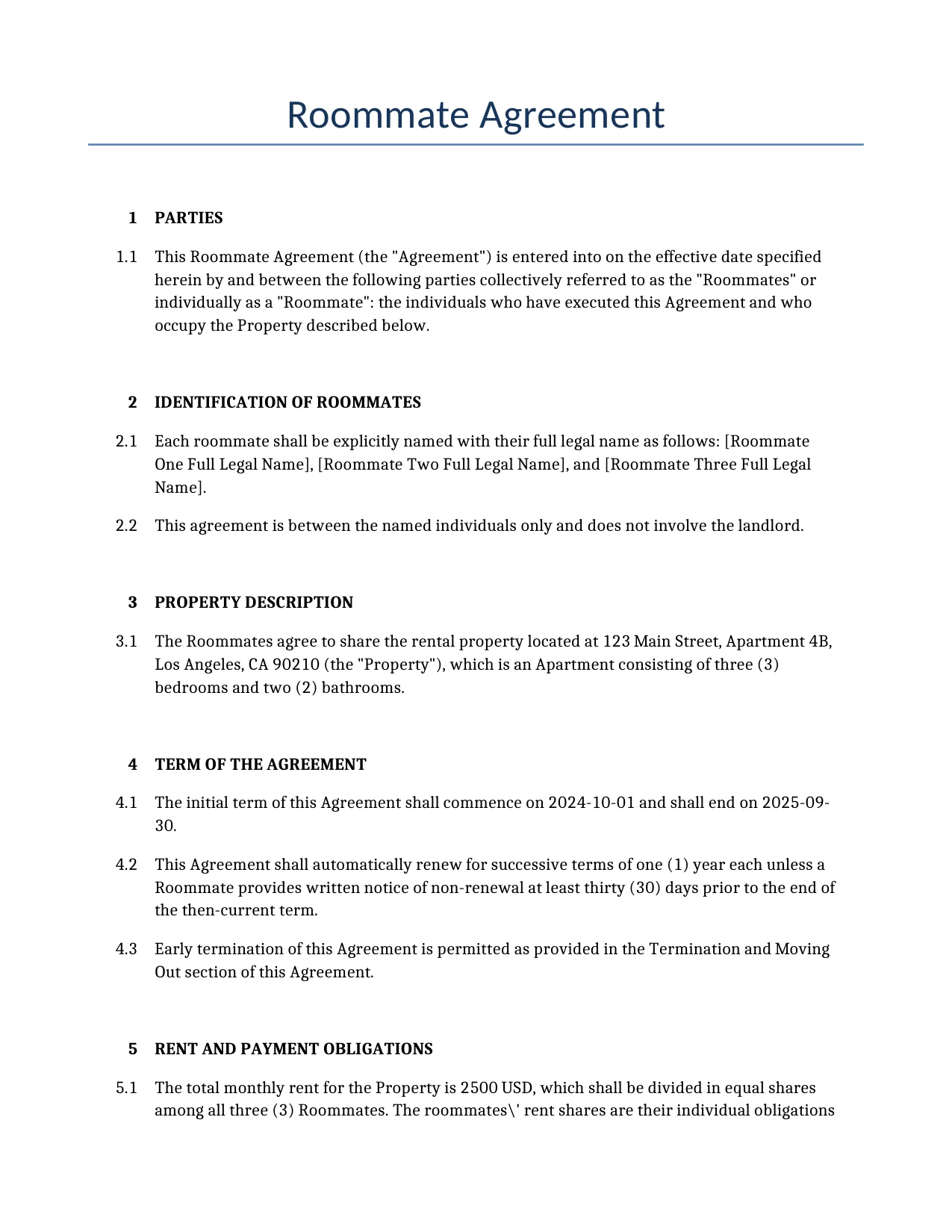
Roommate Agreement
1PARTIES
This Roommate Agreement (the "Agreement") is entered into on the effective date specified herein by and between the following parties collectively referred to as the "Roommates" or individually as a "Roommate": the individuals who have executed this Agreement and who occupy the Property described below.
2IDENTIFICATION OF ROOMMATES
Each roommate shall be explicitly named with their full legal name as follows: [Roommate One Full Legal Name], [Roommate Two Full Legal Name], and [Roommate Three Full Legal Name].
This agreement is between the named individuals only and does not involve the landlord.
3PROPERTY DESCRIPTION
The Roommates agree to share the rental property located at 123 Main Street, Apartment 4B, Los Angeles, CA 90210 (the "Property"), which is an Apartment consisting of three (3) bedrooms and two (2) bathrooms.
4TERM OF THE AGREEMENT
The initial term of this Agreement shall commence on 2024-10-01 and shall end on 2025-09-30.
This Agreement shall automatically renew for successive terms of one (1) year each unless a Roommate provides written notice of non-renewal at least thirty (30) days prior to the end of the then-current term.
Early termination of this Agreement is permitted as provided in the Termination and Moving Out section of this Agreement.
5RENT AND PAYMENT OBLIGATIONS
The total monthly rent for the Property is 2500 USD, which shall be divided in equal shares among all three (3) Roommates. The roommates\' rent shares are their individual obligations to each other.
Each Roommate shall pay his or her share of the rent on or before the first (1st) day of each month by bank transfer to the landlord\'s account. The roommates remain jointly and severally liable to the landlord.
If any Roommate fails to pay his or her share of the rent by the due date, a late fee shall be assessed as permitted under applicable law, and the defaulting Roommate shall be responsible for such late fee. If one roommate does not pay, the others may cover the unpaid share and seek reimbursement from the defaulting roommate, including through small claims court or other legal remedies if necessary.
6PAYMENT OF RENT TO LANDLORD
One roommate may be designated to pay the full rent to the landlord and collect shares from the others. The designee shall be chosen by mutual agreement of all roommates.
The designee shall be responsible for timely payment of the full rent to the landlord and for providing receipts or proof of payment to the other roommates.
Under California law, all roommates remain jointly and severally liable to the landlord for the full amount of rent regardless of any internal arrangements.
7SECURITY DEPOSIT
The total security deposit for the Property is 1500.00 USD, which shall be contributed in equal shares among all Roommates.
The Roommates agree to joint and several liability for the full amount of the security deposit.
The security deposit may be withheld for unpaid rent, damages beyond normal wear and tear, or excessive cleaning required.
Each Roommate shall provide at least thirty (30) days\' notice before move-out.
The landlord will refund the security deposit within thirty (30) days after move-out, minus any deductions for damages or unpaid bills, and the Roommates agree to split any remaining refund equally unless otherwise specified.
8UTILITIES AND SHARED EXPENSES
The Roommates shall share the costs of Electricity, Water, and Internet as well as Groceries, cleaning supplies, and streaming services.
All shared utilities and expenses shall be allocated equally among the Roommates.
One Roommate shall be designated as the primary payer who shall pay the bills and collect the respective shares from the other Roommates.
Payments for shared utilities and expenses shall be due monthly on the fifth (5th) day of each month.
If any Roommate fails to pay his or her share, the other Roommates shall cover the unpaid share temporarily, and the defaulting Roommate shall reimburse the others within fourteen (14) days.
All Roommates shall be jointly liable for the full amount of shared expenses if one fails to pay. Failure to pay shared expenses may lead to other remedies such as mediation, small claims action, or deduction from security deposit (as only the landlord can evict).
Disputes over shared expenses shall be handled through the Dispute Resolution section of this Agreement.
All roommates shall maintain records of payments for shared expenses, including receipts and transfer confirmations, for at least one year.
9ROOM ASSIGNMENTS AND PERSONAL SPACE
Rooms and personal areas shall be assigned by mutual agreement among all Roommates.
Changes to room assignments shall be permitted after the initial assignment upon mutual agreement of all Roommates.
No common areas shall be designated as shared personal spaces.
Guests shall never be allowed access to other Roommates\' personal spaces without explicit permission from the affected Roommate except in emergencies.
Personal belongings shall not be stored in common areas except as mutually agreed.
Each Roommate shall not use or borrow any personal items belonging to another Roommate without asking for permission first, shall keep hands off each other\'s belongings in shared spaces, and shall report any damage to shared or personal items immediately.
Each Roommate shall respect the privacy expectations of the other Roommates in their personal spaces.
10HOUSE RULES AND COMMON AREAS
The common areas subject to this Agreement are the Kitchen, Living Room, and Bathroom.
Guests shall be allowed to use the common areas only with prior notice to all other Roommates.
The Roommates shall follow a weekly rotating schedule for cleaning the common areas.
The common areas shall be cleaned three (3) days per week.
The specific cleaning tasks for the common areas shall include wiping down kitchen counters, vacuuming living room floors, and cleaning the bathroom sink and toilet.
The Roommates shall share the cost and use of cleaning supplies for the common areas.
Responsibility for minor maintenance tasks in the common areas, such as changing light bulbs or unclogging drains, shall rotate among all Roommates.
Each Roommate shall report any major maintenance issues in the common areas to all other Roommates promptly.
11QUIET HOURS AND NOISE POLICIES
Quiet hours for the Property shall be observed from 10:00 PM each day until 7:00 AM each day.
The same quiet hours shall apply to both weekdays and weekends.
During non-quiet hours, each Roommate shall keep music and television volumes at a reasonable level that does not disturb others, and no loud gatherings shall occur after 8:00 PM on weekdays.
No guest of any Roommate shall create noise during quiet hours.
Any Roommate who experiences a noise disturbance shall first provide a verbal warning to the offending Roommate, followed by a written notice via email or text if the disturbance continues, and may then request mediation by all Roommates.
Two (2) warnings shall be given before any further action is taken for repeated disturbances.
12GUESTS AND OVERNIGHT VISITORS
Each Roommate shall be limited to two (2) guests per week.
No Roommate shall have more than two (2) guests per visit.
No guest shall stay for more than three (3) consecutive overnight stays.
Each Roommate shall provide advance notification to all other Roommates before having any guest.
Each Roommate shall be liable for the behavior and any damage caused by their guests, and shall reimburse other roommates or the landlord for any costs incurred.
13PETS POLICY
Up to one (1) dog or cat per roommate is permitted in the Property, subject to the underlying lease restrictions. No aggressive breeds or pets over 50 lbs are allowed.
Each pet owner shall be solely responsible for the day-to-day care of his or her own pet.
The pet owner shall be responsible for repairing or paying for any damages caused by his or her pet to the landlord, including scratches on furniture or cleaning up messes.
Pet owners must clean up after their pets in all common areas immediately and comply with all local pet laws and lease restrictions.
14CLEANING AND MAINTENANCE DUTIES
The Roommates shall participate in a shared cleaning schedule for the Property.
Main common area cleaning shall occur weekly.
Cleaning tasks including vacuuming and sweeping floors, cleaning bathroom surfaces and fixtures, washing dishes and kitchen appliances, and taking out trash and recycling shall be assigned to the Roommates on a rotating basis.
Responsibility for minor maintenance tasks such as changing light bulbs or unclogging drains shall follow a rotating schedule among all Roommates.
Failure to complete assigned cleaning or maintenance duties shall result in a first warning after one missed task, followed by a ten dollar ($10.00) fine per subsequent missed task, with repeated non-compliance leading to discussion of lease termination.
15DAMAGE AND REPAIRS
Each Roommate shall report any damages to shared areas within forty-eight (48) hours after discovering such damage.
All Roommates shall jointly arrange and oversee repairs to shared areas.
The costs for repairs to shared areas shall be equally divided among all Roommates.
Each Roommate who incurs repair expenses shall provide receipts for any such expenses claimed.
16DISPUTE RESOLUTION
Any disputes among the Roommates shall be resolved first by mandatory mediation and then by majority vote if mediation is unsuccessful.
All Roommates shall make good faith efforts in the dispute resolution process.
17TERMINATION AND MOVING OUT
This Agreement may be terminated prior to the end of the fixed term by mutual written agreement of all Roommates or for breach of the terms hereof.
Any Roommate who wishes to terminate this Agreement shall provide at least thirty (30) days\' advance written notice delivered in person or by certified mail.
The security deposit shall be returned to the vacating Roommate within the timeframe required by law after move-out, minus any lawful deductions.
Any replacement roommate proposed by a vacating Roommate must be approved by the remaining Roommates.
Upon move-out, the vacating Roommate must remove all personal belongings, return shared keys and access devices, and conduct a joint walkthrough with the remaining Roommates to confirm the condition of shared spaces.
The vacating Roommate shall clean his or her own room and the common areas used by him or her or shall hire a professional cleaning service at the vacating Roommate\'s expense.
18SUBLETTING AND REPLACEMENT ROOMMATES
Subletting of rooms is permitted only with the prior written approval of all other Roommates and the landlord if required.
Replacement of departing Roommates is permitted only with the prior written approval of all remaining Roommates and the landlord if required.
A Roommate intending to be replaced shall provide at least thirty (30) days\' notice.
The notice period for replacement Roommates shall be thirty (30) days.
The original Roommate shall remain liable for the subletter\'s actions and obligations under this Agreement.
Full liability shall transfer to the replacement roommate upon approval by all parties and execution of this Agreement or an addendum hereto.
19INSURANCE
All Roommates shall maintain renter\'s insurance at all times during the term of this Agreement.
Each Roommate shall provide proof of his or her renter\'s insurance to the other Roommates upon request.
Each Roommate\'s renter\'s insurance shall provide minimum coverage of twenty thousand dollars ($20,000) for personal property and one hundred thousand dollars ($100,000) for liability.
Each Roommate shall be liable only for his or her own losses not covered by insurance.
20PROHIBITED ACTIVITIES
No Roommate shall engage in Drug Manufacturing or Distribution or Weapons Possession on the Property.
Smoking is prohibited inside the rental Property.
No Roommate shall possess or use Marijuana, Cocaine or Other Hard Drugs on the Property.
Loud parties or gatherings that disturb neighbors are prohibited.
Open Flames or Candles and Hazardous Storage are prohibited on the Property.
21ALCOHOL AND SMOKING POLICY
Responsible alcohol use is permitted in the Property provided it does not violate the lease, disturb neighbors, or lead to prohibited activities.
Marijuana use is permitted only to the extent allowed by California law and the underlying lease; no smoking of marijuana indoors.
Smoking of tobacco or marijuana is prohibited indoors but permitted in designated outdoor areas if allowed by the lease and local laws.
All roommates must comply with California law and the underlying lease regarding these substances.
22AMENDMENTS AND MODIFICATIONS
All amendments and modifications to this Agreement must be in writing and must be signed by all Roommates.
23GOVERNING LAW
This Agreement shall be governed by and construed in accordance with the laws of the State of California, without regard to its conflict of laws principles.
The Roommates agree that the courts of the governing state shall have exclusive jurisdiction over any disputes arising under this Agreement.
24ENTIRE AGREEMENT
This Agreement constitutes the entire understanding between the Roommates and supersedes all prior oral or written agreements between the Roommates.
Any modifications to this Agreement must be made in writing and signed by all Roommates.
25SEVERABILITY
If any provision of this Agreement is held to be invalid or unenforceable, the remaining provisions shall remain in full force and effect.
26NOTICES
All notices shall be delivered to the Property address: 123 Main Street, Apartment 4B, Los Angeles, CA 90210, or to each roommate\'s email if agreed upon.
Formal notices among the Roommates may be delivered by hand delivery, certified mail, or email as permitted under California Civil Code requirements for roommate notices.
Mailed notices shall be considered delivered after three (3) days.
Addresses for notices may be updated by written notification to all roommates, and email is acceptable for notices if all parties agree in writing.
27COMPLIANCE WITH APPLICABLE LAW
This Agreement is intended to comply with the Fair Housing Act, the Civil Rights Act of 1968 (Title VIII), the Uniform Residential Landlord and Tenant Act where applicable, the Americans with Disabilities Act, the Truth in Lending Act where applicable, and the applicable provisions of the California Civil Code Sections 1940 through 1954.1, as well as all other relevant State Landlord-Tenant Laws.
Nothing in this Agreement shall be interpreted to violate any provision of the foregoing statutes or any other applicable law.
28WAIVER
The failure of any Roommate to enforce any provision of this Agreement shall not constitute a waiver of that provision or any other provision.
29NO PARTNERSHIP
This Agreement creates no partnership, joint venture, or other business entity between the Roommates. It is solely an agreement to share living space and expenses.
30FORCE MAJEURE
No Roommate shall be liable for failure to perform obligations under this Agreement if such failure is due to events beyond their control, such as natural disasters, acts of God, or government orders (Force Majeure), provided they notify the others promptly.
31RELATIONSHIP TO UNDERLYING LEASE
This Roommate Agreement does not modify the underlying lease with the landlord. All roommates remain bound by the terms of the lease with the landlord.
32SIGNATURES AND EXECUTION
Each roommate has read and understood the agreement and agrees to be bound by its terms.
| ROOMMATE ONE | |
| Signature: | |
| Print Name: | |
| Date: |
| ROOMMATE TWO | |
| Signature: | |
| Print Name: | |
| Date: |
| ROOMMATE THREE | |
| Signature: | |
| Print Name: | |
| Date: |
This example shows approximately 70% of a typical document and is provided for illustrative purposes only. The remaining content has been omitted.
Every document generated by Docaro is tailored to your specific circumstances, jurisdiction and the information you provide. The completed document includes all applicable clauses and provisions required for your situation.
To generate the full, personalised document, answer a short series of questions and your document will be created instantly.