
AI Generated American Termination Notice
PDF & Word - 2026 Updated
Docaro Pricing
When do you need a Termination Letter in the United States?
American Legal Rules for a Termination Letter
Using the wrong structure for a termination letter can inadvertently waive employer rights or expose to wrongful termination claims.
What a Proper Termination Letter Should Include
- Employee and Employer DetailsInclude the full names, job titles, and contact information of both the employee and the employer to clearly identify the parties involved.
- Date of TerminationState the exact date when the employment will end to provide a clear timeline.
- Reason for TerminationBriefly explain the cause of the termination, such as performance issues or company restructuring, while keeping it factual.
- Final Pay and BenefitsOutline the details of the employee's last paycheck, including any owed wages, unused vacation pay, and how benefits like health insurance will end.
- Return of Company PropertyList any items the employee must return, such as keys, equipment, or documents, and specify the deadline for doing so.
- Next Steps and ContactsProvide instructions on what happens next, like who to contact for questions, and any required paperwork or exit procedures.
Generate Your Document in 4 Easy Steps
Why Use Docaro?
 United States
Free Example Termination Letter Template
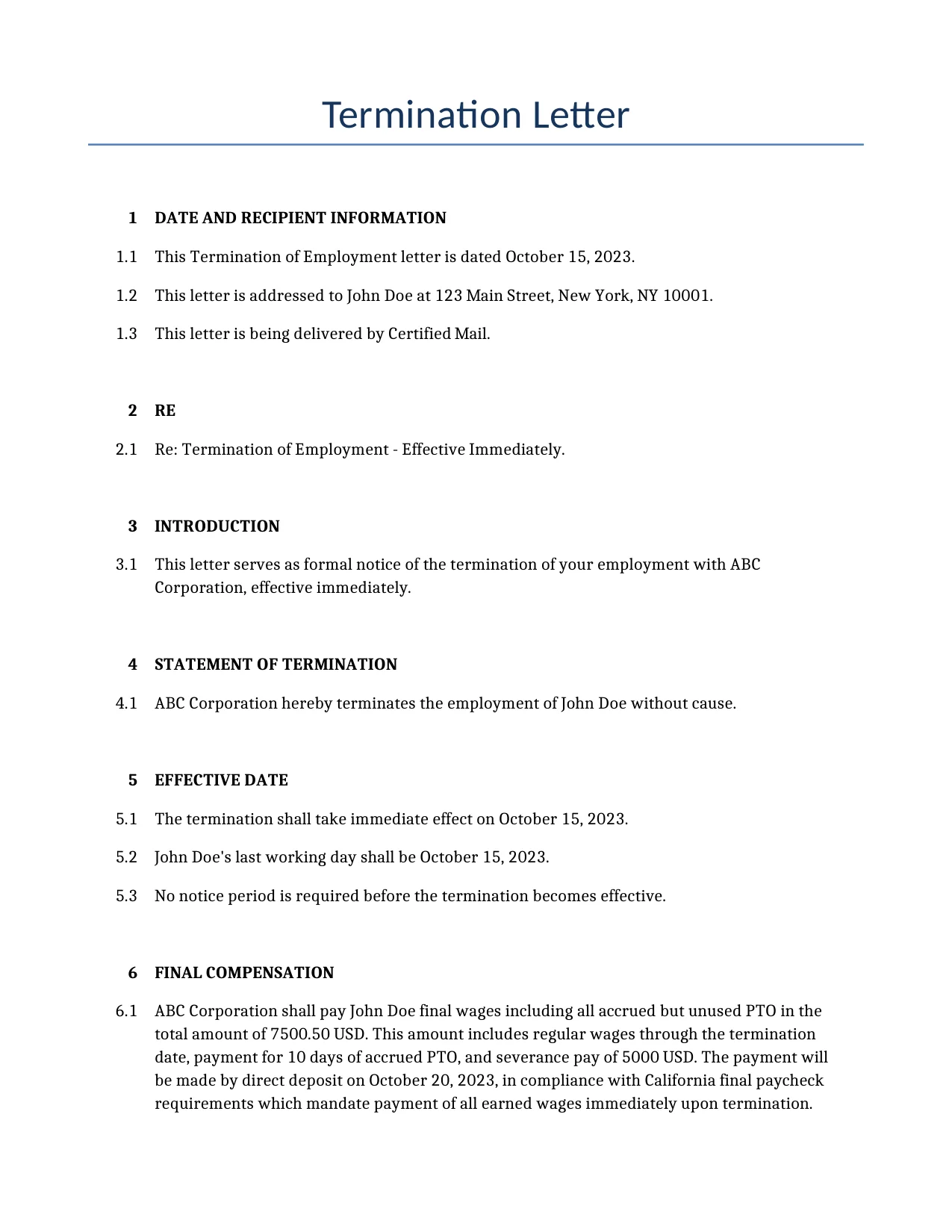
Below is a free template example of a Termination Letter for use in the United States generated by our AI model.
The clauses in your actual Termination Letter will vary from this example as they will be entirely bespoke to your requirements as set out in the questionnaire you complete.
Termination of Employment
1DATE AND RECIPIENT INFORMATION
This Termination of Employment letter is dated October 15, 2023.
This letter is addressed to John Doe at 123 Main Street, New York, NY 10001.
This letter is being delivered by Certified Mail.
2RE
Re: Termination of Employment - Effective Immediately.
3INTRODUCTION
This letter serves as formal notice of the termination of your employment with ABC Corporation, effective immediately.
4STATEMENT OF TERMINATION
ABC Corporation hereby terminates the employment of John Doe without cause.
5EFFECTIVE DATE
The termination shall take immediate effect on October 15, 2023.
John Doe's last working day shall be October 15, 2023.
No notice period is required before the termination becomes effective.
6FINAL COMPENSATION
ABC Corporation shall pay John Doe final wages including all accrued but unused PTO in the total amount of 7500.50 USD. This amount includes regular wages through the termination date, payment for 10 days of accrued PTO, and severance pay of 5000 USD. The payment will be made by direct deposit on October 20, 2023, in compliance with California final paycheck requirements which mandate payment of all earned wages immediately upon termination.
All payments are subject to applicable federal, state, and local tax withholdings as required by law.
7FINAL PAY BREAKDOWN
Regular wages through October 15, 2023: 1500.50 USD.
Accrued PTO payout (10 days): 1000.00 USD.
Severance pay: 5000.00 USD.
Total gross amount: 7500.50 USD (subject to required tax withholdings).
This payment complies with California Labor Code requirements for immediate payment of final wages upon termination.
8RETURN OF COMPANY PROPERTY
You must return all company property in good working condition (normal wear and tear excepted) no later than October 20, 2023. Company property includes but is not limited to: laptop, mobile phone, tablet, access cards, keys, credit cards, documents, files, software, equipment, and any other materials provided during employment.
Property may be returned by mailing with tracking or by dropping off at the designated HR location.
You must delete all personal data from company devices before return. You are required to certify in writing that all confidential information has been returned or destroyed.
Failure to return all company property or reimbursement for any lost or damaged items (beyond normal wear and tear) may result in deduction from any final payments owed to the extent permitted by law.
9CONFIDENTIALITY AND NON-DISCLOSURE
You shall continue to maintain the confidentiality of all proprietary business information, trade secrets, customer data, financial records, and any other non-public information disclosed during employment, in accordance with the existing NDA and confidentiality provisions in your Employment Agreement.
You agree not to use any confidential information for your own benefit or the benefit of any third party. You further agree not to disparage the company, its officers, directors, or employees.
You shall return all physical documents containing confidential information and delete all digital copies.
You shall certify the destruction of any remaining confidential information.
10NON-COMPETE AND NON-SOLICITATION
You acknowledge that the non-compete and non-solicitation covenants contained in the Employment Agreement dated March 15, 2020, between ABC Corporation and you, specifically Section 8: Restrictive Covenants, remain in full force and effect after termination. These covenants are quoted as follows: [Insert specific enforceable language from Employment Agreement here]. These terms are intended to comply with applicable California law, which generally prohibits non-competes except in limited circumstances such as the sale of business.
The severance payment provided herein serves as consideration for these post-termination obligations.
11COBRA AND BENEFITS CONTINUATION
ABC Corporation is subject to the requirements of the Consolidated Omnibus Budget Reconciliation Act (COBRA). Enclosed with this letter is the COBRA notice providing important information about your rights.
The date of the qualifying event is October 15, 2023.
You currently have health insurance coverage through ABC Corporation. The last day of coverage is October 15, 2023.
The qualifying event is involuntary termination of employment not due to gross misconduct.
You have 60 days from the date of this notice to elect COBRA continuation coverage. If elected, you are responsible for paying the full premium plus a 2% administrative fee. Coverage may be continued for up to 18 months.
For information regarding COBRA continuation coverage, please contact ABC Insurance Co. at 123 Main St, Anytown, USA 12345; Phone: (555) 123-4567; Email: admin@abcinsurance.com.
12UNEMPLOYMENT BENEFITS
For information about unemployment insurance benefits, please contact the California Employment Development Department (EDD) directly.
13AT-WILL EMPLOYMENT CONFIRMATION
Your employment with ABC Corporation has been at-will, consistent with your Employment Agreement and applicable law. This termination is consistent with that at-will relationship.
14NON-DISCRIMINATION COMPLIANCE
This termination is not based on any protected characteristic and complies with all federal, state, and local anti-discrimination laws, including but not limited to Title VII, the ADEA, the ADA, and California FEHA.
15NO ADMISSION OF LIABILITY
This letter and any payments provided do not constitute an admission of any liability or wrongdoing by ABC Corporation.
16REFERENCES AND FUTURE INQUIRIES
ABC Corporation's policy is to provide only factual information about former employees' dates of employment, job titles, and last salary upon verified request, without any evaluative comments.
All references shall be restricted to neutral statements only, such as confirming dates of employment and job title without opinions.
ABC Corporation shall respond only to requests for employment dates and title and salary verification.
The single point of contact for all reference and verification inquiries is the Human Resources Director, Jane Smith.
Written authorization from John Doe shall be required before providing any reference or verification information.
17EXIT PROCEDURES
You are required to complete an exit interview and return all company property as outlined above.
ABC Corporation shall issue your final paycheck and COBRA notice as part of the exit procedures.
18WAIVER AND RELEASE
In exchange for the severance payment of 5000 USD and other good and valuable consideration, the receipt and sufficiency of which are hereby acknowledged, you, who are over the age of 40, hereby waive and release all known claims up to the termination date against ABC Corporation, its affiliates, officers, directors, employees, and agents, including but not limited to claims under the Fair Labor Standards Act (FLSA), Title VII of the Civil Rights Act of 1964, Age Discrimination in Employment Act (ADEA), Americans with Disabilities Act (ADA), Family and Medical Leave Act (FMLA), National Labor Relations Act (NLRA), Uniformed Services Employment and Reemployment Rights Act (USERRA), California Fair Employment and Housing Act, and all other federal, state, or local laws, to the fullest extent permitted by law. This waiver does not include claims that may arise after the date this waiver is executed, rights to unemployment benefits, or workers' compensation benefits.
You have been advised to consult with an attorney prior to signing this waiver and release. You have 21 days to consider this agreement. You have seven days to revoke this waiver and release after signing. This waiver and release shall become effective on the eighth day after signing, provided that no revocation has been received.
19GOVERNING LAW
This letter and the termination of employment shall be governed by and construed in accordance with the laws of the State of California, without regard to its conflict of laws principles.
The parties consent to the exclusive jurisdiction of the courts in the State of California for any disputes arising out of or relating to this termination.
20ENTIRE AGREEMENT
This letter, together with the referenced Employment Agreement, constitutes the entire agreement between the parties with respect to the subject matter hereof and supersedes all prior understandings, agreements, or representations, whether written or oral.
21SEVERABILITY
If any provision of this letter is held to be invalid, illegal, or unenforceable by a court of competent jurisdiction, the remaining provisions shall remain in full force and effect, and the invalid provision shall be deemed modified to the minimum extent necessary to make it enforceable.
22NOTICES
All notices required or permitted under this letter shall be in writing and shall be deemed duly given if delivered by hand, sent by certified mail with return receipt requested, or sent by overnight courier to the addresses set forth above or to such other address as either party may designate by written notice.
23VARIATION
No variation of this letter shall be effective unless it is in writing and signed by both parties.
24CLOSING
If you have any questions regarding this termination, please contact Jane Smith at jane.smith@company.com.
25SIGNATURE SECTION
Sincerely,
ABC Corporation
By: _______________________________
Name: Jane Smith
Title: Human Resources Director
Date: _______________________________
I, John Doe, acknowledge receipt of this letter and understand its contents. I further acknowledge and agree to the waiver and release set forth in Section 18 above.
Signature: _______________________________
Name: John Doe
Date: _______________________________
26TEMPLATE NOTE
This is a template document. It should be reviewed and customized by legal counsel for compliance with specific jurisdictional requirements before use.
This example shows approximately 70% of a typical document and is provided for illustrative purposes only. The remaining content has been omitted.
Every document generated by Docaro is tailored to your specific circumstances, jurisdiction and the information you provide. The completed document includes all applicable clauses and provisions required for your situation.
To generate the full, personalised document, answer a short series of questions and your document will be created instantly.