
AI Generated Standard Operating Procedure for use in the United States
PDF & Word - 2026 Updated
Docaro Pricing
When Do You Need a Standard Operating Procedure in the United States?
American Legal Rules for a Standard Operating Procedure
Using an improper structure for a standard operating procedure can lead to compliance failures or operational inefficiencies.
What a Proper Standard Operating Procedure Should Include
- PurposeClearly state the goal of the procedure and why it is needed.
- ScopeDefine what the procedure covers, including any limits or exclusions.
- ResponsibilitiesList who is responsible for each step and their roles.
- Step-by-Step InstructionsProvide detailed, sequential actions to follow the procedure.
- Resources and MaterialsIdentify any tools, equipment, or documents required.
- Safety PrecautionsHighlight potential risks and how to avoid them.
- ReferencesInclude related policies, standards, or external guidelines.
- Review and UpdatesSpecify how often the procedure will be checked and revised.
Generate Your Document in 4 Easy Steps
Why Use Docaro?
 United States
Free Example Standard Operating Procedure Template
Below is a free template example of a Standard Operating Procedure for use in the United States generated by our AI model.
The clauses in your actual Standard Operating Procedure will vary from this example as they will be entirely bespoke to your requirements as set out in the questionnaire you complete.
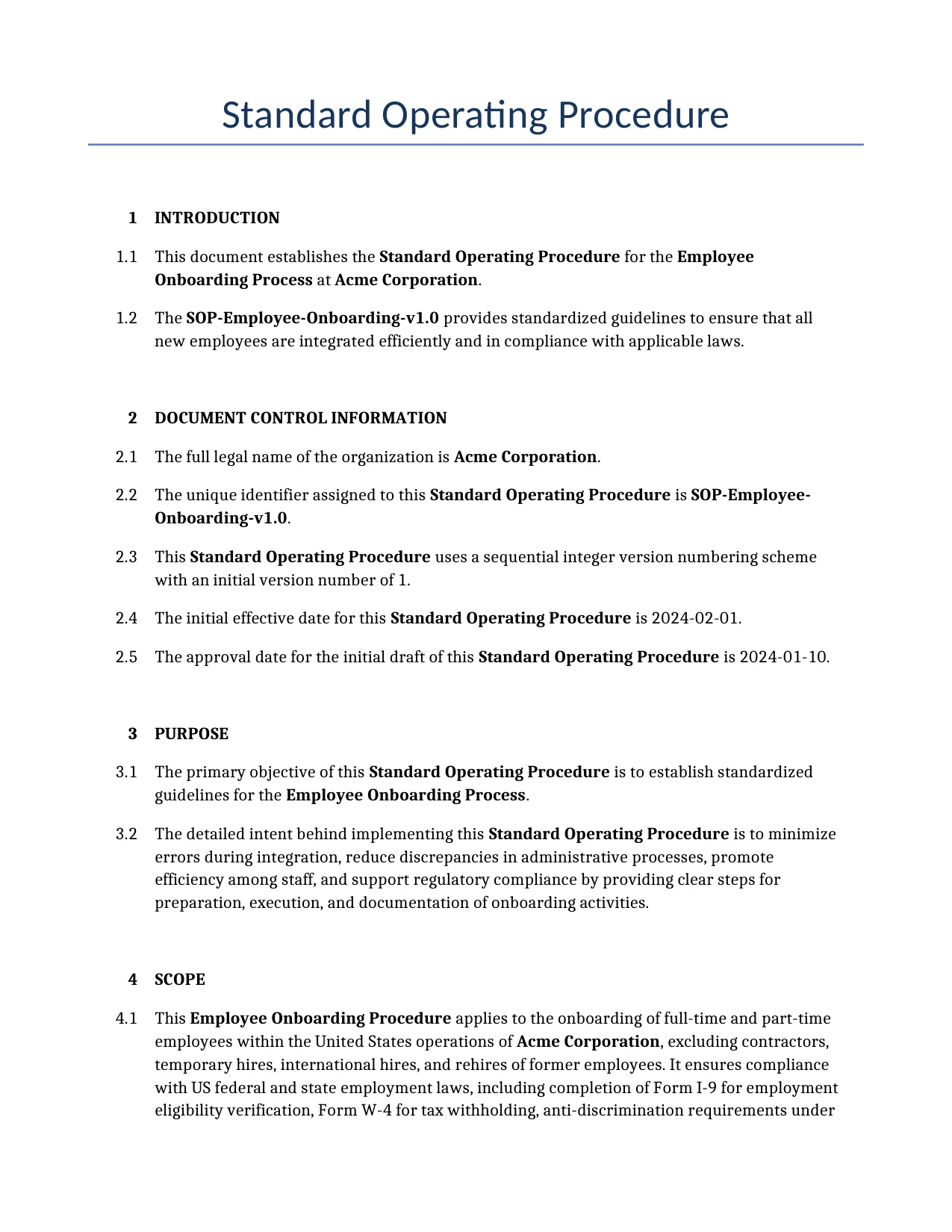
Standard Operating Procedure for Employee Onboarding at Acme Corporation
1INTRODUCTION
This document establishes the Standard Operating Procedure for the Employee Onboarding Process at Acme Corporation.
The SOP-Employee-Onboarding-v1.0 provides standardized guidelines to ensure that all new employees are integrated efficiently and in compliance with applicable laws.
2DOCUMENT CONTROL INFORMATION
The full legal name of the organization is Acme Corporation.
The unique identifier assigned to this Standard Operating Procedure is SOP-Employee-Onboarding-v1.0.
This Standard Operating Procedure uses a sequential integer version numbering scheme with an initial version number of 1.
The initial effective date for this Standard Operating Procedure is 2024-02-01.
The approval date for the initial draft of this Standard Operating Procedure is 2024-01-10.
3PURPOSE
The primary objective of this Standard Operating Procedure is to establish standardized guidelines for the Employee Onboarding Process.
The detailed intent behind implementing this Standard Operating Procedure is to minimize errors during integration, reduce discrepancies in administrative processes, promote efficiency among staff, and support regulatory compliance by providing clear steps for preparation, execution, and documentation of onboarding activities.
4SCOPE
This Employee Onboarding Procedure applies to the onboarding of full-time and part-time employees within the United States operations of Acme Corporation, excluding contractors, temporary hires, international hires, and rehires of former employees. It ensures compliance with US federal and state employment laws, including completion of Form I-9 for employment eligibility verification, Form W-4 for tax withholding, anti-discrimination requirements under EEOC guidelines, and timely benefits enrollment per the Affordable Care Act.
The procedure outlines the steps for integrating new employees into the company's systems, culture, and teams, ensuring compliance with federal and state employment laws including FLSA, FMLA, EEOC, OSHA, and immigration requirements.
This procedure does not cover international hires or rehiring of former employees.
This procedure is limited to initial onboarding and does not address performance evaluations post-probation.
The procedure applies to the departments of Human Resources, IT, and all hiring managers.
5REFERENCES
This Standard Operating Procedure references the Employee Handbook, Code of Conduct, IT Security Policy, and all applicable federal and state employment laws including the Immigration Reform and Control Act, Fair Labor Standards Act, Family and Medical Leave Act, and Equal Employment Opportunity Commission regulations.
6DEFINITIONS AND ACRONYMS
Compliance Audit means a systematic review to ensure adherence to internal policies and external regulations.
The following acronyms are defined as follows: CEO means Chief Executive Officer, HR means Human Resources, SOP means Standard Operating Procedure, OSHA means Occupational Safety and Health Administration, EEOC means Equal Employment Opportunity Commission, FLSA means Fair Labor Standards Act, FMLA means Family and Medical Leave Act, I-9 means Employment Eligibility Verification Form, and W-4 means Employee's Withholding Certificate.
7RESPONSIBILITIES
The Human Resources Department shall coordinate the onboarding schedule, prepare welcome packets including all required forms (I-9, W-4, benefits enrollment), conduct initial orientation sessions, verify compliance with employment laws, and maintain personnel records for the Employee Onboarding Procedure.
The Hiring Managers shall assign mentors to new hires, provide department-specific training, introduce the new employee to the team, and monitor the first 90 days of performance for the Employee Onboarding Procedure.
The IT Department shall set up employee accounts, provide hardware (laptop, access badge), software access, email, and ensure cybersecurity and data privacy training is completed for the Employee Onboarding Procedure.
The parties involved in executing the Employee Onboarding Procedure may delegate responsibilities to subordinates as appropriate. All roles must ensure timely completion of paperwork and training to comply with US federal and state laws.
8PROCEDURE TIMELINE
Pre-Arrival Preparations (Upon Offer Acceptance): HR conducts background checks (where permitted by state law), prepares new hire packet with I-9, W-4, and benefits forms, coordinates with IT for account setup, and sends welcome email with Day 1 agenda. This ensures compliance with immigration verification requirements under the Immigration Reform and Control Act.
Day 1 Activities: Welcome meeting with HR and manager, completion of all required paperwork (I-9 with identity and employment authorization verification, W-4, state-specific notices like wage theft prevention), benefits enrollment overview per ACA and COBRA requirements, IT provisioning (laptop, email, system access), office tour, and emergency procedures orientation. All forms must be completed within the first day where possible to meet legal deadlines.
First Week Activities: Comprehensive new hire orientation on company policies, code of conduct, anti-harassment training (per state laws such as California's AB 1825 where applicable), data security, FLSA and FMLA overviews, OSHA-compliant office safety training, department introductions, and role-specific training. EEOC anti-discrimination policies must be covered. Schedule 30/60/90 day check-ins per US best practices.
30-Day Check-In: Manager and HR review initial performance, confirm completion of all training and forms, address any issues, and gather new hire feedback via survey.
90-Day Probation Review: Formal performance evaluation, compliance verification that all legal requirements (I-9, tax forms, training) are met, and decision on continued employment. This timeline aligns with US best practices for effective onboarding and legal compliance.
9MATERIALS AND EQUIPMENT
The procedure requires new hire packets including welcome booklets, federal and state tax forms (W-4, state equivalents), Form I-9, benefits enrollment guides, and company policy acknowledgments.
Equipment required includes company-provided laptops or computers, access badges, ergonomic keyboards/mice (as needed), and headsets for remote workers.
The procedure requires the use of HR Information System (HRIS) software for tracking, email and collaboration tools, and digital signature platforms for electronic forms.
Materials should be prepared in advance for each new hire with no fixed quantity as it is per-employee.
10SAFETY PRECAUTIONS
The HR Safety Coordinator is responsible for overseeing office safety orientation as part of the onboarding process to ensure compliance with OSHA standards for general industry.
New employees shall receive training on ergonomic workstation setup, including proper chair adjustment, monitor placement, keyboard positioning, and lighting to prevent repetitive strain injuries.
General office safety orientation shall cover hazard identification in administrative environments, slip/trip/fall prevention, and proper lifting techniques.
During new hire training, all employees must be informed of emergency procedures including fire evacuation routes, assembly points, and how to report incidents. No headcount by a specific officer is required; department managers shall account for their teams.
An evacuation alarm will sound, and employees shall proceed to the nearest marked exit and assemble at the designated outdoor meeting point.
Safety training for new hires shall be completed on Day 1 or within the first week, with references to OSHA compliance for office-based employees. No manufacturing-specific PPE (such as eye/face/head/hand protection), chemical hazards, production floor, or warehouse references apply.
The Safety Precautions shall specifically address general office ergonomic, physical, and environmental hazards. All new employees shall report safety incidents immediately to their manager or HR.
First aid kits are located in the main office break room and other designated areas. No quarterly mandatory training applies; onboarding safety is one-time with refresher as needed.
11PROCEDURE STEPS
This procedure outlines the sequential steps for Employee Onboarding at Acme Corporation to ensure efficient integration and full compliance with US federal and state employment laws.
Pre-Onboarding (After Offer Acceptance): HR confirms acceptance, initiates background checks (compliant with FCRA and state laws), prepares personalized new hire packet with I-9, W-4, benefits, and policy forms. IT prepares accounts and equipment. Manager prepares workspace and schedule. This must be completed prior to start date.
Day 1: Welcome and Paperwork. Greet new hire, provide orientation overview, complete Form I-9 (with original documents verified in person within 3 business days per immigration law), W-4, state tax forms, benefits enrollment (including ACA notices and COBRA rights), and direct deposit setup. Conduct IT setup: issue laptop, badge, email, and system logins. Review emergency procedures and office safety (ergonomics, exits).
Orientation and Training (Days 1-5): Deliver sessions on company history, culture, code of conduct, anti-discrimination/EEOC policies, anti-harassment training (meeting state requirements), data privacy/security, FLSA wage rules, FMLA leave rights, and OSHA safety standards. Introduce to team and department. Complete all compliance training via HRIS.
Week 1 Follow-Up: Assign mentor, begin role-specific training, set performance goals, and confirm all forms are submitted and accurate. HR verifies I-9 compliance and enters data securely.
30/60/90 Day Check-Ins: Manager conducts structured meetings to review progress, gather feedback via survey, verify training completion, and address any compliance gaps. At 90 days, perform formal review and confirm all legal onboarding requirements are fulfilled. HR audits all documentation for completeness.
12QUALITY CONTROLS
Quality controls ensure that all onboarding procedures are followed accurately, with regular audits to maintain consistency, adherence to company standards, and legal requirements under US employment laws.
HR shall perform audits of completed forms and training records within 5 business days of hire.
Verification methods include review of signed documents, confirmation of I-9 and tax form accuracy, HRIS tracking of training completion, and new hire feedback surveys at 30 and 90 days.
The HR Director is responsible for overseeing quality controls for onboarding and may be contacted via the HR department email.
In response to identified non-compliance (e.g., missing forms or incomplete training), the company shall take immediate corrective action such as follow-up with the new hire, document the issue, and escalate to senior management if it involves legal risks like I-9 violations. Annual review of the SOP ensures ongoing compliance.
13RECORD KEEPING
The record keeping policy in this Standard Operating Procedure is named the Corporate Record Management and Privacy Policy.
An electronic logging system (HRIS) shall be implemented for all onboarding records, with physical copies stored in secure, locked filing systems.
The types of records to be included are signed I-9 forms, W-4 and tax documents, benefits enrollment confirmations, training certifications, orientation acknowledgments, and personnel files.
All documentation must be created in a clear, legible format using approved templates, stored securely with access limited to authorized personnel, and updated regularly to ensure accuracy and compliance with federal regulations including HIPAA for any medical/benefit information.
Retention periods: I-9 forms must be kept for 3 years from date of hire or 1 year after termination (whichever is later) per federal law; other personnel records for at least 7 years or as required by state law. The HR Director shall oversee proper maintenance.
Records shall be disposed of after the retention period using a Certified Destruction Service compliant with privacy regulations (e.g., shredding or secure digital deletion).
The HR Director and department heads shall be responsible for ensuring all records are properly logged, confidential, and retained per legal standards.
14TROUBLESHOOTING
A common issue is incomplete paperwork (e.g., missing I-9 documentation), which can delay legal compliance. Occurs occasionally. Corrective action: HR follows up immediately with new hire to obtain valid documents, provides guidance on acceptable forms, documents the resolution in HRIS, and retrains staff on requirements if systemic. Estimated time: 1 business day.
Delays in background checks may postpone start date. Mitigation: Initiate checks earlier in pre-onboarding, communicate transparently with candidate per FCRA, and adjust timeline. Document all communications.
System access problems (e.g., IT account not provisioned) can hinder productivity. Corrective: IT helpdesk creates emergency access, investigates root cause (e.g., communication gap), implements within 2 hours, and updates provisioning checklist to prevent recurrence.
Benefits enrollment errors (e.g., incorrect deductions) are typically low severity but should be fixed promptly. Steps: HR reviews enrollment data, contacts benefits provider, corrects in system, and notifies employee. Occurs rarely with proper Day 1 review.
I-9 verification failures (e.g., invalid documents) require immediate attention to avoid fines. HR re-verifies with employee, obtains correct documentation within the 3-day window, consults legal if needed, and logs the incident for compliance audit.
15TRAINING REQUIREMENTS
The specific topics to be included in onboarding training are: company policies and culture, code of conduct, anti-harassment and anti-discrimination training (per EEOC and state laws such as AB 1825 in California if applicable), data privacy and cybersecurity, FLSA/FMLA/OSHA compliance overview, role-specific skills, and ergonomic/office safety orientation.
Formal certification shall be required for certain trainings (e.g., harassment prevention where mandated by state law) after completion via acknowledgment forms or quizzes in the HRIS.
All core onboarding training must be completed within the first week of employment, with role-specific training ongoing through the first 30 days. Refresher training follows company policy (e.g., annual for compliance topics).
The methods to be used include in-person or virtual new hire orientation sessions, online interactive modules in the HRIS/LMS, manager-led department training, and written materials in the welcome packet.
A formal tracking mechanism shall be implemented via the HRIS for all training completion, certifications, and acknowledgments. The HR Department shall audit records to ensure 100% compliance before the 30-day check-in.
16COMPLIANCE WITH EQUAL EMPLOYMENT OPPORTUNITY
Acme Corporation is committed to equal employment opportunity and prohibits discrimination or harassment based on race, color, religion, sex, sexual orientation, gender identity, national origin, age, disability, or genetic information as required by EEOC regulations and Title VII of the Civil Rights Act.
All onboarding activities, including recruitment, hiring, training, and orientation, must adhere to these principles. New hires receive mandatory training on EEO policies, reporting procedures for violations, and the company's non-retaliation stance. HR monitors for compliance and maintains records of all related communications and trainings.
17REVISION HISTORY
Revisions to this Standard Operating Procedure shall be approved by the HR Director.
The Revision History shall use Version Numbering as the tracking method for documenting changes.
The initial approval date for the SOP's first version in the Revision History is 2024-01-10.
The description for the initial version in the Revision History section is Initial draft of the SOP for Employee Onboarding at Acme Corporation, revised to focus exclusively on US-compliant HR processes, legal requirements, and removal of all manufacturing-related content.
The approver in each Revision History entry is HR Director.
18APPENDICES
The first appendix is named Employee Onboarding Checklist and is a Form.
This appendix includes a printable and digital checklist for new hires and responsible parties, covering steps like document submission (I-9, W-4), IT setup, orientation sessions, training completion, and 30/90-day reviews.
The confidentiality level that shall apply to this appendix is Internal Use Only.
19GOVERNING LAW
This Standard Operating Procedure shall be governed by and construed in accordance with US federal and state laws applicable to employee onboarding, including but not limited to the Immigration Reform and Control Act of 1986 (for Form I-9 and employment eligibility), the Affordable Care Act (for benefits notifications), COBRA continuation coverage requirements, Fair Labor Standards Act (FLSA), Family and Medical Leave Act (FMLA), Occupational Safety and Health Act (OSHA), Equal Employment Opportunity laws (Title VII, ADA, ADEA, GINA), workers' compensation statutes, state-specific requirements such as paid sick leave, wage theft prevention notices, and anti-discrimination mandates. Compliance must be maintained with the most current regulations at all times.
All parties acknowledge that this document has been prepared to comply with the most up-to-date requirements of the aforementioned legislation as of the effective date. This SOP shall be reviewed annually for legal updates by the HR Director, with revisions implemented as necessary to reflect changes in federal, state, or local employment law.
20SIGNATURES
The undersigned parties agree to the terms and conditions set forth in this Standard Operating Procedure.
Approver Name: _______________________________ Date: _______________
Title: ________________________________________
Signature: ____________________________________
This example shows approximately 70% of a typical document and is provided for illustrative purposes only. The remaining content has been omitted.
Every document generated by Docaro is tailored to your specific circumstances, jurisdiction and the information you provide. The completed document includes all applicable clauses and provisions required for your situation.
To generate the full, personalised document, answer a short series of questions and your document will be created instantly.