
AI Generated American Terms of Service
PDF & Word - 2026 Updated
Docaro Pricing
When Do You Need a Terms of Service in the United States?
Key US Legal Rules for Terms of Service
Using the wrong structure for terms of service can fail to adequately protect against liability or enforce key provisions.
What a Proper Terms of Service Should Include
- IntroductionA welcoming statement that outlines the purpose of the terms and the agreement between the user and the website.
- User EligibilityRequirements for who can use the site, such as age restrictions and the need for truthful information.
- Acceptable UseRules on how users can interact with the site, prohibiting harmful or illegal activities.
- Intellectual PropertyClarification that the site's content is protected and users have limited rights to use it.
- User ContentGuidelines for content users post, including ownership and the site's right to use or remove it.
- DisclaimersStatements limiting the site's liability and clarifying that no guarantees are made about services.
- Limitation of LiabilityProtections for the site against claims for damages arising from use.
- TerminationConditions under which user accounts or access can be ended by either party.
- Governing LawSpecification of which state's laws apply to any disputes.
- Changes to TermsNotice that the terms can be updated and how users will be informed of changes.
Generate Your Document in 4 Easy Steps
Why Use Docaro?
 United States
Free Example Terms of Service Template
Below is a free template example of a Terms of Service for use in the United States generated by our AI model.
The clauses in your actual Terms of Service will vary from this example as they will be entirely bespoke to your requirements as set out in the questionnaire you complete.
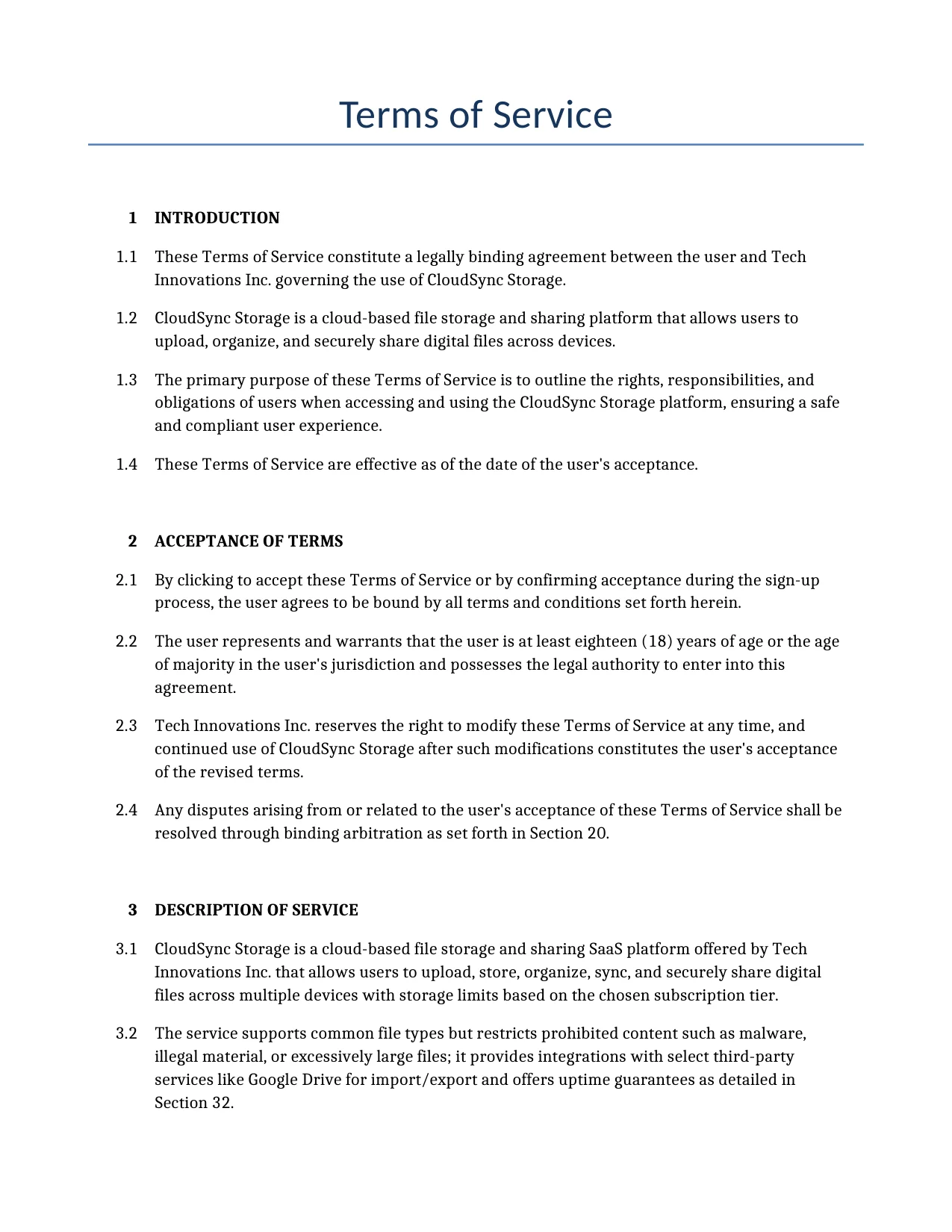
Terms of Service
1INTRODUCTION
These Terms of Service constitute a legally binding agreement between the user and Tech Innovations Inc. governing the use of CloudSync Storage.
CloudSync Storage is a cloud-based file storage and sharing platform that allows users to upload, organize, and securely share digital files across devices.
The primary purpose of these Terms of Service is to outline the rights, responsibilities, and obligations of users when accessing and using the CloudSync Storage platform, ensuring a safe and compliant user experience.
These Terms of Service are effective as of the date of the user's acceptance.
2ACCEPTANCE OF TERMS
By clicking to accept these Terms of Service or by confirming acceptance during the sign-up process, the user agrees to be bound by all terms and conditions set forth herein.
The user represents and warrants that the user is at least eighteen (18) years of age or the age of majority in the user's jurisdiction and possesses the legal authority to enter into this agreement.
Tech Innovations Inc. reserves the right to modify these Terms of Service at any time, and continued use of CloudSync Storage after such modifications constitutes the user's acceptance of the revised terms.
Any disputes arising from or related to the user's acceptance of these Terms of Service shall be resolved through binding arbitration as set forth in Section 20.
3DESCRIPTION OF SERVICE
CloudSync Storage is a cloud-based file storage and sharing SaaS platform offered by Tech Innovations Inc. that allows users to upload, store, organize, sync, and securely share digital files across multiple devices with storage limits based on the chosen subscription tier.
The service supports common file types but restricts prohibited content such as malware, illegal material, or excessively large files; it provides integrations with select third-party services like Google Drive for import/export and offers uptime guarantees as detailed in Section 32.
Subscription tiers include free, basic, and premium plans billed in USD with clear cancellation options; users may export data via the API or web interface as described in Section 33.
4USER ACCOUNTS
To access CloudSync Storage, the user must create an account by providing accurate and complete registration information and verifying the user's email address.
The user must create and maintain a strong password that meets industry-standard strength requirements to protect the user's account.
Multiple users are not permitted to share a single account, and each individual user must maintain a unique account.
Tech Innovations Inc. reserves the right to delete any inactive user account after twelve (12) months of inactivity.
5USER RESPONSIBILITIES
The user is responsible for maintaining the confidentiality of the user's account credentials and for all activities that occur under the user's account.
The user must comply with all applicable United States federal, state, and local laws when using CloudSync Storage.
With respect to any content the user uploads or shares, the user warrants that the user owns or has all necessary rights to such content.
6PROHIBITED CONDUCT
The user shall not upload, store, or share any content that violates applicable laws, infringes intellectual property rights, contains malware, or constitutes hate speech, harassment, or illegal activities.
The user shall not attempt to gain unauthorized access to the service, interfere with its operation, engage in spamming, or use the service for fraudulent purposes.
Tech Innovations Inc. reserves the right to suspend or terminate accounts for violations of these rules without prior notice in cases of severe breach.
7INTELLECTUAL PROPERTY RIGHTS
The user retains ownership of any intellectual property rights in user-generated content, and the user grants Tech Innovations Inc. a non-exclusive, perpetual, worldwide license to use, reproduce, modify, distribute, and sublicense such content solely as necessary to provide and improve the CloudSync Storage service.
The user represents and warrants that the user owns or has all necessary rights to the content the user submits to CloudSync Storage.
Tech Innovations Inc. owns all intellectual property rights in its pre-existing materials, including the CloudSync Storage platform, trademarks, and related technology.
The user is prohibited from using Tech Innovations Inc.'s trademarks without express prior written permission.
The user agrees to indemnify Tech Innovations Inc. against any claims arising from the user's content that infringe on third-party intellectual property rights.
8USER CONTENT
User Content means any text, images, videos, audio, software, or other materials that users upload, post, submit, or otherwise provide to the website or services.
The user retains ownership of the user's User Content.
The user grants Tech Innovations Inc. a non-exclusive, worldwide, royalty-free, perpetual license to reproduce and distribute, modify and adapt, and publicly display and perform the user's User Content solely to operate, improve, and provide the CloudSync Storage service.
The license granted by the user to Tech Innovations Inc. survives termination but is limited to the purposes stated herein.
The user represents and warrants that the user owns or has the necessary rights to submit User Content, that it does not infringe on any third-party rights, and that it complies with all applicable laws.
The user agrees to indemnify Tech Innovations Inc. for any claims arising from the user's User Content.
Tech Innovations Inc. reserves the right to review, remove, or block User Content at its sole discretion if it violates these Terms.
9THIRD-PARTY CONTENT AND SERVICES
CloudSync Storage integrates with third-party services and provides links to third-party websites.
Third-party services integrated into CloudSync Storage are granted read access to user data and write access to user data as necessary for the integration to function.
Tech Innovations Inc. disclaims any responsibility for third-party content and services, and the user accesses such content and services at the user's own risk.
Tech Innovations Inc. shall have no liability for any third-party content or services, including but not limited to any damages or losses arising from the user's use thereof.
The user agrees to comply with any applicable third-party terms of service when accessing linked or integrated third-party services.
10PAYMENTS AND BILLING
Access to CloudSync Storage is provided on a subscription basis with tiers billed monthly or annually in U.S. Dollars; users may choose from free limited storage, basic, or premium plans with specified storage limits per tier.
Subscriptions automatically renew unless canceled at least 24 hours before the end of the current period via the account settings or by contacting support; clear cancellation instructions are provided in the billing portal.
Payments are processed securely through Stripe using credit card, debit card, or other approved methods; all charges include applicable sales taxes based on the user's location.
Refunds are available only as specified in our refund policy; users may dispute charges within sixty (60) days, and Tech Innovations Inc. will investigate in good faith.
11PRIVACY POLICY
The user's privacy is important to Tech Innovations Inc., and the collection, use, and protection of the user's personal data is governed by the Privacy Policy located at https://www.cloudsync.com/privacy-policy, which is incorporated herein by reference.
Tech Innovations Inc. collects personal data including contact information, usage data, and payment information as detailed in the Privacy Policy and this Section 32.
Such data is used for service provision, analytics and improvement, legal compliance, and other purposes outlined in the Privacy Policy.
Users have rights under the California Consumer Privacy Act (CCPA/CPRA) to access, delete, or opt-out of the sale of their personal information; details are provided in the Privacy Policy and Section 32.
12CONFIDENTIALITY
Confidential Information includes any non-public information disclosed by one party to the other, such as trade secrets, business plans, customer lists, and technical data, whether oral, written, or electronic.
Publicly available information and information that the receiving party independently develops shall be excluded from the definition of Confidential Information.
Permitted disclosures of Confidential Information may be made to legal authorities, to affiliates and employees, or for audits or due diligence without breaching this agreement.
The receiving party must keep the Confidential Information strictly confidential, use it only for the purposes of this agreement, limit access to those who need to know, and not disclose it to any third parties without prior written consent.
The receiving party shall implement reasonable security measures to protect Confidential Information.
Upon discovering a breach of confidentiality, the receiving party shall notify the disclosing party within three (3) days.
Upon termination of this agreement, the receiving party shall return or destroy all Confidential Information.
In the event of a breach of confidentiality, the disclosing party shall be entitled to seek injunctive relief and monetary damages.
13REPRESENTATIONS AND WARRANTIES
The user represents that the user is at least eighteen (18) years old.
The user warrants that the user has the legal authority to enter into these Terms of Service.
The user represents that the user will comply with all applicable United States federal, state, and local laws when using CloudSync Storage.
The user assures that the user's use of CloudSync Storage will not infringe any third-party intellectual property rights.
Tech Innovations Inc. represents that it has the authority to enter into these Terms of Service.
Tech Innovations Inc. warrants that it complies with all applicable laws in providing CloudSync Storage.
Except as expressly provided, Tech Innovations Inc. makes no additional warranties regarding data integrity, uninterrupted service, or fitness for purpose; all other warranties are disclaimed as set forth in Section 14.
14DISCLAIMERS
CloudSync Storage is provided on an "as is" basis without any warranties of any kind.
Tech Innovations Inc. disclaims the implied warranty of merchantability.
Tech Innovations Inc. disclaims the implied warranty of fitness for a particular purpose.
Tech Innovations Inc. disclaims any warranty regarding non-infringement of third-party rights.
Tech Innovations Inc. further disclaims any warranty that user data will be free from loss, corruption, or unauthorized access, and users are responsible for maintaining their own backups.
15LIMITATION OF LIABILITY
The total liability of Tech Innovations Inc. for any damages arising from the use of CloudSync Storage shall not exceed the fees paid by the user in the twelve (12) months preceding the claim.
Tech Innovations Inc. shall not be liable for any consequential, incidental, or indirect damages.
Tech Innovations Inc. shall not be liable for any punitive or exemplary damages.
The limitations of liability set forth herein shall not apply in cases of Tech Innovations Inc.'s gross negligence or willful misconduct.
These limitations apply to data loss, service interruptions, or any claims related to cloud storage integrity or availability.
16INDEMNIFICATION
The user agrees to indemnify Tech Innovations Inc. against any claims arising from the user's use of CloudSync Storage, violation of these Terms of Service, or intellectual property infringement.
This indemnification obligation applies to claims brought by third parties against Tech Innovations Inc. due to the user's actions.
The user shall indemnify Tech Innovations Inc. for legal fees and costs, settlements and judgments, and direct damages.
Tech Innovations Inc. shall have the right to control the defense and settlement of any indemnified claims at the user's expense.
The indemnification obligations apply to the user and the user's affiliates.
The indemnification obligations shall survive the termination of these Terms of Service.
17TERMINATION
The user may terminate this agreement at any time by canceling the subscription and providing thirty (30) days' prior written notice to Tech Innovations Inc.
Tech Innovations Inc. reserves the right to terminate this agreement immediately for breach of these Terms of Service, non-payment, or illegal activity.
In the event of a breach, the user shall have a cure period of thirty (30) days to remedy the breach before termination may occur.
Upon termination, the user shall have no further access to the services or data, but may export data as provided in Section 33 prior to termination.
The user may request retrieval of the user's data within sixty (60) days after termination.
Provisions relating to confidentiality, payments, intellectual property, indemnification, limitation of liability, and dispute resolution shall survive termination of these Terms of Service.
Termination notices shall be delivered to the user by email or in-app notification.
18SUSPENSION OR REMOVAL OF CONTENT
Tech Innovations Inc. reserves the right to suspend the user's account, remove user-generated content, or permanently terminate the user's account for violations of these Terms of Service.
Violations include posting illegal content, harassment, spam, intellectual property infringement, or any activity that disrupts the platform's operation.
Tech Innovations Inc. shall provide prior notice to the user when feasible before suspending an account, removing content, or terminating an account.
Tech Innovations Inc. shall exercise reasonable discretion in enforcing its policies regarding suspension or removal.
Third parties may report content for potential removal or suspension, and Tech Innovations Inc. shall investigate such reports.
The user may appeal any suspension, content removal, or termination through the process provided by Tech Innovations Inc.
19GOVERNING LAW
These Terms of Service shall be governed by and construed in accordance with the laws of the State of California and applicable federal laws of the United States, without regard to its conflict of laws principles. Any disputes shall be subject to the exclusive jurisdiction of the courts located in San Francisco County, California.
20DISPUTE RESOLUTION
PLEASE READ THIS SECTION CAREFULLY AS IT AFFECTS YOUR LEGAL RIGHTS. IT REQUIRES BINDING ARBITRATION AND INCLUDES A CLASS ACTION WAIVER.
Any disputes arising out of or relating to these Terms of Service shall be resolved through binding arbitration administered by the American Arbitration Association (AAA) under its Commercial Arbitration Rules, in accordance with the Federal Arbitration Act.
The arbitration shall take place in San Francisco, California, and shall be conducted in English. The arbitrator's decision shall be final and binding.
You waive any right to participate in a class action lawsuit or class-wide arbitration against Tech Innovations Inc.
This Dispute Resolution section is governed by California law consistent with Section 19.
21FORCE MAJEURE
Neither party shall be liable for any delay or failure to perform its obligations under these Terms of Service if such delay or failure is caused by natural disasters, acts of God, pandemics or epidemics, or cyber attacks.
Economic or financial events, such as market fluctuations, shall not constitute a force majeure event.
The affected party shall provide prompt notice to the other party upon the occurrence of a force majeure event.
The affected party shall undertake reasonable efforts to mitigate the effects of the force majeure event.
If a force majeure event persists for more than sixty (60) days, either party may terminate these Terms of Service upon written notice to the other party.
This Force Majeure section is governed by California law consistent with Section 19.
22ASSIGNMENT
The user may not assign any rights or obligations under these Terms of Service without the prior written consent of Tech Innovations Inc.
Tech Innovations Inc. may assign its rights and obligations under these Terms of Service to any successor or affiliate without the user's consent.
These Terms of Service shall be binding upon and inure to the benefit of the parties' respective successors and permitted assigns.
23SEVERABILITY
If any provision of these Terms of Service is held to be invalid or unenforceable, the remaining provisions shall remain in full force and effect.
This severability clause shall apply to all provisions of these Terms of Service equally.
24WAIVER OF RIGHTS
The failure of Tech Innovations Inc. to enforce any provision of these Terms of Service shall not constitute a waiver of that provision or any other provision.
Any waiver must be in writing and signed by an authorized representative of Tech Innovations Inc. to be effective.
This waiver provision shall apply generally to all provisions of these Terms of Service.
25ENTIRE AGREEMENT
These Terms of Service constitute the entire agreement between the user and Tech Innovations Inc. with respect to the subject matter hereof and supersede all prior understandings, agreements, and representations, whether written or oral.
26AMENDMENTS
Tech Innovations Inc. may amend these Terms of Service by posting the updated Terms of Service and notifying users via email or in-app notice.
Material changes to these Terms of Service shall require enhanced notice to users.
Amendments shall become effective after a specified notice period of at least thirty (30) days.
The user may object to any amendment and terminate the user's use of CloudSync Storage if the user does not agree to the amended terms.
27NOTICES
All notices under these Terms of Service shall be delivered by email or certified mail.
Notices to Tech Innovations Inc. shall be sent to legalnotices@techinnovations.com or to 123 Innovation Drive, San Francisco, CA 94105.
Notices shall be deemed received upon transmission for email or three (3) days after mailing.
28EXPORT CONTROLS
The user shall not use CloudSync Storage in any country embargoed or sanctioned by the United States, including but not limited to Cuba, Iran, North Korea, Syria, or the Crimea region of Ukraine.
The user shall comply with screening against United States denied parties lists, such as the Denied Persons List, Entity List, or Specially Designated Nationals List.
The user's location shall be verified through IP address geolocation and self-certification by the user to ensure compliance with export restrictions.
The user represents that the user will comply with all applicable United States export laws and will not engage in any prohibited activities.
29DMCA COMPLIANCE
Tech Innovations Inc. designates John Doe as its DMCA agent, whose contact information is as follows: address at 123 Innovation Drive, San Francisco, CA 94105, email at dmca@techinnovations.com, and phone number at (555) 123-4567.
Users may file counter notices under the Digital Millennium Copyright Act by following the detailed counter notice procedure provided by Tech Innovations Inc.
Tech Innovations Inc. maintains a policy of terminating accounts of repeat copyright infringers.
Tech Innovations Inc. shall respond to valid DMCA takedown notices within forty-eight (48) hours in compliance with the DMCA.
30MISCELLANEOUS PROVISIONS
The headings in these Terms of Service are for descriptive purposes only and shall not affect the interpretation of any provision.
These Terms of Service may be executed in counterparts, each of which shall be deemed an original, and all of which together shall constitute one and the same instrument.
Electronic signatures shall be permitted and shall have the same legal effect as original signatures.
All remedies under these Terms of Service are cumulative and not exclusive of any remedies provided by law.
By using CloudSync Storage, you consent to receiving electronic communications from Tech Innovations Inc. regarding your account, service updates, and legal notices.
If you access CloudSync Storage via a mobile app, you agree to additional terms specific to mobile use, including compliance with app store rules and data usage on mobile networks.
Any feedback, suggestions, or ideas you provide to Tech Innovations Inc. regarding the service grants us a perpetual, irrevocable, royalty-free license to use, modify, and incorporate them without compensation or attribution to you.
Subscriptions are subject to automatic renewal disclosures per California and other U.S. state laws; cancellation is available via account settings with links provided in renewal notices.
Users are responsible for all applicable taxes arising from use of the service except as explicitly collected by Tech Innovations Inc.
31SERVICE LEVELS AND AVAILABILITY
Tech Innovations Inc. aims to provide 99.9% uptime for CloudSync Storage, excluding scheduled maintenance. If uptime falls below this in a given month, users may be eligible for service credits as calculated in our SLA.
Service credits are the sole remedy for downtime and do not apply in cases of force majeure, user errors, or third-party issues. Details on claiming credits are available in the support portal.
No guarantees are made for absolute availability, and Tech Innovations Inc. shall not be liable for any losses due to service interruptions beyond the specified credits.
32DATA HANDLING, SECURITY, AND PRIVACY
Types of data collected include account information, uploaded files (as User Content), usage statistics, and payment details. We collect this to provide storage services, ensure security, improve features, and comply with legal obligations.
We share data only with service providers under strict agreements, for legal compliance, or with user consent. Under CCPA/CPRA, California residents have rights to know what data is collected, request deletion, opt-out of sales (we do not sell data), and non-discrimination for exercising rights.
In the event of a data breach involving personal information, we will notify affected users and relevant authorities within 30 days or as required by law. We implement industry-standard security including encryption at rest and in transit, access controls, regular audits, and SOC 2 compliance where applicable.
For children's privacy under COPPA, CloudSync Storage is not directed at children under 13. We do not knowingly collect data from children under 13 without verifiable parental consent. If such data is discovered, it will be deleted promptly.
Users may request data deletion or export at any time subject to legal retention requirements. We retain data as needed for service provision, legal compliance, and legitimate business purposes after account termination.
International users: By using the service, you consent to data transfers to and processing in the United States, subject to appropriate safeguards.
33DATA BACKUPS, DISASTER RECOVERY, AND EXPORT
Users are solely responsible for maintaining their own backups of uploaded files. Tech Innovations Inc. performs system-level backups for disaster recovery but makes no guarantee against all data loss and disclaims liability for any loss of user data, corruption, or unavailability.
We scan uploaded files for malware and prohibit certain file types (e.g., executables that may contain viruses). Users must not upload illegal, infringing, or harmful content.
Users may export their data at any time through the web interface or API in standard formats such as ZIP archives. API usage is subject to rate limits and terms in our developer documentation.
Beta or trial features are provided "as is" with no warranties and may be modified or discontinued at any time; users participate at their own risk.
34SIGNATURE
By accepting these Terms of Service, the user agrees to be legally bound by all provisions contained herein.
User Signature: _______________________________ Date: _______________
On behalf of Tech Innovations Inc.: _______________________________ Date: _______________
This example shows approximately 70% of a typical document and is provided for illustrative purposes only. The remaining content has been omitted.
Every document generated by Docaro is tailored to your specific circumstances, jurisdiction and the information you provide. The completed document includes all applicable clauses and provisions required for your situation.
To generate the full, personalised document, answer a short series of questions and your document will be created instantly.