
AI Generated American Arbitration Agreement
PDF & Word - 2026 Updated
Docaro Pricing
When Do You Need an Arbitration Agreement in the United States?
American Legal Rules for an Arbitration Agreement
Using an inappropriate arbitration clause structure may fail to enforce the intended dispute resolution process or render the agreement unenforceable.
What a Proper Arbitration Agreement Should Include
- Clear Agreement to ArbitrateState that both parties agree to settle disputes through arbitration instead of going to court.
- Scope of DisputesDefine which types of disputes, such as contract disagreements or employment issues, will be handled by arbitration.
- Selection of ArbitratorExplain how the neutral arbitrator or panel will be chosen, often through a recognized organization.
- Arbitration Rules and LocationSpecify the rules that will govern the process and the physical location or virtual setting for hearings.
- Costs and FeesOutline who pays the arbitration expenses and any related fees to avoid surprises.
- Enforceability and Governing LawInclude that the agreement is legally binding under U.S. law and how decisions can be enforced in court.
- Waiver of Jury TrialNote that both parties give up the right to a trial by jury for covered disputes.
- SignaturesRequire signatures from all parties to confirm they understand and agree to the terms.
Generate Your Document in 4 Easy Steps
Why Use Docaro?
 United States
Free Example Arbitration Agreement Template
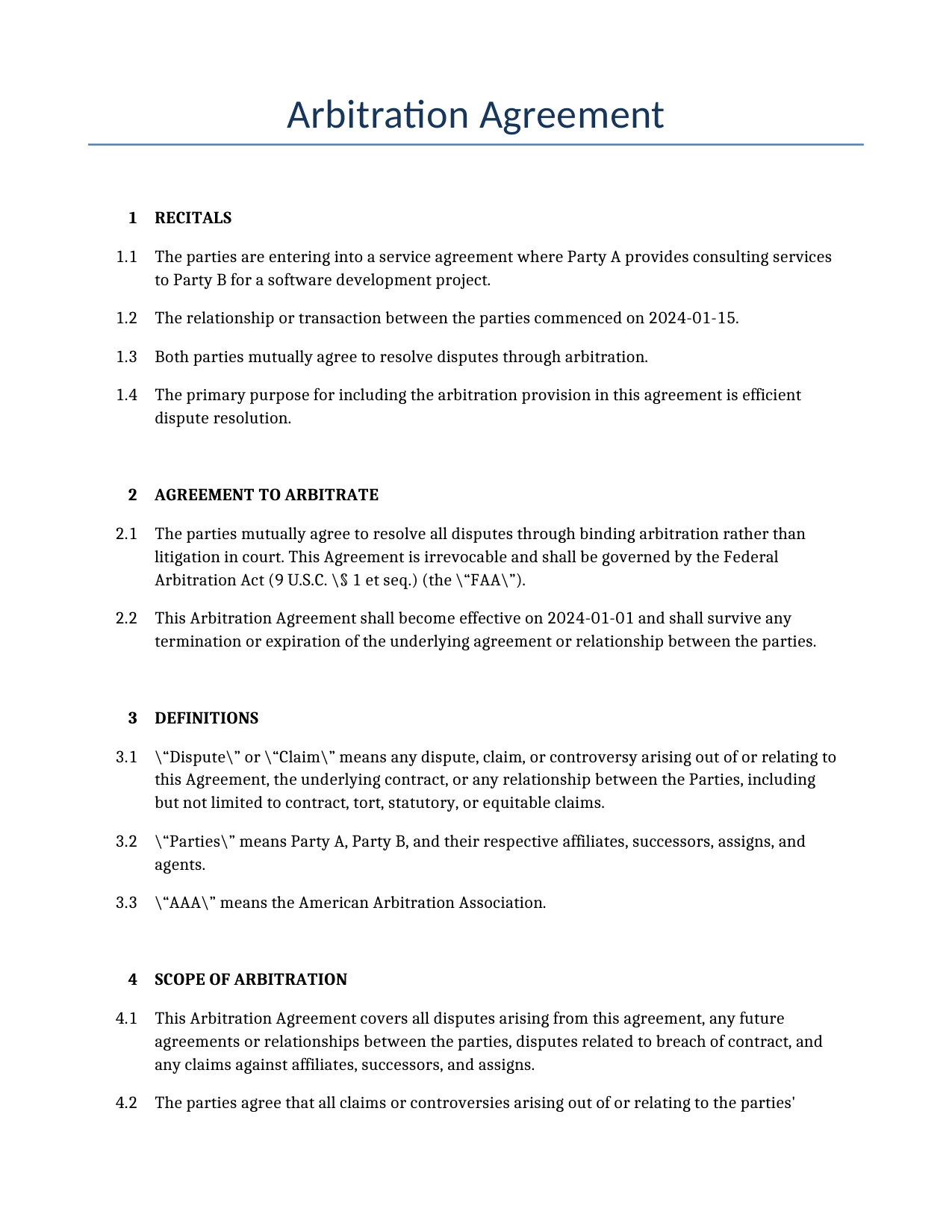
Below is a free template example of a Arbitration Agreement for use in the United States generated by our AI model.
The clauses in your actual Arbitration Agreement will vary from this example as they will be entirely bespoke to your requirements as set out in the questionnaire you complete.
Arbitration Agreement
1RECITALS
The parties are entering into a service agreement where Party A provides consulting services to Party B for a software development project.
The relationship or transaction between the parties commenced on 2024-01-15.
Both parties mutually agree to resolve disputes through arbitration.
The primary purpose for including the arbitration provision in this agreement is efficient dispute resolution.
2AGREEMENT TO ARBITRATE
The parties mutually agree to resolve all disputes through binding arbitration rather than litigation in court. This Agreement is irrevocable and shall be governed by the Federal Arbitration Act (9 U.S.C. \§ 1 et seq.) (the \“FAA\”).
This Arbitration Agreement shall become effective on 2024-01-01 and shall survive any termination or expiration of the underlying agreement or relationship between the parties.
3DEFINITIONS
\“Dispute\” or \“Claim\” means any dispute, claim, or controversy arising out of or relating to this Agreement, the underlying contract, or any relationship between the Parties, including but not limited to contract, tort, statutory, or equitable claims.
\“Parties\” means Party A, Party B, and their respective affiliates, successors, assigns, and agents.
\“AAA\” means the American Arbitration Association.
4SCOPE OF ARBITRATION
This Arbitration Agreement covers all disputes arising from this agreement, any future agreements or relationships between the parties, disputes related to breach of contract, and any claims against affiliates, successors, and assigns.
The parties agree that all claims or controversies arising out of or relating to the parties' relationship shall be subject to arbitration.
5ARBITRATION FORUM AND RULES
The arbitration proceedings shall be administered by the American Arbitration Association (AAA) in accordance with the AAA Commercial Arbitration Rules. If the AAA is unavailable, the arbitration shall be administered by JAMS under its then-current rules.
No modifications to the selected rules shall apply.
6NUMBER OF ARBITRATORS
The arbitration shall be conducted by a single arbitrator.
7SELECTION OF ARBITRATOR(S)
The selection of the arbitrator shall be administered by the American Arbitration Association (AAA).
The arbitrator shall be a licensed attorney, an industry expert, and shall possess a minimum of ten (10) years of experience in the relevant industry or area of law.
The parties shall appoint the arbitrator within 30 days after a demand for arbitration is made.
If the parties cannot agree on the arbitrator, the arbitrator shall be appointed by the arbitration institution selected in this agreement.
8ARBITRATION PROCEDURES
The discovery phase in the arbitration shall be allowed for 60 days.
Document discovery shall be allowed in the arbitration procedures.
Depositions shall be permitted during the arbitration discovery phase.
The arbitration hearings shall be conducted in an in-person format.
Live witness testimony shall be allowed during the arbitration hearings.
Expert witnesses shall be permitted in the arbitration proceedings.
The Federal Rules of Evidence shall apply for presenting and admitting evidence in the arbitration.
The arbitrator shall issue the final award within 30 days after the hearing.
9LANGUAGE OF ARBITRATION
The arbitration proceedings shall be conducted in English.
10LOCATION AND VENUE
The arbitration shall take place in Los Angeles, California, at a physical location.
The arbitration shall be governed by California law for venue purposes.
The venue for the arbitration shall be Los Angeles County.
11COSTS AND FEES
The parties shall equally split the arbitration costs and fees, subject to the arbitrator\’s authority to reallocate costs and award attorneys\’ fees and costs to the prevailing party where permitted by law or contract.
The arbitration costs shall be allocated by being split equally between parties, subject to reallocation by the arbitrator.
The administrative fees shall be allocated by being split equally between parties, subject to reallocation by the arbitrator.
The arbitrator\’s compensation shall be allocated by being split equally between parties, subject to reallocation by the arbitrator.
The parties shall be required to make advance payment of estimated costs and fees.
12CONFIDENTIALITY
All parties shall maintain the confidentiality of the existence of the arbitration, the proceedings, the documents, and the awards, provided that either party may disclose the award in any proceeding to enforce or vacate it under the FAA.
Limited disclosures shall be permitted pursuant to a court order, to a regulatory authority, and to professional advisors.
The confidentiality obligations shall be mutual between all parties and shall survive perpetually after the arbitration award, except as necessary for enforcement.
13BINDING NATURE OF AWARD
The arbitrator\’s award shall be final and binding on all parties.
The arbitrator\’s award may be appealed or challenged exclusively on the statutory grounds set forth in FAA \§ 10 and \§ 11. The parties hereby expressly waive any right to appeal the award on any other basis.
14ENFORCEABILITY OF AWARD
The arbitration award shall be governed for enforceability purposes under the Federal Arbitration Act.
The arbitration award may be enforced in any court of competent jurisdiction.
15WAIVER OF JURY TRIAL
The parties hereby waive any right to a jury trial for all disputes arising out of or relating to this agreement, including but not limited to contract breaches, tort claims, and any other legal actions.
The parties acknowledge that waiving a jury trial means that disputes will be decided by an arbitrator or judge without a jury.
16CLASS ACTION WAIVER
The parties waive the right to bring or participate in any class action or collective action, and all claims shall be brought individually in arbitration.
This class action waiver and collective action waiver shall cover all disputes and employment claims.
17SMALL CLAIMS AND EQUITABLE RELIEF
Nothing in this Agreement precludes a party from filing a small claims action in court, provided the claim is within the jurisdictional limit and is not aggregated with other claims. Either party may seek provisional remedies or equitable relief (including but not limited to preliminary injunctions or temporary restraining orders) in a court of competent jurisdiction to preserve the status quo or prevent irreparable harm pending arbitration.
18REMEDIES IN ARBITRATION
The arbitrator may award any form of relief or remedy that would be available in a court of competent jurisdiction, including but not limited to monetary damages, injunctive relief, declaratory relief, and attorneys\’ fees and costs where authorized by law or the underlying agreement.
19CONSOLIDATION OR JOINDER
Unless all parties otherwise agree in writing, no arbitration shall be consolidated with any other arbitration, and neither party may join or consolidate claims with those of any third party. There shall be no joinder or class arbitration.
20DELEGATION CLAUSE
The arbitrator, and not any federal, state, or local court or agency, shall have exclusive authority to resolve any dispute relating to the interpretation, applicability, enforceability, or formation of this Arbitration Agreement, including but not limited to any claim that all or any part of this Arbitration Agreement is void or voidable. This Delegation Clause shall be interpreted under the FAA and shall survive any challenge to the Agreement.
21INTERIM RELIEF AND PROVISIONAL REMEDIES
Either party may apply to the arbitrator for interim relief or provisional remedies (including preliminary injunctions) after the arbitration is commenced. A request for such relief to a court shall not be deemed incompatible with or a waiver of this Agreement.
22ELECTRONIC SIGNATURES AND E-SIGN ACT
This Agreement may be executed by electronic signature, which shall be deemed an original for all purposes. The parties agree that this Agreement and any electronic signatures comply with the Electronic Signatures in Global and National Commerce Act (E-SIGN Act) and the Uniform Electronic Transactions Act (UETA), and shall be valid and enforceable.
23SEVERABILITY
If any provision of this Arbitration Agreement is found to be invalid or unenforceable, the remaining provisions shall remain in full force and effect. If the class action waiver is found to be unenforceable, then any class or representative claims shall be litigated in court and not arbitrated, but all other provisions shall remain enforceable.
24GOVERNING LAW
This Arbitration Agreement and any arbitration conducted hereunder shall be governed by and interpreted in accordance with the Federal Arbitration Act (FAA) and, to the extent not preempted by the FAA, the laws of the State of California without regard to its conflict of laws principles. Any reference to other arbitration statutes is for informational purposes only and does not alter the applicability of the FAA.
25ENTIRE AGREEMENT
This Arbitration Agreement constitutes the entire understanding between the parties regarding arbitration and supersedes all prior agreements regarding only arbitration-related matters.
26AMENDMENTS
This Arbitration Agreement can only be modified in writing, and all amendments to this Arbitration Agreement must be made in writing.
Amendments to this Arbitration Agreement shall not be permitted through oral agreements.
Notice of proposed amendments to this Arbitration Agreement shall be provided by certified mail or email with read receipt.
An amendment to this Arbitration Agreement shall not become effective until 30 days after notice is provided.
Amendments to this Arbitration Agreement shall require unanimous consent of the parties.
Amendments to this Arbitration Agreement shall be executed in the format of an electronic signature via DocuSign.
27NOTICES
All notices related to the arbitration shall be delivered by personal delivery, certified mail, or email.
Notices to Party A shall be delivered to 123 Main Street, Suite 100, Anytown, CA 90210.
Notices to Party B shall be delivered to 456 Oak Avenue, Apartment 5B, Othertown, NY 10001.
Notices delivered by personal delivery shall be deemed received on the date of delivery.
Notices sent by mail shall be deemed received 3 days after mailing.
All notices shall be provided in English.
28COUNTERPARTS
This Arbitration Agreement may be executed in multiple counterparts, each of which shall be deemed an original and all of which together shall constitute one and the same instrument.
29SIGNATURES
IN WITNESS WHEREOF, the parties have executed this Arbitration Agreement as of the date first above written.
Party A: _______________________________ Date: _______________
Party B: _______________________________ Date: _______________
This example shows approximately 70% of a typical document and is provided for illustrative purposes only. The remaining content has been omitted.
Every document generated by Docaro is tailored to your specific circumstances, jurisdiction and the information you provide. The completed document includes all applicable clauses and provisions required for your situation.
To generate the full, personalised document, answer a short series of questions and your document will be created instantly.