
AI Generated American Internship Agreement
PDF & Word - 2026 Updated
Docaro Pricing
When Do You Need an Internship Agreement in the United States?
American Legal Rules for an Internship Agreement
Using the wrong structure for an internship agreement may inadvertently classify the intern as an employee, triggering labor law obligations.
What a Proper Internship Agreement Should Include
- Parties InvolvedClearly identify the company and the intern, including full names and contact details.
- Internship DurationSpecify the start and end dates, along with any possibility for extension.
- Role and ResponsibilitiesDescribe the intern's duties and what they will learn during the internship.
- Compensation DetailsOutline if the internship is paid, unpaid, or includes benefits like stipends or reimbursements.
- Work ScheduleDefine the expected hours, days, and any flexibility in the intern's work time.
- Supervision and TrainingIdentify who will guide the intern and what training will be provided.
- Confidentiality RulesExplain how the intern must protect the company's private information.
- Termination ConditionsState the reasons and process for ending the internship early.
- Legal ComplianceNote that the agreement follows U.S. labor laws to ensure fair treatment.
- SignaturesInclude spaces for both parties to sign and date the agreement.
Generate Your Document in 4 Easy Steps
Why Use Docaro?
 United States
Free Example Internship Agreement Template
Below is a free template example of a Internship Agreement for use in the United States generated by our AI model.
The clauses in your actual Internship Agreement will vary from this example as they will be entirely bespoke to your requirements as set out in the questionnaire you complete.
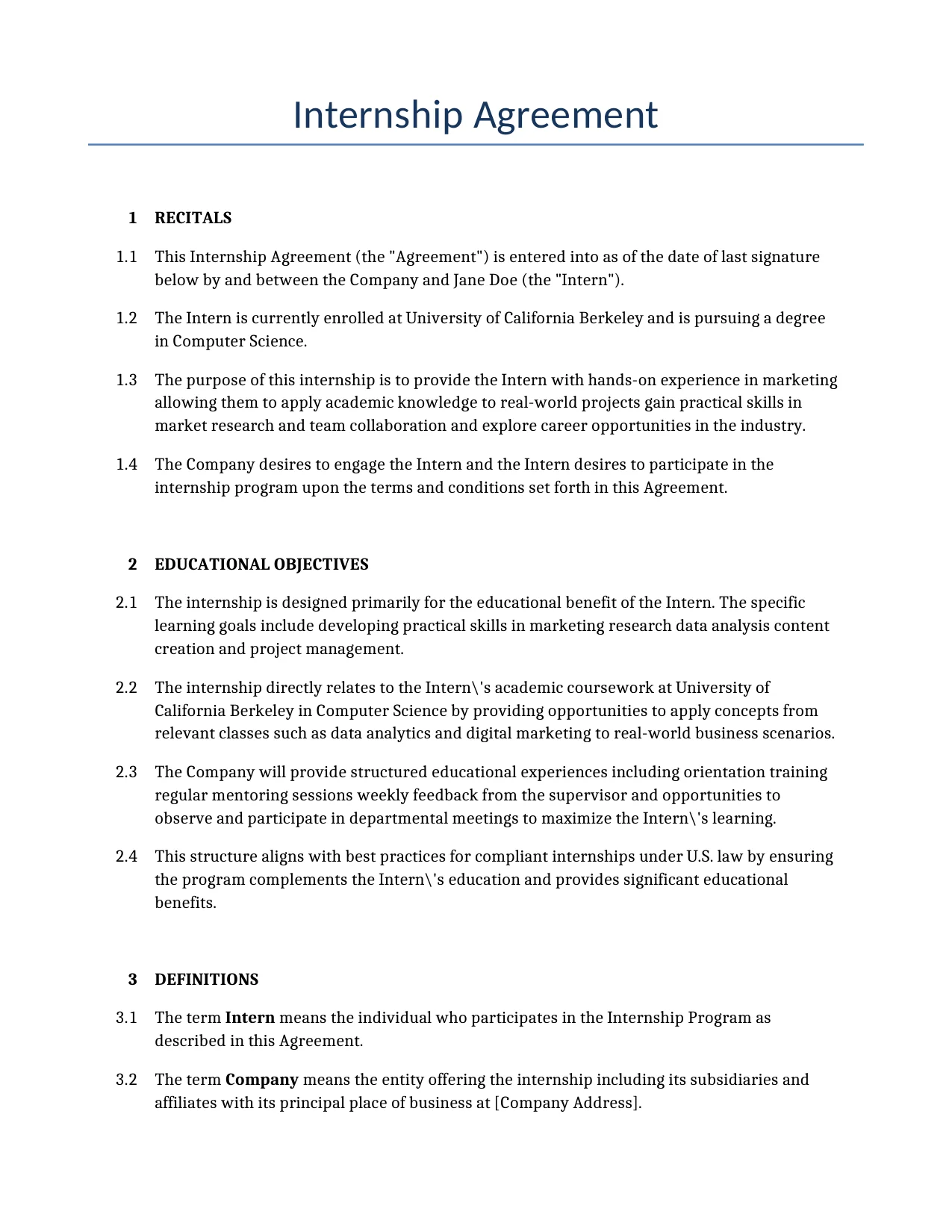
Internship Agreement
1RECITALS
This Internship Agreement (the "Agreement") is entered into as of the date of last signature below by and between the Company and Jane Doe (the "Intern").
The Intern is currently enrolled at University of California Berkeley and is pursuing a degree in Computer Science.
The purpose of this internship is to provide the Intern with hands-on experience in marketing allowing them to apply academic knowledge to real-world projects gain practical skills in market research and team collaboration and explore career opportunities in the industry.
The Company desires to engage the Intern and the Intern desires to participate in the internship program upon the terms and conditions set forth in this Agreement.
2EDUCATIONAL OBJECTIVES
The internship is designed primarily for the educational benefit of the Intern. The specific learning goals include developing practical skills in marketing research data analysis content creation and project management.
The internship directly relates to the Intern\'s academic coursework at University of California Berkeley in Computer Science by providing opportunities to apply concepts from relevant classes such as data analytics and digital marketing to real-world business scenarios.
The Company will provide structured educational experiences including orientation training regular mentoring sessions weekly feedback from the supervisor and opportunities to observe and participate in departmental meetings to maximize the Intern\'s learning.
This structure aligns with best practices for compliant internships under U.S. law by ensuring the program complements the Intern\'s education and provides significant educational benefits.
3DEFINITIONS
The term Intern means the individual who participates in the Internship Program as described in this Agreement.
The term Company means the entity offering the internship including its subsidiaries and affiliates with its principal place of business at [Company Address].
The term Confidential Information means any non-public information disclosed by the Company to the Intern including but not limited to trade secrets business plans customer lists and technical data.
The term Intellectual Property means all patents copyrights trademarks trade secrets and any other proprietary rights arising from the Intern\'s work under this Agreement.
The term Services means assisting in marketing research data analysis and administrative tasks as directed by the Company\'s supervisor during the Internship Period.
The term Internship Period means the period commencing on 2024-06-01 and ending on 2024-08-31 unless earlier terminated or extended in accordance with this Agreement.
4INTERNSHIP POSITION AND DUTIES
The Intern shall serve in the position of Marketing Intern within the Marketing Department of the Company.
The primary duties and responsibilities of the Intern shall include assisting with social media campaigns conducting market research supporting event coordination and creating content for promotional materials.
The Intern shall perform the Services diligently and to the best of the Intern\'s ability under the direction and supervision of the Company.
5TERM OF INTERNSHIP
This Agreement shall commence on 2024-06-01 and shall continue until 2024-08-31 unless sooner terminated as provided herein. The internship is at-will and can be terminated by either party at any time with or without cause or notice.
This is a paid full-time internship.
The parties may agree in writing to extend the term of the internship for an additional period upon mutually agreed terms and conditions.
6AT-WILL INTERNSHIP
The internship does not create an employment relationship between the Company and the Intern. It is not a promise or contract of employment for any specific duration or future employment. The internship can be terminated by either party at any time without notice or cause. This Agreement is not an employment contract.
7COMPENSATION AND BENEFITS
The Company shall pay the Intern an hourly wage of $X per hour for all hours worked. If the Intern works more than 40 hours in a workweek the Company shall pay overtime at 1.5 times the regular hourly rate as required by the Fair Labor Standards Act (FLSA).
The Company shall reimburse the Intern for reasonable work-related expenses incurred during the Internship Period provided that such expenses are pre-approved in writing by the Company and supported by appropriate documentation.
The Intern shall not be entitled to any other benefits including but not limited to health insurance retirement plans or paid time off.
8TAXES AND WITHHOLDING
The Company will withhold applicable federal state and local taxes from the Intern\'s pay as required by law for employees or interns and will issue a Form W-2 to the Intern at year-end.
9WORK SCHEDULE AND LOCATION
The Intern shall work full-time on Monday through Friday from 9 AM to 5 PM.
The primary location for the performance of the Services shall be 123 Main Street New York NY 10001.
The Intern shall not work remotely from any location other than the primary site without the prior written approval of the Company.
10SUPERVISION AND TRAINING
Dr. Emily Carter shall serve as the direct supervisor of the Intern.
The supervisor shall assign daily tasks provide weekly feedback ensure compliance with safety protocols and mentor the Intern on project management skills.
The supervisor and the Intern shall schedule and attend regular meetings at times mutually agreed upon by the parties.
The Company shall provide the Intern with orientation to company policies and procedures as well as job-specific skills training.
11COMPLIANCE WITH LAWS AND POLICIES
The Intern shall comply with all applicable federal state and local laws during the Internship Period including but not limited to the Fair Labor Standards Act (FLSA) Title VII of the Civil Rights Act the Age Discrimination in Employment Act (ADEA) and the Americans with Disabilities Act (ADA).
The Intern shall comply with all Company policies including any employee handbook or code of conduct.
The Intern shall follow all applicable safety regulations and protocols.
Non-compliance with any of the foregoing may result in immediate termination of the internship.
12CONFIDENTIALITY
The Intern agrees to maintain the confidentiality of all Confidential Information and shall not disclose such information to any third party without the prior written consent of the Company.
The Intern agrees not to use any Confidential Information for personal or unauthorized purposes.
Upon termination of the Internship Period the Intern shall return all physical and digital materials containing Confidential Information to the Company and shall certify in writing the destruction of any copies thereof.
The obligations of confidentiality shall not apply to information that the Intern is compelled to disclose by law provided that the Intern gives the Company prompt notice of such legal compulsion to allow the Company to seek a protective order.
The Company shall be entitled to seek injunctive relief in the event of any breach or threatened breach of this Section 12 in addition to any other remedies available at law or in equity.
13INTELLECTUAL PROPERTY
The Intern shall disclose to the Company any pre-existing inventions or intellectual property that the Intern owns prior to the commencement of the Internship Period that might conflict with or relate to the Services.
The Company shall have full ownership of all Intellectual Property created by the Intern during the Internship Period on Company time and using Company resources.
The Intern hereby assigns to the Company all rights title and interest in and to any inventions or Intellectual Property created during the Internship Period.
Upon termination of the Internship Period the Intern shall return to the Company all materials containing Intellectual Property.
14NON-COMPETE AND NON-SOLICITATION
During the Internship Period and for a period of six (6) months thereafter the Intern shall not directly or indirectly solicit any of the Company\'s employees or clients. In consideration for this restriction the Company provides the Intern with the training skills and experience gained during the internship.
15INTERN STATUS
The Intern acknowledges that the Intern is participating in this educational internship program as a non-employee trainee or intern and not as an employee of the Company. The internship is structured for the primary educational benefit of the Intern and meets the criteria of the U.S. Department of Labor\'s test for internships even though it is a paid position.
The Intern is responsible for their own taxes on any wages received to the extent not withheld by the Company as provided in this Agreement. The Intern is not entitled to employee benefits such as health insurance retirement plans or paid time off from the Company.
16PERFORMANCE EVALUATION
The Company shall conduct performance evaluations of the Intern on a quarterly basis.
The Company shall conduct a final performance evaluation at the end of the Internship Period.
The Direct Supervisor shall be responsible for conducting all performance evaluations.
17INSURANCE AND LIABILITY
The Company will provide workers\' compensation coverage if required by law for the jurisdiction.
The Intern hereby releases and waives any claims against the Company for liability arising from ordinary risks associated with the internship.
The Company hereby releases and waives any claims against the Intern for liability arising from ordinary risks associated with the internship.
The Company\'s liability under this Agreement shall be capped at the limit of the Company\'s applicable insurance policy.
The Company shall indemnify the Intern against claims arising from the Company\'s negligence or willful misconduct to the extent of third-party claims.
The Intern shall indemnify the Company against claims arising from the Intern\'s negligence or willful misconduct during the internship to the extent of third-party claims.
18TERMINATION
The internship is at-will and either party may terminate this Agreement at any time with or without cause or notice.
The Company may terminate the Intern\'s participation immediately for cause including misconduct or violation of policies or failure to perform duties.
The Intern may terminate this Agreement immediately for cause including unsafe working conditions or harassment or discrimination.
The provisions of Sections 12 13 and 14 shall survive any termination of this Agreement.
19DISPUTE RESOLUTION
Any dispute arising out of or relating to this Agreement shall be resolved exclusively by binding arbitration in accordance with the rules of the American Arbitration Association.
The arbitration shall be conducted in the State of New York which shall be the exclusive jurisdiction for any disputes arising under this Agreement.
All dispute resolution proceedings shall remain confidential.
The Company shall pay all costs of the arbitration including mediator or arbitrator fees.
20GOVERNING LAW
This Agreement shall be governed by and construed in accordance with the laws of the State of New York without regard to its conflict of laws principles.
21EQUAL OPPORTUNITY AND ANTI-HARASSMENT
The Company is committed to providing a discrimination-free and harassment-free environment. The Company complies with Title VII the ADA the ADEA and all other applicable federal state and local equal opportunity and anti-harassment laws.
The Intern should report any concerns regarding discrimination or harassment to their supervisor Dr. Emily Carter or to [HR Contact Information].
22ACKNOWLEDGMENT OF FLSA COMPLIANCE
The parties acknowledge and confirm that this internship meets the U.S. Department of Labor\'s criteria for internships under the FLSA. The Intern will receive training the experience is for the primary benefit of the Intern there is no expectation of compensation beyond the agreed pay the internship does not displace regular employees and there is no guarantee of a job at the conclusion of the internship.
23ENTIRE AGREEMENT
This Agreement constitutes the entire understanding between the Intern and the Company with respect to the subject matter hereof and supersedes all prior agreements understandings or representations whether oral or written.
24SEVERABILITY
If any provision of this Agreement is held to be invalid or unenforceable the remaining provisions shall remain in full force and effect.
25WAIVER
No failure or delay by either party to enforce any provision of this Agreement shall constitute a waiver of that provision or any other provision.
26ASSIGNMENT
Neither the Company nor the Intern may assign any rights or delegate any obligations under this Agreement without the prior written consent of the other party except that the Company may assign this Agreement to a successor in interest.
This Agreement shall be binding upon and inure to the benefit of the parties\' successors and assigns.
27NOTICES
All notices under this Agreement shall be in writing and shall be delivered by certified mail email or overnight courier to the addresses specified below or to such other address as a party may designate in writing.
Notices to the Intern shall be sent to 123 Internship Lane New York NY 10001.
Notices sent by mail shall be deemed delivered three days after mailing.
28AMENDMENTS
Any modification to this Agreement must be in writing and signed by both the Intern and the Company.
Amendments may be signed on behalf of the Company by its CEO or equivalent or HR Director.
29COUNTERPARTS
This Agreement may be executed in counterparts each of which shall be deemed an original but all of which together shall constitute one and the same instrument.
30SIGNATURE PAGE
IN WITNESS WHEREOF the parties have executed this Agreement as of the date first above written.
Company: _______________________________ By: ________________________________ Title: _______________________________ Date: ________________________________
Intern: Jane Doe Signature: _______________________________ Date: ________________________________
This example shows approximately 70% of a typical document and is provided for illustrative purposes only. The remaining content has been omitted.
Every document generated by Docaro is tailored to your specific circumstances, jurisdiction and the information you provide. The completed document includes all applicable clauses and provisions required for your situation.
To generate the full, personalised document, answer a short series of questions and your document will be created instantly.