
AI Generated American Last Will and Testament
PDF & Word - 2026 Updated
Docaro Pricing
When Do You Need a Last Will and Testament in the United States?
American Legal Rules for a Last Will and Testament
Using an incorrect structure for a last will and testament may result in it being invalid or contested in court.
What a Proper Last Will and Testament Should Include
- Introduction and DeclarationsStart by stating your full name, that you are of sound mind, and that this document is your last will, revoking any previous ones.
- Appointment of ExecutorName a trusted person to carry out your wishes and manage your estate after your passing.
- Guardians for Minor ChildrenIf you have young children, specify who should care for them if both parents are unable to.
- Distribution of AssetsClearly list who gets your property, money, and belongings, including specific items or shares for beneficiaries.
- Payment of Debts and TaxesDirect that your debts, funeral costs, and any taxes be paid from your estate before distribution.
- Signature and WitnessesSign the will in the presence of at least two unbiased witnesses who also sign it.
Generate Your Document in 4 Easy Steps
Why Use Docaro?
 United States
Free Example Last Will and Testament Template
Below is a free template example of a Last Will and Testament for use in the United States generated by our AI model.
The clauses in your actual Last Will and Testament will vary from this example as they will be entirely bespoke to your requirements as set out in the questionnaire you complete.
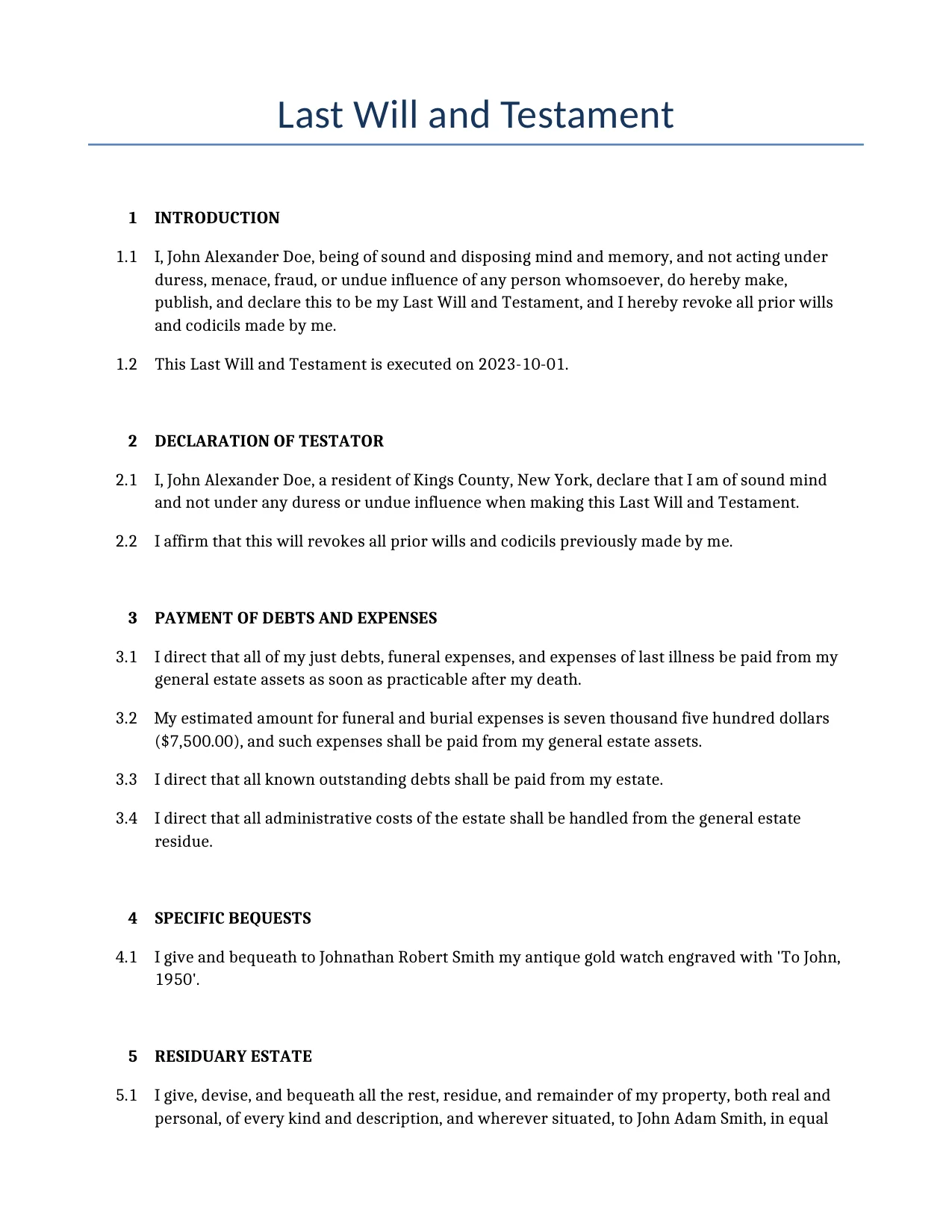
Last Will and Testament
1INTRODUCTION
I, John Alexander Doe, being of sound and disposing mind and memory, and not acting under duress, menace, fraud, or undue influence of any person whomsoever, do hereby make, publish, and declare this to be my Last Will and Testament, and I hereby revoke all prior wills and codicils made by me.
This Last Will and Testament is executed on 2023-10-01.
2DECLARATION OF TESTATOR
I, John Alexander Doe, a resident of Kings County, New York, declare that I am of sound mind and not under any duress or undue influence when making this Last Will and Testament.
I affirm that this will revokes all prior wills and codicils previously made by me.
3PAYMENT OF DEBTS AND EXPENSES
I direct that all of my just debts, funeral expenses, and expenses of last illness be paid from my general estate assets as soon as practicable after my death.
My estimated amount for funeral and burial expenses is seven thousand five hundred dollars ($7,500.00), and such expenses shall be paid from my general estate assets.
I direct that all known outstanding debts shall be paid from my estate.
I direct that all administrative costs of the estate shall be handled from the general estate residue.
4SPECIFIC BEQUESTS
I give and bequeath to Johnathan Robert Smith my antique gold watch engraved with 'To John, 1950'.
5RESIDUARY ESTATE
I give, devise, and bequeath all the rest, residue, and remainder of my property, both real and personal, of every kind and description, and wherever situated, to John Adam Smith, in equal shares.
6APPOINTMENT OF EXECUTOR
I hereby nominate and appoint John Michael Smith as the Executor of this my Last Will and Testament.
If John Michael Smith shall be unable or unwilling to serve as Executor, then I nominate and appoint the successor executor as provided in a separate writing or as determined by the court.
7EXECUTOR'S POWERS AND DUTIES
My Executor shall have the power to sell or otherwise dispose of real property without court supervision.
My Executor shall have the power to manage and invest estate funds without court supervision.
My Executor shall have the power to initiate, defend, or settle litigation on behalf of the estate without court supervision.
My Executor shall have full authority to settle any amount regarding claims of or against the estate without court supervision.
My Executor shall have the power to delegate duties to agents, attorneys, or other professionals without court supervision.
8APPOINTMENT OF GUARDIAN FOR MINOR CHILDREN
I have two (2) minor children under the age of eighteen (18).
I hereby nominate and appoint Jane Elizabeth Smith, who is my sister, as the primary guardian for the care and custody of my minor children.
9TRUST PROVISIONS FOR MINORS OR BENEFICIARIES
I hereby establish a testamentary trust for my minor children and adult beneficiaries with special needs, including the primary beneficiary born on 2015-03-15.
The trust shall terminate for each beneficiary at the age of twenty-five (25) years, at which time full distribution of assets shall be made.
The trustee shall make staggered distributions of the trust assets to the beneficiaries.
I hereby appoint John A. Smith as the primary trustee for the testamentary trust.
The trustee shall be compensated with reasonable compensation from the trust assets.
10NO-CONTEST CLAUSE
Any beneficiary who contests this Will or any of its provisions or challenges its validity shall forfeit their entire inheritance and be treated as if they predeceased me.
11SEVERABILITY CLAUSE
If any provision of this Will is held to be invalid, illegal, or unenforceable, the remaining provisions shall remain in full force and effect.
12GOVERNING LAW
This Last Will and Testament shall be governed by, construed, and administered in accordance with American law, specifically the laws of the State of New York, including but not limited to the Uniform Probate Code, the Uniform Testamentary Additions to Trusts Act, the Uniform Disclaimer of Property Interests Act, Internal Revenue Code Section 2001 et seq., California Probate Code Sections 6100-6143, and Texas Estates Code Title 2, to the extent applicable.
13TESTIMONIUM CLAUSE
IN WITNESS WHEREOF, I have hereunto set my hand and seal this 2023-10-01, in the presence of the two (2) witnesses who have subscribed their names below at my request.
14SIGNATURE SECTION
Testator: _______________________________ Date: _______________ John Alexander Doe
Witness 1: _______________________________ Date: _______________ Name: _______________________________ Address: _______________________________
Witness 2: _______________________________ Date: _______________ Name: _______________________________ Address: _______________________________
This example shows approximately 70% of a typical document and is provided for illustrative purposes only. The remaining content has been omitted.
Every document generated by Docaro is tailored to your specific circumstances, jurisdiction and the information you provide. The completed document includes all applicable clauses and provisions required for your situation.
To generate the full, personalised document, answer a short series of questions and your document will be created instantly.