
AI Generated Records Retention Policy for use in the United States
PDF & Word - 2026 Updated
Docaro Pricing
When Do You Need a Records Retention Policy in the United States?
American Legal Rules for a Records Retention Policy
Failing to align the data retention policy with applicable industry regulations and organizational needs can result in non-compliance risks and ineffective records management.
What a Proper Records Retention Policy Should Include
- Purpose StatementClearly explain why the policy exists, such as protecting the company, complying with laws, and managing information effectively.
- Scope of CoverageDefine which types of records and departments the policy applies to, ensuring everyone knows what is included.
- Record Categories and Retention PeriodsList different record types, like financial or employee files, and specify how long each must be kept before disposal.
- Storage and Security GuidelinesOutline how records should be stored safely, whether digitally or on paper, to prevent unauthorized access or loss.
- Record Disposal ProceduresDescribe secure methods for destroying records once their retention period ends, like shredding or secure deletion.
- Roles and ResponsibilitiesAssign who is responsible for managing records, such as department heads or a records officer, to ensure accountability.
- Training and Compliance MeasuresRequire employee training on the policy and steps for handling violations to promote adherence across the organization.
- Review and Update ProcessSet a schedule for regularly reviewing and updating the policy to reflect changes in laws or business needs.
Generate Your Document in 4 Easy Steps
Why Use Docaro?
 United States
Free Example Records Retention Policy Template
Below is a free template example of a Records Retention Policy for use in the United States generated by our AI model.
The clauses in your actual Records Retention Policy will vary from this example as they will be entirely bespoke to your requirements as set out in the questionnaire you complete.
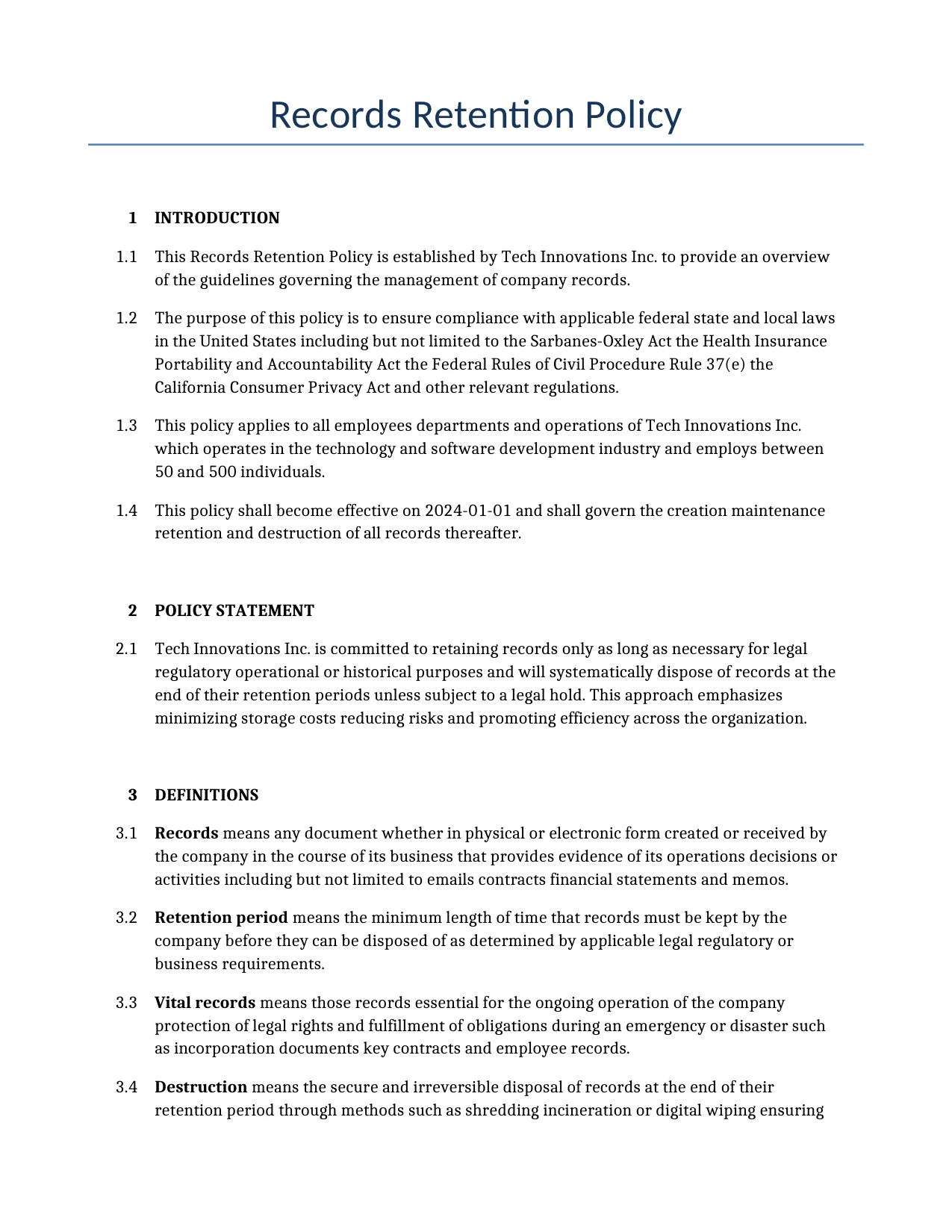
Records Retention Policy
1INTRODUCTION
This Records Retention Policy is established by Tech Innovations Inc. to provide an overview of the guidelines governing the management of company records.
The purpose of this policy is to ensure compliance with applicable federal state and local laws in the United States including but not limited to the Sarbanes-Oxley Act the Health Insurance Portability and Accountability Act the Federal Rules of Civil Procedure Rule 37(e) the California Consumer Privacy Act and other relevant regulations.
This policy applies to all employees departments and operations of Tech Innovations Inc. which operates in the technology and software development industry and employs between 50 and 500 individuals.
This policy shall become effective on 2024-01-01 and shall govern the creation maintenance retention and destruction of all records thereafter.
2POLICY STATEMENT
Tech Innovations Inc. is committed to retaining records only as long as necessary for legal regulatory operational or historical purposes and will systematically dispose of records at the end of their retention periods unless subject to a legal hold. This approach emphasizes minimizing storage costs reducing risks and promoting efficiency across the organization.
3DEFINITIONS
Records means any document whether in physical or electronic form created or received by the company in the course of its business that provides evidence of its operations decisions or activities including but not limited to emails contracts financial statements and memos.
Retention period means the minimum length of time that records must be kept by the company before they can be disposed of as determined by applicable legal regulatory or business requirements.
Vital records means those records essential for the ongoing operation of the company protection of legal rights and fulfillment of obligations during an emergency or disaster such as incorporation documents key contracts and employee records.
Destruction means the secure and irreversible disposal of records at the end of their retention period through methods such as shredding incineration or digital wiping ensuring that the information cannot be recovered or reconstructed.
Legal Hold means a temporary suspension of the company\'s normal records destruction procedures in response to anticipated or actual litigation audits or investigations requiring preservation of relevant records.
Records Coordinator means the individual designated to oversee the implementation and enforcement of the records retention policy across the organization.
Disposition means the final action taken with a record after its retention period which may include destruction archiving for permanent preservation or transfer to another entity.
Metadata means data that provides information about other data such as creation date author or modification history which may need to be retained along with the record itself.
4PURPOSE
The primary purpose of this Records Retention Policy is to establish guidelines for the creation maintenance and disposal of company records to ensure compliance with applicable laws and to support efficient business operations.
The objectives of this policy include promoting legal compliance minimizing risks of litigation and optimizing the storage and retrieval of records for better decision-making.
This policy ensures legal compliance with the Sarbanes-Oxley Act (SOX) the Health Insurance Portability and Accountability Act (HIPAA) the Federal Rules of Civil Procedure (FRCP) Rule 37(e) the California Consumer Privacy Act (CCPA) and state-specific data retention laws.
This policy protects the company from liability by establishing procedures for the proper management and timely destruction of records in accordance with governing American law.
This policy facilitates efficient records management by providing clear guidelines for all departments and employees of Tech Innovations Inc.
5SCOPE
This policy covers all records generated or received by the company in the course of business operations ensuring compliance with federal and state regulations.
The geographic areas covered by this policy include federal nationwide operations and specific states where Tech Innovations Inc. conducts business.
The scope includes all documents data and information created received or maintained by the company encompassing both routine business activities and special projects to promote efficient management and legal compliance.
The types of records included in the scope of this policy are financial records legal and contractual records human resources records and operational records.
This policy applies to both paper records and electronic records maintained by the company.
The departments and business units affected by this policy include Finance Human Resources Legal Operations and Information Technology.
This policy applies to all records in any format including but not limited to paper electronic audio video social media posts instant messages cloud-based data and backup tapes. The policy covers records created by third parties on behalf of the company and records stored on personal devices if used for business purposes.
6RESPONSIBILITIES
Executives will provide strategic oversight approve the policy annually allocate necessary resources and ensure integration with overall corporate governance.
Departments are responsible for ensuring compliance with this Records Retention Policy within their operations.
Departments will designate a records coordinator conduct regular audits of records practices and report compliance issues to senior management.
Employees are assigned responsibilities for adhering to this Records Retention Policy in their daily tasks.
Employees shall complete initial onboarding training and annual training sessions regarding this policy.
Records managers will oversee the development of retention schedules monitor policy adherence across the organization and facilitate destruction of records per approved timelines.
Legal counsel is responsible for reviewing and updating this Records Retention Policy.
Legal counsel shall provide litigation hold advice and regulatory compliance consultation regarding this policy.
7CLASSIFICATION OF RECORDS
Financial records maintained by the organization include balance sheets income statements cash flow reports and general ledgers for tracking all monetary transactions. Minimum retention: 7 years (IRS requirements SOX Section 802).
The organization maintains payroll records for its employees. Minimum retention: 3 years for payroll records under FLSA or 7 years generally (FLSA IRS requirements).
Personnel records handled by the organization include employee contracts performance reviews and training documentation. Minimum retention: 7 years after termination or as required by specific laws (FLSA OSHA FCRA state laws).
Legal records kept by the organization include vendor and client contracts intellectual property agreements litigation files from past disputes and compliance documentation with regulatory bodies. Minimum retention: 7 years after expiration (SOX FRCP state laws like Delaware corporate records retention).
The organization maintains contracts as part of its legal records. Minimum retention: 7 years after expiration (SOX FRCP state laws).
Operational records categories relevant to business operations include inventory logs customer correspondence and project files. Minimum retention: 7 years (general business standards FRCP).
Tax records prepared and stored by the organization include federal and state tax returns W-2 and 1099 forms receipts for deductible expenses and audit trails for sales tax compliance. Minimum retention: 7 years after filing (IRS requirements).
Emails: Minimum retention 7 years (SOX FRCP).
Vital records: Indefinitely (business continuity needs).
Note that retention periods are the minimum and records may need to be kept longer if they are subject to a legal hold audit or ongoing business need. If no specific period is listed the default is 7 years unless otherwise advised by legal counsel.
8RETENTION SCHEDULES
As a publicly traded company Tech Innovations Inc. incorporates Sarbanes-Oxley Act retention requirements into this policy.
This policy includes specific IRS retention schedules for tax records.
The retention period for financial statements and ledgers shall be 7 years in accordance with applicable requirements under the Sarbanes-Oxley Act and general business standards.
The retention period for federal tax returns and supporting documents shall be 7 years.
This retention schedules section shall become effective on 2024-01-01.
This policy integrates state-specific retention requirements that may exceed federal minimums.
See the Classification of Records section and the full retention schedule matrix in the Appendices for comprehensive details on all major record categories with cited legal authorities (e.g. IRS requirements SOX Section 802 HIPAA CCPA FRCP state laws like Delaware corporate records retention).
9RECORDS RETENTION SCHEDULE DEVELOPMENT AND MAINTENANCE
The Records Manager in collaboration with Legal Counsel shall create review and update the retention schedule on an annual basis. This process includes consideration of federal laws (SOX HIPAA FRCP 37(e) IRS rules CCPA) state-specific laws in all operating jurisdictions and industry best practices for technology companies. The schedule must be approved by senior management and distributed to all departments.
10CREATION AND MAINTENANCE OF RECORDS
All records must be created using standardized templates to ensure consistency.
Employees should include the date author and purpose in every record.
Electronic signatures are required for official documents.
The creation of digital records is prioritized over paper-based ones.
Department managers and the legal team are authorized to create official records.
Storage locations designated for records include primary storage in secure on-site servers located in the IT department secondary storage in off-site facilities for disaster recovery and digital records stored in company-approved databases.
Cloud-based storage shall be used for maintaining records.
The default retention period for general records shall be 7 years.
Security measures implemented for record maintenance include encryption access controls and regular backups.
Procedures established for verifying the integrity of records include conducting quarterly checksum verifications on digital files to detect alterations performing manual audits on a sample of paper records annually and using digital signatures to confirm authenticity.
An annual review of all maintained records for accessibility is required.
Records must be classified at creation according to the retention schedule. Appropriate security controls must be implemented based on sensitivity (e.g. confidential personal data). Records must be stored in official company systems rather than personal devices. Procedures for handling records containing personally identifiable information (PII) or protected health information (PHI) must comply with CCPA and HIPAA.
11ACCESS TO RECORDS
All requests for access to records must be submitted in writing to the designated Records Manager who will review the request against the criteria outlined in this policy to ensure compliance with authorization requirements.
Written authorization is required for all record access requests.
The categories of personnel authorized for record access include managers the legal team and external auditors.
Confidentiality measures for protecting record access include handling all accessed records in secure environments with encryption for digital files requiring non-disclosure agreements for personnel and mandating immediate reporting of any suspected breaches to maintain confidentiality.
The data protection measures in this policy comply with the Health Insurance Portability and Accountability Act and the California Consumer Privacy Act.
Mandatory logging of all record access activities is required.
Access authorizations shall be reviewed every 12 months.
This Access to Records section shall become effective on 2024-01-01.
Access must be on a \'need-to-know\' basis limited to authorized personnel for legitimate business purposes with role-based access controls for electronic systems. Audits of access logs must be conducted quarterly and violations of access rules will result in disciplinary action.
12DESTRUCTION OF RECORDS
Methods for securely destroying physical records after the retention period include shredding and incineration.
Methods for securely deleting digital records after the retention period include secure deletion software and physical destruction.
Any third-party vendors used for record destruction must be certified by a recognized standards organization.
John Doe with email address john.doe@company.com is designated as the person responsible for overseeing the destruction of records.
Documentation of all record destruction activities such as certificates of destruction is required.
Documentation of destruction activities shall be retained for 5 years after the destruction date.
This Destruction of Records section of the policy shall become effective on 2024-01-01.
Internal audits of the destruction processes shall be conducted annually.
Mandatory training for employees on the record destruction procedures is required.
Destruction only occurs after confirming no legal hold is in place. A certificate of destruction must include the record description destruction date method and authorizing person\'s name. For electronic records destruction must meet standards such as NIST 800-88 guidelines for media sanitization. Vendors must provide proof of insurance and comply with data privacy laws.
13LEGAL HOLDS AND LITIGATION SUPPORT
The name assigned to the legal hold policy is Corporate Legal Hold and Preservation Policy.
Jane Doe General Counsel with email address jane.doe@company.com and phone number (555) 123-4567 is designated as the legal hold coordinator responsible for overseeing the process.
Record destruction shall be automatically suspended upon receipt of any litigation notice.
Record destruction shall be automatically suspended in response to internal or external audits.
Record destruction shall be automatically suspended upon any government investigation alerts.
The parties that shall receive notifications when a legal hold is initiated include the IT Department the Records Management Team department heads and external counsel.
The step-by-step notification procedure for legal holds is as follows: Upon receiving a trigger event the Legal Hold Coordinator will issue a written hold notice; the IT Department shall be notified to suspend automated deletion; relevant department heads and records team shall be informed via email; and external counsel shall be consulted for confirmation and documentation.
The next review of this legal hold policy is scheduled for 2025-01-15.
The maximum duration for a legal hold before requiring re-evaluation is 24 months.
The types of events that trigger a legal hold under this policy include pending lawsuit government investigation internal audit and anticipated dispute.
Annual training for employees on legal holds and litigation support is required.
Legal holds must be issued in writing clearly identify the records and individuals affected require acknowledgment from recipients and be lifted in writing when no longer needed. Procedures for preserving metadata handling backup tapes and documenting all hold-related decisions are required. The hold process complies with FRCP Rule 37(e) to avoid sanctions for spoliation of evidence.
14ELECTRONIC RECORDS AND DIGITAL MANAGEMENT
A formal retention policy for company emails is implemented and company emails shall be retained for 7 years.
Company databases shall be backed up automatically on a daily basis.
Version control shall be enabled for all digital files.
This Electronic Records and Digital Management section shall become effective on 2024-01-01.
The company shall use the ESIGN Compliant standard for electronic signatures.
A specific protocol for e-discovery is included in this policy.
Jane Doe IT Director is designated as the company Records Coordinator for electronic and digital management.
The company uses cloud storage for electronic records.
The method used for securely destroying electronic records after the retention period is secure deletion software.
Additional requirements include system audits for integrity compliance with e-discovery rules under FRCP secure disposal methods meeting DoD 5220.22-M or equivalent standards management of social media and mobile device records and use of AI or automated tools for classification/retention (if applicable). All electronic records systems must have disaster recovery and business continuity plans.
15PRIVACY AND DATA PROTECTION
This policy ensures compliance with data minimization principles under CCPA and other privacy laws. Procedures are in place for handling data subject requests (access deletion opt-out). Breach notification is required if records are compromised. The policy integrates with the company\'s broader privacy program. If the company handles EU data GDPR requirements are also considered though the focus remains on US laws.
16TRAINING AND AWARENESS
Mandatory training for all employees on this Records Retention Policy is required.
Training sessions on this Records Retention Policy shall be conducted annually.
A specific training session for new hires regarding this Records Retention Policy is included.
Methods used for delivering the training sessions on this Records Retention Policy include in-person workshops online modules and webinars.
Resources provided to promote ongoing awareness of this Records Retention Policy include posters in common areas email newsletters an intranet portal with policy summaries and quarterly compliance reminders.
The initial implementation of the Training and Awareness requirements shall occur on 2024-01-01.
The HR Department is designated as responsible for overseeing the Training and Awareness program.
17AUDITS AND COMPLIANCE MONITORING
Procedures for conducting internal audits to ensure adherence to this Records Retention Policy are included.
Internal audits shall be conducted annually.
A team of 3 members shall be designated for conducting each internal audit.
The internal audits shall cover record creation processes storage and access controls and retention and disposal practices.
The results of internal audits shall be documented in detailed written reports including findings recommendations and action plans stored in a secure digital repository.
Mechanisms for reporting non-compliance with this Records Retention Policy are included.
Reporting channels established for non-compliance issues include an anonymous hotline and compliance officer contact.
Non-compliance reports shall be acknowledged and initially responded to within 5 days.
This section includes both internal and external audit possibilities with risk-based audit frequency (not just annual). Metrics for measuring compliance (e.g. percentage of records destroyed on schedule) are utilized. Escalation procedures for serious non-compliance findings are in place. Audit reports must be reviewed by senior management and findings must be tracked to resolution with documented corrective actions.
18POLICY REVIEW AND UPDATES
The next full review of this Records Retention Policy by responsible parties shall occur on 2025-12-31.
This Records Retention Policy shall be reviewed annually.
The next policy review is scheduled for 2025-06-30.
The Compliance Officer is designated as the person responsible for initiating and overseeing the policy reviews.
Updates to this policy require approval from senior management or the board.
Relevant departments shall be notified of policy updates by email notification and intranet posting.
Records of policy reviews and updates shall be retained for 7 years.
This policy shall be reviewed at least annually or upon significant legal/regulatory changes (e.g. new amendments to SOX HIPAA or state privacy laws). A legal compliance assessment shall be conducted during each review and any changes documented with version control.
19CONSEQUENCES OF NON-COMPLIANCE
Employees who fail to comply with this records retention policy may face verbal warnings for minor infractions written reprimands or suspension without pay for repeated violations and termination of employment for severe or intentional breaches.
Potential legal repercussions for non-compliance with this records retention policy include civil penalties and fines criminal prosecution and litigation exposure.
Corrective measures for addressing non-compliance incidents include immediate retrieval and proper archiving of misplaced records mandatory training sessions on policy compliance and audits of affected departments to prevent future incidents.
Mechanisms for employees to report non-compliance issues include an anonymous hotline compliance officer contact and online portal submission.
The Chief Compliance Officer in collaboration with the Human Resources Department is responsible for overseeing enforcement of these consequences.
20REFERENCES AND APPENDICES
Specific federal laws referenced in this section include the Sarbanes-Oxley Act (SOX) the Health Insurance Portability and Accountability Act (HIPAA) the Fair Credit Reporting Act (FCRA) the Fair Labor Standards Act (FLSA) the Occupational Safety and Health Act (OSHA) and the Federal Rules of Civil Procedure (FRCP) Rule 37(e).
State laws referenced include the California Consumer Privacy Act (CCPA) and its amendments (CPRA) as well as equivalents in other states where the company operates and Delaware corporate records retention requirements.
Industry-specific regulations referenced in this section include SEC regulations for financial reporting export controls relevant to technology companies and other regs for tech/software.
The types of appendices included in this section are a full retention schedule matrix a legal hold request form template a records destruction log template a training acknowledgment form and contact information for the Records Manager and Legal Hold Coordinator as well as a glossary of terms.
The effective date for this Records Retention Policy noted in this section is 2024-01-01.
The references in this section shall be reviewed and updated annually.
21EXCEPTIONS AND WAIVERS
Any exceptions to the policy must be approved in writing by the Legal Department and Records Manager must not violate legal requirements must be documented with justification and duration and will be reviewed periodically.
22GOVERNING LAW
This Records Retention Policy shall be governed by and construed in accordance with American law including all applicable federal and state statutes and regulations such as the Federal Rules of Civil Procedure Rule 37(e) and the California Consumer Privacy Act.
Any disputes arising under this policy shall be resolved in accordance with the laws of the United States and the relevant state jurisdictions.
23SIGNATURE
This policy is approved and adopted by the undersigned on behalf of Tech Innovations Inc. This policy supersedes all prior records retention policies and periodic re-approvals will occur after reviews.
Approval and Adoption: The following have reviewed and approved this policy.
Signature: _______________________________ Date: _______________ Printed Name: ____________________________ Title: CEO
Signature: _______________________________ Date: _______________ Printed Name: ____________________________ Title: Chief Compliance Officer
Signature: _______________________________ Date: _______________ Printed Name: ____________________________ Title: General Counsel
This example shows approximately 70% of a typical document and is provided for illustrative purposes only. The remaining content has been omitted.
Every document generated by Docaro is tailored to your specific circumstances, jurisdiction and the information you provide. The completed document includes all applicable clauses and provisions required for your situation.
To generate the full, personalised document, answer a short series of questions and your document will be created instantly.