
AI Generated American Settlement Agreement
PDF & Word - 2026 Updated
Docaro Pricing
When Do You Need a Settlement Agreement in the United States?
American Legal Rules for a Settlement Agreement
Using the wrong structure for a settlement agreement can invalidate key releases or expose parties to ongoing liability.
What a Proper Settlement Agreement Should Include
- Parties InvolvedClearly identify all people or companies entering the agreement to avoid confusion.
- RecitalsBriefly describe the dispute or issue being settled for context.
- Agreement TermsState the main promises, like payments or actions, that resolve the matter.
- Payment DetailsSpecify the amount, method, and timeline for any money exchanged.
- Release of ClaimsConfirm that both sides give up their right to pursue further legal action on the settled issues.
- ConfidentialityAgree to keep the settlement details private to protect sensitive information.
- Non-DisparagementPromise not to make negative statements about each other publicly.
- Governing LawIndicate which state's laws will apply to interpret and enforce the agreement.
- SignaturesInclude spaces for all parties to sign and date, making the agreement binding.
Generate Your Document in 4 Easy Steps
Why Use Docaro?
 United States
Free Example Settlement Agreement Template
Below is a free template example of a Settlement Agreement for use in the United States generated by our AI model.
The clauses in your actual Settlement Agreement will vary from this example as they will be entirely bespoke to your requirements as set out in the questionnaire you complete.
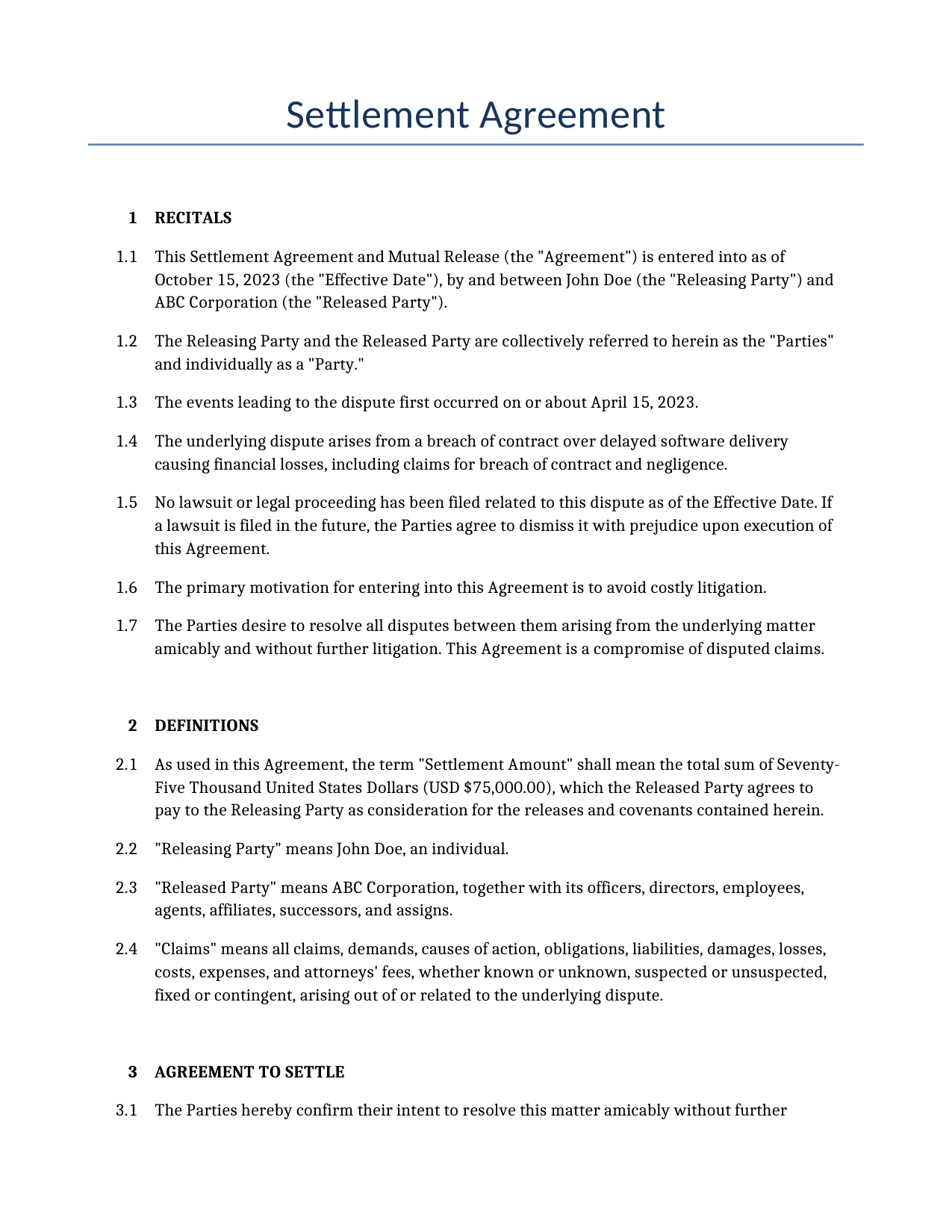
Settlement Agreement and Mutual Release
1RECITALS
This Settlement Agreement and Mutual Release (the "Agreement") is entered into as of October 15, 2023 (the "Effective Date"), by and between John Doe (the "Releasing Party") and ABC Corporation (the "Released Party").
The Releasing Party and the Released Party are collectively referred to herein as the "Parties" and individually as a "Party."
The events leading to the dispute first occurred on or about April 15, 2023.
The underlying dispute arises from a breach of contract over delayed software delivery causing financial losses, including claims for breach of contract and negligence.
No lawsuit or legal proceeding has been filed related to this dispute as of the Effective Date. If a lawsuit is filed in the future, the Parties agree to dismiss it with prejudice upon execution of this Agreement.
The primary motivation for entering into this Agreement is to avoid costly litigation.
The Parties desire to resolve all disputes between them arising from the underlying matter amicably and without further litigation. This Agreement is a compromise of disputed claims.
2DEFINITIONS
As used in this Agreement, the term "Settlement Amount" shall mean the total sum of Seventy-Five Thousand United States Dollars (USD $75,000.00), which the Released Party agrees to pay to the Releasing Party as consideration for the releases and covenants contained herein.
"Releasing Party" means John Doe, an individual.
"Released Party" means ABC Corporation, together with its officers, directors, employees, agents, affiliates, successors, and assigns.
"Claims" means all claims, demands, causes of action, obligations, liabilities, damages, losses, costs, expenses, and attorneys' fees, whether known or unknown, suspected or unsuspected, fixed or contingent, arising out of or related to the underlying dispute.
3AGREEMENT TO SETTLE
The Parties hereby confirm their intent to resolve this matter amicably without further litigation.
This Agreement shall become effective on the Effective Date.
The Parties agree that this Agreement shall be executed on or about the Effective Date.
4RELEASE OF CLAIMS
In consideration of the promises and covenants contained herein, including the payment of the Settlement Amount, each Party hereby irrevocably and unconditionally releases and forever discharges the other Party and its officers, directors, employees, agents, affiliates, successors, and assigns from any and all Claims, including but not limited to claims for breach of contract, negligence, contractual claims, and tort claims, whether known or unknown, arising out of or related to the underlying dispute described herein. This is a mutual release and is reciprocal between the Parties.
Each Party acknowledges that this release constitutes a full and final release of all claims, known and unknown, arising from the underlying matter.
Each Party expressly waives any and all rights and benefits conferred by the provisions of California Civil Code Section 1542, which states: "A general release does not extend to claims that the creditor or releasing party does not know or suspect to exist in his or her favor at the time of executing the release and that, if known by him or her, would have materially affected his or her settlement with the debtor or released party."
The release provided herein shall become effective on the Effective Date and shall be irrevocable upon the execution of this Agreement by the Parties.
The mutual release is explicit and reciprocal, with each Party releasing the other from all Claims arising from the underlying dispute, including unknown claims under California law.
5PAYMENT TERMS
The Released Party shall pay to the Releasing Party the Settlement Amount of Seventy-Five Thousand United States Dollars (USD $75,000.00) as a lump sum payment by wire transfer. The Settlement Amount includes all interest, if any, and is in full satisfaction of all claims, including any claims for interest.
The lump sum payment shall be made on or before January 15, 2024.
The Released Party shall pay interest on any overdue amounts at the rate of one and one-half percent (1.5%) per month until paid in full.
No conditions precedent to payment other than the execution of this Agreement by the Parties are required.
6CONFIDENTIALITY
The Parties agree that the terms of this Agreement and any information relating to the underlying dispute shall be kept confidential.
Disclosures of confidential information shall be permitted to the Parties' attorneys and to the spouse or domestic partner of any Party, provided that such persons agree to maintain the confidentiality of the information.
The non-disclosure obligation shall apply equally to all Parties and shall last indefinitely.
In the event of a breach of this confidentiality provision, the non-breaching Party shall be entitled to seek injunctive relief and actual damages, without the need to post a bond.
Notwithstanding the foregoing, the confidentiality obligations shall not apply to disclosures required by law, court order, subpoena, regulatory agency, or tax authorities (including for tax reporting purposes). The Parties may also disclose the terms of this Agreement to enforce its provisions in any legal proceeding.
7NON-DISPARAGEMENT
The Parties agree to a mutual non-disparagement obligation whereby neither the Releasing Party, the Released Party, their employees, nor their agents shall make any oral statements, written statements, social media posts, or online reviews that disparage the other Party regarding the breach of contract dispute arising on or about April 15, 2023. For purposes of this business dispute, disparagement includes false or misleading statements that could reasonably be expected to harm the other Party's business reputation.
In the event of a breach of this non-disparagement provision, the non-breaching Party shall be entitled to seek injunctive relief.
8NO ADMISSION OF LIABILITY
This Agreement is not, and shall not in any way be construed as, an admission by the Released Party or any of its officers, directors, employees, agents, affiliates, successors, or assigns of any wrongdoing, fault, liability, or violation of any law, statute, or regulation. It is not an admission of any claims, including but not limited to claims for breach of contract or negligence. This Agreement may not be used or admitted into evidence in any proceeding except to enforce its terms or as otherwise required by law.
The provisions of this section shall become effective on the Effective Date.
9REPRESENTATIONS AND WARRANTIES
Each Party represents and warrants that it has the full legal capacity and authority to enter into this Agreement and to perform its obligations hereunder.
The Releasing Party represents and warrants that it has not transferred, assigned, or otherwise disposed of any Claims that are being settled under this Agreement.
The Releasing Party (an individual) represents that he has read and fully understands this Agreement, including the waiver of rights under California Civil Code Section 1542, that he is entering into this Agreement voluntarily after having had the opportunity to consult with counsel, that he is duly authorized to execute this Agreement, and that there are no conflicting obligations that would prevent him from entering into this Agreement.
The Released Party represents and warrants that the individual signing on its behalf is duly authorized to execute this Agreement on its behalf and that there are no pending litigations or proceedings that could affect its authority to enter this Agreement.
10INDEMNIFICATION
Each Party shall indemnify, defend, and hold harmless the other Party from and against any and all third-party claims, losses, and liabilities arising from its own breach of the representations, warranties, or covenants in this Agreement, including any claims related to the released matters that are asserted against the other Party.
The indemnified Party shall provide prompt notice to the indemnifying Party of any claim that may give rise to indemnification under this Agreement.
The indemnifying Party shall have the right to control the defense and settlement of any indemnified claim, provided that no settlement shall impose any obligation on the indemnified Party without its consent.
11GOVERNING LAW
This Agreement shall be governed by and construed in accordance with the laws of the State of California, without regard to its conflict of laws principles.
12DISPUTE RESOLUTION
Any dispute arising out of or relating to this Agreement shall first be subject to mediation administered by a mutually agreed mediator in accordance with the laws of the State of California.
If the dispute is not resolved by mediation, it shall be resolved by binding arbitration under the rules of the American Arbitration Association.
13ENTIRE AGREEMENT
This Agreement constitutes the entire understanding between the Parties and supersedes all prior agreements, understandings, and negotiations regarding the subject matter hereof.
This Agreement may only be modified by a written instrument signed by both Parties.
14SEVERABILITY
If any provision of this Agreement is held to be invalid or unenforceable, the remaining provisions shall remain in full force and effect, and the Parties shall negotiate in good faith to replace the invalid provision with a valid one that achieves the original intent.
15WAIVER OF RIGHTS
The failure of any Party to enforce any provision of this Agreement shall not constitute a waiver of the right to enforce that provision or any other provision at a later time.
This waiver provision applies mutually to all Parties.
16ASSIGNMENT
Neither the Releasing Party nor the Released Party may assign any rights or obligations under this Agreement without the prior written consent of the other Party.
This Agreement shall be binding upon and inure to the benefit of the Parties' respective successors and assigns.
17NOTICES
All notices required or permitted under this Agreement shall be in writing and delivered by personal delivery, certified mail, or email to the following addresses: for the Releasing Party, 123 Main Street, Suite 100, Anytown, CA 90210; for the Released Party, 456 Oak Avenue, Suite 500, Othertown, CA 90210.
Each Party shall notify the other Party in writing of any change in address.
18COUNTERPARTS
This Agreement may be executed in one or more counterparts, each of which shall be deemed an original, but all of which together shall constitute one and the same instrument.
19HEADINGS
The headings in this Agreement are for convenience of reference only and shall not affect the interpretation of this Agreement.
20INTERPRETATION
This Agreement has been jointly drafted by the Parties, and no presumption or burden of proof shall arise favoring or disfavoring any Party by virtue of the authorship of any provision. This Agreement shall be construed as a whole according to its fair meaning and not strictly for or against any Party. There are no exhibits attached to this Agreement.
21TAXES
The Released Party will issue an IRS Form 1099 to the Releasing Party if required by law. The Parties acknowledge that settlement payments for breach of contract are generally taxable as ordinary income to the recipient under U.S. law. Each Party shall be responsible for its own tax obligations arising from this Agreement and shall report the payments consistently with applicable law. The Parties make no representations regarding the tax treatment of the Settlement Amount.
22FORCE MAJEURE
Neither Party shall be liable for any delay or failure to perform its obligations under this Agreement if such delay or failure is due to acts of God, war or terrorism, pandemics or epidemics, or other events beyond the reasonable control of the Party.
Economic hardship or financial difficulties shall not constitute a force majeure event.
The affected Party shall provide written notice of any force majeure event within a reasonable time.
The affected Party shall use reasonable efforts to mitigate the effects of any force majeure event.
Force majeure shall not excuse any payment obligations under this Agreement.
23NON-INTERFERENCE
The Parties mutually agree not to encourage, assist, or interfere with any third parties in bringing claims against the other Party related to the underlying dispute, for a period of five (5) years beginning on the Effective Date.
Exceptions to this non-interference provision include lawful competition or disclosures required by law.
In the event of a breach of this non-interference provision, the non-breaching Party shall be entitled to injunctive relief, monetary damages, and recovery of attorney fees.
24SURVIVAL
The following provisions shall survive the termination or completion of this Agreement: the Release of Claims (Section 4), Confidentiality (Section 6), Non-Disparagement (Section 7), No Admission of Liability (Section 8), Representations and Warranties (Section 9), Indemnification (Section 10), Governing Law (Section 11), Dispute Resolution (Section 12), Taxes (Section 21), Non-Interference (Section 23), Attorneys' Fees and Costs (Section 27), and any other provision that by its nature is intended to survive.
25COMPLIANCE WITH APPLICABLE LAW
This Agreement is intended to comply with all applicable provisions of California contract law, including but not limited to California Civil Code Sections 1541 and 1542, and general release enforceability under federal and state law. The Parties acknowledge that this Agreement resolves a commercial breach of contract dispute and does not involve employment or labor claims.
The Parties acknowledge that this Agreement does not waive any rights or claims that may arise after the date of execution.
26DISMISSAL OF CLAIMS
If a lawsuit is filed in the future related to the claims being settled herein, the Parties shall file a stipulation of dismissal with prejudice in accordance with applicable court rules.
27ATTORNEYS' FEES AND COSTS
Each Party shall bear its own attorneys' fees and costs incurred in connection with the underlying dispute and the negotiation and execution of this Agreement.
The Settlement Amount is in full satisfaction of all claims, including any claims for attorneys' fees, costs, and expenses. There are no exceptions unless expressly provided in another section of this Agreement (such as for enforcement actions).
28EXECUTION
IN WITNESS WHEREOF, the Parties have executed this Agreement as of the Effective Date.
Releasing Party: _______________________________ Date: _______________ John Doe
Released Party: _______________________________ Date: _______________ ABC Corporation By: _______________________________ Its: Authorized Signatory
This example shows approximately 70% of a typical document and is provided for illustrative purposes only. The remaining content has been omitted.
Every document generated by Docaro is tailored to your specific circumstances, jurisdiction and the information you provide. The completed document includes all applicable clauses and provisions required for your situation.
To generate the full, personalised document, answer a short series of questions and your document will be created instantly.