
AI Generated American Cookie Policy
PDF & Word - 2026 Updated
Docaro Pricing
When Do You Need a Cookie Policy in the United States?
American Legal Rules for a Cookie Policy
Failing to incorporate clear consent mechanisms and user rights notifications can lead to non-compliance with federal and state privacy regulations.
What a Proper Cookie Policy Should Include
- Introduction to CookiesExplain what cookies are and how your website uses them to improve user experience.
- Types of Cookies UsedList the different kinds of cookies on your site, like essential ones for functionality and optional ones for tracking.
- Data CollectedDescribe the information cookies gather, such as browsing habits or preferences, without identifying users personally.
- Purpose of CookiesState why cookies are used, for example, to remember logins, personalize content, or analyze site traffic.
- User Choices and ConsentInform users how they can accept or reject non-essential cookies and manage their preferences.
- Third-Party CookiesMention if third parties like advertisers use cookies on your site and how users can control them.
- Data Sharing and SecurityOutline how collected data is protected and shared only as needed, keeping user privacy in mind.
- Policy UpdatesNote that the policy may change and advise users to check back for the latest version.
Generate Your Document in 4 Easy Steps
Why Use Docaro?
 United States
Free Example Cookie Policy Template
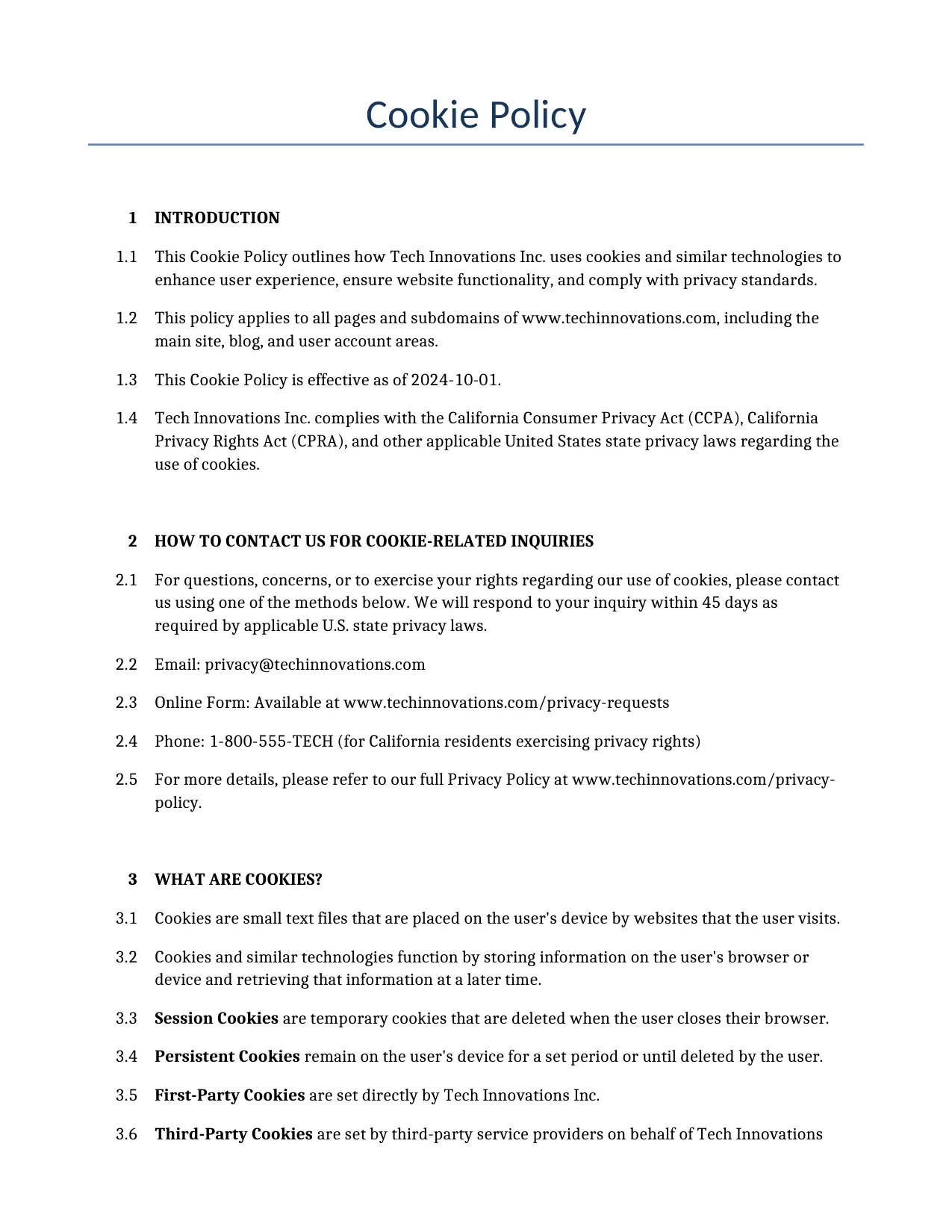
Below is a free template example of a Cookie Policy for use in the United States generated by our AI model.
The clauses in your actual Cookie Policy will vary from this example as they will be entirely bespoke to your requirements as set out in the questionnaire you complete.
Cookie Policy
1INTRODUCTION
This Cookie Policy outlines how Tech Innovations Inc. uses cookies and similar technologies to enhance user experience, ensure website functionality, and comply with privacy standards.
This policy applies to all pages and subdomains of www.techinnovations.com, including the main site, blog, and user account areas.
This Cookie Policy is effective as of 2024-10-01.
Tech Innovations Inc. complies with the California Consumer Privacy Act (CCPA), California Privacy Rights Act (CPRA), and other applicable United States state privacy laws regarding the use of cookies.
2HOW TO CONTACT US FOR COOKIE-RELATED INQUIRIES
For questions, concerns, or to exercise your rights regarding our use of cookies, please contact us using one of the methods below. We will respond to your inquiry within 45 days as required by applicable U.S. state privacy laws.
Email: privacy@techinnovations.com
Online Form: Available at www.techinnovations.com/privacy-requests
Phone: 1-800-555-TECH (for California residents exercising privacy rights)
For more details, please refer to our full Privacy Policy at www.techinnovations.com/privacy-policy.
3WHAT ARE COOKIES?
Cookies are small text files that are placed on the user's device by websites that the user visits.
Cookies and similar technologies function by storing information on the user's browser or device and retrieving that information at a later time.
Session Cookies are temporary cookies that are deleted when the user closes their browser.
Persistent Cookies remain on the user's device for a set period or until deleted by the user.
First-Party Cookies are set directly by Tech Innovations Inc.
Third-Party Cookies are set by third-party service providers on behalf of Tech Innovations Inc.
Cookies play a significant role in enhancing user experience by enabling website functionality, remembering preferences, and providing personalized content.
4TYPES OF COOKIES WE USE
We clearly distinguish between necessary cookies (which are essential for the website to function and do not require consent) and non-necessary cookies (which require your consent or an opt-out under CCPA/CPRA and other U.S. state laws such as the Colorado Privacy Act (CPA), Virginia Consumer Data Protection Act (CDPA), Connecticut Data Privacy Act (CTDPA), and Utah Consumer Privacy Act (UCPA)). Non-necessary cookies include those used for performance, functionality, analytics, and targeting/advertising.
Below is a detailed list of cookie categories:
Essential (Necessary): These cookies are strictly necessary to provide the website services you request, such as enabling core functionality like navigation and access to secure areas. They cannot be switched off. Examples: session_id (purpose: maintains user session; provider: Tech Innovations Inc.; duration: session). Consent not required.
Performance: These help us understand how visitors interact with the website by collecting and reporting information anonymously. Examples: _ga (Google Analytics, purpose: distinguishes users; provider: Google; duration: persistent, expires in 2 years), _hjAbsoluteSessionInProgress (Hotjar, purpose: detects first pageview; provider: Hotjar; duration: session). Consent required for non-essential use.
Functionality: These allow the website to remember choices you make (such as your language or region) and provide enhanced, personalized features. Examples: lang (purpose: remembers language preference; provider: Tech Innovations Inc.; duration: persistent, expires in 1 year). Consent required.
Analytics: These help us measure and analyze how our website is used to improve its performance. Examples: _ga (Google Analytics, purpose: tracks page views and sessions; provider: Google; duration: persistent, expires in 2 years), _hjIncludedInSample (Hotjar, purpose: determines if user is in sample for heatmaps; provider: Hotjar; duration: session). Consent required.
Targeting/Advertising: These are used to deliver personalized advertisements and track their effectiveness. Examples: _gcl_aw (Google Ads, purpose: tracks ad conversions; provider: Google; duration: persistent, expires in 90 days), _fbp (Facebook Pixel, purpose: stores and tracks visits; provider: Meta; duration: persistent, expires in 90 days). Consent required; sharing may constitute a 'sale' under CCPA/CPRA - see sections below for opt-out rights.
5HOW WE USE COOKIES
Tech Innovations Inc. uses cookies to improve website functionality, analyze user behavior, personalize content, and for targeted advertising, in compliance with applicable U.S. privacy laws.
We use functionality cookies to remember user preferences, such as language settings and login information, to enhance navigation and user experience on the site.
We use analytics cookies to track page views, session duration, and user interactions to understand how visitors use the website and optimize its performance.
We use personalization cookies to tailor content recommendations based on past browsing history, such as suggesting relevant articles or products to individual users.
We use advertising cookies to deliver personalized ads by tracking user interests across sites, ensuring advertisements are relevant to the user's previous online activities. See the Data Collection and Sharing section for details on how this may constitute a sale under CCPA/CPRA.
6THIRD-PARTY COOKIES AND SERVICES
Tech Innovations Inc. uses third-party analytics services including Google Analytics and Hotjar.
Google Analytics is used to track website traffic, user behavior, and performance metrics to improve site functionality and user experience.
Hotjar collects heatmaps, session recordings, and survey data to understand how visitors interact with the site and gather feedback.
Tech Innovations Inc. uses third-party advertising networks or services including Google Ads and Facebook Pixel.
Google Ads collects data on user interactions with ads, including clicks and impressions, to optimize ad targeting and measure campaign effectiveness.
The Facebook Pixel tracks user actions such as page views, add-to-cart events, and purchases to enable retargeting and conversion tracking across Facebook platforms.
Tech Innovations Inc. embeds social media plugins or widgets on the website including the Facebook Like Button and Twitter Tweet Button.
The Facebook Like Button allows users to like content on the site and share it on Facebook.
The Facebook Like Button collects data on user interactions, such as likes and shares, and may track user behavior if the user is logged into Facebook.
The Twitter Tweet Button enables users to tweet content from the site.
The Twitter Tweet Button collects data on tweet actions and may share information about the user's visit to Twitter for personalization purposes.
7COOKIE LIST
The following is a comprehensive categorized list of specific cookies used on our website, based on our use of Google Analytics, Hotjar, Google Ads, Facebook Pixel, and social plugins. Consent is required for all non-essential cookies under applicable U.S. laws.
Essential Cookies: session_id (Category: Essential; Provider: Tech Innovations Inc.; Purpose: Maintains user login session; Duration: Session; Consent Required: No).
Performance/Analytics Cookies: _ga (Category: Analytics; Provider: Google; Purpose: Distinguishes users and tracks sessions; Duration: Persistent, expires after 2 years; Consent Required: Yes), _hjAbsoluteSessionInProgress (Category: Analytics; Provider: Hotjar; Purpose: Detects first pageview in session; Duration: Session; Consent Required: Yes).
Functionality Cookies: pref_lang (Category: Functionality; Provider: Tech Innovations Inc.; Purpose: Remembers language preference; Duration: Persistent, expires after 1 year; Consent Required: Yes).
Targeting/Advertising Cookies: _gcl_aw (Category: Targeting/Advertising; Provider: Google; Purpose: Tracks ad conversions for Google Ads; Duration: Persistent, expires after 90 days; Consent Required: Yes), _fbp (Category: Targeting/Advertising; Provider: Meta; Purpose: Tracks visits for Facebook Pixel retargeting; Duration: Persistent, expires after 90 days; Consent Required: Yes), fr (Category: Targeting/Advertising; Provider: Meta; Purpose: Used for Facebook advertising; Duration: Persistent, expires after 90 days; Consent Required: Yes).
8YOUR COOKIE CHOICES AND CONTROLS
Users may manage cookies through their browser settings by adjusting preferences to accept, block, or delete cookies.
Tech Innovations Inc. uses a cookie consent management tool on the website.
Tech Innovations Inc. offers opt-out mechanisms for tracking and advertising cookies including the Do Not Track Browser Signal, Third-Party Opt-Out Tools, and Global Privacy Control (GPC). We honor GPC signals, which communicate your opt-out preference for the sale of personal information and targeted advertising via cookies.
Users may exercise granular preferences for tracking cookies separately from advertising cookies through the cookie settings panel.
Users may utilize advertising-related controls including Interest-Based Advertising Opt-Out and Retargeting Ad Preferences. California residents and residents of other states may opt-out of the sale of their personal information under CCPA/CPRA via our 'Do Not Sell or Share My Personal Information' link or button located in the footer of our website.
9COOKIE CONSENT AND WITHDRAWAL
Tech Innovations Inc. implements a cookie consent banner to obtain user consent for non-essential cookies.
The consent mechanisms implemented for cookies include an Opt-in Banner for non-essential cookies and Implied Consent for Essentials.
This website uses cookies to enhance your experience. By clicking 'Accept', you consent to our use of non-essential cookies for analytics and personalization. You can manage preferences anytime.
To withdraw consent, the user must visit the Cookie Settings in the footer of the website and adjust preferences.
Changes to cookie preferences take effect immediately.
The methods offered for users to withdraw cookie consent include the Cookie Settings Panel and a Footer Link.
Tech Innovations Inc. discloses to users the potential impact on website functionality when consent is withdrawn.
Withdrawing consent for non-essential cookies may limit personalized features, such as recommendations or saved preferences, but essential site functions will remain operational.
Tech Innovations Inc. implements a consent mechanism for third-party cookies and services.
10DATA COLLECTION AND SHARING
The types of cookies that Tech Innovations Inc. uses on the website include Necessary Cookies, Performance Cookies, Functionality Cookies, Analytics Cookies, and Targeting/Advertising Cookies. We distinguish necessary (essential) cookies from non-necessary ones, with consent or opt-out required for the latter under CCPA/CPRA and similar laws.
The specific personal information collected via cookies on the website includes IP addresses, browsing history, device identifiers, and user preferences.
Tech Innovations Inc. processes the personal information collected via cookies for the purposes of Website Functionality, Analytics and Performance, and Marketing and Advertising.
Tech Innovations Inc. encrypts the personal information collected via cookies during processing.
Tech Innovations Inc. stores the personal information collected via cookies on secure servers located in the United States and cloud storage provided by AWS in Virginia.
Tech Innovations Inc. retains the personal information collected via cookies for up to 12 months.
Tech Innovations Inc. shares personal information collected via cookies with Service Providers and Advertising Partners. Sharing cookie data with advertising partners (e.g., Google, Meta) for targeted advertising may constitute a 'sale' of personal information under CCPA/CPRA and other state laws. We do not offer financial incentives for data sharing but receive non-monetary benefits such as improved ad relevance and website revenue from personalized advertising. Users can opt-out of such sales via the 'Do Not Sell or Share My Personal Information' link, GPC signals (which we honor), or by contacting us.
Tech Innovations Inc. provides an opt-out mechanism for California residents and other applicable state residents regarding the sale of their personal information collected via cookies.
11LEGAL BASIS FOR USING COOKIES
Tech Innovations Inc. relies on compliance with applicable U.S. state privacy laws (including CCPA/CPRA, CPA, CDPA, CTDPA, and UCPA), the provision of notice through this policy, and user consent or opt-out mechanisms for non-essential cookies. We do not rely on 'Legitimate Interests' as under GDPR, as U.S. laws emphasize notice, choice, and opt-out rights.
We have a consent mechanism in place for non-essential cookies, such as a cookie banner or preference center.
Tech Innovations Inc. shares cookie data with third parties based on user consent or pursuant to opt-out rights under applicable laws.
12CHILDREN'S PRIVACY
Tech Innovations Inc. does not intend to collect personal information from children under 13 years of age through the website or online service.
The website or online service is not directed to children under 13, meaning it is not primarily aimed at or likely to attract children under 13.
The website or online service, which is intended for a general audience, does not have actual knowledge that it collects personal information from children under 13.
This Children's Privacy section is effective as of 2024-10-01.
In compliance with the Children's Online Privacy Protection Act (COPPA), we do not knowingly collect personal information from children under 13 via cookies or other tracking technologies. If we become aware that a user is under 13 and has provided personal information, we will take steps to delete such information. The site employs age-gating mechanisms on certain features where users must affirm they are over 13; no verification process is used for general browsing as the site is not directed at children.
13DATA SECURITY
Tech Innovations Inc. uses SSL/TLS for data in transit and AES-256 for data at rest to secure cookie data.
Tech Innovations Inc. has implemented access controls to restrict who can access cookie data within the company.
Tech Innovations Inc. complies with ISO 27001 and SOC 2 for protecting cookie data.
Tech Innovations Inc. has a plan in place for notifying affected parties in case of a cookie data breach.
The last security audit related to cookie data protection was conducted on 2024-06-15.
Tech Innovations Inc. conducts reviews of cookie data security measures every 6 months.
14RETENTION OF COOKIE DATA
Tech Innovations Inc. has a defined retention policy for how long cookie data is retained by the website.
The retention period applied to cookie data is a combination of fixed and event-based.
The maximum number of days for which cookie data is retained is 365.
Cookie data is retained for up to one year from the date of collection, or until the user deletes their cookies, whichever comes first.
Data is stored securely and reviewed periodically to ensure compliance with privacy standards.
Tech Innovations Inc. automatically deletes cookie data after the retention period expires.
Tech Innovations Inc. practices anonymization of cookie data before or during retention.
Cookie data is removed or deleted under the circumstances of a user request such as opt-out or deletion request, expiration of retention period, or legal requirement or court order.
Upon expiration or user request, cookie data is automatically purged from the servers using secure deletion methods.
For anonymization, personal identifiers are hashed and stripped from the data prior to long-term storage.
15YOUR RIGHTS UNDER U.S. PRIVACY LAWS
The U.S. state privacy laws that apply to the business for the purposes of informing users about their rights in this Cookie Policy are CCPA/CPRA (California), CPA (Colorado), CDPA (Virginia), CTDPA (Connecticut), and UCPA (Utah).
Under these laws, you have the following rights regarding personal information collected via cookies: right to know/access (what data we collect, categories, sources, purposes, and disclosures/sales), right to delete, right to correct inaccurate information, right to opt-out of sales or sharing for targeted advertising, right to limit use of sensitive personal information (if applicable), and right to non-discrimination for exercising these rights.
Users may submit requests to exercise their privacy rights such as access or deletion via email to privacy@techinnovations.com or through the online form on the website. We verify requests by matching provided information to our records (e.g., email, account details) and may request additional information if needed to prevent fraud. We respond to verified requests within 45 days (extendable by another 45 days if necessary). If we deny a request, you may appeal, and we will respond within 45 days with an explanation and any actions taken.
Users may contact privacy@techinnovations.com regarding their U.S. privacy rights under this Cookie Policy.
Tech Innovations Inc. commits to responding to verified privacy rights requests within 45 days.
16INTERNATIONAL DATA TRANSFERS
While Tech Innovations Inc. operates primarily in the United States and U.S. laws apply to our data practices, we note potential cross-border implications for international users. Cookie data may be transferred to or accessed from other jurisdictions for operational purposes.
Tech Innovations Inc. transfers cookie data to European Union Countries and the United Kingdom in limited cases (e.g., for EU-based service providers).
Tech Innovations Inc. transfers session IDs, user preferences, and analytics data from cookies to servers in the EU and UK for the purpose of providing personalized content and improving website performance.
The safeguards in place for international transfers of cookie data are the EU-US Data Privacy Framework, UK adequacy decisions, Standard Contractual Clauses, Encryption and Technical Measures.
Tech Innovations Inc. complies with the EU-US Data Privacy Framework, the UK's adequacy decision, as well as GDPR requirements where applicable for data transfers, regarding these international data transfers of cookie data. For users in other regions, additional safeguards may apply as per our Privacy Policy.
17CALIFORNIA-SPECIFIC DISCLOSURES
Under CCPA/CPRA, we provide the following disclosures for personal information collected via cookies: Categories collected include Identifiers (e.g., IP address, cookie IDs), Internet or Electronic Network Activity (e.g., browsing history, interactions), and Inferences (e.g., preferences derived from activity).
Purposes for collection: to provide website functionality, perform analytics, personalize content, and enable targeted advertising.
We may sell or share this information with advertising partners for cross-context behavioral advertising. You have the right to opt-out via our 'Do Not Sell or Share My Personal Information' link or by using the GPC signal.
For a full description of our practices, please see our Privacy Policy at www.techinnovations.com/privacy-policy.
Do Not Sell or Share My Personal Information: California residents may exercise this right by clicking the link in our website footer or contacting us at privacy@techinnovations.com.
18UPDATES TO THIS COOKIE POLICY
Updates to this Cookie Policy will be triggered by changes in applicable laws or regulations, modifications to cookie usage practices, or advancements in privacy technology.
Tech Innovations Inc. uses posting a notice on the website and a banner or pop-up alert on the site for notifying users about updates to this Cookie Policy.
Users will be provided with advance notice before Cookie Policy updates take effect.
The effective date for this Cookie Policy is 2024-10-01.
The updated policy will take effect immediately upon posting on the website, unless otherwise specified.
The last updated date for this Cookie Policy is 2024-10-01.
19CONTACT INFORMATION
Users may direct questions, complaints, or requests related to this Cookie Policy to privacy@techinnovations.com.
The physical address for Tech Innovations Inc. is 123 Main Street, New York, NY 10001.
20SIGNATURE
By using the website, the user acknowledges that they have read, understood, and agree to be bound by this Cookie Policy.
Tech Innovations Inc.: _______________________________ Date: _______________
User: _______________________________ Date: _______________
This example shows approximately 70% of a typical document and is provided for illustrative purposes only. The remaining content has been omitted.
Every document generated by Docaro is tailored to your specific circumstances, jurisdiction and the information you provide. The completed document includes all applicable clauses and provisions required for your situation.
To generate the full, personalised document, answer a short series of questions and your document will be created instantly.