
AI Generated Promotion Justification Memorandum for use in the United States
PDF & Word - 2026 Updated
Docaro Pricing
When Do You Need a Promotion Justification Memorandum in the United States?
American Legal Rules for a Promotion Justification Memorandum
Using the wrong structure for a promotion justification memo can undermine its persuasiveness and lead to internal policy violations.
What a Proper Promotion Justification Memorandum Should Include
- Employee DetailsInclude the employee's full name, current position, department, and length of service to clearly identify who is being recommended.
- Reason for PromotionState the specific reasons for the promotion, such as outstanding performance or added responsibilities.
- Performance AchievementsHighlight key accomplishments and contributions that demonstrate the employee's value to the company.
- New Role DescriptionDescribe the proposed new position, including its duties and how it aligns with the employee's skills.
- Impact on CompanyExplain how the promotion will benefit the organization, such as improving efficiency or supporting growth.
- Recommendation and ApprovalProvide a clear endorsement from the supervisor and space for management approval signatures.
Generate Your Document in 4 Easy Steps
Why Use Docaro?
 United States
Free Example Promotion Justification Memorandum Template
Below is a free template example of a Promotion Justification Memorandum for use in the United States generated by our AI model.
The clauses in your actual Promotion Justification Memorandum will vary from this example as they will be entirely bespoke to your requirements as set out in the questionnaire you complete.
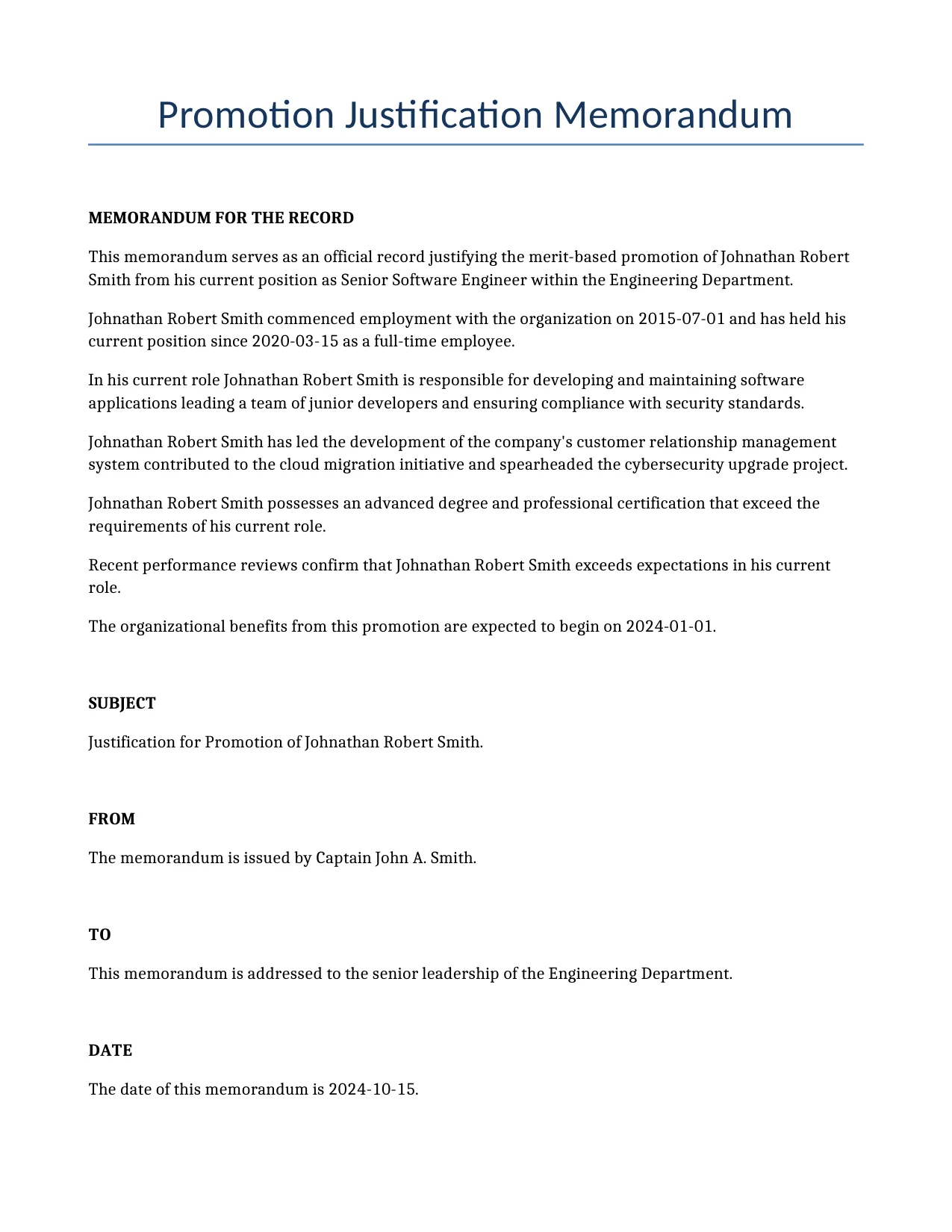
Promotion Justification Memorandum
MEMORANDUM FOR THE RECORD
This memorandum serves as an official record justifying the merit-based promotion of Johnathan Robert Smith from his current position as Senior Software Engineer within the Engineering Department.
Johnathan Robert Smith commenced employment with the organization on 2015-07-01 and has held his current position since 2020-03-15 as a full-time employee.
In his current role Johnathan Robert Smith is responsible for developing and maintaining software applications leading a team of junior developers and ensuring compliance with security standards.
Johnathan Robert Smith has led the development of the company's customer relationship management system contributed to the cloud migration initiative and spearheaded the cybersecurity upgrade project.
Johnathan Robert Smith possesses an advanced degree and professional certification that exceed the requirements of his current role.
Recent performance reviews confirm that Johnathan Robert Smith exceeds expectations in his current role.
The organizational benefits from this promotion are expected to begin on 2024-01-01.
SUBJECT
Justification for Promotion of Johnathan Robert Smith.
FROM
The memorandum is issued by Captain John A. Smith.
TO
This memorandum is addressed to the senior leadership of the Engineering Department.
DATE
The date of this memorandum is 2024-10-15.
INTRODUCTION
The primary purpose of this Promotion Justification Memorandum is to formally recommend the merit-based promotion of Johnathan Robert Smith to the position of Senior Software Engineer highlighting his exceptional performance and contributions to the team over the past three years.
PURPOSE
This memorandum recommends the promotion of Johnathan Robert Smith to Senior Software Engineer at Level 7 effective 2024-01-15.
EMPLOYEE IDENTIFICATION
The employee for whom the promotion is being justified is Johnathan Robert Smith who is identified by employee number 123456.
CURRENT POSITION AND PERFORMANCE SUMMARY
Johnathan Robert Smith currently holds the position of Senior Software Engineer in the Engineering Department and has served in this role for three full years.
Over the past year Johnathan Robert Smith has led the development of a new customer-facing application that increased user engagement by 40 percent mentored junior developers resulting in a 25 percent improvement in team productivity and successfully managed cross-departmental projects delivering all milestones on time and under budget.
Johnathan Robert Smith has consistently exceeded his performance goals in his current role.
JUSTIFICATION FOR PROMOTION
The promotion of Johnathan Robert Smith is justified by his consistent superior performance including leading a key project that improved system efficiency and his expanded role in mentoring junior staff which demonstrates qualifications well beyond his current position.
Johnathan Robert Smith's skills directly align with the requirements of the Senior Software Engineer Level 7 position. He possesses advanced expertise in software architecture cloud systems and cybersecurity which are essential for the role's focus on complex system design and innovation. His proven track record in leading development teams and delivering high-impact projects matches the leadership and technical proficiency outlined in the position description.
The anticipated organizational benefits of this promotion include a projected 30 percent reduction in project delivery timelines for critical initiatives improved code quality leading to 20 percent fewer production incidents and enhanced team capability through targeted mentoring resulting in measurable gains in overall department productivity and innovation output.
KEY ACCOMPLISHMENTS
Johnathan Robert Smith has exceeded project goals led successful initiatives and received awards or recognition.
Over the past three years Johnathan Robert Smith has consistently driven improvements by exceeding performance targets through strategic technical leadership and innovative solution development.
Johnathan Robert Smith led a cross-functional team in developing a new customer relationship management system that streamlined operations and reduced processing time by 40 percent resulting in significant cost savings for the department.
Johnathan Robert Smith possesses eight years of relevant experience in his field.
Johnathan Robert Smith led a high-stakes project to implement an AI-driven analytics platform which involved coordinating with IT marketing and external vendors over six months managing a budget of 150000 dollars and ensuring on-time delivery despite shifting priorities.
This project increased forecasting accuracy by 35 percent leading to improved efficiency while positioning the company as a leader in data-driven decision-making within the industry.
SKILLS AND COMPETENCIES
Johnathan Robert Smith possesses strong leadership skills having led a team of five in project management for the past three years.
Johnathan Robert Smith demonstrates technical expertise in data analysis using tools such as SQL and Python which has enabled him to optimize processes and deliver actionable insights.
The communication skills of Johnathan Robert Smith allow him to effectively present complex information to stakeholders ensuring alignment and buy-in.
These competencies align with the requirements of the promoted position as Johnathan Robert Smith has demonstrated leadership by spearheading a cross-functional team that reduced project delivery time by 20 percent his technical expertise in software development matches the need for innovative problem-solving and his communication skills have been key in technical discussions.
Johnathan Robert Smith possesses eight years of relevant experience in skills applicable to the promoted position.
PROPOSED PROMOTION DETAILS
The proposed new position title for the promotion is Senior Software Engineer.
This promotion is permanent and is based on a level system with the new level designated as Level 7.
The promotion includes a salary adjustment and shall be effective on 2024-01-15.
The new salary range after promotion will be $145000 to $165000 annually depending on final determination within the established pay band for Level 7.
The promotion includes no change in benefits or work schedule but will expand supervisory responsibilities to include direct oversight of up to eight junior engineers and technical leads.
ORGANIZATIONAL IMPACT
Promoting Johnathan Robert Smith to a senior role will enhance the team's ability to manage complex projects more effectively leading to faster decision-making and better resource allocation across the department which will ultimately drive higher overall performance and support organizational goals for innovation and growth.
This promotion will impact increased productivity improved team morale and enhanced strategic capabilities.
Measurable efficiency gains are anticipated from this promotion and eight team members will be positively impacted.
POTENTIAL CONCERNS AND MITIGATIONS
Possible concerns include salary compression relative to peers at Level 7 and potential impact on team dynamics due to expanded supervisory responsibilities. These have been addressed through a comprehensive market analysis confirming the proposed compensation is aligned with internal benchmarks and by developing a structured onboarding plan for the new responsibilities that includes leadership training and clear communication to the team.
Budget implications for the salary adjustment have been reviewed and approved within the department's fiscal plan for the upcoming year with no adverse effects on other planned expenditures.
COMPLIANCE WITH POLICIES
The organization confirms that this promotion adheres to all relevant company policies and procedures.
This promotion complies with Title VII of the Civil Rights Act the Equal Pay Act the Fair Labor Standards Act (FLSA) the Age Discrimination in Employment Act of 1967 (ADEA) and all other applicable provisions of American law governing equal employment opportunity and nondiscrimination in the private sector. The promotion does not create any conflict of interest the selection process was competitive and merit-based and all required internal approvals have been obtained.
The company's promotion policy was last reviewed and updated on 2023-06-15.
Human resources has approved this promotion in accordance with company procedures.
SUPPORTING DOCUMENTATION
Performance Review Report dated 2024-09-01: Summarizes Johnathan Robert Smith's annual performance ratings and key achievements.
Project Completion Certificates dated 2022-2024: Documents successful leadership of major software development initiatives.
Letters of Endorsement dated 2024-10-01: Provides peer and stakeholder recommendations supporting the promotion.
All documentation has been reviewed by Human Resources and meets company retention and privacy standards under applicable U.S. laws such as the Americans with Disabilities Act.
RECOMMENDATION
The undersigned strongly recommends the approval of the promotion for Johnathan Robert Smith to the position of Senior Software Engineer at Level 7 effective 2024-01-15.
This recommendation is based on the employee's exceptional leadership consistent exceedance of performance targets over the past three years and leadership of successful team projects that increased departmental efficiency by 25 percent.
SIGNATURE
John A. Smith, Engineering Manager _______________________________ Date: ________________
HR Representative: Jane R. Doe, Director of Human Resources _______________________________ Date: ________________
This example shows approximately 70% of a typical document and is provided for illustrative purposes only. The remaining content has been omitted.
Every document generated by Docaro is tailored to your specific circumstances, jurisdiction and the information you provide. The completed document includes all applicable clauses and provisions required for your situation.
To generate the full, personalised document, answer a short series of questions and your document will be created instantly.