
AI Generated American Patent License Agreement
PDF & Word - 2026 Updated
Docaro Pricing
When do you need a Patent License Agreement in the United States?
American Legal Rules for a Patent License Agreement
Using the wrong type of patent license agreement can inadvertently grant broader rights or fail to protect essential intellectual property interests.
What a Proper Patent License Agreement Should Include
- Parties InvolvedClearly identify the patent owner granting the license and the person or company receiving it.
- Granted RightsSpecify what rights the licensee gets, such as making, using, selling, or importing products covered by the patent.
- Territory and Time LimitsDefine the geographic areas where the license applies and how long it lasts, including any renewal options.
- Payment TermsOutline how the licensee will pay, including upfront fees, ongoing royalties, or milestones.
- Keeping Records and AuditingRequire the licensee to maintain sales records and allow the licensor to check them for accurate payments.
- Quality StandardsSet rules to ensure the licensee's products meet quality levels that protect the patent's reputation.
- Protecting the PatentDetail how the licensee must help enforce the patent against infringers and handle legal challenges.
- What Happens if Rules Are BrokenExplain the consequences of violations, like terminating the agreement or seeking damages.
- Ending the AgreementDescribe conditions under which the license can end, such as expiration or breach, and what happens afterward.
- Solving DisputesState how disagreements will be resolved, often through negotiation, mediation, or court in a specific location.
- Other Key DetailsCover additional topics like confidentiality, insurance requirements, and any special notices needed.
Generate Your Document in 4 Easy Steps
Why Use Docaro?
 United States
Free Example Patent License Agreement Template
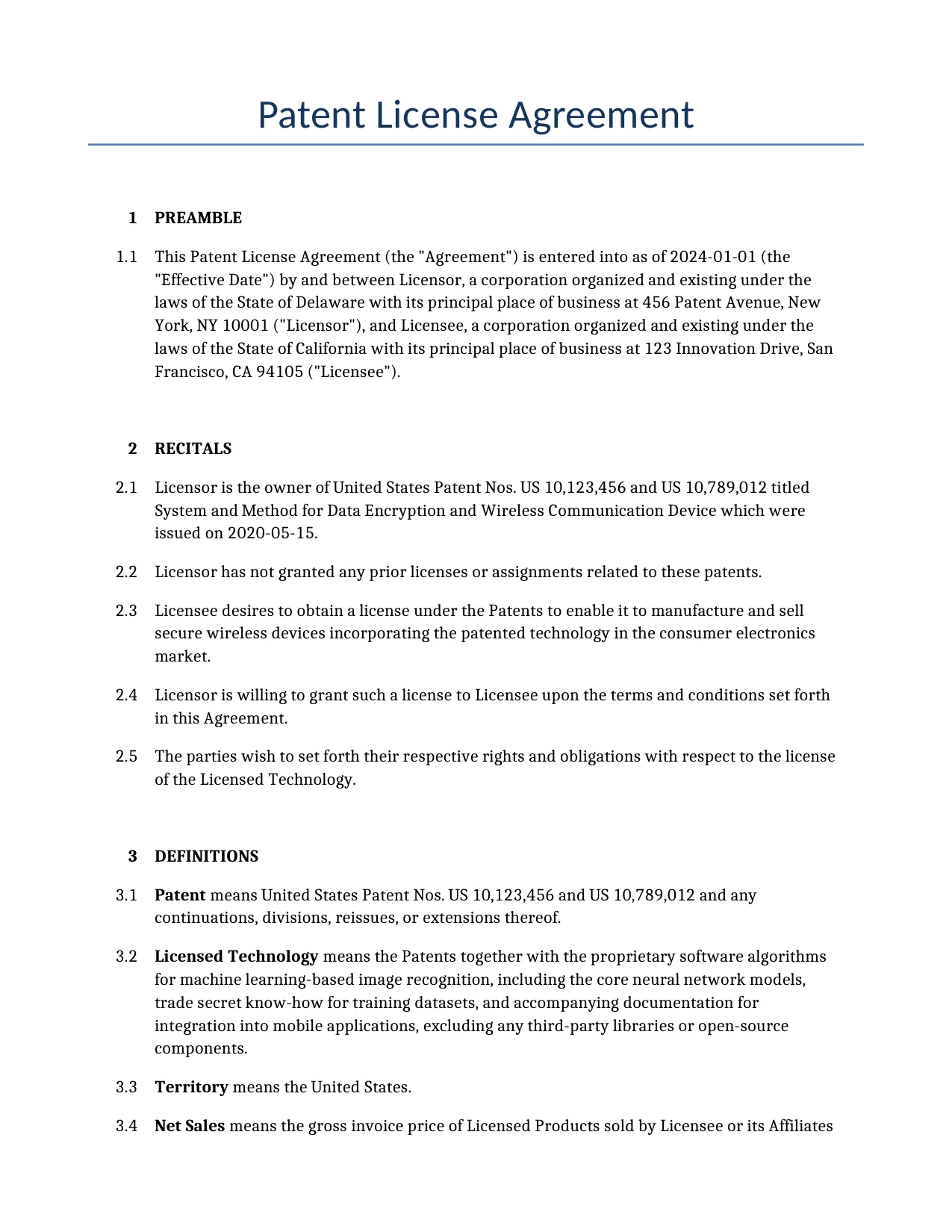
Below is a free template example of a Patent License Agreement for use in the United States generated by our AI model.
The clauses in your actual Patent License Agreement will vary from this example as they will be entirely bespoke to your requirements as set out in the questionnaire you complete.
Patent License Agreement
1PREAMBLE
This Patent License Agreement (the "Agreement") is entered into as of 2024-01-01 (the "Effective Date") by and between Licensor, a corporation organized and existing under the laws of the State of Delaware with its principal place of business at 456 Patent Avenue, New York, NY 10001 ("Licensor"), and Licensee, a corporation organized and existing under the laws of the State of California with its principal place of business at 123 Innovation Drive, San Francisco, CA 94105 ("Licensee").
2RECITALS
Licensor is the owner of United States Patent Nos. US 10,123,456 and US 10,789,012 titled System and Method for Data Encryption and Wireless Communication Device which were issued on 2020-05-15.
Licensor has not granted any prior licenses or assignments related to these patents.
Licensee desires to obtain a license under the Patents to enable it to manufacture and sell secure wireless devices incorporating the patented technology in the consumer electronics market.
Licensor is willing to grant such a license to Licensee upon the terms and conditions set forth in this Agreement.
The parties wish to set forth their respective rights and obligations with respect to the license of the Licensed Technology.
3DEFINITIONS
Patent means United States Patent Nos. US 10,123,456 and US 10,789,012 and any continuations, divisions, reissues, or extensions thereof.
Licensed Technology means the Patents together with the proprietary software algorithms for machine learning-based image recognition, including the core neural network models, trade secret know-how for training datasets, and accompanying documentation for integration into mobile applications, excluding any third-party libraries or open-source components.
Territory means the United States.
Net Sales means the gross invoice price of Licensed Products sold by Licensee or its Affiliates to third parties, less deductions for returns, allowances, discounts, rebates, transportation charges, and taxes or duties paid or allowed by law.
Improvements means any enhancements, modifications, or new inventions developed by Licensee that are derived from or incorporate the Licensed Technology, including patents, copyrights, or trade secrets created during the term of this Agreement, but excluding any independent developments not based on the Licensed Technology.
Confidential Information means any information disclosed by one party to the other party that is designated as confidential or that reasonably should be understood to be confidential given the nature of the information and the circumstances of disclosure, including but not limited to technical, business, financial, and trade secret information related to the Licensed Technology.
Licensed Products means any products manufactured, used, sold, or imported by Licensee that incorporate or are made using the Licensed Technology.
Affiliate means any entity that directly or indirectly controls, is controlled by, or is under common control with a party.
Field of Use means the consumer electronics market for secure wireless devices.
4GRANT OF LICENSE
Subject to the terms and conditions of this Agreement, Licensor hereby grants to Licensee a non-exclusive, non-transferable (except as provided in Section 18), royalty-bearing license under the Licensed Technology (including the Patents and all know-how, trade secrets, and software comprising the Licensed Technology) to make, have made, use, sell, offer to sell, and import Licensed Products solely within the Field of Use and in the Territory during the Term. For clarity, this license does not include the right to modify the Licensed Technology except as necessary for integration into Licensed Products, and no other rights are granted by implication.
No license is granted under any patent, copyright, or other intellectual property right of Licensor other than as expressly set forth herein. All rights not expressly granted to Licensee are reserved by Licensor.
The license granted hereunder shall continue for the life of the last-to-expire Patent unless sooner terminated in accordance with the provisions of this Agreement.
This Agreement is effective as of the Effective Date.
5SUBLICENSING
Licensee shall have the right to sublicense the rights granted hereunder to third parties solely within the Field of Use and Territory provided that Licensee obtains the prior written approval of Licensor for each sublicense, which approval shall not be unreasonably withheld.
Each sublicense granted by Licensee shall include all of the obligations and restrictions applicable to Licensee under this Agreement (including without limitation patent marking, audit, confidentiality, export compliance, and reporting obligations) and shall require that the sublicensee comply with all applicable terms of this Agreement. Each sublicense shall prohibit further sublicensing without Licensor\’s prior written consent.
Licensee shall remain fully liable for any breaches of this Agreement by any sublicensee and for the performance of all obligations of such sublicensee under the sublicense agreement. Licensee shall provide Licensor with a true and complete copy of each sublicense agreement within thirty (30) days after execution.
Upon termination of this Agreement for any reason, all sublicenses shall automatically terminate unless Licensor elects in writing to assume such sublicense in its sole discretion.
6ROYALTIES AND PAYMENTS
Licensee shall pay to Licensor (i) a non-refundable upfront license fee of fifty thousand dollars ($50,000) within thirty (30) days of the Effective Date, and (ii) a running royalty of five and one half percent (5.5\%) of Net Sales of Licensed Products sold or otherwise transferred by Licensee or its Affiliates or sublicensees.
Royalties shall accrue upon the earliest of sale, lease, or other transfer of Licensed Products and shall be paid quarterly within thirty (30) days after the end of each calendar quarter. Licensee shall pay all applicable taxes on payments made under this Agreement except for taxes on Licensor\’s net income. If any withholding tax is required by law, Licensee shall withhold such amounts and provide Licensor with official receipts evidencing payment.
All payments shall be made by wire transfer to the Licensor\’s designated bank account in United States dollars without deduction or offset except as expressly permitted herein.
Income received by Licensee from sublicenses that is not based on Net Sales shall be subject to a royalty of twenty-five percent (25\%) of such sublicense income, which shall be paid quarterly as set forth above.
If Licensee fails to pay any amount when due, such unpaid amount shall bear interest from the due date at the rate of one and one-half percent (1.5\%) per month or the maximum rate permitted by law, whichever is less. In addition to any other rights Licensor may have, if any audit reveals an underpayment of more than five percent (5\%), Licensee shall pay the costs of the audit.
This Agreement is not intended to and does not create any agreement that would violate any state or federal anti-kickback or similar laws, including without limitation the Anti-Kickback Statute (42 U.S.C. \§ 1320a-7b).
7REPORTS AND RECORDS
Licensee shall provide quarterly reports to Licensor within thirty (30) days after the end of each calendar quarter beginning on the Effective Date detailing total units sold, gross revenue generated, net sales after deductions, geographic distribution of sales, sublicense income, and any instances of unauthorized usage.
Licensee shall maintain complete and accurate records of all sales, usage, royalty payments, and other information necessary to verify amounts payable under this Agreement for a period of seven (7) years after the end of the calendar year to which such records relate.
Licensor or its independent certified public accountant shall have the right, upon thirty (30) days\’ written notice and not more than once per calendar year, to audit Licensee\’s records at Licensor\’s expense during normal business hours. If the audit reveals an underpayment of more than five percent (5\%) of the royalties due for the audited period, Licensee shall reimburse Licensor for the reasonable costs of the audit. Any underpayment shall be paid within thirty (30) days of notice with interest as provided in Section 6.5.
All information obtained during any audit shall be treated as Confidential Information of Licensee and shall not be disclosed to any third party except as required by law or to enforce Licensor\’s rights hereunder.
8INTELLECTUAL PROPERTY RIGHTS
Licensor represents that it owns all rights to the Patents free of any encumbrances, liens, or third-party interests and that it is not aware of any facts that would invalidate the Patents. Licensor further represents and warrants that, to the best of its knowledge, the practice of the Licensed Technology does not infringe any third party\’s intellectual property rights.
Nothing in this Agreement transfers ownership of the Patents or any other intellectual property of Licensor to Licensee. Licensee acknowledges that Licensor retains all right, title, and interest in and to the Licensed Technology. No implied licenses are granted hereunder.
Licensee shall own all Improvements that it develops during the term of this Agreement. Licensee shall promptly disclose to Licensor any Improvements in writing and shall grant to Licensor a non-exclusive, royalty-free, irrevocable, worldwide, sublicensable license under such Improvements to make, have made, use, sell, offer to sell, and import products and services (including without limitation in fields outside the Field of Use).
Licensor shall have the sole right, at its expense, to prosecute, maintain, and enforce the Patents, including filing for any continuations, divisions, reissues, or extensions. Licensee shall cooperate with Licensor in such activities at Licensor\’s expense. Licensee shall have no right to challenge the validity or enforceability of the Patents during the term of this Agreement and for two (2) years thereafter (the "No-Challenge Clause"). Any breach of the No-Challenge Clause shall be deemed a material breach of this Agreement.
Licensee shall mark all Licensed Products and their packaging with the applicable patent numbers in accordance with 35 U.S.C. \§ 287. Failure to comply with this patent marking requirement shall preclude recovery of damages for infringement under 35 U.S.C. \§ 287 prior to actual notice of infringement.
Except as expressly set forth herein, Licensor makes no representation or warranty with respect to the validity, enforceability, or non-infringement of the Patents or that any patent will issue on any application. LICENSOR DISCLAIMS ALL OTHER WARRANTIES, EXPRESS OR IMPLIED, INCLUDING WITHOUT LIMITATION ANY WARRANTY OF MERCHANTABILITY, FITNESS FOR A PARTICULAR PURPOSE, OR NON-INFRINGEMENT OF THIRD-PARTY RIGHTS.
9CONFIDENTIALITY
Each party shall protect the Confidential Information of the other party using a standard of care no less than that used for its own information of similar importance and shall not disclose such Confidential Information to any third party without the prior written consent of the disclosing party. Trade secret information shall be protected in perpetuity.
The receiving party shall provide notice to the disclosing party before any compelled disclosure of Confidential Information by law or governmental order and shall cooperate with the disclosing party to seek a protective order or other appropriate remedy.
The obligations of confidentiality shall continue for a period of seven (7) years after the date of disclosure, except that trade secret information shall remain confidential for so long as it remains a trade secret under applicable law.
Upon termination of this Agreement, the receiving party shall return or destroy all Confidential Information at the option of the disclosing party and certify such return or destruction in writing.
In the event of a breach of this Section 9, the disclosing party shall be entitled to seek injunctive relief in addition to any other remedies available at law or in equity, without the necessity of posting a bond.
10REPRESENTATIONS AND WARRANTIES
Licensor represents and warrants that (i) it has full ownership of the Licensed Technology with no liens or claims, (ii) to the best of its knowledge the Licensed Technology does not infringe any third party intellectual property rights, (iii) it has all necessary corporate authority to enter into this Agreement, and (iv) there are no pending or threatened proceedings that could affect the Licensed Technology.
Licensee represents and warrants that (i) it has the financial resources to meet its royalty and other payment obligations under this Agreement, (ii) it has all necessary corporate authority and approvals to enter into and perform under this Agreement, (iii) it has no existing agreements that would conflict with its obligations under this Agreement, and (iv) it will comply with all applicable laws in performing its obligations hereunder.
EXCEPT AS EXPRESSLY SET FORTH IN THIS AGREEMENT, NEITHER PARTY MAKES ANY REPRESENTATIONS OR WARRANTIES OF ANY KIND, EITHER EXPRESS OR IMPLIED, INCLUDING WITHOUT LIMITATION ANY WARRANTIES OF MERCHANTABILITY, FITNESS FOR A PARTICULAR PURPOSE, NON-INFRINGEMENT, OR THAT ANY PATENT IS VALID OR ENFORCEABLE. ALL LICENSED TECHNOLOGY IS PROVIDED "AS IS."
11INDEMNIFICATION
Licensee shall indemnify, defend, and hold harmless Licensor and its officers, directors, employees, and agents from and against any claims, losses, damages, liabilities, and expenses (including reasonable attorneys\’ fees) arising from (i) Licensee\’s breach of any representation, warranty, or covenant hereunder, (ii) Licensee\’s or any sublicensee\’s manufacture, use, sale, or import of Licensed Products, (iii) infringement of any third-party intellectual property by Licensee\’s Improvements or modifications, or (iv) Licensee\’s gross negligence or willful misconduct.
The indemnified party must provide written notice of any claim within thirty (30) days of becoming aware of it, and the indemnifying party shall have the right to control the defense and settlement provided that the indemnified party cooperates fully in the defense at the indemnifying party\’s expense and that no settlement shall impose any financial or other obligation on the indemnified party without its prior written consent.
The indemnification obligations under this Section 11 shall survive termination of this Agreement. Notwithstanding the foregoing, neither party shall be liable to the other for any indirect, incidental, special, consequential, or punitive damages (including without limitation lost profits) arising out of or relating to this Agreement, even if advised of the possibility thereof. Licensor\’s aggregate liability under this Agreement shall not exceed the total royalties paid by Licensee to Licensor in the twelve (12) months preceding the claim.
12TERM AND TERMINATION
The term of this Agreement shall begin on the Effective Date and continue until the expiration of the last-to-expire Patent (the "Term"), unless earlier terminated in accordance with the terms of this Agreement.
Either party may terminate this Agreement upon thirty (30) days\’ written notice if the other party commits a material breach and fails to cure such breach within the thirty (30)-day notice period. In addition, Licensor may terminate this Agreement immediately upon written notice if Licensee (i) challenges the validity or enforceability of any Patent, (ii) becomes bankrupt or insolvent, or (iii) fails to pay any amount due hereunder within thirty (30) days after notice of non-payment.
Licensee may terminate this Agreement for convenience upon ninety (90) days\’ prior written notice to Licensor.
Upon any termination or expiration, the license granted hereunder shall immediately terminate, except as provided in Section 13.
13CONSEQUENCES OF TERMINATION
Upon termination or expiration of this Agreement, Licensee shall immediately cease all use of the Licensed Technology and Patents, except that Licensee shall have a sell-off period of one hundred eighty (180) days to sell any inventory of Licensed Products on hand as of the termination date, subject to payment of royalties thereon.
Licensee shall pay all accrued but unpaid royalties, upfront fees, and other amounts within thirty (30) days after the date of termination or expiration.
Licensee shall return or destroy all Confidential Information at Licensor\’s option within thirty (30) days after termination and certify such action in writing.
The following provisions shall survive termination or expiration of this Agreement: Sections 5 (to the extent of unpaid obligations), 6.2-6.4 (audit rights for pre-termination periods), 7 (Intellectual Property Rights, including the No-Challenge Clause), 8 (Confidentiality), 9 (Representations and Warranties), 10 (Indemnification), 12 (Consequences of Termination), 13.7 (if applicable), 15 (Governing Law), and any other provision that by its nature is intended to survive.
14INFRINGEMENT AND ENFORCEMENT
Each party shall promptly notify the other in writing of any actual or suspected infringement of the Patents by a third party of which it becomes aware.
Licensor shall have the sole right, but not the obligation, to bring and control any action to enforce the Patents against third-party infringers at its own expense. If Licensor does not commence an enforcement action within ninety (90) days after receiving notice of infringement, Licensee may bring such action at its own expense, provided that Licensee has obtained Licensor\’s prior written consent, which shall not be unreasonably withheld. In any action brought by Licensee, Licensor shall have the right to participate at its own expense.
The parties shall reasonably cooperate in any enforcement action. The party controlling the action shall bear all costs and expenses thereof. Any recoveries from a successful enforcement action (whether by judgment, settlement, or otherwise) shall first be used to reimburse the controlling party for its costs and expenses, then to reimburse the other party for any costs incurred, with any remainder allocated as follows: (i) if Licensee brought the action, sixty percent (60\%) to Licensee and forty percent (40\%) to Licensor; (ii) if Licensor brought the action, one hundred percent (100\%) to Licensor.
Neither party shall settle any enforcement action in a manner that admits invalidity of the Patents or imposes any obligation on the other party without the other party\’s prior written consent.
Licensee shall require all sublicensees to comply with the patent marking obligations set forth in Section 8.5 and to notify Licensee of any known infringement, which Licensee shall promptly report to Licensor.
If Licensee is required under 35 U.S.C. \§ 287 to provide actual notice of the Patents to an infringer, Licensee shall do so only with Licensor\’s prior written approval.
15COMPLIANCE WITH LAWS
The parties shall comply with all applicable federal, state, and local laws, regulations, and ordinances in performing their obligations under this Agreement, including without limitation the Sherman Antitrust Act, the Clayton Act, the Federal Trade Commission Act, Article 2 of the Uniform Commercial Code, the Export Administration Regulations (EAR), the International Traffic in Arms Regulations (ITAR), the Foreign Corrupt Practices Act (FCPA), the Defend Trade Secrets Act, and all applicable tax laws (including 35 U.S.C. \§\§ 1 et seq. and related regulations).
Licensee shall not export or re-export any Licensed Technology, directly or indirectly, in violation of United States export control laws or regulations. Licensee shall obtain all necessary export licenses and comply with all filing requirements.
Each party shall maintain adequate procedures to protect trade secrets in accordance with the Defend Trade Secrets Act and shall not engage in any bribery or corrupt practices in violation of the FCPA.
16GOVERNING LAW
This Agreement shall be governed by and construed in accordance with the laws of the State of Delaware without regard to its conflict of laws principles. The United Nations Convention on Contracts for the International Sale of Goods shall not apply.
17DISPUTE RESOLUTION
Any dispute arising out of or relating to this Agreement, including its formation, interpretation, or breach, shall first be addressed through good-faith negotiations between the parties. If the dispute is not resolved within thirty (30) days, either party may submit the dispute to binding arbitration administered by the American Arbitration Association in accordance with its Commercial Arbitration Rules then in effect. The arbitration shall be conducted by a single arbitrator in Wilmington, Delaware, and judgment on the award may be entered in any court having jurisdiction thereof. The prevailing party shall be entitled to recover its reasonable attorneys\’ fees and costs.
Notwithstanding the foregoing, either party may seek injunctive or other equitable relief in a court of competent jurisdiction to prevent irreparable harm or to enforce the confidentiality, no-challenge, or intellectual property provisions of this Agreement without first submitting to arbitration.
All arbitration proceedings shall be kept confidential, and the parties waive any right to a jury trial.
18ASSIGNMENT AND TRANSFER
Neither party may assign this Agreement or any of its rights or obligations hereunder without the prior written consent of the other party, which consent shall not be unreasonably withheld; provided, however, that either party may assign this Agreement without consent to an Affiliate or to a successor in interest by reason of merger, consolidation, or sale of all or substantially all of its assets. Any attempted assignment in violation of this Section shall be null and void.
This Agreement shall be binding upon and inure to the benefit of the parties and their respective permitted successors and assigns.
19FORCE MAJEURE
Neither party shall be liable for any delay or failure to perform its obligations under this Agreement (other than payment obligations) if such delay or failure results from events beyond its reasonable control including acts of God, acts of war, terrorism, epidemics or pandemics, government orders, or strikes.
Economic hardship or financial inability shall not constitute a force majeure event.
The affected party shall notify the other party within ten (10) days of the occurrence of a force majeure event and shall take reasonable steps to mitigate the effects thereof. If the force majeure event continues for more than ninety (90) days, the non-affected party may terminate this Agreement upon written notice.
20NOTICES
All notices under this Agreement shall be in writing and shall be delivered by personal delivery, certified mail (return receipt requested), overnight courier, or email (with confirmation of receipt) to the addresses set forth in the Preamble or to such other address as a party may designate by notice.
Notices sent by certified mail shall be deemed received three (3) business days after mailing. Notices sent by overnight courier shall be deemed received one (1) business day after sending. Notices sent by email shall be deemed received on the date of transmission if sent during normal business hours, otherwise on the next business day.
21ENTIRE AGREEMENT
This Agreement, including any schedules or appendices attached hereto (which are incorporated by reference), constitutes the entire understanding between the parties and supersedes all prior agreements and understandings, whether written or oral, relating to the subject matter hereof. There are no representations, warranties, or covenants except as expressly set forth herein.
22AMENDMENT AND WAIVER
No amendment to this Agreement shall be effective unless it is in writing and signed by a duly authorized representative of each party. No waiver of any breach or right under this Agreement shall constitute a waiver of any other or future breach or right unless expressly stated in writing.
23SEVERABILITY
If any provision of this Agreement is held to be invalid or unenforceable, the remaining provisions shall remain in full force and effect, and the parties agree to negotiate in good faith to replace the invalid provision with a valid one that achieves the original intent as closely as possible.
24LIMITATION OF LIABILITY AND EQUITABLE RELIEF
IN NO EVENT SHALL EITHER PARTY BE LIABLE TO THE OTHER FOR ANY INDIRECT, INCIDENTAL, SPECIAL, CONSEQUENTIAL, OR PUNITIVE DAMAGES (INCLUDING WITHOUT LIMITATION LOST PROFITS, LOSS OF DATA, OR LOSS OF GOODWILL) ARISING OUT OF OR RELATING TO THIS AGREEMENT, EVEN IF ADVISED OF THE POSSIBILITY OF SUCH DAMAGES.
Each party acknowledges that a breach of the confidentiality, intellectual property, or no-challenge provisions of this Agreement may cause irreparable harm for which monetary damages are inadequate. Accordingly, in addition to any other remedies available at law or in equity, the non-breaching party shall be entitled to seek injunctive relief without the necessity of posting a bond or other security.
25NO THIRD-PARTY BENEFICIARIES
Nothing in this Agreement, express or implied, is intended to or shall confer upon any person or entity other than the parties and their permitted successors and assigns any legal or equitable right, benefit, or remedy of any nature whatsoever.
26WAIVER OF JURY TRIAL
Each of Licensor and Licensee hereby irrevocably waives any and all right to trial by jury in any legal proceeding arising out of or relating to this Agreement.
27COUNTERPARTS
This Agreement may be executed in one or more counterparts, each of which shall be deemed an original, and all of which together shall constitute one and the same instrument. Electronic signatures (including DocuSign or similar) shall be deemed original signatures for purposes of this Agreement.
28SIGNATURE PAGE
IN WITNESS WHEREOF, the parties have caused this Agreement to be executed by their duly authorized representatives as of the Effective Date.
Licensor: _______________________________ By: ________________________________ Title: _______________________________ Date: ________________________________
Licensee: _______________________________ By: ________________________________ Title: _______________________________ Date: ________________________________
This example shows approximately 70% of a typical document and is provided for illustrative purposes only. The remaining content has been omitted.
Every document generated by Docaro is tailored to your specific circumstances, jurisdiction and the information you provide. The completed document includes all applicable clauses and provisions required for your situation.
To generate the full, personalised document, answer a short series of questions and your document will be created instantly.