
AI Generated American Copyright License Agreement
PDF & Word - 2026 Updated
Docaro Pricing
When do you need a Copyright License Agreement in the United States?
American Legal Rules for a Copyright License Agreement
Using the wrong type of license agreement can inadvertently grant broader rights or fail to protect intellectual property as intended.
What a Proper Copyright License Agreement Should Include
- Parties InvolvedClearly identify the licensor (owner of the copyright) and the licensee (person or company receiving the license).
- Granted RightsSpecify exactly what rights are being licensed, such as reproduction, distribution, or modification of the work.
- Scope and LimitationsDefine the boundaries of the license, including any restrictions like geographic areas or time periods.
- Payment TermsOutline how and when the licensee will pay the licensor, such as a one-time fee or royalties.
- Duration and TerminationState how long the license lasts and under what conditions it can end.
- Warranties and IndemnitiesInclude promises that the work doesn't infringe others' rights and protections against legal claims.
- ConfidentialityProtect any sensitive information shared during the agreement.
- Governing LawSpecify which U.S. state's laws will apply to interpret and enforce the agreement.
Generate Your Document in 4 Easy Steps
Why Use Docaro?
 United States
Free Example Copyright License Agreement Template
Below is a free template example of a Copyright License Agreement for use in the United States generated by our AI model.
The clauses in your actual Copyright License Agreement will vary from this example as they will be entirely bespoke to your requirements as set out in the questionnaire you complete.
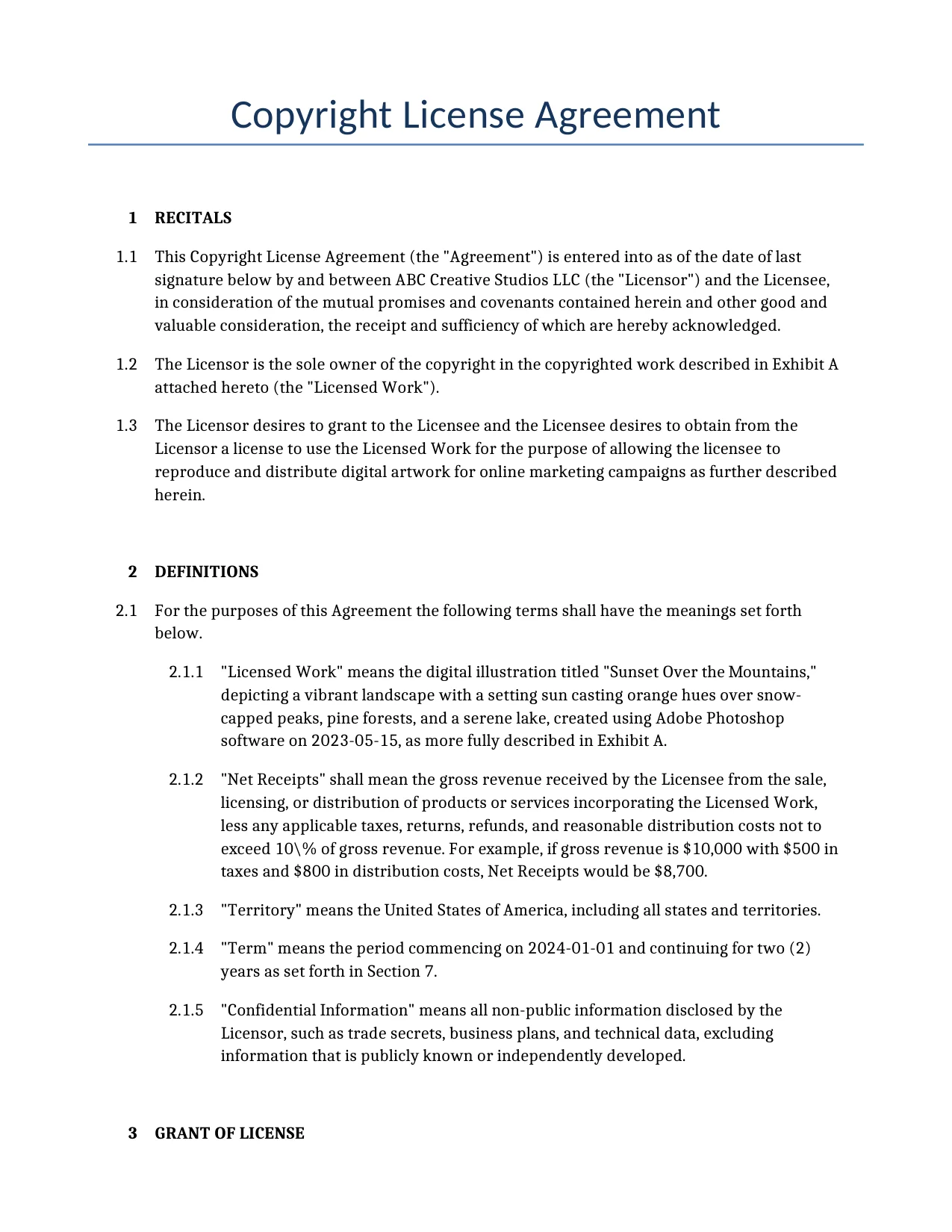
Copyright License Agreement
1RECITALS
This Copyright License Agreement (the "Agreement") is entered into as of the date of last signature below by and between ABC Creative Studios LLC (the "Licensor") and the Licensee, in consideration of the mutual promises and covenants contained herein and other good and valuable consideration, the receipt and sufficiency of which are hereby acknowledged.
The Licensor is the sole owner of the copyright in the copyrighted work described in Exhibit A attached hereto (the "Licensed Work").
The Licensor desires to grant to the Licensee and the Licensee desires to obtain from the Licensor a license to use the Licensed Work for the purpose of allowing the licensee to reproduce and distribute digital artwork for online marketing campaigns as further described herein.
2DEFINITIONS
For the purposes of this Agreement the following terms shall have the meanings set forth below.
"Licensed Work" means the digital illustration titled "Sunset Over the Mountains," depicting a vibrant landscape with a setting sun casting orange hues over snow-capped peaks, pine forests, and a serene lake, created using Adobe Photoshop software on 2023-05-15, as more fully described in Exhibit A.
"Net Receipts" shall mean the gross revenue received by the Licensee from the sale, licensing, or distribution of products or services incorporating the Licensed Work, less any applicable taxes, returns, refunds, and reasonable distribution costs not to exceed 10\% of gross revenue. For example, if gross revenue is $10,000 with $500 in taxes and $800 in distribution costs, Net Receipts would be $8,700.
"Territory" means the United States of America, including all states and territories.
"Term" means the period commencing on 2024-01-01 and continuing for two (2) years as set forth in Section 7.
"Confidential Information" means all non-public information disclosed by the Licensor, such as trade secrets, business plans, and technical data, excluding information that is publicly known or independently developed.
3GRANT OF LICENSE
Subject to the terms and conditions of this Agreement, the Licensor hereby grants to the Licensee a non-exclusive license under the Licensor's copyright in the Licensed Work, limited to the rights under 17 U.S.C. \§ 106 to reproduce the Licensed Work in digital form, to distribute copies of the Licensed Work by digital transmission over the internet, to create and use derivative works consisting solely of modifications for color correction, resizing, and cropping as strictly necessary for online marketing, and to publicly display the Licensed Work, solely for the purpose of online marketing campaigns. This license is limited to the Territory and the Term.
The license granted herein does not include the right to sublicense any of the licensed rights to third parties. The Licensor retains all rights not expressly granted herein, including but not limited to the right to use the Licensed Work for any purpose, to grant other licenses, and to enforce all rights under 17 U.S.C. \§ 106 and 17 U.S.C. \§ 106A where applicable.
The Licensee shall exercise the licensed rights solely in compliance with the purpose of allowing the licensee to reproduce and distribute digital artwork for online marketing campaigns and in accordance with all applicable laws including the Copyright Act of 1976 and the Digital Millennium Copyright Act of 1998. This Agreement prioritizes compliance with U.S. copyright law; references to international treaties such as the Berne Convention are for informational purposes only and do not expand rights or obligations beyond U.S. law.
4CONSIDERATION AND PAYMENT
In consideration for the license granted herein the Licensee shall pay to the Licensor an upfront payment of $5,000.00 on or before 2024-01-15.
The Licensee shall also pay to the Licensor a royalty of 15\% of Net Receipts derived from the Licensee's use of the Licensed Work. This is in addition to a minimum annual guarantee of $2,000 payable in four equal quarterly installments regardless of actual Net Receipts. Net Receipts shall be calculated as described in Section 2.1.2.
Royalties and minimum payments shall be paid quarterly within thirty days after the end of each calendar quarter during the Term, accompanied by a detailed report showing gross revenue, deductions, Net Receipts calculation, and royalty due. Late payments shall accrue interest at the rate of 1.5\% per month or the maximum rate permitted by law, whichever is less.
The Licensor shall have the right upon thirty (30) days' written notice to audit the Licensee's books and records relating to the calculation of Net Receipts and royalties not more than once per calendar year at the Licensor's expense unless the audit reveals an underpayment of more than 5\%, in which case the Licensee shall pay the audit costs.
All payments shall be made in United States dollars by wire transfer or other mutually agreed method.
5OWNERSHIP AND RESERVATION OF RIGHTS
The Licensor retains all right, title, and interest in and to the Licensed Work and all copyrights therein, including all exclusive rights under 17 U.S.C. \§ 106.
This Agreement does not transfer ownership of the copyright in the Licensed Work to the Licensee.
All rights not expressly granted to the Licensee under this Agreement are reserved to the Licensor.
The Licensor does not waive any moral rights under 17 U.S.C. \§ 106A (VARA) or otherwise but agrees that the Licensee may use the Licensed Work without attribution where necessary for online marketing campaigns, provided that all reproductions include a copyright notice in the form: "\© 2023 ABC Creative Studios LLC. All rights reserved."
The Licensee shall ensure that the copyright notice is prominently displayed on or adjacent to all copies or displays of the Licensed Work or any permitted derivatives.
6REPRESENTATIONS AND WARRANTIES
Each party represents and warrants that it has the full power and authority to enter into this Agreement and to perform its obligations hereunder.
The Licensor represents and warrants that: (i) it is the sole owner of the copyright in the Licensed Work with no co-owners or third-party claims; (ii) the Licensed Work is original and does not infringe any third-party intellectual property rights; (iii) the Licensed Work is free of any liens, encumbrances, security interests, or prior licenses that would conflict with this Agreement; and (iv) granting this license will not violate any third-party rights.
The Licensee represents and warrants that it will use the Licensed Work solely in compliance with all applicable United States laws and regulations including the Copyright Act of 1976 and the Digital Millennium Copyright Act of 1998, and that it will not use the Licensed Work in any manner that would violate third-party rights or applicable law.
EXCEPT AS EXPRESSLY SET FORTH IN THIS AGREEMENT, NEITHER PARTY MAKES ANY REPRESENTATIONS OR WARRANTIES OF ANY KIND, EITHER EXPRESS OR IMPLIED, INCLUDING BUT NOT LIMITED TO ANY WARRANTIES OF MERCHANTABILITY, FITNESS FOR A PARTICULAR PURPOSE, OR NON-INFRINGEMENT. ALL RIGHTS AND LICENSES ARE PROVIDED "AS IS."
IN NO EVENT SHALL EITHER PARTY'S TOTAL LIABILITY UNDER THIS AGREEMENT EXCEED THE AMOUNTS PAID OR PAYABLE BY THE LICENSEE TO THE LICENSOR HEREUNDER. NEITHER PARTY SHALL BE LIABLE FOR ANY INDIRECT, INCIDENTAL, SPECIAL, CONSEQUENTIAL, OR PUNITIVE DAMAGES, EVEN IF ADVISED OF THE POSSIBILITY THEREOF.
7INDEMNIFICATION
The Licensor shall indemnify, defend, and hold harmless the Licensee from and against any and all claims, damages, losses, and expenses arising out of any breach of the Licensor's representations and warranties or any copyright infringement claim related to the Licensed Work as provided under the Copyright Act of 1976 and the Digital Millennium Copyright Act, provided that the Licensee gives prompt written notice of any such claim and cooperates in its defense.
The Licensee shall indemnify, defend, and hold harmless the Licensor from and against any and all claims, damages, losses, and expenses arising out of the Licensee's breach of this Agreement, misuse of the Licensed Work, or breach of the Licensee's representations and warranties, provided that the Licensor gives prompt written notice of any such claim and cooperates in its defense.
The indemnified party shall promptly notify the indemnifying party of any claim and shall cooperate in the defense thereof. The indemnifying party shall have the right to control the defense, subject to the indemnified party's right to participate at its own expense.
8LIMITATION OF LIABILITY
IN NO EVENT SHALL EITHER PARTY BE LIABLE TO THE OTHER FOR ANY INDIRECT, SPECIAL, INCIDENTAL, CONSEQUENTIAL, OR PUNITIVE DAMAGES ARISING OUT OF OR RELATED TO THIS AGREEMENT, INCLUDING BUT NOT LIMITED TO LOSS OF PROFITS, LOSS OF DATA, OR BUSINESS INTERRUPTION, EVEN IF SUCH PARTY HAS BEEN ADVISED OF THE POSSIBILITY OF SUCH DAMAGES.
EACH PARTY'S TOTAL CUMULATIVE LIABILITY UNDER THIS AGREEMENT SHALL NOT EXCEED THE TOTAL AMOUNTS PAID OR PAYABLE BY THE LICENSEE TO THE LICENSOR IN THE TWELVE (12) MONTHS PRECEDING THE CLAIM. THIS LIMITATION APPLIES REGARDLESS OF THE LEGAL THEORY ON WHICH THE CLAIM IS BASED.
The limitations set forth in this Section 8 do not apply to liability arising from breach of confidentiality, indemnification obligations, or infringement of the other party's intellectual property rights.
9INTELLECTUAL PROPERTY NOTICES
The Licensee shall include a proper copyright notice (\© 2023 ABC Creative Studios LLC. All rights reserved.) on all reproductions, displays, and distributions of the Licensed Work or any permitted derivatives. The Licensee shall not remove, obscure, or alter any copyright, trademark, or other proprietary notices affixed to or contained within the Licensed Work.
All goodwill associated with the use of the Licensed Work shall inure to the benefit of the Licensor. The Licensee acquires no rights in the Licensor's name, trademarks, or copyrights except as expressly set forth herein.
10NO REVERSE ENGINEERING
The Licensee shall not reverse engineer, decompile, disassemble, or otherwise attempt to derive the source files, creative processes, or underlying code or techniques used to create the Licensed Work, except to the extent expressly permitted by applicable law and only after providing the Licensor with prior written notice.
11EXPORT COMPLIANCE
The Licensed Work and any related technical data may be subject to U.S. export control laws and regulations. The Licensee shall not export, re-export, or transfer the Licensed Work except in compliance with all applicable U.S. export laws, including but not limited to the Export Administration Regulations. The Licensee shall obtain all necessary licenses or authorizations prior to any such export.
12DATA PRIVACY
If the Licensee collects, processes, or stores any personal data in connection with its use or distribution of the Licensed Work in online marketing campaigns, the Licensee shall comply with all applicable data protection and privacy laws, including but not limited to the California Consumer Privacy Act (CCPA) if applicable. The Licensee shall implement reasonable security measures to protect such data and shall not use the Licensed Work in any manner that would violate privacy rights.
13TERM AND TERMINATION
The Term of this Agreement shall commence on 2024-01-01 and continue for two (2) years thereafter unless terminated earlier in accordance with this Section 13. This Agreement shall automatically renew for successive one-year periods unless either party provides written notice of non-renewal at least thirty (30) days prior to the end of the then-current term.
The Licensee shall have the right to terminate this Agreement at any time upon thirty (30) days' written notice to the Licensor for convenience.
Either party may terminate this Agreement upon thirty (30) days' written notice if the other party commits a material breach and fails to cure such breach within the thirty (30)-day notice period. The Licensor may also terminate immediately upon notice if the Licensee becomes insolvent, files for bankruptcy, or fails to pay any amounts due hereunder.
Upon termination or expiration, the Licensee shall have a sell-off period of ninety (90) days to sell or distribute any physical or digital inventory of the Licensed Work existing as of the termination date, subject to continued payment of royalties thereon. After the sell-off period, the Licensee must immediately cease all use of the Licensed Work, and all rights granted hereunder shall revert to the Licensor. Any outstanding payments shall become due immediately.
The Licensee shall within ten (10) days after the end of the sell-off period (if any) destroy or return all copies of the Licensed Work and certify such destruction or return in writing to the Licensor. Sections addressing ownership, representations and warranties, indemnification, limitation of liability, confidentiality, intellectual property notices, governing law, and any other provision that by its nature should survive shall survive termination or expiration of this Agreement. This Agreement is subject to the termination rights under 17 U.S.C. \§\§ 203 and 304 where applicable, which cannot be contractually waived in advance.
14CONFIDENTIALITY
Each party shall maintain the secrecy of Confidential Information disclosed by the other party and shall use at least reasonable care to protect such Confidential Information.
Exceptions to the confidentiality obligations shall apply to information required by law to be disclosed or disclosed to professional advisors under a duty of confidentiality.
The receiving party shall provide notice to the disclosing party prior to any permitted disclosure of Confidential Information.
The parties agree that breach of this Section 14 may cause irreparable harm for which monetary damages are inadequate and that injunctive relief shall be an available remedy.
15NOTICES
All notices under this Agreement shall be in writing and shall be delivered by email (with confirmation of receipt) or certified mail to the addresses set forth below.
Notices to the Licensor shall be sent to 123 Creator Lane, New York, NY 10001, Email: legal@abccreative.com.
Notices to the Licensee shall be sent to 456 User Street, Los Angeles, CA 90001, Email: contracts@licensee.com.
Notices sent by certified mail shall be deemed delivered five business days after mailing. Notices sent by email shall be deemed delivered upon confirmation of receipt.
16ASSIGNMENT AND DELEGATION
Neither the Licensor nor the Licensee may assign this Agreement without the prior written consent of the other party, which shall not be unreasonably withheld. Any attempted assignment without consent shall be null and void.
No duties or obligations under this Agreement may be delegated without the prior written consent of the non-delegating party.
This Agreement shall be binding upon and inure to the benefit of the parties' respective successors and permitted assigns.
17GOVERNING LAW AND JURISDICTION
This Agreement shall be governed by and construed in accordance with the laws of the State of New York without regard to its conflict of laws principles. Any reference to the Berne Convention or other international treaties is subordinate to U.S. copyright law and this governing law provision.
The parties agree that the state and federal courts located in New York County, New York shall have exclusive jurisdiction and venue over any disputes arising from this Agreement. Each party consents to the personal jurisdiction of such courts and waives any objection based on forum non conveniens.
The prevailing party in any action or proceeding to enforce or interpret this Agreement shall be entitled to recover its reasonable attorneys' fees and costs in addition to any other relief to which it is entitled.
18DISPUTE RESOLUTION
Any dispute arising out of or relating to this Agreement shall first be resolved through good faith negotiations. If unresolved within thirty (30) days, the dispute shall be resolved by arbitration in New York, New York under the rules of the American Arbitration Association by a single arbitrator. The arbitration award shall be final and binding.
The prevailing party in any dispute resolution proceeding shall be entitled to recover its reasonable attorneys' fees and costs.
All dispute resolution proceedings shall be confidential. Each party hereby waives its right to a jury trial in any action or proceeding arising out of or relating to this Agreement.
19FORCE MAJEURE
Neither party shall be liable for any delay or failure to perform its obligations under this Agreement if such delay or failure is caused by a Force Majeure event including acts of God, war, natural disasters, pandemics, terrorism, government regulations, or supply chain disruptions, provided that labor disputes, strikes, or lockouts shall not constitute a Force Majeure event.
The affected party shall provide written notice of the Force Majeure event within ten days of its occurrence.
The affected party shall undertake reasonable efforts to mitigate the effects of the Force Majeure event.
If a Force Majeure event continues for more than sixty days either party may terminate this Agreement upon written notice.
Force Majeure shall not excuse any payment obligations under this Agreement.
20ENTIRE AGREEMENT AND AMENDMENT
This Agreement, including all exhibits attached hereto, constitutes the entire understanding between the Licensor and the Licensee with respect to the subject matter hereof and supersedes all prior agreements and understandings whether written or oral.
This Agreement may not be amended except by a written instrument signed by both the Licensor and the Licensee.
21WAIVER
No waiver of any breach or default under this Agreement shall be effective unless made in writing and signed by the waiving party.
No delay or omission in exercising any right or remedy shall be deemed a waiver of that right or remedy.
A waiver of one breach shall not constitute a waiver of any prior, concurrent, or subsequent breach.
The provisions of this Section 21 shall apply to both parties.
22RELATIONSHIP OF THE PARTIES
The parties are independent contractors and nothing in this Agreement shall create a partnership, agency, employment, or fiduciary relationship between them.
Neither party acts as an agent for the other and neither party has authority to bind the other.
23NO THIRD-PARTY BENEFICIARIES
This Agreement is for the sole benefit of the parties hereto and their respective successors and permitted assigns. Nothing herein, express or implied, is intended to or shall confer upon any other person or entity any legal or equitable right, benefit, or remedy of any nature whatsoever under or by reason of this Agreement.
24INTERPRETATION
The parties have participated jointly in the negotiation and drafting of this Agreement. In the event of an ambiguity or question of intent or interpretation, this Agreement shall be construed as if drafted jointly by the parties and no presumption or burden of proof shall arise favoring or disfavoring any party by virtue of the authorship of any of the provisions.
References to sections, exhibits, or other documents are for convenience only and shall not affect the interpretation of this Agreement. The words "include," "includes," and "including" shall be deemed to be followed by the phrase "without limitation."
25COUNTERPARTS AND ELECTRONIC SIGNATURES
This Agreement may be executed in counterparts each of which shall be deemed an original and all of which together shall constitute one and the same instrument. Electronic signatures (including those compliant with the U.S. Electronic Signatures in Global and National Commerce Act (E-SIGN) and the Uniform Electronic Transactions Act (UETA)) shall be deemed original signatures for purposes of this Agreement and shall be valid and binding.
26HEADINGS
The headings in this Agreement are for convenience only and shall not affect the interpretation of this Agreement.
27SEVERABILITY
If any provision of this Agreement is held to be invalid or unenforceable such provision shall be severed from the Agreement and the remaining provisions shall continue in full force and effect.
28SURVIVAL
The provisions of Sections 5, 6, 7, 8, 9, 10, 12, 14, 17, 18, 20, 21, 22, 23, 24, 27, and 28 shall survive any termination or expiration of this Agreement.
29COMPLIANCE WITH APPLICABLE LAW
The parties shall comply with all applicable laws including the Copyright Act of 1976, the Digital Millennium Copyright Act of 1998, the Uniform Commercial Code Article 2 where applicable, and the Uniform Electronic Transactions Act in performing their obligations under this Agreement. This Agreement is intended to be fully compliant with U.S. copyright law (Title 17 of the U.S. Code), including provisions regarding exclusive rights, registration, DMCA safe harbors, and termination rights under 17 U.S.C. \§\§ 203 and 304. Moral rights under VARA (17 U.S.C. \§ 106A) are addressed as set forth in Section 5.4 and are not waivable for works of visual art as defined therein.
30SIGNATURE PAGE
IN WITNESS WHEREOF the parties have executed this Agreement as of the date first above written.
Licensor: ABC Creative Studios LLC
By: _______________________________
Name:
Title:
Date:
Licensee:
By: _______________________________
Name:
Title:
Date:
31EXHIBIT A - DESCRIPTION OF LICENSED WORK
The Licensed Work is a digital illustration titled "Sunset Over the Mountains," created by ABC Creative Studios LLC on or about May 15, 2023, using Adobe Photoshop. It depicts a vibrant landscape with a setting sun casting orange hues over snow-capped peaks, pine forests, and a serene lake. A high-resolution digital file (e.g., PSD or PNG format, minimum 300 DPI) of the Licensed Work will be provided to the Licensee upon execution of this Agreement and full payment of the upfront fee. Metadata includes: Creator - ABC Creative Studios LLC; Creation Date - 2023-05-15; Copyright Notice - \© 2023 ABC Creative Studios LLC. All rights reserved. This Exhibit may be amended by mutual written agreement to attach sample files or additional descriptions.
This example shows approximately 70% of a typical document and is provided for illustrative purposes only. The remaining content has been omitted.
Every document generated by Docaro is tailored to your specific circumstances, jurisdiction and the information you provide. The completed document includes all applicable clauses and provisions required for your situation.
To generate the full, personalised document, answer a short series of questions and your document will be created instantly.