Docaro

AI Generated American Board Resolution - 2026 Updated

A professional boardroom scene with diverse business executives gathered around a conference table, engaged in a serious discussion, symbolizing corporate decision-making and governance in the United States.
Effortlessly create board resolutions for American corporations with our AI-powered tool.
Free instant document creation.
Legally compliant agreements.
No signup required.
Generate your document for free.
Download PDF, Word and email for $9.99 USD.

Generate Your Board Resolution in 4 Easy Steps

1
Answer a Few Questions
Our AI guides you through the info required.
2
Generate Your Document
Docaro builds the document based on your requirements.
3
Review & Edit
Review your document and submit any further requested changes.
4
Download & Sign
Download your ready to sign document as a PDF, Word, Txt or HTML.

Why Use Our AI Board Resolution Generator?

Fast Generation
Quickly generate a comprehensive Board Resolution, eliminating the hassle and time associated with traditional document drafting.
Guided Process
Our user-friendly platform simplifies the document creation process, enabling you to complete agreements with just a few clicks.
Professionally Formatted Document
Your Board Resolution will be formatted to professional standards, including headings, clause numbers and structured layout. No further editing is required.
High Accuracy
Our AI ensures high accuracy by using advanced algorithms to craft agreements that perfectly cater to your specific requirements.
Compliance with American Law
Rest assured that all generated documents meet the latest legal standards and regulations of the United States, enhancing trust and reliability.
Cost-Effective
Save money by generating legally sound tenancy agreements without the need for expensive legal services or consultations.
Get Started for Free - No Sign Up Required
No payment or sign up is required to start generating your Board Resolution. Simply answer a few questions and a preview of your final document will be generated.
Looking to Generate a Board Resolution in a Different Country?
Choose a different country:

Compliance Legislation

Your AI Generated Board Resolution will be checked for compliance against the following legislation and regulations:
Governs corporate matters in Delaware, including the adoption, amendment, and execution of board resolutions by directors under Sections 141 (board powers) and 142 (committees). Many US companies incorporate in Delaware, making this applicable.
Provides a template for state corporation laws, covering board resolutions in Sections 8.01-8.25, including authority to act via resolutions. Adopted or influenced in most states.
Updated version of the MBCA, detailing board of directors' roles in resolutions under Chapter 8, applicable in states that have adopted it.
Requires board resolutions for audit committee approvals and corporate governance matters, particularly Sections 301 and 406 on disclosures and ethics.
Regulates public company board resolutions related to securities, such as approvals for filings, under Section 10B (audit committees) and Rule 10b-5.
Applies to corporations in New York, with Article 3 (Directors) outlining board resolutions for actions like bylaws amendments (Section 602).
Governs California corporations, including board resolutions under Sections 300 (management) and 310 (interested director transactions).
For real estate investment trusts, requires board resolutions for compliance with asset and income tests, applicable if the resolution pertains to REIT governance.

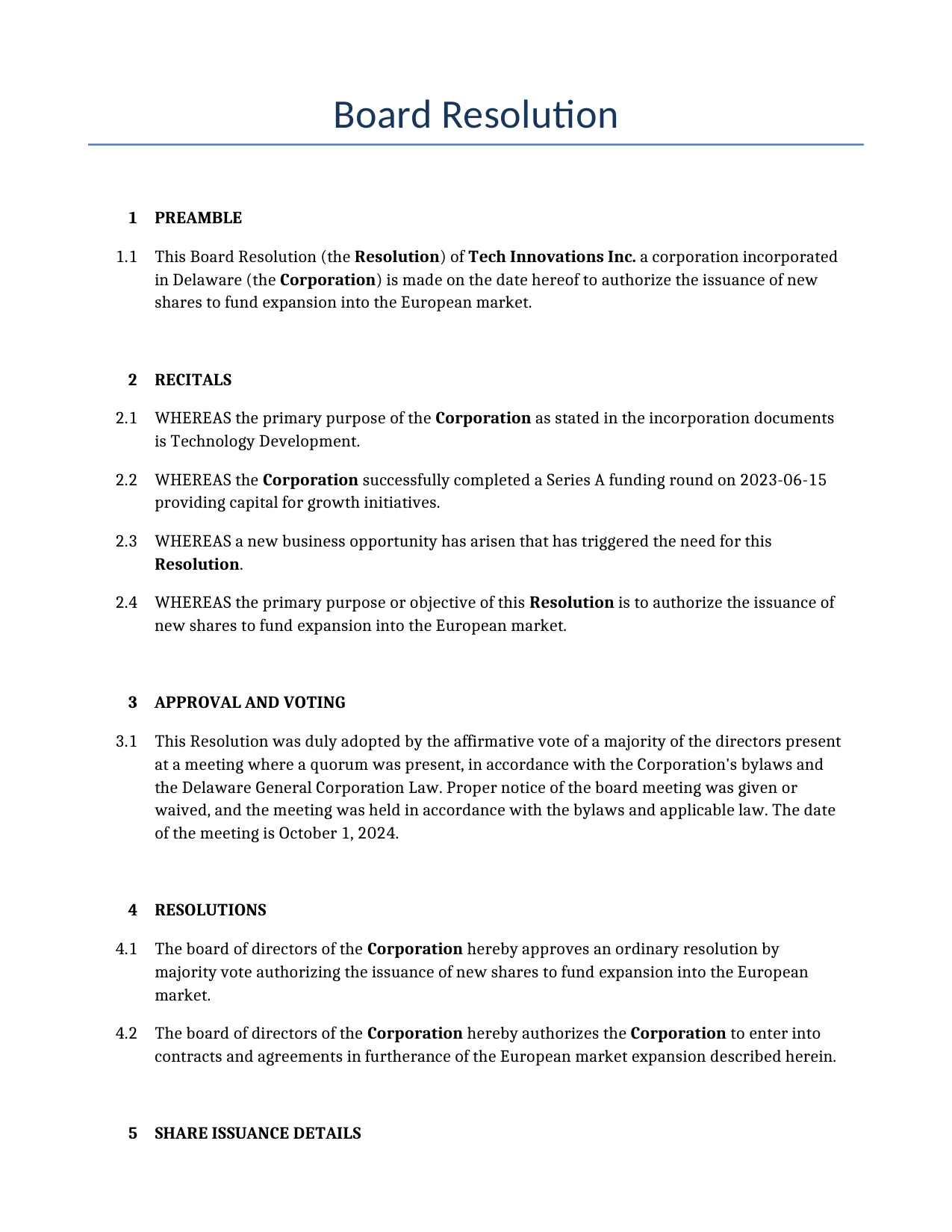
Example Board Resolution

Below is an example of a Board Resolution generated by our AI model. The clauses in your Board Resolution will vary from this example as they will be entirely bespoke to your requirements as set out in the questionnaire you complete.
Page 1

What is a Board Resolution in the United States?

A board resolution is a formal document that records the decisions or actions approved by a corporation's board of directors during a meeting or through unanimous written consent. It serves as an official endorsement of key corporate matters, such as approving mergers, appointing officers, or authorizing financial transactions, ensuring clarity and accountability in decision-making. In corporate governance, board resolutions play a crucial role by providing a legal record that aligns the company's operations with shareholder interests and regulatory compliance.

Under US law, the legal basis for board resolutions is primarily governed by state statutes, with the Delaware General Corporation Law (DGCL) being the most influential due to Delaware's popularity as a incorporation state for many companies. Section 141 of the DGCL outlines the board's authority to manage corporate affairs and requires resolutions to be adopted by a majority vote unless the certificate of incorporation specifies otherwise.

"Corporate decisions must be formalized through board resolutions to ensure legal enforceability and compliance with fiduciary duties." – American Bar Association, Model Business Corporation Act § 8.21. Recommendation: Always document key decisions in written board resolutions to protect the corporation and its directors from liability.
Professional signing board resolution document

When Should You Use a Board Resolution?

A board resolution is essential for approving major transactions in a corporation, such as mergers, acquisitions, or significant asset sales, ensuring that decisions are formally documented and aligned with shareholder interests. This process not only provides legal protection by demonstrating due diligence but also maintains transparency in corporate governance. For more details on corporate transaction approvals, refer to the SEC guidelines.

Another critical scenario for a board resolution is the appointment of officers, including CEOs or directors, which formalizes leadership roles and sets clear accountability within the organization. Resolutions in this context help prevent disputes by recording the board's consensus on key personnel. They play a vital role in maintaining corporate records, serving as official evidence for audits, compliance, and historical reference.

Amending bylaws requires a board resolution to update the company's internal rules, such as changing voting procedures or director terms, which must be approved to reflect evolving business needs. This ensures all changes are legally binding and properly archived in corporate minutes. Overall, board resolutions uphold corporate record-keeping standards, facilitating smooth operations and regulatory adherence; see resources from the Cornell Law School for in-depth legal insights.

When Should You Not Use a Board Resolution?

In corporate governance, a board resolution is often unnecessary for routine operational decisions, such as day-to-day management tasks like approving minor expenditures or hiring staff at the operational level. These decisions are typically delegated to company officers or executives under the bylaws or standard operating procedures, allowing for efficient business operations without the need for formal board approval. This approach ensures that the board focuses on strategic matters rather than getting bogged down in minutiae, as outlined in resources like the Cornell Law School's Legal Information Institute.

Another situation where a board resolution may be inappropriate is when unanimous shareholder consents can be used to approve certain actions, particularly in closely held corporations. This alternative bypasses the need for a formal board meeting and resolution, enabling quick decisions on matters like amending bylaws or approving mergers if all shareholders agree in writing. It's a streamlined process that promotes agility, especially in smaller companies, and is supported by statutes such as those in the Delaware General Corporation Law, detailed on Delaware's official code site.

Alternatives to board resolutions also include management by consent or officer delegations, where authority is explicitly granted via initial board policies or organizational charts. For instance, routine contracts under a certain monetary threshold can be handled by the CEO without board involvement, reducing administrative burden. These methods enhance corporate efficiency and are best practices recommended by governance experts to balance oversight with operational speed.

Group of executives in board meeting

What Are the Key Clauses in a Board Resolution Document?

A board resolution in US corporate law serves as a formal document recording decisions made by a company's board of directors, ensuring compliance with state statutes like the Delaware General Corporation Law. The preamble typically identifies the corporation, the date, time, and location of the meeting, and whether it's in-person or via electronic means, setting the foundational context. For example, it might state: "The Board of Directors of XYZ Corporation, a Delaware corporation, met on [date] at [location] pursuant to notice duly given."

The recitals section provides background information, explaining the purpose and rationale behind the resolutions, often starting with "WHEREAS" clauses to outline facts or prior actions. These clauses build a narrative that justifies the decisions, such as "WHEREAS, the Company seeks to approve a merger with ABC Inc. to expand market share." Recitals enhance clarity and legal defensibility, as seen in standard templates from the SEC filings.

The core resolutions section contains the actual decisions, phrased affirmatively with "RESOLVED, THAT" followed by specific actions, and may include sub-resolutions for complex matters. An example is: "RESOLVED, that the Board approves the merger agreement and authorizes the CEO to execute it." This section ensures enforceability under US corporate governance rules.

Finally, the approval sections conclude with statements on unanimous consent, attendance, and signatures, often including a certification by the secretary. For instance: "All directors present voted in favor, and this resolution is duly adopted." To explore further, refer to resources like the Westlaw Corporate Law database for authoritative templates and precedents.

1
Review Document Purpose
Examine the board resolution document to understand its overall objective and context for key clauses.
2
Identify Core Clauses
Scan for essential sections like recitals, resolutions, approvals, and authorizations that form the document's backbone.
3
Draft Precise Language
Compose clear, concise wording for each identified clause, ensuring legal accuracy and alignment with company policies.
4
Verify and Finalize
Check drafted clauses for completeness, consistency, and compliance before incorporating into the final resolution.

What Are the Key Rights and Obligations of Parties Involved?

In the context of US corporate law, board members and officers hold significant fiduciary duties when adopting and implementing a board resolution, including the duties of care, loyalty, and good faith. These duties require directors to act in the best interests of the corporation and its shareholders, ensuring that resolutions are adopted after reasonable inquiry and without conflicts of interest. For instance, under Delaware General Corporation Law, which influences many states, board resolutions must reflect informed decision-making to avoid breaches of fiduciary duty.

The corporation itself has obligations to enforce and document board resolutions properly, providing the necessary resources for implementation while holding officers accountable for execution. Officers, as agents of the corporation, must implement resolutions diligently, adhering to the same fiduciary standards to prevent personal liability. This framework promotes corporate governance and can be further explored through authoritative sources like the Delaware Code Title 8 or the SEC's corporate governance guidelines.

When conflicts arise, board members may need to recuse themselves to uphold their duty of loyalty, and the corporation should maintain records of resolutions for transparency and legal compliance. Failure to fulfill these rights and obligations can lead to shareholder lawsuits or regulatory scrutiny, emphasizing the importance of ethical practices in board resolution adoption. Key aspects include:

  • Duty of Care: Directors must investigate and deliberate thoroughly before approving resolutions.
  • Duty of Loyalty: Avoid self-dealing and prioritize corporate interests over personal gain.
  • Implementation Rights: Officers have the authority to act on resolutions but must do so within legal bounds.

Are There Any Key Exclusions in Board Resolutions?

Board resolutions in corporate governance often include common exclusions to ensure that certain critical decisions remain outside the board's unilateral authority. For instance, matters reserved for shareholders, such as amendments to the articles of incorporation or major changes in capital structure, cannot be approved solely by the board. These exclusions protect shareholder rights and maintain a balance of power within the company, as outlined in standard corporate bylaws.

Another frequent limitation involves regulatory approvals, where board resolutions may be conditioned on obtaining necessary permissions from government agencies or industry regulators before implementation. This ensures compliance with laws like securities regulations or antitrust rules, preventing the company from proceeding with unenforceable actions. Failure to secure these approvals can render the resolution void, exposing the company to legal risks and potential invalidation by courts.

The implications for enforceability of board resolutions are significant, as exclusions and limitations safeguard against overreach but require careful drafting to avoid ambiguity. If a resolution attempts to override reserved matters or ignores regulatory hurdles, it may be challenged in litigation, leading to delays or financial penalties. To mitigate this, companies should consult legal experts and reference authoritative sources like the SEC guidelines for best practices in resolution drafting.

What Recent or Upcoming Legal Changes Affect Board Resolutions?

Recent US corporate law changes in state statutes, particularly in Delaware, have focused on enhancing board oversight of emerging risks like cybersecurity and climate change. The 2023 amendments to the Delaware General Corporation Law (DGCL) now require boards to explicitly address material risk disclosures in resolutions, aiming to align with federal ESG reporting standards. These updates could increase board liability for oversight failures, prompting companies to revise governance policies for better compliance.

Anticipated SEC regulations under the 2023 climate disclosure rules will mandate detailed board resolutions on greenhouse gas emissions and climate-related risks, effective as early as 2025 for larger filers. This builds on the SEC's final rules adopted in March 2024, which require Scope 1 and 2 emissions reporting in proxy statements. The potential effects include heightened scrutiny on board diversity and expertise, with non-compliance risking enforcement actions and investor lawsuits; for more details, see the SEC's official announcement.

Overall, these corporate governance reforms in US law emphasize transparency and accountability, influencing how boards draft resolutions to mitigate legal risks. Companies may need to integrate AI-driven compliance tools to stay ahead of evolving SEC enforcement trends. Staying informed through resources like the Harvard Law School Forum on Corporate Governance is crucial for navigating these changes effectively.

How to Draft a Board Resolution in the United States

Drafting a board resolution is a critical process for formalizing decisions made by a company's board of directors, ensuring legal compliance and clear documentation. This involves outlining the purpose, detailing the decision, and including necessary approvals from board members. For comprehensive guidance on how to draft a board resolution, especially in the United States, refer to our detailed resource at How to Draft a Board Resolution in the United States.

Best practices for drafting board resolutions include using precise language to avoid ambiguity, specifying the date and attendees of the meeting, and obtaining unanimous or majority consent as required by bylaws. Always review the resolution against corporate governance laws, such as those outlined by the U.S. Securities and Exchange Commission (SEC), to ensure enforceability. Incorporating these steps enhances corporate governance and minimizes legal risks.

  • Start with a clear title and preamble stating the resolution's intent.
  • Detail the specific action or approval needed.
  • End with signatures from authorized board members for validation.

Legal Requirements for Board Resolutions in US Companies

Board resolutions in US companies must adhere to statutory requirements outlined in state corporate laws, such as the Delaware General Corporation Law, which mandates that resolutions be approved by a majority vote of directors present at a duly called meeting. These legal requirements for board resolutions ensure proper governance and documentation of key decisions. For detailed insights, explore our comprehensive guide on Legal Requirements for Board Resolutions in US Companies.

Under common law principles, board resolutions require good faith, due care, and loyalty from directors to avoid fiduciary duty breaches, as established in landmark cases like those from the Delaware Chancery Court. This includes maintaining accurate minutes and records to demonstrate compliance with corporate formalities. Authoritative sources like the Delaware Code Title 8 provide foundational statutes for US corporate board resolutions.

Common Mistakes to Avoid in Board Resolution Documents

Board resolutions are essential legal documents that formalize corporate decisions, yet they often contain frequent errors such as incomplete details, vague language, and missing approvals. These mistakes can lead to invalid resolutions, legal disputes, or compliance issues in corporate governance. To prevent them, always review resolutions against company bylaws and consult legal experts for accuracy.

Common pitfalls include failing to specify the date, attendees, and voting outcomes, which undermines the document's enforceability. For a detailed guide on board resolution mistakes and avoidance strategies, refer to our resource on Common Mistakes to Avoid in Board Resolution Documents.

Board Resolution FAQs

A board resolution is a formal document that records decisions made by a company's board of directors during a meeting. It serves as official proof of actions like approving contracts, appointing officers, or authorizing financial transactions, ensuring compliance with U.S. corporate laws such as those under Delaware or other state statutes.

Document Generation FAQs

Docaro is an AI-powered legal document generator that helps you create fully formatted, legally sound contracts and agreements in minutes. Just answer a few guided questions and download your document instantly.
You Might Also Be Interested In
Consultancy Agreement
Shareholders' Agreement
Business Sale Agreement
Asset Purchase Agreement
Founders' Agreement
Stock Purchase Agreement
Corporate Bylaws
Articles Of Incorporation
LLC Operating Agreement
Partnership Agreement

Related Articles

A professional scene of a diverse group of business executives sitting around a conference table in a modern boardroom, engaged in a serious discussion with charts and graphs projected on a screen, symbolizing corporate decision-making and governance without showing any documents.
Learn how to draft a board resolution in the United States with our comprehensive guide. Discover essential steps, templates, legal requirements, and tips for corporate governance compliance.
A professional boardroom scene with diverse executives seated around a conference table, engaged in a serious discussion, symbolizing corporate decision-making and governance in US companies, with subtle American flag elements in the background to evoke legal context.
Discover the key legal requirements for board resolutions in US companies, including drafting, approval processes, and compliance under corporate law to ensure validity and avoid pitfalls.
A professional boardroom scene with diverse executives engaged in a collaborative discussion around a conference table, symbolizing effective decision-making and governance in business, with charts and graphs on a screen in the background, conveying strategy and unity without focusing on documents.
Discover the most common mistakes to avoid when drafting board resolution documents. Learn expert tips to ensure compliance, clarity, and legal validity for your corporate governance.