
AI Generated American Commercial Lease Agreement
PDF & Word - 2026 Updated
Docaro Pricing
When Do You Need a Commercial Lease Agreement in the United States?
American Legal Rules for a Commercial Lease Agreement
Using the wrong type of commercial lease agreement can expose landlords to unintended liabilities or fail to adequately protect tenant interests.
What a Proper Commercial Lease Agreement Should Include
- Parties InvolvedClearly identify the landlord and tenant, including their full names and addresses, to establish who is entering the agreement.
- Property DescriptionProvide a detailed description of the leased property, including its address, size, and any specific features or boundaries.
- Lease TermSpecify the start and end dates of the lease, along with any options for renewal or early termination.
- Rent DetailsOutline the rent amount, payment schedule, due dates, and any late fees or methods of payment.
- Security DepositState the amount of the security deposit, its purpose, and the conditions for its return at the end of the lease.
- Use of PropertyDefine how the tenant can use the property, such as for specific business activities, and any restrictions.
- Maintenance ResponsibilitiesClarify who is responsible for repairs, upkeep, and maintenance of the property, including utilities and common areas.
- Insurance and LiabilityRequire both parties to maintain appropriate insurance coverage and outline liability for damages or injuries.
- Default and RemediesDescribe what happens if a party fails to meet obligations, including eviction processes and dispute resolution.
- SignaturesInclude spaces for both parties to sign and date the agreement, making it legally binding.
Generate Your Document in 4 Easy Steps
Why Use Docaro?
 United States
Free Example Commercial Lease Agreement Template
Below is a free template example of a Commercial Lease Agreement for use in the United States generated by our AI model.
The clauses in your actual Commercial Lease Agreement will vary from this example as they will be entirely bespoke to your requirements as set out in the questionnaire you complete.
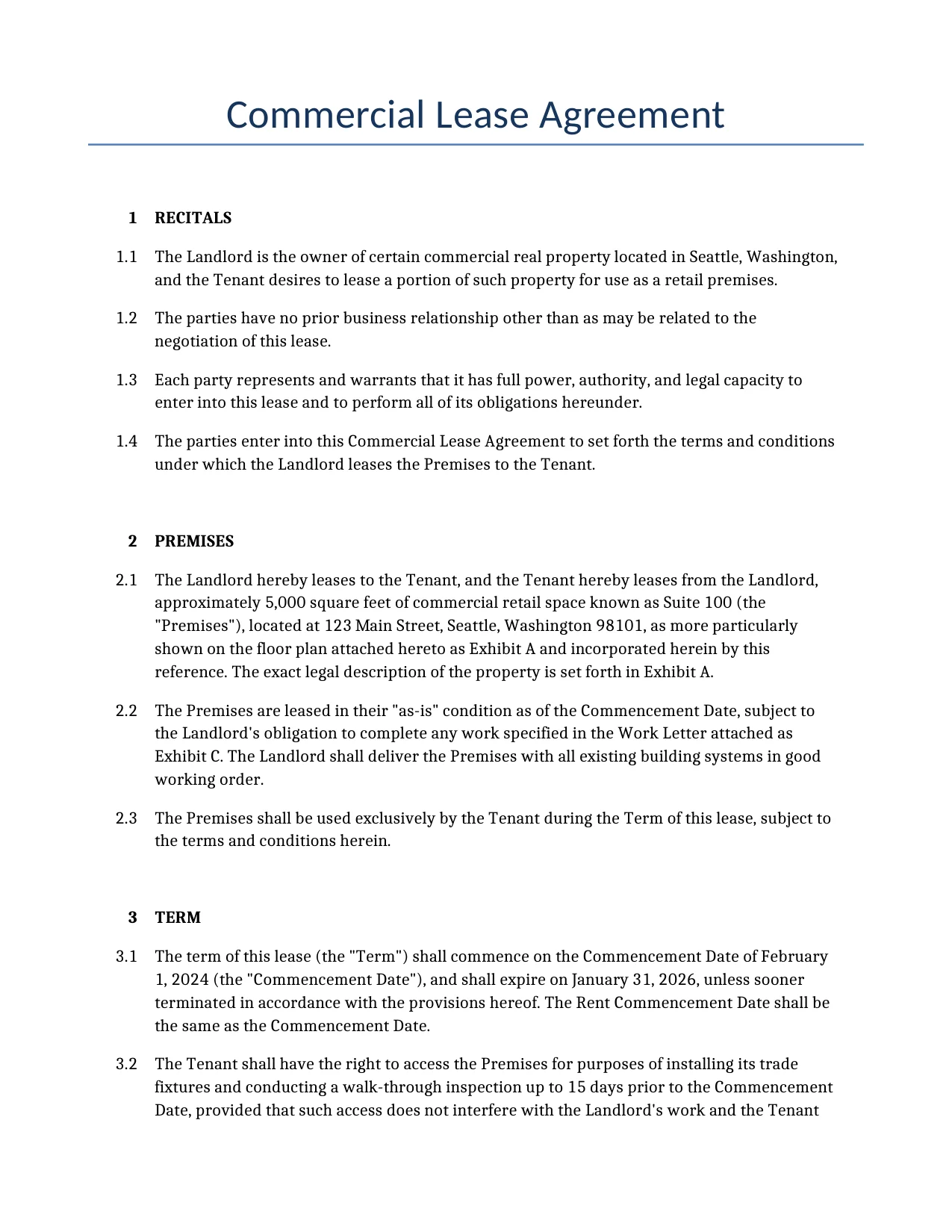
Commercial Lease Agreement
1RECITALS
The Landlord is the owner of certain commercial real property located in Seattle, Washington, and the Tenant desires to lease a portion of such property for use as a retail premises.
The parties have no prior business relationship other than as may be related to the negotiation of this lease.
Each party represents and warrants that it has full power, authority, and legal capacity to enter into this lease and to perform all of its obligations hereunder.
The parties enter into this Commercial Lease Agreement to set forth the terms and conditions under which the Landlord leases the Premises to the Tenant.
2PREMISES
The Landlord hereby leases to the Tenant, and the Tenant hereby leases from the Landlord, approximately 5,000 square feet of commercial retail space known as Suite 100 (the "Premises"), located at 123 Main Street, Seattle, Washington 98101, as more particularly shown on the floor plan attached hereto as Exhibit A and incorporated herein by this reference. The exact legal description of the property is set forth in Exhibit A.
The Premises are leased in their "as-is" condition as of the Commencement Date, subject to the Landlord's obligation to complete any work specified in the Work Letter attached as Exhibit C. The Landlord shall deliver the Premises with all existing building systems in good working order.
The Premises shall be used exclusively by the Tenant during the Term of this lease, subject to the terms and conditions herein.
3TERM
The term of this lease (the "Term") shall commence on the Commencement Date of February 1, 2024 (the "Commencement Date"), and shall expire on January 31, 2026, unless sooner terminated in accordance with the provisions hereof. The Rent Commencement Date shall be the same as the Commencement Date.
The Tenant shall have the right to access the Premises for purposes of installing its trade fixtures and conducting a walk-through inspection up to 15 days prior to the Commencement Date, provided that such access does not interfere with the Landlord's work and the Tenant carries required insurance.
The Tenant shall have the option to renew this lease for one (1) additional period of two (2) years (the "Renewal Term") upon the same terms and conditions except for Base Rent, which shall be adjusted to one hundred percent (100\%) of the then prevailing fair market rental rate for comparable retail space in the Seattle market. The Tenant must give the Landlord written notice of its election to renew not less than one hundred twenty (120) days prior to the expiration of the then-current Term. There shall be no cap on market rate increases.
4RENT
The Tenant shall pay to the Landlord Base Rent according to the following schedule, payable in advance on the first (1st) day of each calendar month during the Term without deduction, offset, or abatement (except as expressly provided herein):
January 1, 2024 to January 31, 2025: $2,500.00 per month
February 1, 2025 to January 31, 2026: $2,600.00 per month.
Base Rent and Additional Rent shall be paid by ACH or wire transfer to an account designated by the Landlord. If any payment is not received within five (5) days after the due date, a late fee of five percent (5\%) of the overdue amount shall be due. No sales tax is applicable in this jurisdiction on rent.
The Tenant shall have no right to offset or deduct any amounts from rent unless expressly permitted under this lease.
5ADDITIONAL RENT AND OPERATING EXPENSES
In addition to Base Rent, the Tenant shall pay as Additional Rent the Tenant's Proportionate Share of Operating Expenses. The Tenant's Proportionate Share is 20\% (calculated as the Premises' 5,000 square feet divided by the Building's 25,000 square feet of leasable area).
Operating Expenses shall include all reasonable costs of operating, maintaining, and repairing the Building and Common Areas, including property taxes, insurance, utilities for common areas, maintenance, janitorial, and management fees (not to exceed 5\% of gross rents). Operating Expenses shall exclude: capital expenditures (except amortized over useful life with interest), Landlord's marketing costs, costs of correcting code violations, Landlord's income taxes, and costs for which Landlord is reimbursed by insurance.
Controllable Operating Expenses shall be capped at a 5\% annual increase. Estimates shall be provided annually, with payments due monthly on the first day of each month. The calendar year shall be used for calculations. Landlord shall deliver a reconciliation within ninety (90) days after year-end, with overpayments credited or refunded and underpayments due within thirty (30) days.
The Tenant shall have the right to audit Landlord's books and records upon reasonable notice and during business hours, at Tenant's expense. If the audit reveals an overstatement of more than five percent (5\%), Landlord shall reimburse Tenant for the audit costs.
6SECURITY DEPOSIT
The Tenant shall deposit with the Landlord upon execution of this lease the sum of Five Thousand Dollars ($5,000.00), representing two (2) months of Base Rent, as a security deposit.
The security deposit may be commingled with Landlord's funds and shall not accrue interest except as required by Washington law. In lieu of cash, Tenant may deliver an irrevocable letter of credit in the same amount on terms reasonably acceptable to Landlord.
The Landlord may apply the security deposit to unpaid rent, damages beyond normal wear and tear, or cleaning costs. Within twenty-one (21) days after termination of the lease and delivery of possession (per Washington law), the Landlord shall return the deposit or balance, together with an itemized statement of deductions.
7USE OF PREMISES
The Premises shall be used for the operation of a retail coffee shop, including the sale of beverages, food items, baked goods, light snacks, ancillary catering services, and occasional private events (with prior notice to Landlord), and for no other purpose without Landlord's consent. Tenant shall comply with any exclusive use rights granted to other tenants in the Building.
The Tenant shall not create a nuisance, disturb other tenants, or use or store any hazardous materials except in compliance with all applicable federal, state, and local laws, including but not limited to the Comprehensive Environmental Response, Compensation and Liability Act (CERCLA), the Resource Conservation and Recovery Act (RCRA), and Washington state environmental regulations. The property is subject to recorded CC&Rs, and Tenant shall comply therewith.
The Tenant shall comply with all provisions of this lease regarding use of the Premises.
8ASSIGNMENT AND SUBLETTING
An assignment is a transfer of all of Tenant's interest in the lease or Premises for the entire remaining Term. A sublease is a transfer of less than all of such interest or for less than the full Term. Tenant shall not assign or sublet without the prior written consent of Landlord, which shall not be unreasonably withheld, conditioned, or delayed.
Landlord may elect to recapture the space instead of consenting. Landlord shall be entitled to fifty percent (50\%) of any profit from a sublease or assignment after deduction of reasonable costs. Consent shall not be required for transfers to an affiliate, subsidiary, or successor by merger or consolidation, provided Tenant remains liable and gives notice.
Tenant shall pay a reasonable processing fee not to exceed $500. Landlord shall respond within fifteen (15) days. Original Tenant shall remain primarily liable.
9ALTERATIONS AND IMPROVEMENTS
Cosmetic alterations (e.g., painting, flooring) may be made without consent. Minor alterations costing less than $10,000 may be made with notice to Landlord. Major alterations require prior written consent, not to be unreasonably withheld. All work shall comply with laws, codes, and insurance requirements.
Tenant-owned trade fixtures shall remain the property of Tenant and shall be removed at the end of the Term, with repair of any damage. All other alterations become Landlord's property. Tenant shall keep the Premises free of liens and shall restore the Premises to their original condition upon expiration, reasonable wear and tear excepted.
10MAINTENANCE AND REPAIRS
Landlord shall maintain the structural elements, roof, foundation, exterior walls, and base building systems (including HVAC serving the Premises, plumbing, and electrical). Tenant shall maintain the interior, non-structural elements, fixtures, and any Tenant improvements. Tenant shall maintain systems under warranty and keep regular maintenance logs available for Landlord inspection.
For non-emergency repairs requiring Landlord approval, Tenant shall provide at least ten (10) days' notice. In emergencies, Tenant may make repairs with notice as soon as practicable (within 24 hours) and seek reimbursement if Landlord's responsibility. Approval thresholds for Tenant-performed work shall not exceed $5,000 per occurrence without consent.
11UTILITIES AND SERVICES
Utilities to the Premises shall be separately submetered and paid directly by Tenant. Utilities for common areas are included in Operating Expenses. Landlord shall maintain base building systems. Landlord shall not be liable for interruptions except those due to its negligence.
If utilities are interrupted for more than five (5) consecutive business days due to Landlord's negligence, rent shall abate proportionately. After-hours HVAC shall be available at a charge of $75 per hour, with four (4) hours' notice.
Landlord shall not provide janitorial services; Tenant is responsible for its own.
12INSURANCE
Tenant shall maintain, at its expense: (i) Commercial General Liability Insurance with limits of not less than $2,000,000 per occurrence and $4,000,000 aggregate, increasing by $1,000,000 every three years; (ii) Property Insurance covering all risks for Tenant's property and improvements in an amount equal to full replacement cost; (iii) Workers' Compensation as required by law; and (iv) Business Interruption Insurance for at least twelve (12) months of rent. Landlord shall be named as additional insured. Policies shall include waiver of subrogation.
Landlord shall maintain property insurance on the Building (including the Premises) with limits of not less than full replacement cost, and commercial general liability insurance. Certificates of insurance with endorsements shall be delivered to the other party at least ten (10) days prior to the Commencement Date and upon renewal. The mutual waiver of subrogation shall survive termination of this lease.
13INDEMNIFICATION
Each party shall indemnify, defend, and hold harmless the other from claims, liabilities, damages, and expenses (including reasonable attorneys' fees) to the extent arising from its own negligence or willful misconduct or that of its agents, employees, or invitees on the Premises or Building. This obligation is mutual and shall be consistent with the insurance requirements herein. The foregoing shall not apply to the extent caused by the indemnified party's negligence or willful misconduct.
14DAMAGE TO PREMISES
If the Premises are damaged by fire or other casualty, Landlord shall notify Tenant within thirty (30) days of its estimate to repair. If repairs can be completed within one hundred eighty (180) days, Landlord shall repair, and rent shall abate proportionately to the extent the Premises are unusable. If repairs cannot be completed within one hundred eighty (180) days or if more than fifty percent (50\%) of the Building is damaged, either party may terminate this lease. Insurance proceeds shall be used for repairs.
Temporary relocation may be required at Landlord's expense if feasible during repairs.
15CONDEMNATION
If all or a substantial portion (more than 25\%) of the Premises is taken by condemnation, this lease shall terminate. Rent shall abate proportionately for any partial taking. The award shall belong to Landlord, except that Tenant shall be entitled to any portion specifically awarded for loss of Tenant's business, trade fixtures, or relocation costs. Landlord shall notify Tenant promptly of any condemnation proceedings.
16DEFAULT AND REMEDIES
Tenant shall be in default if it fails to pay rent within ten (10) days after written notice, or fails to perform any other obligation within thirty (30) days after notice (or such longer time as is reasonably necessary with diligence). Upon default, Landlord may terminate the lease, repossess the Premises (by legal process only, as self-help without court order is limited under Washington law), recover damages, and/or re-let the Premises. Automatic acceleration of rent is deleted. Attorneys' fees shall be awarded to the prevailing party.
17LANDLORD'S DEFAULT
Landlord shall be in default if it fails to perform any obligation within thirty (30) days after written notice (or such longer time as is reasonably necessary). Upon Landlord default, Tenant may terminate this lease, sue for damages, or perform Landlord's obligations and deduct costs from rent (subject to applicable law). Remedies are reciprocal, and attorneys' fees shall be awarded to the prevailing party. Notices to Landlord shall be sent to the address in the Notices section.
18SUBORDINATION, ATTORNMENT AND ESTOPPEL
This lease shall be subordinate to any ground lease, mortgage, or deed of trust affecting the Property, provided that the holder delivers a commercially reasonable subordination, non-disturbance, and attornment agreement (SNDA) to Tenant. Tenant shall attorn to any successor landlord. Tenant shall deliver an estoppel certificate within ten (10) business days of request, certifying the status of the lease, rent paid, and any defaults (in the form attached as Exhibit D).
19QUIET ENJOYMENT
Provided Tenant is not in default, Landlord covenants that Tenant shall have quiet enjoyment of the Premises free from interference by Landlord or anyone claiming through Landlord, and Landlord shall enforce this covenant against other tenants. Landlord may enter the Premises upon at least 24 hours' notice (except in emergencies) for inspections, repairs, or showings, and Tenant shall have the right to accompany Landlord.
20HOLDING OVER
If Tenant holds over without Landlord's consent, it shall create a month-to-month tenancy at 150\% of the then-current Base Rent for the first 30 days and 200\% thereafter. Holdover rent is in addition to any damages suffered by Landlord. Tenant shall provide at least 30 days' notice of intent to vacate to avoid holdover.
21SIGNS, PARKING, AND COMPLIANCE WITH LAWS
Tenant may install exterior and interior signs with Landlord's prior approval, which shall not be unreasonably withheld if consistent with Building standards and applicable laws. Tenant shall bear all costs and remove signs at Term end. Parking is provided at no additional cost for up to 10 vehicles in the common lot, subject to rules.
Tenant shall comply with all applicable Washington state and City of Seattle laws, ordinances, and regulations, including the Seattle Municipal Code, current building codes, and the Americans with Disabilities Act (ADA). Landlord shall be responsible for ADA compliance in Common Areas; Tenant for the Premises. Irrelevant federal statutes from prior draft are removed.
22HAZARDOUS MATERIALS
Tenant shall not bring, use, store, or dispose of any Hazardous Materials (as defined under CERCLA, RCRA, and Washington Model Toxics Control Act) on the Premises without Landlord's prior written consent and full compliance with all laws. Hazardous Materials include, without limitation, asbestos, lead, petroleum products, solvents, and any substance listed under applicable regulations.
If Tenant uses any chemicals, it shall provide environmental reports upon request. Landlord shall have access to the Premises to conduct testing at reasonable times. At surrender, Tenant shall certify the Premises are free of contamination caused by Tenant and shall remediate any such contamination at its expense. Landlord represents that, to its knowledge, the Premises have not been used for industrial purposes involving Hazardous Materials prior to this lease.
23ENVIRONMENTAL PROVISIONS
In addition to the Hazardous Materials section, Tenant shall promptly notify Landlord of any release or violation and shall indemnify Landlord for any claims arising from Tenant's violation of environmental laws. Tenant shall surrender the Premises in the same environmental condition as received, normal wear excepted.
24RULES AND REGULATIONS
Tenant shall comply with the Rules and Regulations attached as Exhibit B, as may be reasonably amended by Landlord from time to time with notice to Tenant. Rules shall not unreasonably interfere with Tenant's permitted use.
25SURRENDER OF PREMISES
At the expiration or earlier termination of this lease, Tenant shall surrender the Premises broom-clean, in good condition (reasonable wear and tear excepted), with all Tenant improvements and alterations (except those Landlord has agreed may remain) removed, keys returned, and all utilities disconnected. Failure to do so shall constitute a holdover.
26NO RECORDING OF LEASE OR MEMORANDUM
Neither this lease nor any memorandum hereof shall be recorded without the prior written consent of Landlord. Any such recording shall be at Tenant's expense and shall not affect title.
27CONFIDENTIALITY
Each party agrees to keep the terms of this lease and any proprietary information confidential, except as required by law, accounting requirements, or to enforce rights hereunder. Disclosure to attorneys, accountants, and prospective assignees shall be permitted under confidentiality agreements.
28NO PARTNERSHIP
Nothing in this lease shall be construed as creating a partnership or joint venture between Landlord and Tenant.
29FINANCIAL STATEMENTS FROM TENANT
Upon Landlord's reasonable request (not more than once per year), Tenant shall provide current financial statements certified by an officer, provided Landlord maintains such information as confidential.
30LANDLORD'S REPRESENTATIONS AND WARRANTIES
Landlord represents and warrants that: (i) it has full authority to enter into this lease; (ii) to its knowledge, the Premises are free of hazardous substances; (iii) there are no other leases or agreements affecting the Premises that would interfere with Tenant's use; and (iv) the Premises comply with applicable laws as of the Commencement Date, except as disclosed.
31TENANT REPRESENTATIONS
Tenant represents and warrants that: (i) it has full authority to enter into this lease; (ii) no brokers were involved except as disclosed in the Brokers section; (iii) its financial condition is as represented; and (iv) it has not filed for bankruptcy.
32OFAC COMPLIANCE
Each party represents that it is not a person or entity with whom U.S. persons are prohibited from doing business under regulations of the Office of Foreign Assets Control (OFAC) of the U.S. Department of the Treasury.
33ANTI-TERRORISM
Neither party is in violation of any anti-terrorism laws, including the USA PATRIOT Act. Each party agrees to comply with such laws during the Term.
34NOTICES
All notices shall be in writing and delivered by personal delivery, certified mail (return receipt requested), or email (with read receipt and confirmation copy by mail) to: Landlord at 123 Main Street, Suite 100, Seattle, WA 98101, email: landlord@example.com; Tenant at its primary business address or as provided on the signature page. Notices are effective upon receipt or three (3) business days after mailing.
35BROKERS
CBRE represented the Landlord and shall be paid a commission of 4\% of the total Base Rent by Landlord pursuant to a separate agreement. Jones Lang LaSalle represented the Tenant and shall be paid by Landlord pursuant to a separate agreement. Each party represents no other brokers were involved.
36FORCE MAJEURE
Neither party shall be liable for delays caused by acts of God, strikes, pandemics, or other events beyond its reasonable control (except payment of rent and monetary obligations, which shall not be excused). The affected party shall notify the other and use reasonable efforts to mitigate.
37ENTIRE AGREEMENT
This lease, together with all exhibits and any addendum, constitutes the entire agreement and supersedes all prior agreements. Reference to the Uniform Commercial Code Article 2A is deleted as inapplicable to real property leases.
38GOVERNING LAW
This lease shall be governed by the laws of the State of Washington. Venue for any dispute shall be exclusively in the state or federal courts located in King County, Washington.
39DISPUTE RESOLUTION
The parties shall attempt to resolve disputes through good-faith negotiation. If unsuccessful, disputes shall be litigated in King County, Washington. The parties waive any objection to venue.
40ATTORNEYS FEES
In any action arising out of this lease, the prevailing party shall be entitled to recover its reasonable attorneys' fees and costs from the other party. This provision is reciprocal.
41TIME OF ESSENCE
Time is of the essence with respect to all obligations under this lease.
42SUCCESSORS AND ASSIGNS
This lease binds and inures to the benefit of the parties and their respective successors and permitted assigns.
43EXHIBITS AND ATTACHMENTS
The following exhibits are attached and incorporated: Exhibit A (Floor Plan and Legal Description), Exhibit B (Rules and Regulations), Exhibit C (Work Letter, if applicable), Exhibit D (Form of Estoppel Certificate). An addendum for specific business terms, including energy code disclosures and asbestos notifications per Washington requirements (if applicable for the building), is attached and incorporated.
44COUNTERPARTS
This lease may be executed in counterparts, each of which is an original, and all of which together constitute one instrument. Electronic signatures shall be binding.
45SIGNATURE PAGE
| LANDLORD | |
| Signature: | |
| Print Name: | |
| Date: |
| TENANT | |
| Signature: | |
| Print Name: | |
| Date: |
This example shows approximately 70% of a typical document and is provided for illustrative purposes only. The remaining content has been omitted.
Every document generated by Docaro is tailored to your specific circumstances, jurisdiction and the information you provide. The completed document includes all applicable clauses and provisions required for your situation.
To generate the full, personalised document, answer a short series of questions and your document will be created instantly.