
AI Generated American Privacy Policy
PDF & Word - 2026 Updated
Docaro Pricing
When Do You Need a Privacy Policy in the United States?
American Legal Rules for a Privacy Policy
Failing to include mandatory disclosures about data collection and user rights can expose your business to regulatory violations and liability.
What a Proper Privacy Policy Should Include
- Information We CollectClearly list the types of personal data your site gathers, like names, emails, or browsing habits.
- How We Use Your DataExplain the reasons for collecting data, such as improving services or sending updates.
- Data Sharing PracticesDescribe if and with whom you share user information, like partners or for legal requirements.
- User Rights and ChoicesOutline options for users to access, correct, or delete their personal information.
- Cookies and TrackingDetail the use of cookies or similar tools to track user activity on your site.
- Data Security MeasuresState the steps taken to protect collected information from unauthorized access.
- Children's PrivacySpecify rules for handling data from users under 13, following applicable laws.
- Policy Changes and UpdatesIndicate how you'll notify users about changes to the privacy policy.
Generate Your Document in 4 Easy Steps
Why Use Docaro?
 United States
Free Example Privacy Policy Template
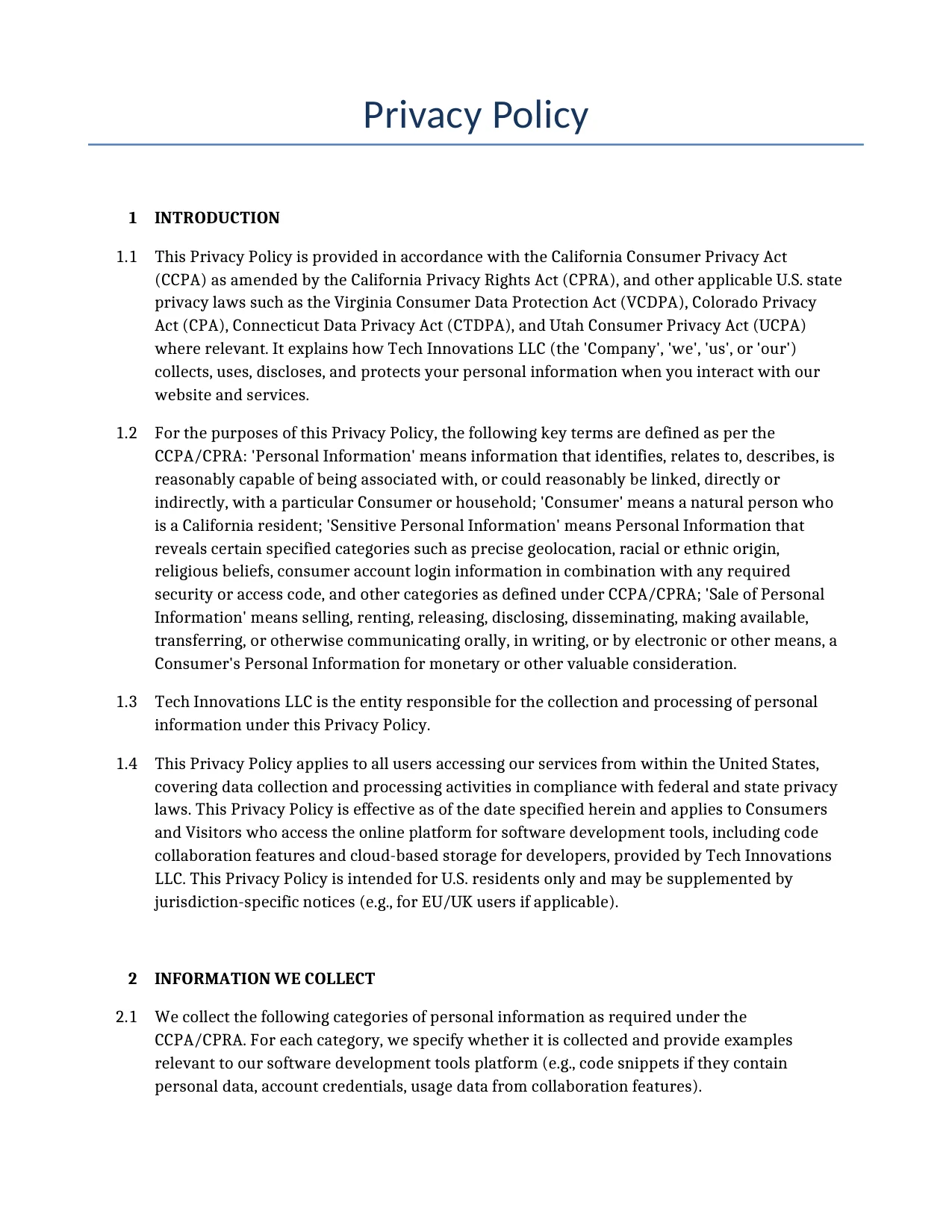
Below is a free template example of a Privacy Policy for use in the United States generated by our AI model.
The clauses in your actual Privacy Policy will vary from this example as they will be entirely bespoke to your requirements as set out in the questionnaire you complete.
Privacy Policy
1INTRODUCTION
This Privacy Policy is provided in accordance with the California Consumer Privacy Act (CCPA) as amended by the California Privacy Rights Act (CPRA), and other applicable U.S. state privacy laws such as the Virginia Consumer Data Protection Act (VCDPA), Colorado Privacy Act (CPA), Connecticut Data Privacy Act (CTDPA), and Utah Consumer Privacy Act (UCPA) where relevant. It explains how Tech Innovations LLC (the 'Company', 'we', 'us', or 'our') collects, uses, discloses, and protects your personal information when you interact with our website and services.
For the purposes of this Privacy Policy, the following key terms are defined as per the CCPA/CPRA: 'Personal Information' means information that identifies, relates to, describes, is reasonably capable of being associated with, or could reasonably be linked, directly or indirectly, with a particular Consumer or household; 'Consumer' means a natural person who is a California resident; 'Sensitive Personal Information' means Personal Information that reveals certain specified categories such as precise geolocation, racial or ethnic origin, religious beliefs, consumer account login information in combination with any required security or access code, and other categories as defined under CCPA/CPRA; 'Sale of Personal Information' means selling, renting, releasing, disclosing, disseminating, making available, transferring, or otherwise communicating orally, in writing, or by electronic or other means, a Consumer's Personal Information for monetary or other valuable consideration.
Tech Innovations LLC is the entity responsible for the collection and processing of personal information under this Privacy Policy.
This Privacy Policy applies to all users accessing our services from within the United States, covering data collection and processing activities in compliance with federal and state privacy laws. This Privacy Policy is effective as of the date specified herein and applies to Consumers and Visitors who access the online platform for software development tools, including code collaboration features and cloud-based storage for developers, provided by Tech Innovations LLC. This Privacy Policy is intended for U.S. residents only and may be supplemented by jurisdiction-specific notices (e.g., for EU/UK users if applicable).
2INFORMATION WE COLLECT
We collect the following categories of personal information as required under the CCPA/CPRA. For each category, we specify whether it is collected and provide examples relevant to our software development tools platform (e.g., code snippets if they contain personal data, account credentials, usage data from collaboration features).
(a) Identifiers: Collected - Yes. Examples: Real name, alias, postal address, unique personal identifier, online identifier, Internet Protocol (IP) address, email address, account name, Social Security number (if applicable), driver's license number (if applicable), passport number (if applicable), or other similar identifiers. In our platform: usernames, email addresses for account creation, IP addresses from logins.
(b) Personal information categories listed in the California Customer Records statute (Cal. Civ. Code \§ 1798.80(e)): Collected - Yes. Examples: Signature, physical characteristics or description, telephone number, insurance policy number, education, employment, employment history, bank account number, credit card number, debit card number, or any other financial information, medical information, or health insurance information. In our platform: billing information, phone numbers for two-factor authentication.
(c) Commercial information: Collected - Yes. Examples: Records of personal property, products or services purchased, obtained, or considered, or other purchasing or consuming histories or tendencies. In our platform: subscription details for premium developer tools, purchase history of add-ons.
(d) Internet or other similar network activity: Collected - Yes. Examples: Browsing history, search history, information on a consumer's interaction with a website, application, or advertisement. In our platform: usage data from collaboration features, interaction with code repositories, session logs.
(e) Geolocation data: Collected - Yes (non-precise). Examples: Physical location or movements (precise geolocation is Sensitive Personal Information). In our platform: approximate location derived from IP for regional service optimization.
(f) Professional or employment-related information: Collected - Yes. Examples: Current or past job history or performance evaluations. In our platform: professional profiles linked to developer accounts, company affiliation for team features.
(g) Inferences drawn from other personal information: Collected - Yes. Examples: Profile reflecting a person's preferences, characteristics, psychological trends, predispositions, behavior, attitudes, intelligence, abilities, and aptitudes. In our platform: inferred developer preferences based on tool usage patterns.
(h) Sensitive personal information: Collected - Limited. Examples: Account login credentials in combination with passwords or access codes, precise geolocation. In our platform: We may process account credentials for authentication but do not collect racial origin, biometric data, or other sensitive categories unless explicitly provided and consented to. We do not use Sensitive Personal Information for purposes other than those permitted without consent under CPRA.
3SOURCES OF PERSONAL INFORMATION AND PURPOSES
We collect personal information from the following sources: (1) Directly from Consumers, such as when you create an account, submit forms, upload code snippets (if they contain personal data), or provide account credentials; (2) Automatically from your interactions with our service, including through cookies, logs from collaboration features, and usage data; (3) From third parties such as advertising networks, data analytics providers (e.g., Google Analytics), government entities (for legal compliance), and business partners.
The table below maps each category of personal information to the business or commercial purposes for which it is collected:
Category | Business/Commercial Purposes Identifiers | Provide and manage accounts, authenticate users, communicate with you, comply with legal obligations. Personal Records | Process transactions, provide customer support, verify identity. Commercial Information | Manage subscriptions, analyze purchase trends to improve services. Internet Activity | Monitor service usage, enhance platform security, perform analytics on collaboration features. Geolocation Data | Optimize regional performance, comply with location-based laws. Professional Information | Facilitate team collaborations, tailor professional features. Inferences | Improve user experience through personalization of development tools. Sensitive Personal Information | Authenticate access (limited to necessary uses without additional consent).
4HOW WE USE YOUR INFORMATION
We use personal information for the following specific business and commercial purposes aligned with CCPA/CPRA:
Providing Services: To operate our software development platform, including code collaboration, cloud storage, and account management (business purpose: performing services).
Improving User Experience: To analyze usage data from features and draw inferences for platform enhancements (business purpose: research and development).
Marketing and Advertising: To send promotional communications and, where permitted, engage in targeted advertising or cross-context behavioral advertising as defined under CPRA. We do use personal information for targeted advertising.
Legal Compliance and Safety: To comply with laws, enforce agreements, and protect rights (business purpose: security and fraud prevention).
We do not use Sensitive Personal Information for purposes other than those permitted without consent under CPRA.
5INFORMATION SHARING AND DISCLOSURE
We distinguish between 'sharing' for cross-context behavioral advertising, 'selling' of personal information, and disclosures to 'service providers' or 'contractors' under CCPA/CPRA. We do not sell personal information as defined under CCPA/CPRA. However, we may share personal information for cross-context behavioral advertising (targeted ads). You may opt out of the sale or sharing of your personal information by clicking the 'Do Not Sell or Share My Personal Information' link on our homepage and in this Privacy Policy.
We disclose categories of personal information to the following third parties for the listed purposes: Service Providers/Contractors (e.g., AWS for hosting, Google Analytics for analytics, Mailchimp for emails) - purposes: operational support, data processing under contracts that prohibit selling or sharing; Advertising Networks - purposes: targeted advertising (sharing for cross-context behavioral advertising); Government Entities - purposes: legal compliance; In a merger or acquisition - purposes: business transfer.
We process opt-out requests for 'Do Not Sell or Share My Personal Information' promptly and honor Global Privacy Control (GPC) signals as opt-out requests for sharing/selling.
6COOKIES AND TRACKING TECHNOLOGIES
We use a cookie consent banner to obtain user consent for non-essential cookies in compliance with applicable laws. The table below lists each cookie or tracking technology, its purpose, duration, and whether it is first-party or third-party:
Cookie Name | Purpose | Duration | First/Third Party _session | Website Functionality (session management) | Session (expires on browser close) | First-party _ga | Analytics and Performance (Google Analytics user tracking) | 2 years | Third-party _ad | Advertising and Marketing (targeted ads via Google Ads) | 1 year or until opt-out | Third-party _gpc | Honors Global Privacy Control signals | Session | First-party
We honor Do Not Track (DNT) signals and Global Privacy Control (GPC) signals from users' browsers by treating them as opt-out requests for sharing and targeted advertising.
We share data collected via cookies with third parties for the purposes outlined in Section 5.
7FINANCIAL INCENTIVES
We do not offer any financial incentives related to the collection, sale, or deletion of personal information.
8CHILDREN'S PRIVACY
Our services are not directed to children under 13 years of age, in compliance with the Children's Online Privacy Protection Act (COPPA). We do not knowingly collect personal information from children under 13 (or under 16 for certain activities requiring consent). If we discover that we have collected personal information from a child under 13 without verifiable parental consent, we will delete such information promptly. We implement age-gating mechanisms where appropriate, and if the service could be used by minors, we may require parental consent for users under 18 in certain jurisdictions.
No third parties integrated with our services collect personal information from children under 13 through the platform.
9YOUR CALIFORNIA PRIVACY RIGHTS AND RIGHTS FOR RESIDENTS OF OTHER STATES
As a California resident under CCPA/CPRA, you have the following rights: Right to Know (access categories and specific pieces of personal information collected, sold, or shared in the past 12 months); Right to Delete (request deletion of your personal information, subject to exceptions); Right to Correct (request correction of inaccurate personal information); Right to Opt-Out of Sale/Sharing (via the 'Do Not Sell or Share My Personal Information' link); Right to Limit Use of Sensitive Personal Information (if applicable); Right to Non-Discrimination (we will not discriminate against you for exercising these rights).
To submit a verifiable consumer request, email us at privacy@example.com or use our online form at https://www.example.com/privacy-request. We will verify your identity (e.g., matching provided data to our records) and respond within 45 days (extendable by another 45 days). You may appeal our decision via the same channels. For residents of Virginia (VCDPA), Colorado (CPA), Connecticut (CTDPA), and Utah (UCPA) where we do business, similar rights apply including access, deletion, opt-out of processing for targeted advertising, and correction. Submit requests using the same methods above. We process these in accordance with each law's requirements.
10DATA SECURITY
We implement reasonable administrative, technical, and physical safeguards to protect your personal information, including encryption at rest and in transit, role-based access controls, regular security audits, employee training, and data processing agreements with vendors. However, no security system is impenetrable, and we cannot guarantee absolute security of your personal information.
In the event of a data breach involving personal information, we will notify affected California residents (and residents of other states as required) without unreasonable delay, in compliance with applicable state data breach notification laws, including providing details on the breach and recommended protective steps.
11DATA RETENTION
We retain personal information only as long as necessary to fulfill the purposes for which it was collected, comply with legal obligations, resolve disputes, and enforce agreements. Retention is granular by category: Account data (identifiers, personal records) is retained while the account is active plus 24 months; Internet activity and usage data from collaboration features is retained for 12 months; Cookies per durations listed in Section 6; Inferences and commercial information for 24 months; Sensitive Personal Information only as long as needed for permitted purposes. At the end of the retention period, we securely delete or anonymize the information using industry-standard methods.
12INTERNATIONAL DATA TRANSFERS
Although this Privacy Policy is for U.S. users and the company is U.S.-based, if any transfers of personal information occur to recipients outside the U.S. (e.g., to service providers in the EU or India), we use appropriate safeguards such as Standard Contractual Clauses, encryption, and technical measures. For users outside the U.S., different privacy policies or supplements may apply.
13THIRD-PARTY LINKS AND SERVICES
We are not responsible for the privacy practices of third-party websites or services linked to or integrated with our platform, including External Website Links, Social Media Links, Payment Processors, and Analytics Tools. We encourage you to review their privacy policies.
14NOTICE TO NEVADA RESIDENTS
If you are a Nevada resident, under Nevada law you may opt out of the sale of certain personal information. Although we do not sell personal information, you may submit opt-out requests using the methods in Section 9 or via the 'Do Not Sell or Share My Personal Information' link.
15DO NOT SELL OR SHARE MY PERSONAL INFORMATION
Pursuant to CCPA/CPRA requirements, we provide a clear and conspicuous 'Do Not Sell or Share My Personal Information' link on our homepage and in this Privacy Policy. This link allows you to opt out of the sale or sharing of your personal information, including for cross-context behavioral advertising. We honor all such requests, including those submitted via Global Privacy Control (GPC) signals, and process them without requiring additional verification in most cases.
16CHANGES TO THIS PRIVACY POLICY
We review and update this Privacy Policy periodically. Material changes will be notified with a prominent notice on the website and, where required by law, via email or other direct communication. Continued use of our services after such changes constitutes your acceptance of the updated policy. Changes become effective on the date specified in the updated Privacy Policy.
17CONTACT INFORMATION
For privacy-related inquiries, please contact us at privacy@example.com. Our address is 123 Main Street, New York, NY 10001.
18GOVERNING LAW
This Privacy Policy is governed by the laws of the State of Delaware and applicable U.S. federal and state privacy laws, without regard to conflict of law principles.
19LAST UPDATED
This Privacy Policy was last updated on January 1, 2025, and is effective as of that date. Use of our service constitutes acceptance of this policy. Note: Sections regarding entire agreement, severability, notices, variation, and signatures have been removed as they are more appropriate for a Terms of Service.
This example shows approximately 70% of a typical document and is provided for illustrative purposes only. The remaining content has been omitted.
Every document generated by Docaro is tailored to your specific circumstances, jurisdiction and the information you provide. The completed document includes all applicable clauses and provisions required for your situation.
To generate the full, personalised document, answer a short series of questions and your document will be created instantly.