
AI Generated American Partnership Agreement
PDF & Word - 2026 Updated
Docaro Pricing
When Do You Need a Partnership Agreement in the United States?
American Legal Rules for a Partnership Agreement
Selecting the incorrect partnership structure, such as general versus limited, can expose partners to unintended personal liability for business debts and obligations.
What a Proper Partnership Agreement Should Include
- Names and Details of PartnersList the full names, addresses, and contact information of all partners entering the agreement.
- Purpose of the PartnershipDescribe the main goals and business activities the partnership aims to pursue.
- Capital ContributionsSpecify what each partner will contribute in money, property, or services to start the business.
- Profit and Loss SharingOutline how profits and losses will be divided among the partners.
- Management and Decision-MakingDefine who makes decisions and how voting or management roles are handled.
- Duties and ResponsibilitiesDetail the specific roles and obligations of each partner in running the business.
- Salary and WithdrawalsExplain if partners will receive salaries or how they can withdraw funds from the partnership.
- Books and RecordsState how financial records will be kept and shared among partners.
- Adding or Removing PartnersSet rules for bringing in new partners or what happens when a partner leaves.
- Dissolution ProcessDescribe the steps to end the partnership and handle remaining assets or debts.
Generate Your Document in 4 Easy Steps
Why Use Docaro?
 United States
Free Example Partnership Agreement Template
Below is a free template example of a Partnership Agreement for use in the United States generated by our AI model.
The clauses in your actual Partnership Agreement will vary from this example as they will be entirely bespoke to your requirements as set out in the questionnaire you complete.
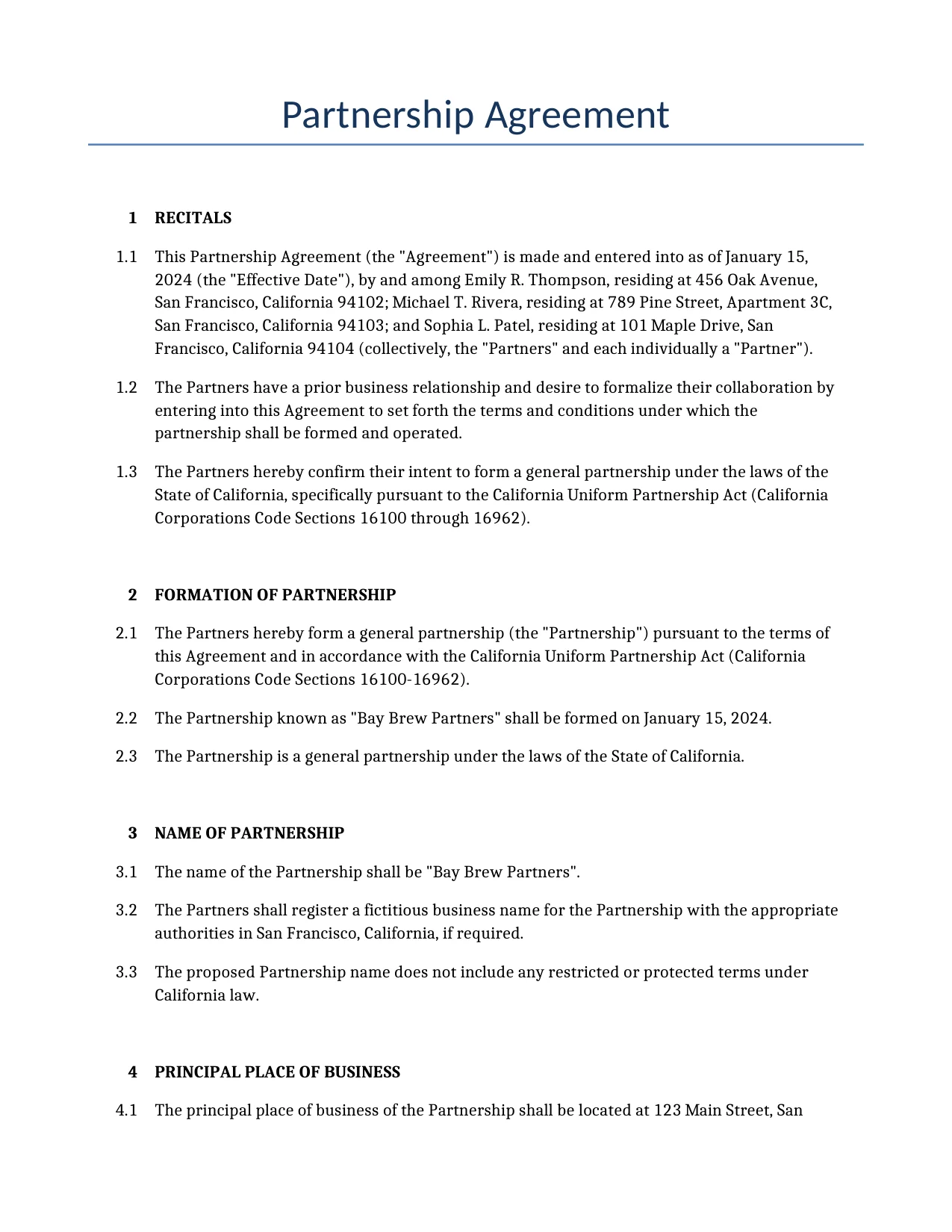
Partnership Agreement
1RECITALS
This Partnership Agreement (the "Agreement") is made and entered into as of January 15, 2024 (the "Effective Date"), by and among Emily R. Thompson, residing at 456 Oak Avenue, San Francisco, California 94102; Michael T. Rivera, residing at 789 Pine Street, Apartment 3C, San Francisco, California 94103; and Sophia L. Patel, residing at 101 Maple Drive, San Francisco, California 94104 (collectively, the "Partners" and each individually a "Partner").
The Partners have a prior business relationship and desire to formalize their collaboration by entering into this Agreement to set forth the terms and conditions under which the partnership shall be formed and operated.
The Partners hereby confirm their intent to form a general partnership under the laws of the State of California, specifically pursuant to the California Uniform Partnership Act (California Corporations Code Sections 16100 through 16962).
2FORMATION OF PARTNERSHIP
The Partners hereby form a general partnership (the "Partnership") pursuant to the terms of this Agreement and in accordance with the California Uniform Partnership Act (California Corporations Code Sections 16100-16962).
The Partnership known as "Bay Brew Partners" shall be formed on January 15, 2024.
The Partnership is a general partnership under the laws of the State of California.
3NAME OF PARTNERSHIP
The name of the Partnership shall be "Bay Brew Partners".
The Partners shall register a fictitious business name for the Partnership with the appropriate authorities in San Francisco, California, if required.
The proposed Partnership name does not include any restricted or protected terms under California law.
4PRINCIPAL PLACE OF BUSINESS
The principal place of business of the Partnership shall be located at 123 Main Street, San Francisco, California 94105.
Partnership business may be conducted at the principal place of business and at such other locations as determined by the Partners.
5PARTNERS
The Partners of the Partnership and their respective ownership percentages are as follows: Emily R. Thompson (40\%), residing at 456 Oak Avenue, San Francisco, California 94102; Michael T. Rivera (35\%), residing at 789 Pine Street, Apartment 3C, San Francisco, California 94103; and Sophia L. Patel (25\%), residing at 101 Maple Drive, San Francisco, California 94104.
The ownership percentages set forth above shall be used for purposes of profit and loss allocation, voting where applicable, and other rights and obligations as specified in this Agreement. The percentages total 100\% and align with the Partners' capital contributions and profit/loss sharing ratios.
6TERM OF PARTNERSHIP
The Partnership shall commence on the Effective Date and shall continue until December 31, 2033 (the "Initial Term"), unless sooner dissolved or terminated in accordance with the provisions of this Agreement.
The term of the Partnership may be extended beyond the Initial Term by mutual written agreement of all Partners executed at least ninety (90) days prior to the expiration of the then-current term. If not extended, the Partnership shall be dissolved and wound up in accordance with this Agreement.
7PURPOSE OF PARTNERSHIP
The primary purpose of the Partnership is to operate a boutique coffee shop in San Francisco, California, specializing in organic and fair-trade beverages, pastries, and related food and beverage products, including retail sales and associated professional services to provide high-quality, sustainable coffee and baked goods to the local community while promoting ethical sourcing practices.
The Partnership may engage in any other lawful activity or purpose that is related or incidental to the foregoing or that is approved by unanimous consent of the Partners.
8CAPITAL CONTRIBUTIONS
Emily R. Thompson shall make an initial capital contribution of cash in the amount of $50,000 to the Partnership's bank account on January 15, 2024, with a fair market value of $50,000.
Michael T. Rivera shall make an initial capital contribution of property consisting of leasehold improvements and equipment for the coffee shop location valued at $87,500 on January 15, 2024, with a fair market value of $87,500.
Sophia L. Patel shall make an initial capital contribution of cash in the amount of $62,500 to the Partnership's bank account on January 15, 2024, with a fair market value of $62,500.
No interest shall be paid on any capital contributions unless otherwise agreed to in writing by all Partners.
9ADDITIONAL CONTRIBUTIONS
No Partner shall be obligated to make any additional capital contributions to the Partnership except as approved by the unanimous consent of all Partners. Any such additional contributions shall be made pro rata in accordance with the Partners' then-current ownership percentages unless otherwise unanimously agreed.
If a Partner fails to make an approved additional capital contribution (a "Defaulting Partner"), the non-defaulting Partners may, but are not required to, contribute the Defaulting Partner's share on a pro rata basis. In such event, the Defaulting Partner's ownership percentage shall be diluted according to the following formula: New Ownership Percentage = (Defaulting Partner's Prior Capital Account Balance) / (Total Partnership Capital After Additional Contributions). The non-defaulting Partners' ownership percentages shall be increased proportionately.
Capital calls for approved additional contributions shall require at least thirty (30) days' written notice to all Partners.
10CAPITAL ACCOUNTS
The Partnership shall maintain capital accounts for each Partner using the accrual basis of accounting in accordance with applicable tax regulations.
The Partnership shall maintain separate records for each Partner's tax basis in addition to book capital accounts.
Net income, gains, losses, and deductions shall be allocated among the Partners' capital accounts in accordance with the profit and loss sharing ratios set forth in this Agreement.
Capital accounts shall be revalued upon certain events, including the admission of a new Partner or the distribution of property, in accordance with Treasury Regulations Section 1.704-1(b)(2)(iv).
11PROFITS AND LOSSES
Profits and losses of the Partnership shall be allocated among the Partners in accordance with their ownership percentages: 40\% to Emily R. Thompson, 35\% to Michael T. Rivera, and 25\% to Sophia L. Patel.
All allocations of profits and losses shall comply with IRC Section 704(b) and shall have substantial economic effect within the meaning of the Treasury Regulations promulgated thereunder. Tax allocations shall follow the same method as book allocations to the extent permitted by law.
12DISTRIBUTIONS
The Partnership shall make distributions of available cash on a quarterly basis or at such other times as approved by a majority of the Partners, subject to the restrictions set forth herein.
Distributions shall be made proportionally based on each Partner's ownership percentage.
No distribution shall be made if, after giving effect to the distribution, the Partnership would be rendered insolvent or if the distribution would violate applicable California law, including the California Uniform Partnership Act.
Distributions upon liquidation or dissolution of the Partnership shall be made in accordance with the Liquidation section of this Agreement after satisfaction of all liabilities to creditors.
13MANAGEMENT AND AUTHORITY
In accordance with the California Uniform Partnership Act, all Partners shall have equal rights in the management and conduct of the Partnership's business unless otherwise provided in this Agreement. Ordinary course decisions shall be made by majority vote based on ownership interest.
Each Partner shall have the authority to bind the Partnership in the ordinary course of business. However, no Partner may, without the unanimous prior written consent of all Partners, undertake any extraordinary transaction, including but not limited to: (i) selling all or substantially all of the Partnership's assets; (ii) incurring indebtedness exceeding $25,000; (iii) admitting a new Partner; (iv) amending this Agreement; or (v) dissolving the Partnership.
Partners may delegate management authority to employees, managers, or third parties only upon approval by a majority vote of the Partners based on ownership interest.
14VOTING RIGHTS
Except as otherwise provided in this Agreement, all decisions of the Partners shall be made by a majority vote based on ownership percentages. Each Partner shall have voting rights in proportion to their ownership interest.
A quorum for any meeting or vote shall consist of Partners holding a majority of the ownership interests in the Partnership.
The following major decisions shall require unanimous approval of all Partners: (i) admission of new Partners; (ii) sale of all or substantially all Partnership assets; (iii) amendment of this Agreement; (iv) incurring debt in excess of $25,000; (v) changes to the Partnership's purpose; (vi) distributions that deviate from ownership percentages; and (vii) dissolution of the Partnership.
Meetings may be held in person, by telephone, video conference, or other electronic means. Notice of meetings shall be given at least seven (7) days in advance in writing.
15DUTIES OF PARTNERS
Each Partner shall owe fiduciary duties to the Partnership and to the other Partners as provided under the California Uniform Partnership Act (California Corporations Code Sections 16100-16962), including the duty of loyalty, the duty of care, the duty to account to the Partnership for any property, profit, or benefit derived from the Partnership, and the duty not to compete with the Partnership without the consent of the other Partners.
Each Partner shall perform all duties in good faith and with fair dealing, maintain the confidentiality of Partnership information, and act in the best interests of the Partnership.
Partners shall be assigned specific responsibilities with respect to daily operations and major decisions as determined by vote consistent with this Agreement.
16BOOKS AND RECORDS
The Partnership shall maintain complete and accurate books and records at its principal office in accordance with generally accepted accounting principles (GAAP) or other appropriate standards consistently applied.
Each Partner shall have access to the Partnership's books and records at all reasonable times upon reasonable request.
The Partnership shall prepare and distribute annual financial statements to all Partners and shall provide interim financial reports quarterly.
The Partnership shall retain its books and records for at least seven (7) years and shall engage an independent certified public accountant as needed.
17BANK ACCOUNTS
The Partnership shall establish and maintain bank accounts as necessary for its operations, including at least one checking account at a reputable financial institution such as Chase Bank.
All Partners shall have signing authority on the Partnership bank accounts, subject to any limitations established by majority vote. Bank accounts shall be subject to monthly reconciliations.
18FISCAL YEAR AND ACCOUNTING
The Partnership's fiscal year shall end on December 31 of each year.
The Partnership shall use the accrual basis of accounting for maintaining its books, records, and capital accounts.
19TAX MATTERS
The Partnership shall elect to be treated as a partnership for federal, state, and local tax purposes and shall file Form 1065 and issue Schedules K-1 to the Partners.
Emily R. Thompson is hereby designated as the Partnership Representative under IRC Section 6223 (as amended by the Bipartisan Budget Act of 2015) and shall have the authority to act on behalf of the Partnership in tax matters.
The Partnership shall prepare and file all tax returns by the applicable deadlines. The Partnership Representative shall distribute tax information to the Partners in a timely manner to allow for accurate reporting on their individual returns.
Each Partner shall provide the Partnership with any information reasonably requested for tax purposes at least thirty (30) days before the end of the tax year.
20TRANSFER OF PARTNERSHIP INTERESTS
No Partner may transfer, assign, pledge, or otherwise encumber all or any part of their Partnership interest without the prior unanimous written consent of the other Partners, which consent may be withheld in the sole discretion of the non-transferring Partners.
The non-transferring Partners shall have a right of first refusal with respect to any proposed transfer on the same terms and conditions offered to the proposed transferee.
Transfers to a Partner's estate, heirs, or permitted family trusts upon death may occur subject to the buyout provisions set forth in this Agreement. Any transferee must agree in writing to be bound by this Agreement.
21WITHDRAWAL OF A PARTNER
A Partner may voluntarily withdraw from the Partnership only upon ninety (90) days' prior written notice to the other Partners (or such shorter period as unanimously agreed). Withdrawal shall not cause automatic dissolution of the Partnership if at least two Partners remain.
Upon withdrawal, the withdrawing Partner's interest shall be purchased by the Partnership or the remaining Partners pursuant to the buyout provisions set forth in this Agreement or a separate buy-sell agreement if one exists.
22DEATH OR INCAPACITY OF A PARTNER
The Partnership shall not dissolve upon the death or incapacity of a Partner if at least two Partners remain. The interest of the deceased or incapacitated Partner shall be purchased by the surviving or remaining Partners or the Partnership pursuant to a buy-sell agreement or the valuation and payment terms set forth herein.
Incapacity shall mean a Partner's inability to perform their duties due to physical or mental impairment, as certified by two licensed physicians, for a period exceeding ninety (90) consecutive days.
23EXPULSION OF A PARTNER
A Partner may be expelled from the Partnership for cause, including material breach of this Agreement, conviction of a crime involving moral turpitude, gross negligence, or willful misconduct, upon unanimous vote of the remaining Partners after providing at least thirty (30) days' written notice and an opportunity to be heard.
Upon expulsion, the expelled Partner's interest shall be purchased by the Partnership or remaining Partners at a value determined in accordance with the buyout provisions of this Agreement. The expelled Partner shall remain subject to the non-solicitation and confidentiality obligations herein.
24DISSOLUTION AND TERMINATION
The Partnership shall dissolve upon the expiration of its term (if not extended), the unanimous written agreement of all Partners, or as otherwise required by the California Uniform Partnership Act. Dissolution events such as the death, withdrawal, or bankruptcy of a Partner shall not automatically dissolve the Partnership if the remaining Partners unanimously elect to continue the business within ninety (90) days.
Upon dissolution, the Partnership shall be wound up by a Person appointed by majority vote of the Partners (based on ownership), who shall provide at least thirty (30) days' notice of intent to wind up to all known creditors and Partners.
25LIQUIDATION
Upon dissolution, the assets of the Partnership shall be liquidated and applied in the following order: (i) to creditors (including Partners who are creditors to the extent permitted by law); (ii) to establish reserves for contingent liabilities; and (iii) to Partners in accordance with their positive capital account balances.
A final accounting shall be prepared and distributed to all Partners. Any disputes arising from liquidation shall be resolved pursuant to the Dispute Resolution section of this Agreement.
26INDEMNIFICATION
The Partnership shall indemnify each Partner against losses, claims, damages, and expenses (including reasonable attorneys' fees) arising from acts or omissions performed in good faith on behalf of the Partnership, to the fullest extent permitted by the California Uniform Partnership Act.
Indemnification shall not be available for acts involving gross negligence, willful misconduct, breach of fiduciary duty, or violations of law. Partners shall advance expenses as incurred subject to repayment if it is ultimately determined that indemnification is not available.
27INSURANCE
The Partnership shall obtain and maintain, at its expense, appropriate insurance coverage including general liability insurance, property insurance, business interruption insurance, and workers' compensation insurance, each with minimum coverage limits of at least $500,000 or such higher amounts as determined by the Partners.
Insurance shall be obtained effective as of January 15, 2024, or as soon as practicable thereafter, and shall name the Partnership as the insured. Certificates of insurance shall be provided to all Partners upon request.
28CONFIDENTIALITY
Each Partner agrees to maintain the confidentiality of all proprietary and confidential information of the Partnership, including trade secrets, customer lists, financial data, and business strategies, both during the term of the Partnership and thereafter.
Disclosure is permitted only as required by law, to professional advisors under confidentiality obligations, or with the prior written consent of the other Partners. Upon withdrawal or termination, a Partner shall return or destroy all confidential materials.
Remedies for breach shall include injunctive relief, damages, and any other remedies available at law or in equity.
29NON-COMPETE AND NON-SOLICITATION
In recognition of the restrictions on non-compete agreements under California Business and Professions Code Section 16600, the Partners agree that during the term of the Partnership, no Partner shall directly or indirectly engage in any competing business that operates a coffee shop or similar retail food and beverage establishment within San Francisco County without the prior written consent of all other Partners.
For a period of twelve (12) months following a Partner's withdrawal, expulsion, or the termination of the Partnership, no Partner shall solicit or attempt to solicit any customers of the Partnership with whom the Partner had material contact or any employees of the Partnership. This provision shall not prohibit a Partner from engaging in a lawful competing business after departure, subject to the foregoing non-solicitation restriction.
The Partners agree to protect the Partnership's trade secrets in accordance with the California Uniform Trade Secrets Act. If any provision of this section is held unenforceable, it shall be reformed to the minimum extent necessary to render it enforceable. Remedies for breach include injunctive relief without bond and monetary damages.
30DISPUTE RESOLUTION
Any dispute arising out of or relating to this Agreement shall first be submitted to non-binding mediation in San Francisco, California, administered by a mutually agreed mediator or under the rules of JAMS. If the dispute is not resolved within sixty (60) days after mediation commences, it shall be resolved by binding arbitration in San Francisco, California, before a single arbitrator selected in accordance with JAMS Comprehensive Arbitration Rules and Procedures. The arbitration shall be governed by the laws of the State of California.
The arbitrator's decision shall be final and binding, and judgment may be entered thereon in any court of competent jurisdiction. The prevailing party in any arbitration or related legal action shall be entitled to recover its reasonable attorneys' fees and costs. All proceedings shall remain confidential to the extent permitted by law.
31GOVERNING LAW
This Agreement and all matters arising out of or relating to this Agreement shall be governed by and construed in accordance with the laws of the State of California, without regard to its conflict of laws principles. The parties agree that any legal action or proceeding shall be brought exclusively in the state or federal courts located in San Francisco County, California, and hereby consent to the personal jurisdiction and venue of such courts.
32PARTNERSHIP REGISTRATION AND FILINGS
The Partnership shall file a Statement of Partnership Authority with the California Secretary of State if deemed necessary or advisable by the Partners. The Partnership shall obtain an Employer Identification Number (EIN) from the IRS, register for all applicable state and local taxes, and obtain and maintain all required business licenses and permits for operating a coffee shop in San Francisco, including health permits, sales tax permits, and any other regulatory approvals.
The Partners shall ensure ongoing compliance with all filing, reporting, and licensing requirements under California and local law.
33INTELLECTUAL PROPERTY
Any intellectual property (including trademarks, service marks, trade names, copyrights, recipes, branding, website content, and trade secrets) developed, created, or acquired by the Partnership or by any Partner in connection with the Partnership's business shall be owned exclusively by the Partnership. Each Partner hereby assigns to the Partnership all right, title, and interest in and to any such IP and agrees to execute any documents necessary to perfect such ownership.
No Partner shall have any individual right to use Partnership IP except as authorized by the Partnership. Upon withdrawal or termination, a Partner's rights to use any Partnership IP shall immediately cease.
34REPRESENTATIONS AND WARRANTIES
Each Partner represents and warrants to the other Partners and the Partnership that: (i) they have full legal capacity and authority to enter into this Agreement and perform their obligations hereunder; (ii) their capital contributions are free and clear of any liens, encumbrances, or restrictions; (iii) execution and performance of this Agreement will not violate any other agreement, court order, or legal obligation to which they are bound; and (iv) they are not subject to any bankruptcy or insolvency proceedings.
These representations and warranties shall survive the execution of this Agreement and the formation of the Partnership.
35MISCELLANEOUS PROVISIONS
Force Majeure. No Partner shall be liable for any delay or failure to perform its obligations hereunder to the extent such delay or failure is caused by events beyond its reasonable control, including but not limited to acts of God, war, terrorism, pandemics, strikes, or governmental orders (excluding payment obligations).
Assignment. No Partner may assign any of its rights or delegate any of its obligations under this Agreement without the prior written consent of all other Partners. Any attempted assignment without such consent shall be null and void.
No Third-Party Beneficiaries. This Agreement is intended solely for the benefit of the Partners and the Partnership and their respective permitted successors and assigns. Nothing herein shall create any rights in any third parties.
Time is of the Essence. Time is of the essence with respect to all dates, periods, and deadlines set forth in this Agreement.
Severability, Reformation, and Survival. If any provision of this Agreement is held invalid or unenforceable, the remaining provisions shall remain in full force and effect. Any invalid provision shall be reformed to the minimum extent necessary to make it valid and enforceable while preserving the parties' original intent to the greatest extent possible. The provisions of this Agreement relating to confidentiality, non-solicitation, intellectual property, representations and warranties, indemnification, governing law, and dispute resolution shall survive any termination or dissolution of the Partnership.
36ENTIRE AGREEMENT
This Agreement, together with any exhibits attached hereto, constitutes the entire understanding and agreement between the Partners with respect to the subject matter hereof and supersedes all prior written or oral agreements, understandings, or negotiations.
The Effective Date of this Agreement is January 15, 2024.
37AMENDMENTS
This Agreement may be amended only by a written instrument signed by all of the Partners. Any amendment must be approved by unanimous consent.
38NOTICES
All notices, requests, demands, and other communications under this Agreement shall be in writing and shall be deemed duly given if delivered personally, sent by certified mail (return receipt requested), or by overnight courier to the addresses set forth below or to such other address as a party may designate by notice pursuant hereto: For the Partnership: 123 Main Street, San Francisco, CA 94105; For Emily R. Thompson: 456 Oak Avenue, San Francisco, CA 94102; For Michael T. Rivera: 789 Pine Street, Apartment 3C, San Francisco, CA 94103; For Sophia L. Patel: 101 Maple Drive, San Francisco, CA 94104.
Notices shall be effective upon receipt.
39BINDING EFFECT
This Agreement shall be binding upon and inure to the benefit of the Partners and their respective heirs, executors, administrators, legal representatives, successors, and permitted assigns.
40COUNTERPARTS
This Agreement may be executed in one or more counterparts, each of which shall be deemed an original, but all of which together shall constitute one and the same instrument. Electronic signatures (including DocuSign or similar) shall be deemed original signatures for all purposes.
41EXHIBITS
The following exhibits are attached hereto and incorporated by reference: Exhibit A - Detailed Capital Contributions and Valuation Schedule; Exhibit B - Partner Addresses and Contact Information; Exhibit C - Sample Schedule K-1 and Tax Reporting Guidelines. In the event of any conflict between an exhibit and the body of this Agreement, the body shall control.
42SIGNATURES
IN WITNESS WHEREOF, the parties have executed this Partnership Agreement as of the date first above written.
Emily R. Thompson: _______________________________ Date: _______________
Michael T. Rivera: _______________________________ Date: _______________
Sophia L. Patel: _______________________________ Date: _______________
This example shows approximately 70% of a typical document and is provided for illustrative purposes only. The remaining content has been omitted.
Every document generated by Docaro is tailored to your specific circumstances, jurisdiction and the information you provide. The completed document includes all applicable clauses and provisions required for your situation.
To generate the full, personalised document, answer a short series of questions and your document will be created instantly.