
AI Generated American Residential Lease Renewal Agreement
PDF & Word - 2026 Updated
Docaro Pricing
When do you need a Residential Lease Renewal Agreement in the United States?
American Legal Rules for a Residential Lease Renewal Agreement
Using an incorrect structure for a residential lease renewal agreement may inadvertently alter key terms or fail to extend the original lease protections.
What a Proper Residential Lease Renewal Agreement Should Include
- Renewal DatesSpecify the exact start and end dates of the renewed lease period to clearly define the new term.
- Rent Amount and PaymentOutline the new rent price, due dates, and payment methods to avoid any confusion on financial obligations.
- Security Deposit UpdateState the current security deposit amount and any changes, including conditions for its return.
- Property ConditionDescribe the expected condition of the rental property at the start of the renewal.
- Rules and ResponsibilitiesReference or update the key rules for tenants, such as maintenance duties and prohibited activities.
- SignaturesInclude spaces for both landlord and tenant to sign and date, making the agreement legally binding.
Generate Your Document in 4 Easy Steps
Why Use Docaro?
 United States
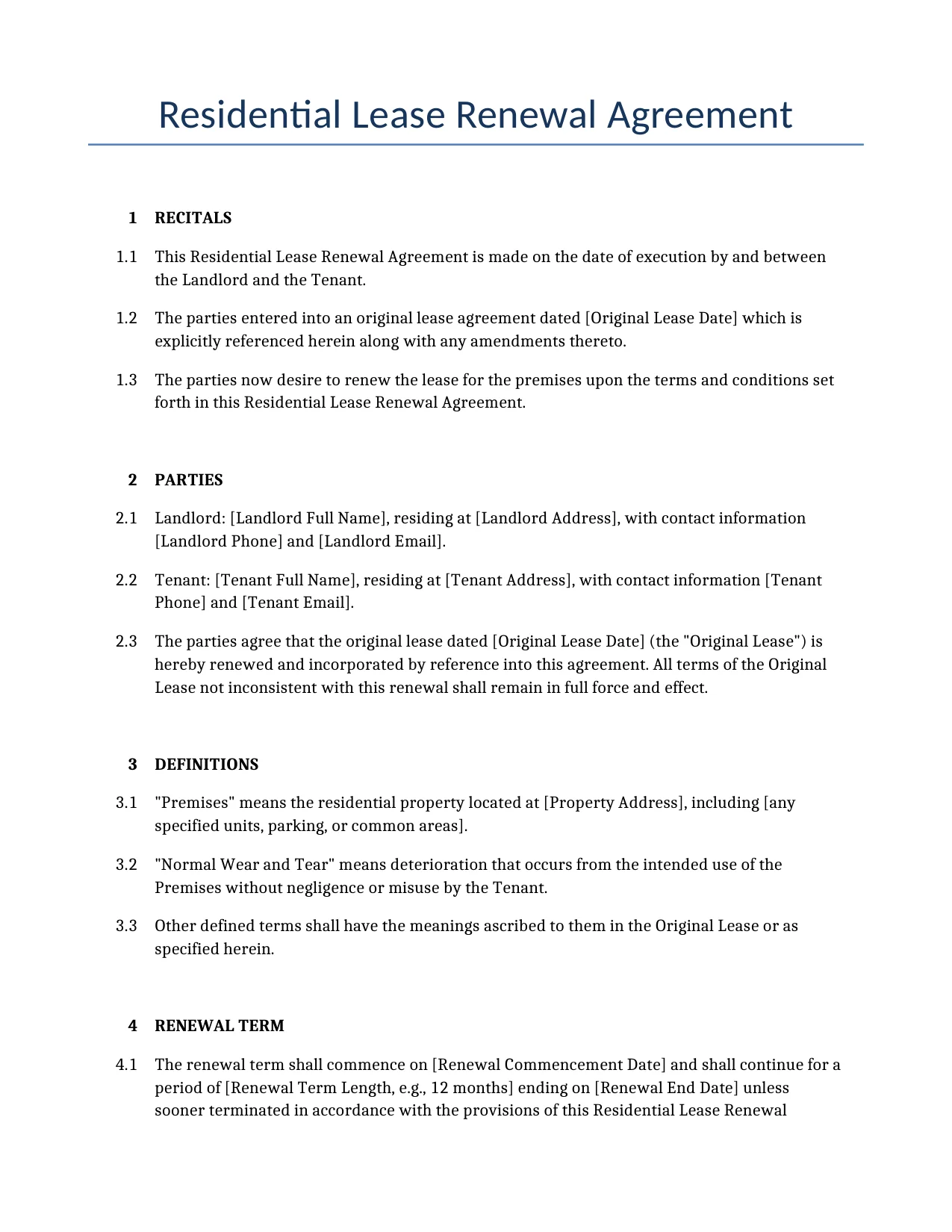
Free Example Residential Lease Renewal Agreement Template
Below is a free template example of a Residential Lease Renewal Agreement for use in the United States generated by our AI model.
The clauses in your actual Residential Lease Renewal Agreement will vary from this example as they will be entirely bespoke to your requirements as set out in the questionnaire you complete.
Residential Lease Renewal Agreement
1RECITALS
This Residential Lease Renewal Agreement is made on the date of execution by and between the Landlord and the Tenant.
The parties entered into an original lease agreement dated [Original Lease Date] which is explicitly referenced herein along with any amendments thereto.
The parties now desire to renew the lease for the premises upon the terms and conditions set forth in this Residential Lease Renewal Agreement.
2PARTIES
Landlord: [Landlord Full Name], residing at [Landlord Address], with contact information [Landlord Phone] and [Landlord Email].
Tenant: [Tenant Full Name], residing at [Tenant Address], with contact information [Tenant Phone] and [Tenant Email].
The parties agree that the original lease dated [Original Lease Date] (the "Original Lease") is hereby renewed and incorporated by reference into this agreement. All terms of the Original Lease not inconsistent with this renewal shall remain in full force and effect.
3DEFINITIONS
"Premises" means the residential property located at [Property Address], including [any specified units, parking, or common areas].
"Normal Wear and Tear" means deterioration that occurs from the intended use of the Premises without negligence or misuse by the Tenant.
Other defined terms shall have the meanings ascribed to them in the Original Lease or as specified herein.
4RENEWAL TERM
The renewal term shall commence on [Renewal Commencement Date] and shall continue for a period of [Renewal Term Length, e.g., 12 months] ending on [Renewal End Date] unless sooner terminated in accordance with the provisions of this Residential Lease Renewal Agreement.
5RENT
The Tenant shall pay to the Landlord a monthly rent in the amount of [Monthly Rent Amount] which shall be due on the [Rent Due Day, e.g., 1st] day of each month during the renewal term.
(a) Acceptable payment methods include electronic transfer, check, or [other methods]. (b) Rent shall be paid to [Landlord Name or Agent] at [Payment Address or Account Details]. (c) Rent is payable without deduction, setoff, or counterclaim. (d) If allowed by law, a grace period of [Grace Period Days, e.g., 5] days shall apply before late fees of [Late Fee Amount] may be imposed. (e) Any rent escalation shall specify exact increase amounts or a clear calculation method (e.g., [specify formula]) and must be documented in a written addendum signed by both parties.
6SECURITY DEPOSIT
The total security deposit for the renewed lease is [Total Security Deposit Amount]. This includes [description of any transfer or supplement from the Original Lease deposit of Original Deposit Amount].
The security deposit shall not exceed the maximum amount permitted under applicable state law (e.g., [state-specific limit]).
Permissible deductions include unpaid rent, cleaning costs, repairs for damages beyond normal wear and tear, and [other lawful deductions].
The Landlord shall provide an itemized accounting of any deductions and return any remaining deposit within [State-Specific Return Period, e.g., 21 days for California] after termination of the tenancy.
[If applicable: The security deposit shall accrue interest at the rate required by jurisdiction, to be paid or credited as provided by law.]
7UTILITIES AND SERVICES
The Tenant shall be responsible for paying the electricity utility during the renewal term.
The Tenant shall be responsible for paying the gas utility during the renewal term.
The Landlord shall be responsible for paying the water and sewer utility during the renewal term.
The Tenant shall be responsible for paying trash removal services during the renewal term.
(a) The Tenant is responsible for all other utilities including internet, cable, and phone. (b) In case of shared meters, billing shall be [prorated or as specified]. (c) Tampering with any utilities is strictly prohibited. (d) The Tenant must transfer all Tenant-paid utility accounts into their name within [number] days of commencement. (e) Failure to pay utilities may result in such amounts being added to rent or constitute grounds for default and eviction.
8USE OF PREMISES
The premises shall be used solely for Residential living as a single-family home.
The permitted occupants of the premises shall be the Tenant and Immediate Family up to a maximum of 4 persons.
Smoking is prohibited inside the premises.
The Tenant shall not use the Premises for any unlawful purpose.
9CONDITION OF PREMISES
The Tenant acknowledges receipt of the Premises in good condition as documented in the attached move-in inspection checklist (Exhibit B). The Premises are currently in [describe current condition, e.g., recently painted, with functional appliances].
The Tenant shall document the condition with photos or video at move-in and provide copies to the Landlord. The Tenant agrees to return the Premises in the same condition at the end of the term, normal wear and tear excepted.
10QUIET ENJOYMENT
The Landlord covenants that the Tenant shall have quiet enjoyment of the Premises without interference, subject to the Landlord's right of entry as provided herein.
The Tenant covenants not to create noise, nuisance, or engage in illegal activities that disturb neighbors or violate the lease. The Tenant shall not use the Premises for any unlawful purpose.
11REPAIRS AND MAINTENANCE
The Tenant is responsible for minor repairs and maintenance (examples: replacing light bulbs, unclogging drains not caused by building issues). The Landlord is responsible for major repairs (examples: roof, foundation, plumbing, electrical systems).
The Tenant must notify the Landlord immediately of any emergencies or major issues. The Tenant is responsible for damages caused by their negligence, misuse, or that of their guests or pets.
The Landlord shall make repairs within a reasonable time after receiving notice. The Tenant may not withhold rent for repairs without strictly following applicable statutory procedures.
12ALTERATIONS AND IMPROVEMENTS
The Tenant may make alterations or improvements to the property during the renewal term only with the prior written approval of the Landlord. Any approved alterations must be performed in a workmanlike manner by licensed professionals where required by law. The Tenant shall obtain all necessary permits at their sole expense.
Upon termination, if requested by the Landlord, the Tenant shall restore the Premises to its original condition at the Tenant's expense. The Tenant shall be liable for any liens or damages resulting from alterations.
13INSURANCE
(a) The Tenant shall carry renter's insurance with minimum liability coverage of [Minimum Liability Amount, e.g., 100000.00] and personal property coverage of [Minimum Property Amount]. (b) The Landlord shall maintain property insurance on the building but not on the Tenant's personal property. (c) The parties waive subrogation rights against each other to the extent of their insurance coverage. (d) The Tenant shall provide proof of insurance annually or upon request. (e) The Landlord is not responsible for any losses to the Tenant not covered by the Tenant's insurance.
14SUBLETTING AND ASSIGNMENT
The Tenant shall not sublet or assign the Premises without the prior written consent of the Landlord, which may be withheld in the Landlord's sole discretion. Any subletting or assignment, even if approved, does not release the original Tenant from liability under this agreement.
Any subtenant must comply with all terms of this lease. The Landlord may charge reasonable fees for processing subletting or assignment requests. Assignment by operation of law or without consent is prohibited.
15RULES AND REGULATIONS
The Tenant agrees to comply with the Rules and Regulations attached as Exhibit C, which are incorporated herein by reference. These include but are not limited to: (a) Noise: Quiet hours from [e.g., 10 PM to 8 AM]; (b) Guests: Limited to [number] overnight without notice; (c) Common areas: Keep clean and orderly; (d) Trash: Dispose in designated areas per schedule; (e) Parking: Follow assigned spaces; (f) Storage: No storage in unauthorized areas; (g) Appliances: Maintain and clean regularly; (h) Prohibited: No illegal activities, no pets beyond approved, no smoking in common areas.
Violation of these rules constitutes a breach of the lease. The Landlord may reasonably amend the rules with [number] days written notice to the Tenant.
16PETS
(a) The Tenant is permitted [number, size, breed restrictions, e.g., up to 2 dogs under 25 lbs, no aggressive breeds]. (b) The Tenant must provide registration and current vaccination records. (c) A non-refundable pet fee of [amount], refundable pet deposit of [amount], and monthly pet rent of [amount] apply. (d) The Tenant is responsible for all damages caused by pets. (e) Compliance with all local pet laws is required. (f) The Landlord may revoke pet permission for violations with notice.
17PARKING
(a) Assigned parking spaces are located at [exact location, e.g., spaces 5 and 6 in the rear lot]. (b) Spaces are [exclusive/shared]. (c) No vehicle maintenance, storage, or repairs (beyond minor emergency) in parking areas. (d) Guest parking requires prior approval and follows [procedures]. (e) Unauthorized vehicles may be towed at owner's expense. (f) Parking permits or stickers are required and must be displayed.
18ENTRY BY LANDLORD
The Landlord may enter the Premises for repairs, inspections, showings to prospective tenants/buyers, or other reasonable purposes upon providing at least [state-specific notice, e.g., 24 hours] notice during reasonable hours (e.g., 9 AM to 6 PM). No notice is required in true emergencies. The Tenant shall not unreasonably withhold consent to entry.
19DEFAULT AND REMEDIES
Default events include: non-payment of rent, unauthorized pets or occupants, illegal use of Premises, abandonment, repeated rule violations, failure to maintain utilities, or other material breaches. Cure periods shall be as required by state law (e.g., [specify if applicable]).
Remedies include eviction, recovery of damages, attorney fees and costs (if permitted), injunctions, acceleration of remaining rent (if allowed by law), collection costs, and interest on unpaid amounts at the maximum legal rate.
20TERMINATION
(1) Early termination by either party is allowed under conditions such as [mutual agreement, breach, or as provided by law]. (2) Notice must be [length, e.g., 30 or 60 days] in writing delivered per the Notices section. (3) Early termination fees or liquidated damages of [amount or formula], if allowed by law. (4) Military termination rights under the Servicemembers Civil Relief Act are preserved. (5) Upon termination, Tenant must surrender the Premises clean, remove all belongings, return keys, and allow final inspection. (6) Holdover tenancy incurs rent at [e.g., 150% or double] the rate until vacated.
21NOTICES
All notices must be in writing. Acceptable methods include certified mail, hand delivery, or email with read receipt (if permitted by state law).
Notices to Landlord: [Landlord Full Name], [Landlord Address], [Phone], [Email]. Notices to Tenant: [Tenant Full Name], [Tenant Address during term or forwarding], [Phone], [Email].
Notices are deemed received [e.g., 3 days after mailing, upon hand delivery, or upon email confirmation]. Either party may change address with proper written notice.
22GOVERNING LAW
This Residential Lease Renewal Agreement shall be governed by the laws of the State of [Chosen State, e.g., California]. The parties agree to comply with all applicable local ordinances, rent control laws (if any), and state landlord-tenant statutes (e.g., California Civil Code §§ 1940-1954.1 as currently amended). Required disclosures under state law are incorporated herein.
23DISCLOSURE REQUIREMENTS
The following disclosures are provided as required by [State] law and attached as exhibits: Lead-Based Paint Disclosure (if building constructed pre-1978, per federal and state law), Mold Disclosure, Asbestos Disclosure (if applicable), Radon Disclosure, Energy Efficiency, Flood Zone Information, Sex Offender Registry Notice, Bed Bug Addendum (if required), and any other mandated notices or addendums.
24JURY TRIAL WAIVER AND ATTORNEY FEES
To the extent permitted by law, the parties waive any right to a jury trial in any litigation arising from this agreement. The prevailing party in any dispute shall be entitled to recover reasonable attorney fees and costs.
25ENTIRE AGREEMENT
This Residential Lease Renewal Agreement, together with the Original Lease dated [Original Lease Date] and all exhibits and addendums, constitutes the entire agreement between the parties and supersedes all prior understandings.
26SEVERABILITY
If any provision of this Residential Lease Renewal Agreement is held to be invalid or unenforceable such invalidity shall not affect the validity or enforceability of the remaining provisions.
27WAIVER
The failure of either party to enforce any provision of this Residential Lease Renewal Agreement shall not constitute a waiver of the right to enforce that provision in the future.
28AMENDMENTS
Any amendments to this Residential Lease Renewal Agreement must be in writing and signed by both the Landlord and the Tenant.
29SUCCESSORS AND ASSIGNS
This Residential Lease Renewal Agreement shall bind the heirs successors and permitted assigns of both the Landlord and the Tenant.
30FORCE MAJEURE
Neither party shall be liable for any delay or failure to perform its obligations under this Residential Lease Renewal Agreement if such delay or failure is due to events beyond its reasonable control including acts of God strikes or wars.
31DISPUTE RESOLUTION
The parties shall first attempt to resolve any disputes under this Residential Lease Renewal Agreement through mediation before pursuing other remedies.
32INDEMNIFICATION
The Tenant shall indemnify the Landlord against any claims or damages arising from the Tenant's use of the premises or breach of this Residential Lease Renewal Agreement.
33EXHIBITS AND ATTACHMENTS
The following exhibits are incorporated by reference and made a part of this agreement: (1) Original Lease; (2) Property Description/Floor Plan; (3) Move-in Inspection Checklist (with photos/video); (4) Rules and Regulations; (5) Pet Agreement (if applicable); (6) Lead-Based Paint Disclosure (if required); (7) Other Addendums [list]. All exhibits must be initialed or signed by the parties.
34SIGNATURES
| LANDLORD | |
| Signature: | |
| Print Name: | |
| Date: |
| TENANT | |
| Signature: | |
| Print Name: | |
| Date: |
This example shows approximately 70% of a typical document and is provided for illustrative purposes only. The remaining content has been omitted.
Every document generated by Docaro is tailored to your specific circumstances, jurisdiction and the information you provide. The completed document includes all applicable clauses and provisions required for your situation.
To generate the full, personalised document, answer a short series of questions and your document will be created instantly.