
AI Generated American Employee Handbook
PDF & Word - 2026 Updated
Docaro Pricing
When Do You Need an Employee Handbook in the United States?
Key Legal Rules for Employee Handbooks in the US
Using the wrong structure for an employee handbook can inadvertently create enforceable employment contracts or obligations.
What a Proper Employee Handbook Should Include
- Company OverviewIntroduce your business's mission, values, and structure to help employees understand the company's goals and culture.
- Employment BasicsCover hiring processes, job classifications, and at-will employment to set clear expectations from the start.
- Work Rules and StandardsOutline expected behaviors, dress code, and performance guidelines to promote a positive work environment.
- Compensation and BenefitsDetail pay schedules, overtime rules, health insurance, and other perks to inform employees about their rewards.
- Time Off and LeaveExplain vacation, sick days, holidays, and family leave policies to support work-life balance.
- Workplace SafetyDescribe safety procedures, emergency protocols, and hazard reporting to ensure a secure environment.
- Anti-Harassment PolicyProhibit discrimination and outline reporting steps to foster respect and equality among staff.
- Disciplinary ActionsSpecify steps for addressing violations, from warnings to termination, to maintain fairness.
- Acknowledgment FormRequire employees to sign that they've read and agree to follow the handbook rules.
Generate Your Document in 4 Easy Steps
Why Use Docaro?
 United States
Free Example Employee Handbook Template
Below is a free template example of a Employee Handbook for use in the United States generated by our AI model.
The clauses in your actual Employee Handbook will vary from this example as they will be entirely bespoke to your requirements as set out in the questionnaire you complete.
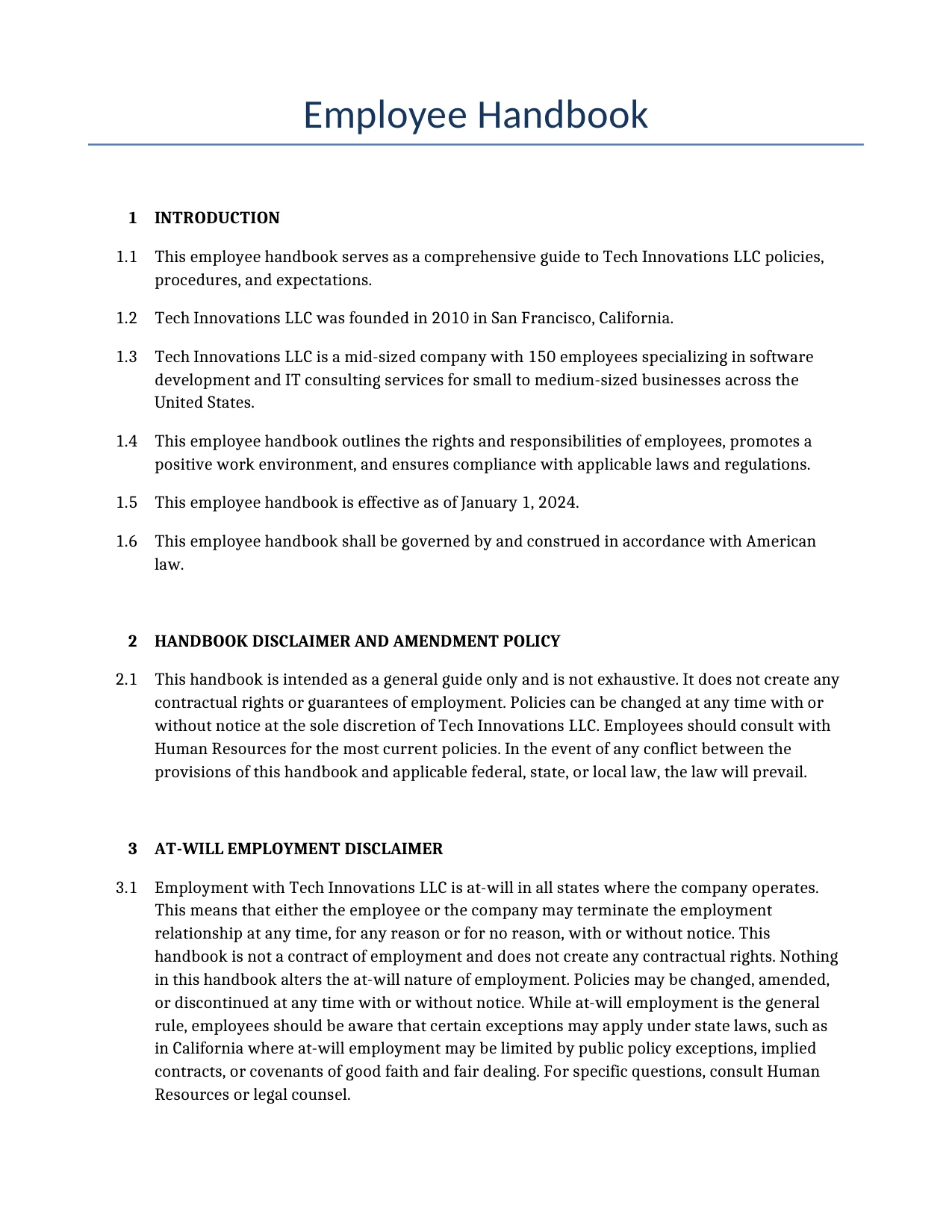
Employee Handbook
1INTRODUCTION
This employee handbook serves as a comprehensive guide to Tech Innovations LLC policies, procedures, and expectations.
Tech Innovations LLC was founded in 2010 in San Francisco, California.
Tech Innovations LLC is a mid-sized company with 150 employees specializing in software development and IT consulting services for small to medium-sized businesses across the United States.
This employee handbook outlines the rights and responsibilities of employees, promotes a positive work environment, and ensures compliance with applicable laws and regulations.
This employee handbook is effective as of January 1, 2024.
This employee handbook shall be governed by and construed in accordance with American law.
2HANDBOOK DISCLAIMER AND AMENDMENT POLICY
This handbook is intended as a general guide only and is not exhaustive. It does not create any contractual rights or guarantees of employment. Policies can be changed at any time with or without notice at the sole discretion of Tech Innovations LLC. Employees should consult with Human Resources for the most current policies. In the event of any conflict between the provisions of this handbook and applicable federal, state, or local law, the law will prevail.
3AT-WILL EMPLOYMENT DISCLAIMER
Employment with Tech Innovations LLC is at-will in all states where the company operates. This means that either the employee or the company may terminate the employment relationship at any time, for any reason or for no reason, with or without notice. This handbook is not a contract of employment and does not create any contractual rights. Nothing in this handbook alters the at-will nature of employment. Policies may be changed, amended, or discontinued at any time with or without notice. While at-will employment is the general rule, employees should be aware that certain exceptions may apply under state laws, such as in California where at-will employment may be limited by public policy exceptions, implied contracts, or covenants of good faith and fair dealing. For specific questions, consult Human Resources or legal counsel.
4COMPANY MISSION AND VALUES
The mission of Tech Innovations LLC is to empower small businesses with innovative software solutions that drive growth and efficiency.
The primary purpose or vision of Tech Innovations LLC beyond its mission is to become the leading provider of cloud-based tools that transform how entrepreneurs manage their operations, fostering a global community of thriving businesses.
Tech Innovations LLC has established four core values that represent its principles.
The first core value of Tech Innovations LLC is Integrity.
Tech Innovations LLC conducts all business dealings with honesty, transparency, and ethical standards, building trust with its employees, customers, and partners.
The second core value of Tech Innovations LLC is Innovation.
The third core value of Tech Innovations LLC is Teamwork.
The fourth core value of Tech Innovations LLC is Customer Focus.
Tech Innovations LLC has established the following guiding principles in addition to its mission and core values.
5EQUAL EMPLOYMENT OPPORTUNITY
Tech Innovations LLC is an equal opportunity employer and complies with all applicable federal, state, and local laws. We prohibit discrimination and harassment of any type and afford equal employment opportunities to employees and applicants without regard to race, color, religion, sex (including pregnancy, childbirth, and related medical conditions), sexual orientation, gender identity, national origin, age (40 and over), disability, genetic information, veteran status, or any other characteristic protected under applicable federal, state, or local law. In states such as California, we also comply with additional protections under the Fair Employment and Housing Act (FEHA), including protections based on marital status, ancestry, medical condition, and military and veteran status. We provide reasonable accommodations for qualified individuals with disabilities and for employees' religious beliefs and practices, unless doing so would cause an undue hardship. Employees should contact Human Resources to request accommodations.
6RECRUITMENT AND HIRING
Tech Innovations LLC shall post job openings on LinkedIn, Indeed, the company website, and local job boards during recruitment.
Applicants shall submit their applications to Tech Innovations LLC via email to hr@company.com or through the online application portal on the company website.
Tech Innovations LLC includes an Equal Employment Opportunity statement in its recruitment materials.
Tech Innovations LLC shall conduct background checks, including Criminal History Check, Employment Verification, and Education Verification on applicants, in compliance with the federal Fair Credit Reporting Act (FCRA) and state laws, particularly California's Investigative Consumer Reporting Agencies Act (ICRAA) and restrictions on the use of criminal history (ban the box). Applicants will receive required FCRA notices and authorizations. Background checks will not include prohibited inquiries under state law.
Tech Innovations LLC shall implement pre-employment drug screening as part of the hiring process in compliance with applicable state laws, including California's restrictions on marijuana testing under the Fair Chance Act and other privacy laws. Drug testing will be limited to permissible substances and circumstances.
Tech Innovations LLC shall conduct interviews during recruitment in the formats of Virtual Video Interviews and Phone Screenings.
Tech Innovations LLC shall require reference checks for all final candidates.
7ORIENTATION AND ONBOARDING
Tech Innovations LLC includes a formal new hire orientation program in its Orientation and Onboarding process.
The new hire orientation program of Tech Innovations LLC shall last 3 days.
Tech Innovations LLC shall use In-person sessions and Online modules for delivering training during onboarding.
Tech Innovations LLC shall include a probationary period in the onboarding process.
8COMPENSATION AND PAYROLL
Tech Innovations LLC shall use a Bi-weekly pay period for employee payroll.
Tech Innovations LLC shall issue paychecks or direct deposits to employees on Fridays.
Tech Innovations LLC shall offer Direct Deposit and Paper Check as wage payment methods to employees.
Tech Innovations LLC shall set a minimum annual salary threshold of $43,888 for exempt employees under the Fair Labor Standards Act (FLSA) as of January 1, 2024. Note that this threshold is subject to change and may increase in the future. The company will comply with all updates to federal and state salary thresholds. In states like California with higher minimum wage and overtime standards, the company will adhere to the more protective requirements. Exempt employees must also meet applicable duties tests.
All non-exempt employees of Tech Innovations LLC shall be eligible for overtime pay at one and one-half times their regular rate for hours worked over 40 in a workweek, or as required by state law (e.g., daily overtime in California). The company complies with all federal, state, and local minimum wage, overtime, and wage and hour laws.
Tech Innovations LLC shall implement a Fixed Salary structure for determining employee compensation.
Tech Innovations LLC shall withhold Federal Income Tax, State Income Tax, and FICA Taxes (Social Security and Medicare) as mandatory payroll deductions from employee wages.
Tech Innovations LLC shall allow employees to elect voluntary deductions such as health insurance premiums or retirement contributions.
Tech Innovations LLC shall calculate overtime rates for non-exempt employees as one and one-half times the regular rate, including nondiscretionary bonuses in the calculation.
The company will provide accurate itemized wage statements as required by state law (e.g., California Labor Code requirements for wage statements including hours worked, rates, and deductions). Wages will be paid timely in accordance with federal and state laws, such as semimonthly or as otherwise mandated in California.
9BENEFITS PROGRAMS
Tech Innovations LLC shall offer health insurance benefits to its employees.
Tech Innovations LLC offers comprehensive health insurance through Blue Cross Blue Shield, including medical, dental, and vision coverage with multiple plan options such as PPO and HMO.
The employer shall contribute to employee health insurance premiums.
Tech Innovations LLC shall offer a 401(k) retirement plan.
Full-time employees of Tech Innovations LLC shall accrue 15 days of paid time off annually. PTO accrual, carryover, and payout upon termination will comply with applicable state laws, including California's requirements for paid sick leave and PTO policies that treat PTO as vested wages.
Paid time off for employees of Tech Innovations LLC shall accrue per pay period.
Tech Innovations LLC shall provide paid holidays.
Eligibility for leave under the Family and Medical Leave Act (FMLA) requires that the company have 50 or more employees within 75 miles, the employee has worked at least 12 months, and has worked at least 1,250 hours in the preceding 12 months. Eligible employees may take up to 12 weeks of unpaid, job-protected leave for qualifying reasons, including birth or adoption of a child, care for a family member with a serious health condition, the employee's own serious health condition, or qualifying exigencies related to military service. Intermittent or reduced-schedule leave may be available where permitted by law. The company will maintain group health benefits during FMLA leave and restore employees to their positions upon return, as required.
In addition to FMLA, the company complies with state-specific leave laws. In California, this includes the California Family Rights Act (CFRA), which provides similar protections to FMLA but with distinctions (e.g., for domestic partners). California Paid Family Leave (PFL) provides wage replacement for up to 8 weeks for bonding with a new child or caring for a seriously ill family member. State Disability Insurance (SDI) provides partial wage replacement for employees unable to work due to non-work-related illness, injury, or pregnancy. The company also provides paid sick leave as required by federal and state laws (including expansions under former FFCRA where applicable or state/local equivalents). Employees should consult HR for specific eligibility, notice, and documentation requirements. All policies comply with state accrual, carryover, usage, and payout rules.
10WORK HOURS AND ATTENDANCE
Employees are expected to work a standard 8 hours per day.
Tech Innovations LLC designates Monday, Tuesday, Wednesday, Thursday, and Friday as standard working days for employees.
For non-exempt employees, Tech Innovations LLC provides compliant meal and rest breaks in accordance with federal and state laws. In California, non-exempt employees are entitled to a 30-minute unpaid meal break for shifts over 5 hours (and a second 30-minute break for shifts over 10 hours) and a 10-minute paid rest break for every 4 hours worked (or major fraction thereof). Breaks must be uninterrupted and duty-free. Employees must report any missed or interrupted breaks to their supervisor or HR immediately. The company maintains make-up break policies where feasible. Violations may result in disciplinary action up to and including termination, and the company prohibits any retaliation for reporting missed breaks. The company complies with all other state-specific wage and hour protections, such as California's requirements for timely payment of wages and accurate time records.
Tech Innovations LLC includes a policy on rest breaks for employees.
Employees are expected to maintain regular and punctual attendance.
Absences or tardiness should be reported in advance whenever possible, and consistent patterns may lead to disciplinary action.
Employees shall use Phone Call to Supervisor or Email to HR for notifying absences.
Tech Innovations LLC shall allow remote work options for employees.
11TIME OFF AND LEAVE POLICIES
Tech Innovations LLC includes a vacation policy in this employee handbook.
Tech Innovations LLC shall provide 15 days of paid vacation to eligible employees per year.
Tech Innovations LLC includes a sick leave policy in this employee handbook.
Tech Innovations LLC shall provide 48 hours of paid sick leave to eligible employees per year.
Tech Innovations LLC includes a holiday policy in this employee handbook.
Tech Innovations LLC shall recognize New Year's Day, Martin Luther King Jr. Day, Memorial Day, Independence Day, Labor Day, Thanksgiving Day, and Christmas Day as paid days off for employees.
Tech Innovations LLC includes a Family and Medical Leave Act (FMLA) policy in this employee handbook.
The Family and Medical Leave Act (FMLA) leave policy of Tech Innovations LLC shall cover Birth of a Child, Adoption or Foster Placement, Serious Health Condition of Employee, and Care for Family Member with Serious Health Condition. Intermittent leave is permitted where allowed by law.
Tech Innovations LLC includes policies for other types of leaves of absence, such as bereavement or jury duty, in this employee handbook.
These time off and leave policies shall become effective on January 1, 2024. All leave policies comply with state requirements for accrual, carryover, and payout, particularly in California.
12PERFORMANCE MANAGEMENT
Tech Innovations LLC includes annual performance reviews for employees.
The frequency for the performance reviews of Tech Innovations LLC shall be Annual.
Tech Innovations LLC includes a formal goal setting process in the performance management section.
Tech Innovations LLC implements an ongoing feedback process outside of formal reviews.
Tech Innovations LLC shall use Informal Meetings and Written Evaluations for providing feedback to employees.
Tech Innovations LLC describes development opportunities for employees in this employee handbook.
The standard performance review period for Tech Innovations LLC is 12 months.
Tech Innovations LLC shall use a 1-5 Scale for rating employee performance during reviews.
Performance management, including any progressive discipline, is not a guarantee of continued employment and does not alter the at-will nature of employment. The company may skip steps or proceed directly to termination for serious offenses, policy violations, safety issues, or other reasons consistent with at-will employment.
13EMPLOYEE CONDUCT AND STANDARDS
Tech Innovations LLC includes a confidentiality policy in the Employee Conduct and Standards section.
Tech Innovations LLC implements a dress code policy for employees.
Tech Innovations LLC establishes a Business Casual dress code for employees.
Tech Innovations LLC includes a policy prohibiting harassment and discrimination in the Employee Conduct and Standards section.
Tech Innovations LLC does not permit social media usage by employees during work hours, except as permitted under off-duty conduct protections under the National Labor Relations Act (NLRB) and state laws. The company respects employees' rights to engage in protected concerted activities.
Tech Innovations LLC includes a Flexible with Notice attendance policy for employees.
The Employee Conduct and Standards policies shall be effective as of January 1, 2024.
Employees shall acknowledge receipt of the Employee Conduct and Standards section.
14ANTI-HARASSMENT AND DISCRIMINATION POLICY
Tech Innovations LLC includes an Equal Employment Opportunity (EEO) statement in this employee handbook.
Tech Innovations LLC explicitly mentions Race and Color, Religion, Sex and Gender, National Origin, Age, Disability, and Genetic Information as protected classes in the Equal Employment Opportunity (EEO) policy, along with all other classes protected under Title VII of the Civil Rights Act, the Age Discrimination in Employment Act (ADEA), the Americans with Disabilities Act (ADA), the Genetic Information Nondiscrimination Act (GINA), and state laws such as California's Fair Employment and Housing Act (FEHA).
Tech Innovations LLC includes a comprehensive anti-discrimination policy.
Sexual harassment is a form of prohibited harassment. It includes quid pro quo harassment (where submission to or rejection of unwelcome sexual advances is used as the basis for employment decisions) and hostile work environment harassment (where unwelcome conduct of a sexual nature is severe or pervasive enough to alter the conditions of employment). Examples of prohibited conduct include unwelcome sexual advances, requests for sexual favors, displaying sexually suggestive materials, inappropriate touching, sexual jokes or comments, and retaliation for complaining about such behavior. This policy prohibits all forms of harassment and discrimination based on any protected class and applies to all interactions in the workplace, including remote and off-site events.
Tech Innovations LLC shall enforce the anti-discrimination policy through Mandatory Training (including for supervisors as required by California law), Investigation Process, Disciplinary Measures, and Non Retaliation Assurance, in compliance with EEOC guidelines and California FEHA requirements.
Tech Innovations LLC explicitly prohibits harassment in the Anti-Harassment and Discrimination Policy.
Tech Innovations LLC explicitly prohibits discrimination in the Anti-Harassment and Discrimination Policy.
Tech Innovations LLC explicitly prohibits retaliation against employees who report harassment or discrimination in the Anti-Harassment and Discrimination Policy.
Tech Innovations LLC includes Race, Religion, Sex, National Origin, Age, Disability, and Genetic Information as protected categories in the definition of prohibited harassment and discrimination, along with all other federally and state-protected categories.
Employees shall use the Human Resources Department, Immediate Supervisor, Designated Compliance Officer, or Anonymous Hotline as reporting channels for harassment or discrimination complaints. Complaints should be made promptly to allow for timely investigation.
Tech Innovations LLC allows anonymous reporting of harassment or discrimination complaints in the policy.
Tech Innovations LLC outlines specific investigation procedures for complaints in the Anti-Harassment and Discrimination Policy, including prompt, impartial, and confidential investigations consistent with EEOC and FEHA guidelines.
Potential outcomes for resolved complaints in the policy include Verbal or Written Warning, Mandatory Training, Suspension Without Pay, or Termination of Employment.
Tech Innovations LLC includes a strong assurance against retaliation for good faith reporting in the policy.
The policy designates Human Resources, Supervisors and Managers, All Employees, and Senior Leadership as responsible for enforcing the Anti-Harassment and Discrimination Policy. Supervisors in California are required to undergo mandatory harassment prevention training.
15WORKPLACE SAFETY AND HEALTH
Tech Innovations LLC complies with all applicable regulations under the Occupational Safety and Health Act (OSHA).
All employees shall receive initial safety training upon hire and annual refreshers thereafter.
Safety training topics for employee training programs of Tech Innovations LLC include Hazard Communication, Personal Protective Equipment, and Emergency Evacuation.
Employees shall report all workplace injuries or near-misses to their supervisor within 24 hours.
Tech Innovations LLC includes detailed emergency procedures in this employee handbook, covering evacuations, medical emergencies, and shelter-in-place.
Tech Innovations LLC shall conduct emergency drills semi-annually.
First aid kits are available in all work areas and maintained by Tech Innovations LLC.
For operations in California, Tech Innovations LLC maintains an Injury and Illness Prevention Program (IIPP) that includes hazard identification, evaluation, correction, training, and communication. The IIPP is available for review upon request. The company posts required OSHA and state safety posters and complies with Hazard Communication (HazCom) standards for handling chemicals (though minimal in IT environments). Emergency action plans are in place. In the software development and IT consulting industry, emphasis is placed on office ergonomics to prevent repetitive strain injuries such as carpal tunnel syndrome. Employees are encouraged to adjust workstations, take breaks, and report ergonomic concerns to HR or safety personnel for evaluation and accommodation.
16CONFIDENTIALITY AND DATA PROTECTION
Employees shall sign a confidentiality agreement as part of their employment with Tech Innovations LLC.
The policy explicitly protects Trade Secrets, Customer Data, and Financial Records.
The policy prohibits employees from disclosing confidential information to third parties without authorization.
The policy requires employees to follow Password Protection, Secure Storage, and Regular Training as data security practices.
The policy requires employees to return all confidential information upon termination of employment.
The policy includes a mechanism for employees to report potential confidentiality breaches.
The scope for the non-disclosure agreements in the policy is perpetual for trade secrets.
The company complies with data privacy laws, including the California Consumer Privacy Act (CCPA/CPRA) for California residents, which provides rights to access, delete, and opt-out of sale of personal information. If handling EU data, the company complies with the General Data Protection Regulation (GDPR). The company may electronically monitor company systems and devices for security and compliance. Bring Your Own Device (BYOD) policies, if applicable, require agreements for data security and separation of personal and company data. Social media guidelines respect off-duty conduct protections under the NLRB and state laws, prohibiting retaliation for lawful off-duty activity.
17USE OF COMPANY PROPERTY AND RESOURCES
Tech Innovations LLC provides Laptops, company cell phones, office desks, and specialized tools for manufacturing staff to employees.
Employees shall maintain an inventory of issued company equipment.
Tech Innovations LLC permits limited personal use of company equipment during breaks.
Employees must keep equipment clean, report any damage immediately, and follow manufacturer instructions for use and storage.
The policy prohibits employees from making unauthorized modifications to company equipment.
Only full-time employees with a valid license may use company vehicles and only for employees on company business.
Employees shall maintain logs for company vehicle usage.
Employees have access to Microsoft Office Suite, proprietary CRM software, and cloud-based project management tools.
The policy prohibits the installation or use of unauthorized software on company devices.
Tech Innovations LLC shall implement employee training on licensing and regular software audits for ensuring compliance with software licenses.
The company's intellectual property that employees must protect includes all trademarks, patents, trade secrets, customer lists, and proprietary processes developed or used by the company.
Employees shall sign a separate confidentiality agreement for intellectual property.
18INFORMATION TECHNOLOGY AND INTERNET USAGE
Employees shall acknowledge that company emails are confidential and not to be shared without authorization.
Tech Innovations LLC allows limited personal email use during breaks only.
Tech Innovations LLC shall monitor internet usage on company devices in compliance with applicable laws.
The social media policy of Tech Innovations LLC applies to employees' use of social media on company time and devices and when mentioning the company. It respects protections for off-duty conduct under NLRB and state laws.
The policy prohibits employees from using social media platforms during work hours except for business purposes or protected activities.
Employees may not install unauthorized software on company devices.
Data sharing must be limited to approved channels and recipients to maintain confidentiality and security.
Consequences for violations of the IT and internet usage policies include written reprimand, suspension or termination.
All employees shall sign an acknowledgment form agreeing to comply with the IT and internet usage policies.
19DRUG AND ALCOHOL POLICY
The Drug and Alcohol Policy prohibits the use of alcohol on company premises and during work hours.
The Drug and Alcohol Policy prohibits the possession or use of illegal drugs by employees at all times.
The Drug and Alcohol Policy prohibits the misuse of prescription medications, including sharing or using without authorization. Drug testing complies with federal and state laws, including California's restrictions on marijuana testing and privacy protections. Pre-employment testing will follow permissible limits and include required notices and consents under the FCRA where applicable.
The policy includes Pre-employment testing, Random testing, Reasonable suspicion testing, and Post-accident testing for drug and alcohol testing, conducted in compliance with all applicable laws.
The policy includes provisions for maintaining confidentiality of drug and alcohol test results.
The policy offers opportunities for rehabilitation, such as leave for treatment, before disciplinary action.
Disciplinary actions for violations of the Drug and Alcohol Policy include written warning, suspension without pay, and termination of employment.
The Drug and Alcohol Policy shall become effective on January 1, 2024.
20SMOKING AND TOBACCO USE
Tech Innovations LLC implements a complete ban on smoking within all indoor areas of the workplace.
Tech Innovations LLC permits designated outdoor smoking areas for employees who smoke.
Tech Innovations LLC shall implement Verbal Warning and Written Reprimand as enforcement mechanisms for the smoking policy.
The policy explicitly covers and regulates Cigarettes and E-cigarettes and Vaping Devices.
21DISCIPLINARY ACTIONS
Tech Innovations LLC includes a verbal warning as the first step in its progressive discipline process.
Tech Innovations LLC includes a written warning as a step in its progressive discipline process.
Tech Innovations LLC includes a performance improvement plan (PIP) as part of its progressive discipline procedures.
Tech Innovations LLC includes suspension without pay as a possible disciplinary action.
Duration options for employee suspensions in this employee handbook include one to three days and one to two weeks.
Tech Innovations LLC allows for immediate termination without progressive steps for certain violations.
Prior warnings expire 12 months after issuance in the progressive discipline policy of Tech Innovations LLC.
Progressive discipline is not a guarantee and the company may skip steps or proceed to immediate termination for serious offenses, policy violations, safety issues, misconduct, or other reasons, consistent with at-will employment. Termination may occur for policy violations, safety issues, or other just causes while maintaining at-will status.
22TERMINATION OF EMPLOYMENT
Tech Innovations LLC shall issue final pay to terminated employees on the next regular payday or as required by state law (e.g., within 72 hours or immediately in California for certain terminations).
Employees shall provide a notice period before voluntary termination.
Employees shall provide 14 days of notice for voluntary termination.
Tech Innovations LLC shall implement a progressive discipline policy before involuntary termination, but may skip steps as noted in the Disciplinary Actions section to maintain at-will employment.
Reasons for involuntary termination that Tech Innovations LLC includes in this employee handbook are Poor Performance, Misconduct, and Excessive Absenteeism.
Upon termination, employees will participate in an exit interview to discuss reasons for leaving and provide feedback.
Human Resources will conduct a final review of benefits and provide information on Consolidated Omnibus Budget Reconciliation Act (COBRA) continuation if applicable.
All company keys, access cards, and electronic devices must be returned immediately.
Employees shall return all company property upon termination.
Tech Innovations LLC shall handle the timing of final pay for terminated employees within 72 hours or as required by law.
Tech Innovations LLC shall include payout of accrued but unused vacation time in the final pay, as required by state law.
This Termination of Employment policy shall become effective on January 1, 2024.
23WORKERS' COMPENSATION
Tech Innovations LLC carries workers' compensation insurance as required by law to provide benefits for work-related injuries or illnesses. Employees are entitled to medical care, temporary disability benefits, and other compensation as provided by state law. Employees must immediately report any work-related injury or illness to their supervisor, no matter how minor. Failure to report promptly may affect eligibility for benefits. The company will not retaliate against any employee for filing a workers' compensation claim. For questions, contact Human Resources.
24UNEMPLOYMENT INSURANCE
Tech Innovations LLC participates in the state unemployment insurance program. Eligible employees who become unemployed through no fault of their own may qualify for unemployment benefits. The company will provide required information to the state agency and will not contest valid claims. Eligibility is determined by the state agency based on factors such as reason for separation and wages earned.
25GRIEVANCE AND COMPLAINT PROCEDURES
Tech Innovations LLC includes a formal grievance policy in this employee handbook.
Tech Innovations LLC provides an option for informal complaint resolution before formal procedures.
Tech Innovations LLC designates the Immediate Supervisor and Human Resources Department as the initial recipients for employee complaints.
Employees shall submit complaints in writing via email to Human Resources or in person to the supervisor.
The standard timeline for completing investigations into complaints is 30 days.
Tech Innovations LLC allows employees to submit anonymous complaints.
The grievance procedures include Supervisor Review, Human Resources Investigation, and Senior Management Appeal as levels of resolution.
This employee handbook explicitly includes a clause prohibiting retaliation against complainants.
All complaints must be documented in writing, including dates, details of the issue, and any evidence provided.
Investigations require a summary report signed by the investigator.
26APPLICABLE LAW AND STATE VARIATIONS
Tech Innovations LLC operates across multiple U.S. states, and this handbook provides general guidelines. Where state law provides greater protections or requirements (e.g., California wage orders, paid sick leave mandates, background check restrictions, or leave laws), the company will follow the applicable state law. Employees should consult HR or state-specific addendums for details on variations, such as California's requirements for meal and rest breaks, overtime, final pay, and privacy protections.
27EMPLOYEE ACKNOWLEDGMENT
I acknowledge that I have received a copy of the Tech Innovations LLC Employee Handbook. I understand that it contains general information only, is not a contract of employment, does not create any contractual rights, and that my employment is at-will. I acknowledge the at-will nature of my employment and that the handbook does not alter this status. I further acknowledge receipt of other required policies or notices, including those related to Equal Employment Opportunity, anti-harassment and discrimination prevention, and workplace safety. I understand that policies may change at any time. In case of any conflict with law, the law prevails. I agree to abide by the policies set forth.
Employees shall provide the acknowledgment through electronic signature.
28SIGNATURE SECTION
| EMPLOYEE | |
| Signature: | |
| Print Name: | |
| Date: |
| EMPLOYER REPRESENTATIVE | |
| Signature: | |
| Print Name: | |
| Date: |
This example shows approximately 70% of a typical document and is provided for illustrative purposes only. The remaining content has been omitted.
Every document generated by Docaro is tailored to your specific circumstances, jurisdiction and the information you provide. The completed document includes all applicable clauses and provisions required for your situation.
To generate the full, personalised document, answer a short series of questions and your document will be created instantly.