
AI Generated Rental Application for use in the United States
PDF & Word - 2026 Updated
Docaro Pricing
When do you need a Rental Application in the United States?
American Legal Rules for a Rental Application
Using the wrong type of rental application can lead to unenforceable screening processes or unintended legal obligations.
What a Proper Rental Application Should Include
- Personal InformationCollect the applicant's full name, date of birth, contact details, and Social Security number to verify identity.
- Employment and Income DetailsAsk for current job information, salary, and employer contacts to assess financial stability.
- Rental HistoryRequest previous addresses, landlord references, and reasons for leaving to evaluate past tenancy behavior.
- Credit and Background Check AuthorizationInclude consent to run credit reports and criminal background checks for reliability screening.
- ReferencesGather personal or professional references to confirm the applicant's character and responsibility.
- Pet and Vehicle InformationNote any pets or vehicles to ensure they fit property rules and parking availability.
- Signature and DateRequire the applicant's signature to confirm the information is accurate and complete.
Generate Your Document in 4 Easy Steps
Why Use Docaro?
 United States
Free Example Rental Application Template
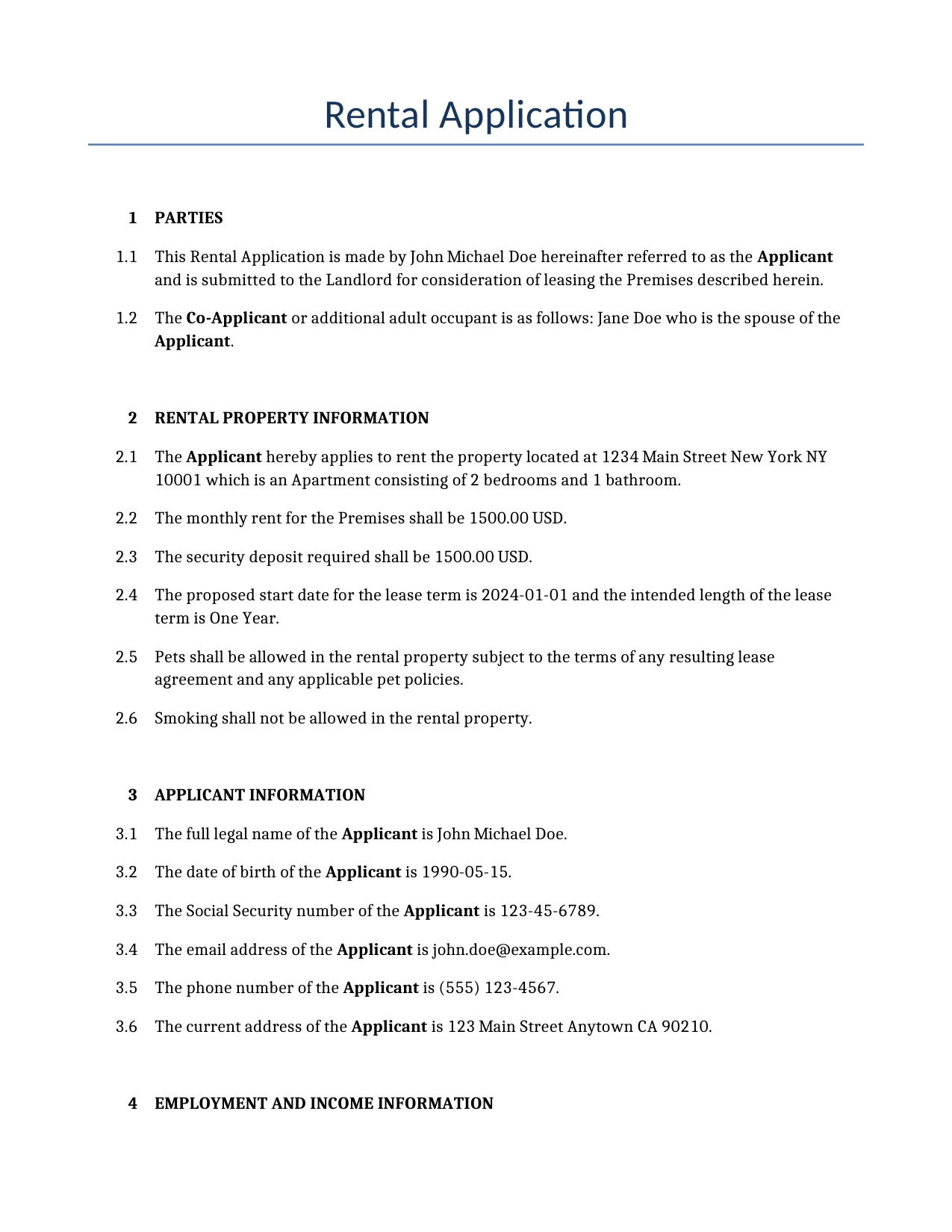
Below is a free template example of a Rental Application for use in the United States generated by our AI model.
The clauses in your actual Rental Application will vary from this example as they will be entirely bespoke to your requirements as set out in the questionnaire you complete.
Rental Application
1PARTIES
This Rental Application is made by John Michael Doe hereinafter referred to as the Applicant and is submitted to the Landlord for consideration of leasing the Premises described herein.
The Co-Applicant or additional adult occupant is as follows: Jane Doe who is the spouse of the Applicant.
2RENTAL PROPERTY INFORMATION
The Applicant hereby applies to rent the property located at 1234 Main Street New York NY 10001 which is an Apartment consisting of 2 bedrooms and 1 bathroom.
The monthly rent for the Premises shall be 1500.00 USD.
The security deposit required shall be 1500.00 USD.
The proposed start date for the lease term is 2024-01-01 and the intended length of the lease term is One Year.
Pets shall be allowed in the rental property subject to the terms of any resulting lease agreement and any applicable pet policies.
Smoking shall not be allowed in the rental property.
3APPLICANT INFORMATION
The full legal name of the Applicant is John Michael Doe.
The date of birth of the Applicant is 1990-05-15.
The Social Security number of the Applicant is 123-45-6789.
The email address of the Applicant is john.doe@example.com.
The phone number of the Applicant is (555) 123-4567.
The current address of the Applicant is 123 Main Street Anytown CA 90210.
4EMPLOYMENT AND INCOME INFORMATION
The Applicant is currently employed full-time.
The current employer of the Applicant is Tech Innovations Inc. at 123 Innovation Drive San Francisco CA 94105 where the Applicant holds the position of Software Developer.
The phone number of the current employer is (415) 555-0123 and the Applicant began this employment on 2022-03-15 with an annual salary of 75000.0 USD.
The Applicant has previous employment to report from the last two years and has additional sources of income from Investments or Dividends.
The total monthly income of the Applicant from all sources is 6500.0 USD.
5RENTAL HISTORY
The Applicant has the following rental history: The previous rental address was 123 Elm Street Austin TX 78701 where the Applicant resided from 2020-06-15 to 2022-03-20.
The landlord for this previous rental was John Smith whose phone number is (512) 555-0123 and the reason for leaving was Moved for Job.
6CREDIT HISTORY AUTHORIZATION
The Applicant named John A. Doe with Social Security Number 123-45-6789 and date of birth 01/15/1985 hereby authorizes the Landlord to perform a credit check.
The Applicant consents to the Landlord obtaining the Applicant credit report for the rental application and agrees to pay any related fees for the credit check as required by the Landlord.
7CRIMINAL BACKGROUND CHECK AUTHORIZATION
The Applicant consents to the Landlord conducting a criminal background check on the Applicant as part of the rental application.
The Applicant has no criminal history to disclose to the Landlord.
8EVICTION HISTORY
The Applicant discloses that the Applicant has two prior evictions in the Applicant history.
9PET INFORMATION
The Applicant has two pets that will be living in the rental property which are a Dog that is a Golden Retriever of large size weighing approximately 65 lbs and a Cat that is a Siamese of small size weighing approximately 10 lbs.
The pets have up-to-date vaccination records and none of the pets are classified as service or emotional support animals under applicable laws.
10VEHICLE INFORMATION
The Applicant has two vehicles that will be parked on the property.
11REFERENCES
The Applicant provides the following personal reference: Jane Smith who is a former neighbor of the Applicant and whose phone number is (555) 123-4567.
12EMERGENCY CONTACT
The primary emergency contact of the Applicant is John Doe who is the brother of the Applicant and whose phone number is (555) 123-4567.
13OCCUPANTS
In addition to the Applicant and any Co-Applicant the Applicant intends to have one additional occupant in the rental property who is Jane Doe born on 1990-05-15 and who is the spouse of the Applicant.
14APPLICATION FEE
The application fee is 20.00 USD (the maximum permitted under New York Real Property Law \§ 238-a as of 2024). This fee will be used to cover the actual costs of obtaining a tenant screening report (including credit and criminal background checks) from a consumer reporting agency. The fee is non-refundable only to the extent permitted by New York law; if the Landlord does not obtain a screening report or if the application is denied for reasons unrelated to the screening, the fee shall be refunded within 30 days. The Landlord will provide an itemized receipt detailing the use of the fee upon request or if the application is denied.
If the application is denied, the Applicant will be notified in writing within 14 days and provided with the name and contact information of the consumer reporting agency that furnished the report, along with a statement of the Applicant\'s rights to dispute the accuracy or completeness of the report under the federal Fair Credit Reporting Act (FCRA) and New York law.
Applicants must pay the fee online via the provided payment portal using a credit or debit card or by online transfer to the specified account. For money orders applicants must mail to [Landlord\'s Address] with the application form. Cash payments are accepted in person only at the property office during business hours.
The deadline for submitting the application fee is 2024-12-31.
15FAIR HOUSING NOTICE
The Landlord complies with all applicable fair housing laws including the Fair Housing Act.
The Landlord will not discriminate against any person in the rental of the Premises on the basis of Race Color Religion Sex National Origin Familial Status or Disability.
The Landlord will provide reasonable accommodations for disabilities as required by law.
16TERMS AND CONDITIONS
The Applicant agrees to all the terms and conditions outlined in this Rental Application.
Any falsification of information in this Rental Application shall result in Application Rejection.
The Landlord has no obligation to rent to the Applicant even if this Rental Application is approved.
This Rental Application does not create a tenancy or lease and the Applicant acknowledges that no tenancy is formed until a separate written lease agreement is fully executed by all parties.
17APPLICANT CERTIFICATION
The Applicant certifies that all information provided in this Rental Application is true and accurate to the best of the Applicant knowledge under penalty of perjury.
The Applicant authorizes the Landlord to conduct background credit and reference checks based on the information provided.
The Applicant has not been evicted nor faced eviction proceedings.
18ENTIRE AGREEMENT
This Rental Application constitutes the entire agreement between the Applicant and the Landlord with respect to the subject matter hereof and supersedes all prior understandings and agreements whether written or oral.
19SEVERABILITY
If any provision of this Rental Application is held to be invalid or unenforceable such invalidity or unenforceability shall not affect the other provisions of this Rental Application which shall remain in full force and effect. This clause shall be interpreted in accordance with New York law.
20GOVERNING LAW
This Rental Application shall be governed by and construed in accordance with the laws of the State of New York without regard to its conflict of laws principles. Any disputes arising from this application shall be resolved in the courts located in New York County New York.
21NOTICES
Any notices required or permitted under this Rental Application shall be in writing and shall be delivered personally or sent by certified mail return receipt requested to the addresses provided by the parties. The Applicant acknowledges receipt of any required notices under New York or federal law including but not limited to the New York Tenant Screening Report disclosure if a consumer report is used.
22VARIATION
No variation of this Rental Application shall be effective unless it is in writing and signed by both the Applicant and the Landlord.
23CO-APPLICANTS AND ADDITIONAL OCCUPANTS
Each co-applicant must complete a separate copy of this Rental Application providing their own full name date of birth Social Security number contact information employment history rental history and all other required details. All co-applicants and adult occupants authorize the same background checks and agree to be bound by the terms herein. Additional occupants under the age of 18 must be listed with their names and dates of birth but are not required to sign.
The application remains valid for 30 days from the date of submission. If no lease is executed within that period the application is considered withdrawn unless extended in writing by the Landlord.
24FULL AUTHORIZATION AND CONSENT FOR BACKGROUND CHECKS
I the undersigned Applicant hereby authorize the Landlord or its authorized agents to obtain a consumer report from a consumer reporting agency for the purposes of this rental application. This report may include information regarding my credit history criminal background eviction history rental history and employment history. I understand that this authorization is in compliance with the federal Fair Credit Reporting Act (15 U.S.C. \§ 1681 et seq.) and New York State laws. I have the right to request the name and address of the consumer reporting agency that furnished the report. If any information in the report is inaccurate or incomplete I have the right to dispute it directly with the agency and the Landlord will consider any correction provided.
Signature: _______________________________ Date: _______________
25PET POLICY DETAILS
In addition to the information provided in Section 9 the following pet policy applies: No aggressive breeds as defined by the Landlord\'s insurance carrier (including but not limited to Pit Bulls Rottweilers or Dobermans) are permitted. An additional pet deposit of 500.00 USD per pet (refundable in accordance with New York law) may be required. Pets must be approved in writing prior to occupancy. Service and emotional support animals are evaluated in accordance with the Fair Housing Act and New York law and do not incur pet fees.
26REFERENCES
The Applicant must provide at least two references including prior landlords or professional contacts. For each reference provide name relationship phone number and email if available. The Landlord may contact these references to verify rental history and character.
27LEAD-BASED PAINT DISCLOSURE
If the Premises were built before 1978 the Landlord will provide a separate Lead-Based Paint Disclosure and pamphlet as required by federal law (42 U.S.C. \§ 4852d). The Applicant acknowledges that they have received or will receive this disclosure prior to signing a lease.
28DATA PRIVACY AND USE OF INFORMATION
The Applicant\'s information will be used solely for the purpose of evaluating this rental application and managing the tenancy if approved. The Landlord will protect this data in compliance with applicable laws including New York\'s SHIELD Act and any applicable provisions similar to the California Consumer Privacy Act (CCPA). Information will not be shared except as necessary with service providers consumer reporting agencies or as required by law. The Applicant has the right to request access to or correction of their information.
29AMENDMENTS
This Rental Application may be amended only by a written instrument signed by both the Applicant and the Landlord. No oral modifications are valid.
30SIGNATURES
The Applicant has executed this Rental Application on the date first above written.
Applicant Signature: _______________________________ Date: _______________
Print Name: John Michael Doe
Co-Applicant Signature: _______________________________ Date: _______________
Print Name: Jane Doe
Landlord Signature: _______________________________ Date: _______________
Print Name: _______________________________
This example shows approximately 70% of a typical document and is provided for illustrative purposes only. The remaining content has been omitted.
Every document generated by Docaro is tailored to your specific circumstances, jurisdiction and the information you provide. The completed document includes all applicable clauses and provisions required for your situation.
To generate the full, personalised document, answer a short series of questions and your document will be created instantly.