
AI Generated Service Agreement for use in the United States
PDF & Word - 2026 Updated
Docaro Pricing
When do you need a Service Agreement in the United States?
American Legal Rules for a Service Agreement
Using the wrong type of service agreement can inadvertently create unintended liabilities or obligations for the parties involved.
What a Proper Service Agreement Should Include
- Parties InvolvedClearly identify who is providing the service and who is receiving it, including their full names or business names and contact details.
- Service DescriptionDetail exactly what services will be provided, including any specific tasks, timelines, or standards of performance.
- Payment TermsSpecify how much will be paid, when payments are due, and any late fees or accepted payment methods.
- Duration and TerminationOutline how long the agreement lasts and under what conditions either party can end it early.
- ResponsibilitiesList the duties of each party to ensure everyone knows what they need to do.
- ConfidentialityProtect sensitive information shared during the service by agreeing not to disclose it to others.
- Liability LimitsDefine who is responsible for any problems or damages that might occur and cap potential financial losses.
- Dispute ResolutionDescribe how disagreements will be handled, such as through negotiation or mediation, to avoid court battles.
- SignaturesInclude spaces for both parties to sign and date, making the agreement legally binding.
Generate Your Document in 4 Easy Steps
Why Use Docaro?
 United States
Free Example Service Agreement Template
Below is a free template example of a Service Agreement for use in the United States generated by our AI model.
The clauses in your actual Service Agreement will vary from this example as they will be entirely bespoke to your requirements as set out in the questionnaire you complete.
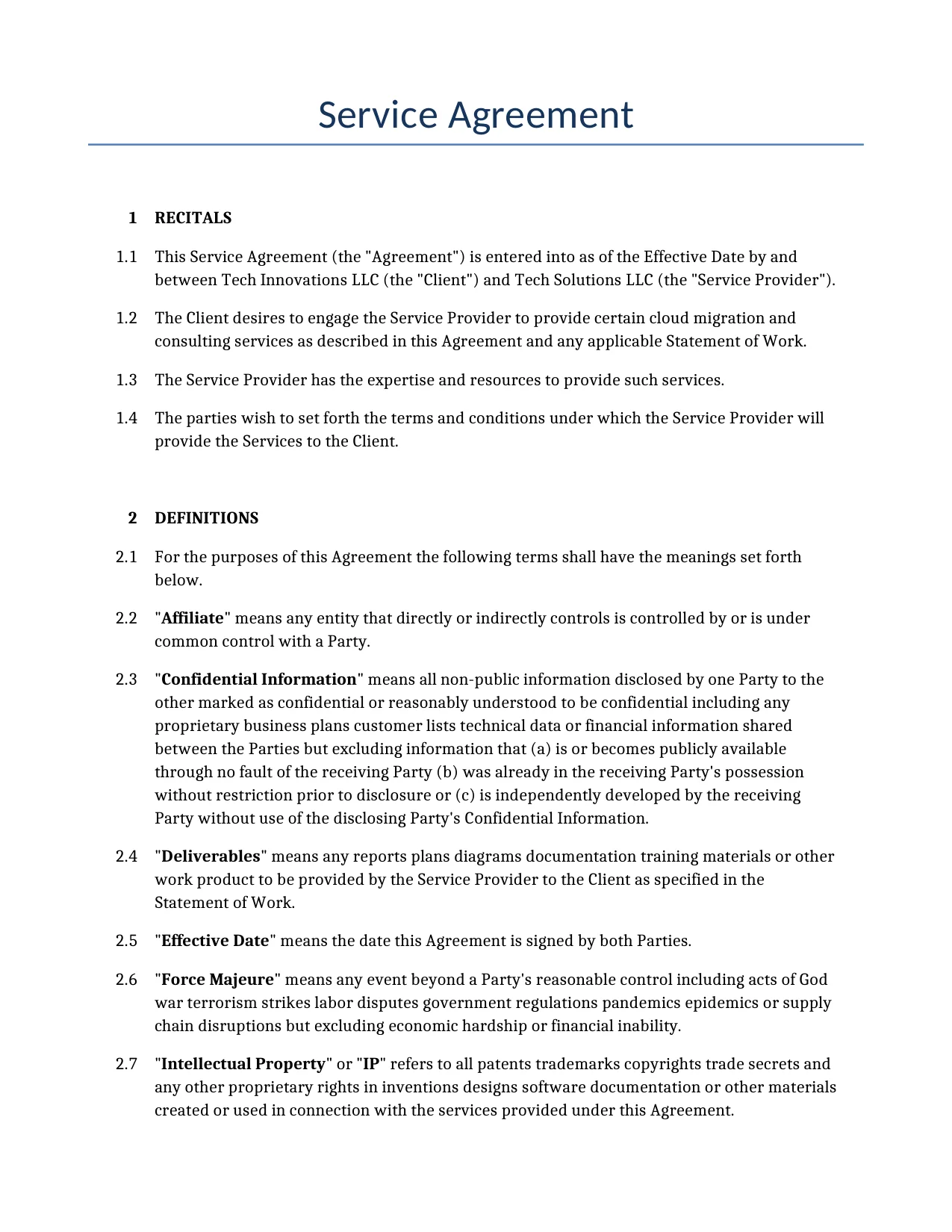
Service Agreement
1RECITALS
This Service Agreement (the "Agreement") is entered into as of the Effective Date by and between Tech Innovations LLC (the "Client") and Tech Solutions LLC (the "Service Provider").
The Client desires to engage the Service Provider to provide certain cloud migration and consulting services as described in this Agreement and any applicable Statement of Work.
The Service Provider has the expertise and resources to provide such services.
The parties wish to set forth the terms and conditions under which the Service Provider will provide the Services to the Client.
2DEFINITIONS
For the purposes of this Agreement the following terms shall have the meanings set forth below.
"Affiliate" means any entity that directly or indirectly controls is controlled by or is under common control with a Party.
"Confidential Information" means all non-public information disclosed by one Party to the other marked as confidential or reasonably understood to be confidential including any proprietary business plans customer lists technical data or financial information shared between the Parties but excluding information that (a) is or becomes publicly available through no fault of the receiving Party (b) was already in the receiving Party's possession without restriction prior to disclosure or (c) is independently developed by the receiving Party without use of the disclosing Party's Confidential Information.
"Deliverables" means any reports plans diagrams documentation training materials or other work product to be provided by the Service Provider to the Client as specified in the Statement of Work.
"Effective Date" means the date this Agreement is signed by both Parties.
"Force Majeure" means any event beyond a Party's reasonable control including acts of God war terrorism strikes labor disputes government regulations pandemics epidemics or supply chain disruptions but excluding economic hardship or financial inability.
"Intellectual Property" or "IP" refers to all patents trademarks copyrights trade secrets and any other proprietary rights in inventions designs software documentation or other materials created or used in connection with the services provided under this Agreement.
"Party" or "Parties" means individually or collectively the Client and the Service Provider as the context requires.
"Services" means the cloud migration and consulting services to be provided by the Service Provider as described in Section 3 and the Statement of Work.
"Statement of Work" or "SOW" means the document attached as Schedule A detailing the specific services timelines milestones deliverables acceptance criteria assumptions and dependencies.
3SCOPE OF SERVICES
The Service Provider shall provide professional cloud migration and consulting services including assessment of the Client's current infrastructure migration planning implementation optimization and training (the "Services").
The Services shall include but are not limited to: (a) conducting a comprehensive assessment of the Client's existing systems and applications; (b) developing a detailed migration plan; (c) assisting with the implementation of cloud infrastructure; (d) performing optimization to improve performance and scalability; and (e) providing training to the Client's team.
The Service Provider shall deliver the following Deliverables in connection with the Services: migration plans cloud architecture diagrams performance reports and training materials as further detailed in the Statement of Work.
The Service Provider shall perform the Services in a professional manner consistent with industry standards using qualified personnel.
The Services shall be performed in accordance with the timeline milestones and acceptance criteria set forth in the Statement of Work.
4TERM AND TERMINATION
This Agreement shall commence on the Effective Date and shall continue for an initial term of one (1) year unless terminated earlier in accordance with this Section 4 (the "Term").
This Agreement shall automatically renew for successive one-year periods unless either Party provides the other with at least sixty (60) days' written notice prior to the expiration of the then-current Term of its intent not to renew.
Either Party may terminate this Agreement for convenience at any time upon thirty (30) days' written notice to the other Party.
Either Party may terminate this Agreement for cause upon written notice if the other Party commits a material breach of this Agreement and fails to cure such breach within thirty (30) days after receiving written notice thereof.
Either Party may terminate this Agreement immediately upon written notice if the other Party becomes insolvent files for bankruptcy or ceases its business operations.
Upon termination or expiration the Service Provider shall provide reasonable transition assistance to the Client for up to thirty (30) days to facilitate the orderly transfer of the Services. The Client shall pay for such transition assistance at the Service Provider's then-current hourly rates.
Upon termination the Client shall pay for all Services rendered up to the effective date of termination. Any prepaid fees for Services not yet rendered shall be refunded on a pro-rata basis. The Service Provider shall deliver any completed Deliverables and work-in-progress to the Client upon receipt of full payment for such work.
The following provisions shall survive termination or expiration of this Agreement: Sections 2 (Definitions to the extent necessary) 7 (Confidentiality) 8 (Intellectual Property Rights) 10 (Indemnification) 11 (Limitation of Liability) 13 (Independent Contractor Status) 14 (Non-Solicitation) 20 (Miscellaneous) and any other provisions that by their nature are intended to survive.
5COMPENSATION AND PAYMENT TERMS
In consideration for the Services the Client shall pay the Service Provider fees as set forth in the Statement of Work which may include a combination of fixed fees for milestones and hourly rates for additional services (the "Fees").
The Service Provider shall send invoices via email at the end of each month or upon achievement of milestones detailing the Services provided and the amounts due.
The Client shall pay all invoices within thirty (30) days of receipt. Payments shall be made via bank transfer credit card or check mailed to the Service Provider's address.
Late payments shall incur interest at the rate of one and one-half percent (1.5\%) per month or the maximum rate permitted by California law whichever is less.
The Fees are exclusive of taxes unless otherwise specified in the Statement of Work.
6TAXES
The Client shall be responsible for all sales use or other transaction taxes applicable to the Services in California and the United States except for any taxes based on the Service Provider's net income.
If required by law the Service Provider shall collect and remit such taxes to the appropriate authorities and shall itemize them on invoices provided to the Client.
7EXPENSES
The Service Provider shall be reimbursed for all reasonable and necessary expenses incurred in performing the Services such as travel materials and lodging upon submission of receipts and prior approval for any expense exceeding one hundred dollars ($100).
8CONFIDENTIALITY
Each Party shall maintain the confidentiality of the other Party's Confidential Information and shall not disclose such information to any third party without the prior written consent of the disclosing Party.
Permitted disclosures of Confidential Information include disclosures to legal advisors or auditors as required by law or court order and to Affiliates subcontractors or employees who have a need to know and are bound by nondisclosure agreements at least as protective as this Section 8.
The obligations under this Section 8 shall commence on the Effective Date and shall continue for a period of five (5) years after termination or expiration of this Agreement except with respect to trade secrets which shall remain confidential in perpetuity for so long as they remain trade secrets under applicable law.
Upon termination or expiration of this Agreement each Party shall return or destroy all Confidential Information of the other Party and certify such return or destruction in writing within thirty (30) days.
9INTELLECTUAL PROPERTY RIGHTS
As between the Parties each Party retains ownership of its Background IP. "Background IP" means all IP owned or licensed by a Party prior to the Effective Date or developed independently of this Agreement.
Subject to the Client's payment of all Fees due the Service Provider hereby assigns to the Client all right title and interest in and to the Foreground IP. "Foreground IP" means all IP developed by the Service Provider specifically for the Client under this Agreement and embodied in the Deliverables excluding any Background IP.
The Parties agree that the Deliverables shall be considered works made for hire under the U.S. Copyright Act to the extent applicable. To the extent any Deliverables do not qualify as works made for hire the Service Provider assigns all rights therein to the Client as set forth above.
The Service Provider grants the Client a perpetual irrevocable worldwide non-exclusive royalty-free license to use any Background IP of the Service Provider incorporated into the Deliverables solely as necessary to use and enjoy the Deliverables.
The Client grants the Service Provider a limited non-exclusive royalty-free license to use any materials data or content provided by the Client solely as necessary to perform the Services during the Term.
The Service Provider shall obtain written assignments from its employees and subcontractors of all rights in any Foreground IP and shall provide such assignments to the Client upon request.
10WARRANTIES AND REPRESENTATIONS
Each Party represents and warrants that it has the full legal authority to enter into this Agreement and that no existing agreements or obligations conflict with the terms hereof.
The Service Provider warrants that it will perform the Services in a professional and workmanlike manner consistent with industry standards and that the Deliverables will conform in all material respects to the specifications in the Statement of Work for a period of thirty (30) days after delivery.
EXCEPT FOR THE EXPRESS WARRANTIES SET FORTH IN THIS SECTION 10 THE SERVICES AND DELIVERABLES ARE PROVIDED "AS IS" WITHOUT ANY OTHER WARRANTIES. THE SERVICE PROVIDER DISCLAIMS ALL OTHER WARRANTIES EXPRESS OR IMPLIED INCLUDING ANY IMPLIED WARRANTIES OF MERCHANTABILITY FITNESS FOR A PARTICULAR PURPOSE OR NON-INFRINGEMENT TO THE MAXIMUM EXTENT PERMITTED BY LAW. NO WARRANTIES UNDER THE UNIFORM COMMERCIAL CODE OR MAGNUSON-MOSS WARRANTY ACT SHALL APPLY TO THE EXTENT THEY ARE INAPPLICABLE TO CONSULTING SERVICES.
11INDEMNIFICATION
Each Party (the "Indemnifying Party") shall indemnify defend and hold harmless the other Party and its Affiliates officers directors employees and agents (the "Indemnified Party") from and against any third-party claims damages losses liabilities and expenses (including reasonable attorneys' fees) arising from (a) the Indemnifying Party's breach of this Agreement (b) the Indemnifying Party's gross negligence or willful misconduct or (c) in the case of the Service Provider any claim that the Deliverables infringe third-party IP rights or in the case of the Client any claim related to the Client's data or the Client's use of the Deliverables in violation of this Agreement.
The indemnification obligations under this Section 11 shall be subject to a monetary cap equal to two (2) times the total fees paid under this Agreement except for claims related to IP infringement confidentiality breaches gross negligence or willful misconduct which shall not be capped or for which the cap shall be increased to the extent of available insurance coverage.
The Indemnified Party shall provide prompt written notice of any claim. The Indemnifying Party shall have the right to control the defense and settlement of such claims provided that no settlement shall impose any liability or admission of fault on the Indemnified Party without its prior written consent. The Indemnified Party shall cooperate in the defense at the Indemnifying Party's expense.
The indemnification obligations under this Section 11 shall survive termination or expiration of this Agreement for a period of two (2) years except for claims related to IP infringement or confidentiality which shall survive indefinitely. This Section shall be interpreted in accordance with California law regarding the enforceability of indemnification provisions including those related to negligence.
12LIMITATION OF LIABILITY
NEITHER PARTY SHALL BE LIABLE TO THE OTHER FOR ANY INDIRECT CONSEQUENTIAL PUNITIVE OR SPECIAL DAMAGES INCLUDING LOST PROFITS LOST DATA OR BUSINESS INTERRUPTION EVEN IF ADVISED OF THE POSSIBILITY OF SUCH DAMAGES.
THE TOTAL LIABILITY OF EITHER PARTY UNDER THIS AGREEMENT SHALL NOT EXCEED TWO (2) TIMES THE TOTAL FEES PAID BY THE CLIENT TO THE SERVICE PROVIDER IN THE TWELVE (12) MONTHS PRECEDING THE CLAIM.
The limitations of liability under this Section 12 shall apply mutually to both Parties but shall not apply to (a) a Party's indemnification obligations (b) liability for gross negligence or willful misconduct (c) breaches of confidentiality or (d) IP infringement claims. This Section shall not limit liability that cannot be limited under applicable law. References to unrelated consumer protection laws such as the Consumer Product Safety Act or Truth in Lending Act shall not apply to this B2B agreement.
13DATA PRIVACY AND SECURITY
Each Party shall comply with all applicable data privacy and security laws including the California Consumer Privacy Act (CCPA) as amended by the California Privacy Rights Act (CPRA) and other U.S. federal and state laws relating to the processing of personal information.
The Service Provider shall implement and maintain reasonable administrative technical and physical security measures to protect any Client data processed in connection with the Services consistent with industry standards for cloud services.
In the event of a security breach involving Client data the Service Provider shall notify the Client without undue delay and in any event within seventy-two (72) hours of becoming aware of the breach. The notification shall include details of the breach and the measures taken to mitigate it.
Upon termination or expiration of this Agreement the Service Provider shall at the Client's direction return or securely delete all Client data within thirty (30) days and certify such deletion in writing.
14INSURANCE
The Service Provider shall maintain during the Term and for two (2) years thereafter at its own expense the following insurance coverage with insurers rated A- or better by A.M. Best: (a) Commercial General Liability insurance with limits of not less than one million dollars ($1,000,000) per occurrence and two million dollars ($2,000,000) aggregate; (b) Professional Liability (Errors & Omissions) insurance with limits of not less than two million dollars ($2,000,000) per claim and aggregate; and (c) Workers' Compensation insurance as required by law.
The Service Provider shall name the Client as an additional insured on the general liability policy. Such policies shall be primary and non-contributory with respect to any insurance maintained by the Client. The Service Provider shall provide certificates of insurance evidencing such coverage upon request and shall notify the Client at least thirty (30) days prior to any material change or cancellation.
15INDEPENDENT CONTRACTOR STATUS
The Service Provider is an independent contractor and not an employee agent or partner of the Client. Nothing in this Agreement shall be construed to create a partnership joint venture or employer-employee relationship.
The Service Provider shall have full control over how when and where the Services are performed without direction from the Client on methods or supervision and shall provide its own tools equipment and supplies.
The Service Provider represents and warrants that it is in full compliance with all applicable labor and employment laws including proper classification of its workers as employees or independent contractors payment of all wages and benefits compliance with tax withholding obligations and maintenance of appropriate insurance. The Service Provider is not entitled to any Client employee benefits such as health insurance retirement plans or paid leave.
The Service Provider may hire its own assistants or subcontractors at its discretion subject to the provisions of Section 18. The Service Provider is solely responsible for all taxes including self-employment taxes arising from payments received under this Agreement and maintains its own workers' compensation coverage.
16NON-SOLICITATION
During the Term and for twelve (12) months after termination or expiration of this Agreement neither Party shall directly or indirectly solicit for employment or engagement any employee or independent contractor of the other Party with whom it had material contact in connection with this Agreement without the other Party's prior written consent. This obligation is mutual.
The Parties acknowledge that this non-solicitation covenant is reasonable in scope duration and geography and is supported by adequate consideration including the mutual promises and the exchange of Confidential Information and compensation under this Agreement. The Parties agree that a breach of this Section would cause irreparable harm for which monetary damages would be inadequate and that the non-breaching Party shall be entitled to seek injunctive relief in addition to any other remedies available at law or in equity. This Section is intended to comply with California law under which employee non-competes are generally unenforceable but customer and employee non-solicits meeting reasonableness standards may be enforceable.
17GOVERNING LAW
This Agreement shall be governed by and construed in accordance with the laws of the State of California and applicable United States federal law without regard to conflict of laws principles.
The state and federal courts located in Los Angeles County California shall have exclusive jurisdiction over any disputes arising under this Agreement and the Parties hereby consent to the personal jurisdiction and venue of such courts.
18DISPUTE RESOLUTION
The Parties agree to first attempt to resolve any dispute arising under this Agreement through good faith negotiations. Either Party may request non-binding mediation in Los Angeles California as a means to facilitate settlement prior to initiating litigation.
If the Parties are unable to resolve the dispute through negotiation or mediation either Party may initiate litigation in accordance with Section 17. This Section does not mandate arbitration; however if the Parties mutually agree to binding arbitration it shall be conducted in Los Angeles California in accordance with the rules of the American Arbitration Association and the Federal Arbitration Act.
The prevailing Party in any action to enforce this Agreement shall be entitled to recover its reasonable attorneys' fees and costs in addition to any other relief to which it is entitled in accordance with California law. Either Party shall provide at least thirty (30) days' written notice before initiating formal dispute resolution proceedings.
19FORCE MAJEURE
Neither Party shall be liable for any delay or failure to perform its obligations under this Agreement (other than payment obligations which shall only be excused in extreme cases where performance is wholly impossible) if such delay or failure is caused by a Force Majeure event including but not limited to acts of God war terrorism strikes labor disputes government regulations pandemics epidemics natural disasters or supply chain disruptions provided that such event is beyond the reasonable control of the affected Party and could not have been prevented with reasonable diligence.
The affected Party shall provide prompt written notice of the Force Majeure event to the other Party via email or certified mail within five (5) business days of its occurrence including an estimate of its expected duration and shall use commercially reasonable efforts to mitigate the effects of the event and resume performance as soon as possible.
If a Force Majeure event prevents performance for more than sixty (60) days either Party may terminate this Agreement upon written notice without liability except for payment for Services already rendered.
20ASSIGNMENT AND DELEGATION
Neither Party may assign its rights or delegate its duties under this Agreement without the prior written consent of the other Party which shall not be unreasonably withheld. Notwithstanding the foregoing either Party may assign this Agreement without consent to an Affiliate or to a successor in interest in connection with a merger acquisition or sale of all or substantially all of its assets provided that the assigning Party provides prompt written notice to the other Party.
The Service Provider may subcontract portions of the Services to qualified third parties provided that the Service Provider remains fully responsible for the performance of such subcontractors and the Client has no reasonable objection to the subcontractor. The Service Provider shall ensure that all subcontractors are bound by terms at least as protective as this Agreement including confidentiality and IP provisions.
This Agreement shall be binding upon and inure to the benefit of the Parties' successors and permitted assigns.
21NOTICES
All notices under this Agreement shall be in writing and delivered by certified mail return receipt requested email with confirmation of receipt overnight courier or personal delivery to the following addresses: (a) for the Client Tech Innovations LLC 456 Client Avenue Los Angeles CA 90210 Attention: Legal Department Email: legal@techinnovations.com; (b) for the Service Provider Tech Solutions LLC 123 Main Street Suite 100 Austin TX 78701 Attention: Legal Department Email: contracts@techsolutions.com. A copy of all legal notices shall also be sent to the same addresses marked "Attention: General Counsel".
Notices shall be deemed received (a) upon delivery if by personal delivery or overnight courier (b) three (3) business days after mailing if by certified mail or (c) upon confirmation of receipt or read receipt if by email.
Each Party shall promptly notify the other of any change in its notice address.
22EXPORT CONTROL AND COMPLIANCE
Both Parties shall comply with all applicable U.S. export control laws sanctions administered by the Office of Foreign Assets Control (OFAC) and anti-corruption laws including the Foreign Corrupt Practices Act (FCPA). Neither Party shall export re-export or transfer any technology data or services provided under this Agreement in violation of such laws.
Each Party represents that it is not a Sanctioned Person and that it will not engage in any corrupt practices in connection with the Services.
23COMPLIANCE WITH LAWS
Each Party shall comply with all applicable federal state and local laws regulations and ordinances in connection with its performance under this Agreement including but not limited to data privacy and security laws anti-bribery and anti-corruption laws (such as the FCPA) and any industry-specific regulations applicable to cloud computing services. This Section replaces any prior references to specific unrelated consumer laws.
24SCHEDULE A: STATEMENT OF WORK
This Schedule A forms part of the Service Agreement dated as of the Effective Date between Tech Innovations LLC (Client) and Tech Solutions LLC (Service Provider).
Services: Cloud infrastructure assessment migration planning implementation optimization post-migration support and training for Client's development team.
Timeline and Milestones: (1) Assessment Phase: Complete within 30 days of Effective Date Deliverable: Assessment Report; (2) Migration Planning: Complete within 60 days Deliverable: Migration Plan and Cloud Architecture Diagrams; (3) Implementation: Complete within 120 days Deliverable: Migrated Environment and Performance Report; (4) Optimization and Training: Complete within 150 days Deliverable: Optimization Recommendations Training Materials and Session Recordings.
Compensation: Fixed fee of $150,000 payable 20% upon signing 30% upon delivery of Migration Plan 30% upon successful migration and 20% upon completion of optimization and training. Additional services at $250 per hour.
Acceptance Criteria: Deliverables shall be deemed accepted if not rejected in writing with specific comments within ten (10) business days of delivery. Service Provider shall have ten (10) business days to correct any deficiencies.
Assumptions and Dependencies: Client shall provide timely access to its systems personnel and information. Client is responsible for any third-party licensing costs. Project assumes no major changes in scope; material changes may require a change order and additional fees.
25MISCELLANEOUS
This Agreement is for the benefit of the Parties and their respective permitted successors and assigns only. There are no third-party beneficiaries under this Agreement.
Headings in this Agreement are for convenience only and shall not affect the interpretation of any provision. Words importing the singular include the plural and vice versa. The term "including" means including without limitation.
This Agreement may be executed in counterparts each of which shall be deemed an original and all of which together shall constitute one instrument. Electronic signatures (including via DocuSign or similar platforms) shall be valid and binding to the same extent as original signatures under the Electronic Signatures in Global and National Commerce Act (E-SIGN Act) and the Uniform Electronic Transactions Act (UETA).
If any provision of this Agreement is held to be invalid or unenforceable the remaining provisions shall remain in full force and effect. The Parties shall negotiate in good faith to replace any invalid provision with a valid one that achieves the original intent.
The failure of either Party to enforce any provision of this Agreement shall not constitute a waiver of that provision or any other provision and any waiver must be in writing and signed by the waiving Party to be effective.
This Agreement may be amended only by a written instrument signed by both Parties. This Agreement constitutes the entire agreement between the Parties with respect to the subject matter hereof and supersedes all prior agreements understandings and negotiations whether written or oral.
26SIGNATURES
IN WITNESS WHEREOF the parties have executed this Agreement as of the Effective Date.
Client: Tech Innovations LLC
By: _______________________________
Name: _____________________________
Title: ______________________________
Date: ______________________________
Service Provider: Tech Solutions LLC
By: _______________________________
Name: _____________________________
Title: ______________________________
Date: ______________________________
This example shows approximately 70% of a typical document and is provided for illustrative purposes only. The remaining content has been omitted.
Every document generated by Docaro is tailored to your specific circumstances, jurisdiction and the information you provide. The completed document includes all applicable clauses and provisions required for your situation.
To generate the full, personalised document, answer a short series of questions and your document will be created instantly.