
AI Generated American Debt Settlement Agreement
PDF & Word - 2026 Updated
Docaro Pricing
When Do You Need a Debt Settlement Agreement in the United States?
American Legal Rules for a Debt Settlement Agreement
Using the wrong structure for a debt settlement agreement can invalidate the settlement or expose parties to ongoing liability.
What a Proper Debt Settlement Agreement Should Include
- Parties InvolvedClearly identify the debtor and creditor, including their full names and contact details.
- Original Debt AmountState the total amount of the debt being settled, including any interest or fees.
- Settlement AmountSpecify the reduced amount the debtor agrees to pay to fully resolve the debt.
- Payment TermsOutline how and when the settlement payment will be made, such as a lump sum or installments.
- Release of ClaimsConfirm that the creditor will forgive the remaining debt and release the debtor from further liability upon full payment.
- No Admission of LiabilityState that the settlement does not admit any wrongdoing or liability by the debtor.
- Confidentiality ClauseAgree that both parties will keep the settlement details private and not disclose them.
- Governing LawIndicate the state law that will apply to the agreement.
- Signatures and DatesInclude spaces for both parties to sign and date the agreement to make it official.
Generate Your Document in 4 Easy Steps
Why Use Docaro?
 United States
Free Example Debt Settlement Agreement Template
Below is a free template example of a Debt Settlement Agreement for use in the United States generated by our AI model.
The clauses in your actual Debt Settlement Agreement will vary from this example as they will be entirely bespoke to your requirements as set out in the questionnaire you complete.
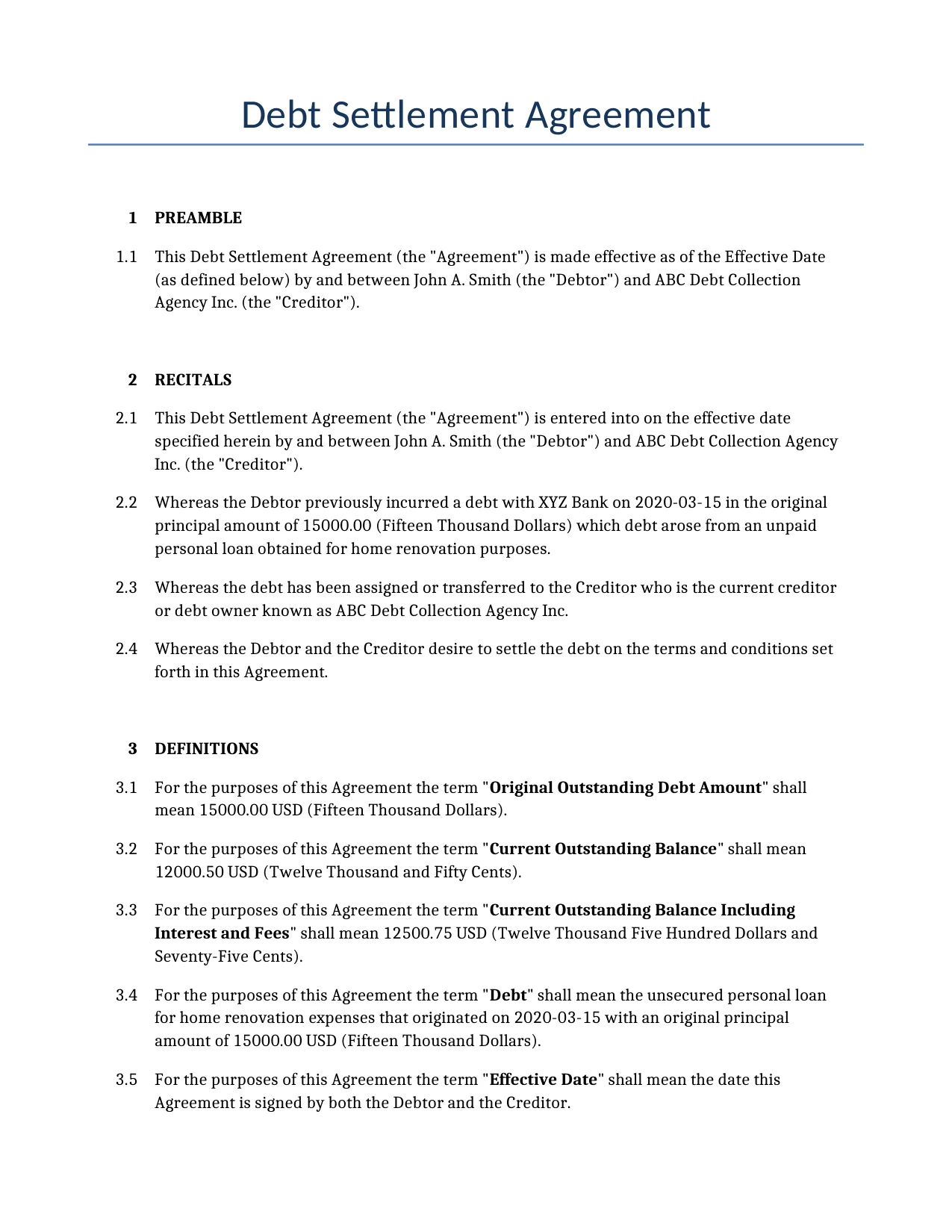
Debt Settlement Agreement
1PREAMBLE
This Debt Settlement Agreement (the "Agreement") is made effective as of the Effective Date (as defined below) by and between John A. Smith (the "Debtor") and ABC Debt Collection Agency Inc. (the "Creditor").
2RECITALS
This Debt Settlement Agreement (the "Agreement") is entered into on the effective date specified herein by and between John A. Smith (the "Debtor") and ABC Debt Collection Agency Inc. (the "Creditor").
Whereas the Debtor previously incurred a debt with XYZ Bank on 2020-03-15 in the original principal amount of 15000.00 (Fifteen Thousand Dollars) which debt arose from an unpaid personal loan obtained for home renovation purposes.
Whereas the debt has been assigned or transferred to the Creditor who is the current creditor or debt owner known as ABC Debt Collection Agency Inc.
Whereas the Debtor and the Creditor desire to settle the debt on the terms and conditions set forth in this Agreement.
3DEFINITIONS
For the purposes of this Agreement the term "Original Outstanding Debt Amount" shall mean 15000.00 USD (Fifteen Thousand Dollars).
For the purposes of this Agreement the term "Current Outstanding Balance" shall mean 12000.50 USD (Twelve Thousand and Fifty Cents).
For the purposes of this Agreement the term "Current Outstanding Balance Including Interest and Fees" shall mean 12500.75 USD (Twelve Thousand Five Hundred Dollars and Seventy-Five Cents).
For the purposes of this Agreement the term "Debt" shall mean the unsecured personal loan for home renovation expenses that originated on 2020-03-15 with an original principal amount of 15000.00 USD (Fifteen Thousand Dollars).
For the purposes of this Agreement the term "Effective Date" shall mean the date this Agreement is signed by both the Debtor and the Creditor.
4ACKNOWLEDGMENT OF DEBT
The Debtor acknowledges that the Debtor owes the Creditor a valid debt described as an unpaid personal loan for home renovation which is due and owing under the laws of the United States.
The Debtor acknowledges that the Original Outstanding Debt Amount of the debt owed to the Creditor is 15000.00 USD (Fifteen Thousand Dollars).
The Debtor acknowledges that the Current Outstanding Balance Including Interest and Fees of the debt owed to the Creditor is 12500.75 USD (Twelve Thousand Five Hundred Dollars and Seventy-Five Cents).
The Debtor acknowledges that the debt was originally incurred on 2020-03-15 and includes simple interest.
The Debtor acknowledges that there is no existing dispute regarding the existence or amount of the debt owed to the Creditor and that the Debt is valid enforceable and owing.
5SETTLEMENT AMOUNT
The Debtor agrees to pay the Creditor a reduced amount of 7500.00 USD (Seven Thousand Five Hundred Dollars) as a compromise of the Current Outstanding Balance Including Interest and Fees in full settlement of the entire Debt.
The total amount the Debtor agrees to pay to settle the Debt is 7500.00 USD (Seven Thousand Five Hundred Dollars). This reduced amount is accepted in full satisfaction of the Debt only upon timely payment in accordance with the Payment Terms section of this Agreement.
6PAYMENT TERMS
The Debtor shall pay the settlement amount to the Creditor as a lump sum payment by wire transfer or cashier's check.
The full settlement payment shall be due on 2024-09-15.
The Debtor shall remit the settlement amount to the Creditor at the following address: ABC Debt Collection Agency Inc. 456 Collection Boulevard Suite 200 Dallas TX 75201 Attn: Settlement Department Email: settlements@abcdebt.com Phone: (214) 555-0123.
Time is of the essence with respect to all payment obligations under this Agreement. In the event of a failure to make the payment by the due date the Debtor shall be in default as set forth in the Default and Remedies section of this Agreement.
No interest will accrue on the settlement amount after the agreement date.
The Debtor may make prepayments without penalty.
The parties acknowledge that if any portion of the Debt is forgiven pursuant to this Agreement the Creditor may be required to issue a Form 1099-C to the Debtor for any canceled debt in excess of 600.00 USD in accordance with IRS requirements. The Debtor is advised to consult with a tax professional regarding any potential tax implications of this settlement.
7FULL AND FINAL SETTLEMENT
This Agreement shall become effective on the Effective Date which is the date of last signature by the parties hereto.
Upon the Debtor making the full settlement payment to the Creditor and upon the Creditor's receipt and clearance of such full settlement payment the Debt shall be fully discharged and no further obligations shall remain.
All accrued interest fees and penalties shall be waived explicitly and irrevocably upon completion of the full settlement payment in accordance with this Agreement.
Any late fees or penalties associated with the Debt shall be waived upon full settlement payment.
8RELEASE OF CLAIMS
Upon full payment of the settlement amount and confirmation of clearance of funds the Creditor on behalf of itself its affiliates successors and assigns shall release the Debtor from all claims related to the Debt including the principal amount accrued interest late fees and penalties.
The release of claims shall include all claims arising from the original debt and claims related to collection activities.
The release shall include a general release of all known and unknown claims related to the Debt. If this Agreement is governed by California law or if otherwise applicable the parties expressly waive the provisions of California Civil Code Section 1542 which states: A general release does not extend to claims that the creditor or releasing party does not know or suspect to exist in his or her favor at the time of executing the release and that if known by him or her would have materially affected his or her settlement with the debtor or released party.
The release of claims shall become effective upon the Creditor's confirmation of receipt and clearance of the full settlement payment and shall include a covenant not to sue. This release is provided in compliance with applicable state laws on general releases.
9REPRESENTATIONS AND WARRANTIES
Each party represents and warrants that it has the full right and authority to execute this Agreement.
Each party represents and warrants that entering into this Agreement will not violate any other contracts or obligations it has.
The Debtor represents and warrants that the Debtor is not currently in any bankruptcy proceedings.
The Debtor represents and warrants that the Debtor has disclosed all material facts related to the Debt and the Debtor's financial situation.
The Debtor acknowledges that the Debtor defaulted on the Debt on 2023-06-15 due to missing several monthly payments caused by unexpected job loss and financial hardship.
The Debtor represents and warrants that the motivation for entering into this Agreement is to resolve the outstanding debt quickly and avoid further collection actions while improving the Debtor's financial stability.
The Creditor represents and warrants that it has the full right and authority to enter into this Agreement and to settle the Debt.
The Creditor represents and warrants that it is the current owner or authorized servicer of the Debt and has the authority to release claims upon settlement.
The Creditor represents and warrants that it is in compliance with the Fair Debt Collection Practices Act (FDCPA) and all applicable debt collection laws.
Each party represents and warrants that it is not entering into this Agreement under duress and that there have been no prior settlement agreements regarding the Debt.
The parties acknowledge that the Debt is an unsecured personal loan and not a credit card obligation.
10DEFAULT AND REMEDIES
The following events shall constitute a default under this Agreement: (i) failure to make the settlement payment when due; (ii) breach of any representation warranty or covenant in this Agreement; or (iii) breach of any other term of this Agreement.
The Debtor shall have a grace period of 10 days after written notice before a missed payment or other curable breach constitutes a default provided that such cure period complies with applicable state laws.
The Creditor shall provide written notice to the Debtor before exercising remedies upon default in accordance with the Notices section and applicable state laws.
Upon the Debtor's default and failure to cure within the applicable period the Creditor shall have the following remedies: revocation of the settlement offer and reinstatement of the full Current Outstanding Balance Including Interest and Fees along with the right to pursue collection of the full amount. All remedies shall comply with US consumer protection regulations including those enforced by the Consumer Financial Protection Bureau (CFPB) and shall not include punitive measures prohibited by law.
11CONFIDENTIALITY
The Debtor and the Creditor agree to keep the terms of this Agreement confidential except as required by law.
The confidentiality obligation shall last indefinitely.
12COMPLIANCE WITH DEBT COLLECTION LAWS
The Creditor represents and warrants that it complies with the Fair Debt Collection Practices Act (FDCPA) in all collection activities related to the Debt.
The Creditor represents that no harassment or abusive practices have occurred in connection with the collection of the Debt.
The parties agree that this Agreement does not violate any usury laws or other applicable debt collection regulations including those enforced by the Consumer Financial Protection Bureau (CFPB).
Both parties acknowledge that they have had the opportunity to seek independent legal advice regarding this Agreement and its terms.
13GOVERNING LAW
This Agreement shall be governed exclusively by and construed in accordance with the laws of the State of Texas without regard to its conflict of laws principles. Any claims or disputes arising out of or related to this Agreement shall be subject to the exclusive jurisdiction and venue of the state and federal courts located in Dallas County Texas.
14DISPUTE RESOLUTION
Any disputes arising out of or relating to this Agreement may be initiated by either party and shall be resolved first through mediation.
If mediation fails the parties agree to resolve the dispute through binding arbitration.
Arbitration sessions shall be conducted in Dallas Texas before a single arbitrator in accordance with the rules of the American Arbitration Association.
The time limit for either party to initiate the resolution process shall be two (2) years after a dispute arises or the longest period permitted under the applicable statute of limitations whichever is longer.
15COSTS AND ATTORNEYS FEES
In any action or proceeding to enforce or interpret this Agreement the prevailing party shall be entitled to recover its reasonable attorneys' fees court costs and other related expenses from the non-prevailing party in addition to any other relief to which it is entitled in line with standard US contract practices.
16NOTICES
All formal notices under this Agreement shall be in writing and delivered by certified mail return receipt requested or by email with confirmation of receipt.
Notices to the Debtor shall be sent to: John A. Smith 123 Main Street Apartment 4B New York NY 10001 Email: john.smith@email.com Phone: (212) 555-6789. Notices to the Creditor shall be sent to: ABC Debt Collection Agency Inc. 456 Collection Boulevard Suite 200 Dallas TX 75201 Attn: Legal Department Email: legal@abcdebt.com Phone: (214) 555-0123.
Notices shall be deemed effective three (3) business days after mailing by certified mail or upon confirmed delivery by email.
17ASSIGNMENT
The Debtor may not assign any rights or obligations under this Agreement without the prior written consent of the Creditor as this Agreement is personal to the Debtor. The Creditor may assign its rights or obligations under this Agreement to a third party with notice to the Debtor.
This Agreement shall be binding on any permitted assignees successors and assigns of the parties.
18FORCE MAJEURE
Neither the Debtor nor the Creditor shall be liable for any delay or non-performance due to force majeure events which are defined as events beyond the parties' reasonable control including but not limited to strikes labor disputes natural disasters government regulations or acts of God excluding financial inability of either party.
The affected party shall provide written notice to the other party within seven (7) days after the force majeure event.
The affected party shall use reasonable efforts to mitigate the effects of the force majeure event. Payment obligations under this Agreement shall not be excused by force majeure.
If a force majeure event persists beyond thirty (30) days either party may terminate this Agreement upon written notice.
19NO ADMISSION OF LIABILITY
This Agreement is a compromise of a disputed claim. Neither party admits any wrongdoing or liability. Neither this Agreement nor any statements made in connection with it may be used as evidence of any admission of liability or wrongdoing in any proceeding.
20COMPLIANCE WITH APPLICABLE LAW
This Agreement is made in compliance with the Fair Debt Collection Practices Act (FDCPA) applicable state collection agency licensing requirements IRS reporting obligations for canceled debt (including issuance of Form 1099-C where the forgiven debt exceeds 600.00 USD) and all rules of the Consumer Financial Protection Bureau (CFPB). The Creditor represents that it is licensed to operate as a debt collector where required under applicable law. References to inapplicable laws have been removed.
The Creditor represents that the settlement offered herein does not involve any deceptive trade practices and that all disclosures required under applicable law have been or will be made to the Debtor.
21SEVERABILITY
If any provision of this Agreement is found to be invalid or unenforceable the remaining provisions shall remain in full force and effect.
22ENTIRE AGREEMENT
This Agreement represents the complete understanding between the Debtor and the Creditor and supersedes any prior agreements between the parties.
Any future modifications to this Agreement must be in writing and signed by both the Debtor and the Creditor.
23AMENDMENTS
Any amendments to this Agreement must be made in writing and signed by both the Debtor and the Creditor.
24WAIVER
The failure of either the Debtor or the Creditor to enforce any provision of this Agreement shall not constitute a waiver of that or any other provision.
25COUNTERPARTS
This Agreement may be executed in counterparts each of which shall be deemed an original and all of which together shall constitute one and the same instrument.
26HEADINGS
The headings in this Agreement are for convenience only and shall not affect the interpretation of this Agreement.
27SIGNATURES
IN WITNESS WHEREOF the parties have executed this Agreement as of the Effective Date first above written. Electronic signatures complying with the Electronic Signatures in Global and National Commerce Act (ESIGN Act) and the Uniform Electronic Transactions Act (UETA) are valid and binding.
Debtor: _______________________________ Date: _______________ Printed Name: John A. Smith
Creditor: _______________________________ Date: _______________ ABC Debt Collection Agency Inc. By: _______________________________ Printed Name: ________________ Title: ________________
Notary Acknowledgment (optional for execution under seal): State of _______________ County of _______________ This instrument was acknowledged before me on _______________ by John A. Smith. Notary Public: ________________ My Commission Expires: _______________
Notary Acknowledgment (optional for execution under seal): State of _______________ County of _______________ This instrument was acknowledged before me on _______________ by Authorized Signatory of ABC Debt Collection Agency Inc. Notary Public: ________________ My Commission Expires: _______________
This example shows approximately 70% of a typical document and is provided for illustrative purposes only. The remaining content has been omitted.
Every document generated by Docaro is tailored to your specific circumstances, jurisdiction and the information you provide. The completed document includes all applicable clauses and provisions required for your situation.
To generate the full, personalised document, answer a short series of questions and your document will be created instantly.