
AI Generated Disclaimer of Interest for use in the United States
PDF & Word - 2026 Updated
Docaro Pricing
When Do You Need a Disclaimer of Interest in the United States?
American Legal Rules for a Disclaimer of Interest
Using the wrong type or structure of deed of variation can invalidate inheritance tax planning or fail to properly redirect estate assets.
What a Proper Disclaimer of Interest Should Include
- Clear Statement of DisclaimExplicitly state that you are refusing to accept the interest in the property or asset.
- Identification of the InterestDescribe the specific property, inheritance, or benefit being disclaimed.
- Your Personal DetailsInclude your full name, address, and relationship to the deceased or the asset owner.
- Date and TimingNote the date of the document and confirm it is filed within the required legal timeframe, typically nine months after the transfer.
- Signatures and WitnessesSign the document in the presence of witnesses or a notary to make it legally binding.
- Filing InstructionsIndicate where and how the disclaimer will be filed, such as with the court or executor.
Generate Your Document in 4 Easy Steps
Why Use Docaro?
 United States
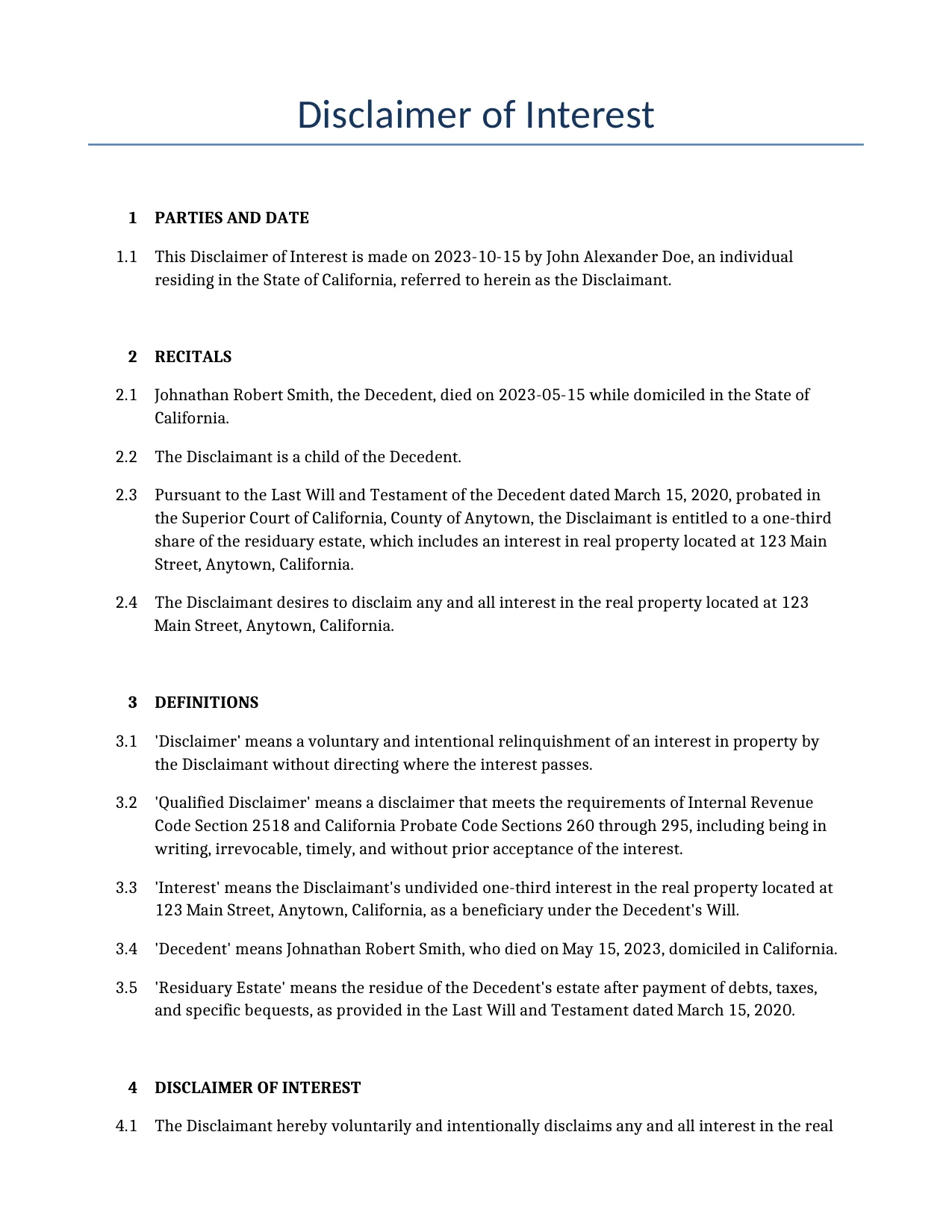
Free Example Disclaimer of Interest Template
Below is a free template example of a Disclaimer of Interest for use in the United States generated by our AI model.
The clauses in your actual Disclaimer of Interest will vary from this example as they will be entirely bespoke to your requirements as set out in the questionnaire you complete.
Disclaimer of Interest in Real Property Located at 123 Main Street, Anytown, California
1PARTIES AND DATE
This Disclaimer of Interest is made on 2023-10-15 by John Alexander Doe, an individual residing in the State of California, referred to herein as the Disclaimant.
2RECITALS
Johnathan Robert Smith, the Decedent, died on 2023-05-15 while domiciled in the State of California.
The Disclaimant is a child of the Decedent.
Pursuant to the Last Will and Testament of the Decedent dated March 15, 2020, probated in the Superior Court of California, County of Anytown, the Disclaimant is entitled to a one-third share of the residuary estate, which includes an interest in real property located at 123 Main Street, Anytown, California.
The Disclaimant desires to disclaim any and all interest in the real property located at 123 Main Street, Anytown, California.
3DEFINITIONS
'Disclaimer' means a voluntary and intentional relinquishment of an interest in property by the Disclaimant without directing where the interest passes.
'Qualified Disclaimer' means a disclaimer that meets the requirements of Internal Revenue Code Section 2518 and California Probate Code Sections 260 through 295, including being in writing, irrevocable, timely, and without prior acceptance of the interest.
'Interest' means the Disclaimant's undivided one-third interest in the real property located at 123 Main Street, Anytown, California, as a beneficiary under the Decedent's Will.
'Decedent' means Johnathan Robert Smith, who died on May 15, 2023, domiciled in California.
'Residuary Estate' means the residue of the Decedent's estate after payment of debts, taxes, and specific bequests, as provided in the Last Will and Testament dated March 15, 2020.
4DISCLAIMER OF INTEREST
The Disclaimant hereby voluntarily and intentionally disclaims any and all interest in the real property located at 123 Main Street, Anytown, California.
This disclaimer constitutes a deliberate relinquishment of all rights to the interest and is not merely a refusal to accept the interest.
The Disclaimant affirms that this disclaimer is made of the Disclaimant’s own free will, without any coercion or undue influence.
5PARTIAL DISCLAIMER
The Disclaimant disclaims only a severable interest to which the Disclaimant is entitled, specifically the undivided one-third interest in the real property located at 123 Main Street, Anytown, California, which is separate from any other assets of the residuary estate. This partial disclaimer is made pursuant to California Probate Code Section 280 and is intended to be treated as a qualified partial disclaimer without affecting the Disclaimant’s interest in the remainder of the residuary estate.
The remainder of any interest not expressly disclaimed herein shall pass according to the terms of the Last Will and Testament of the Decedent dated March 15, 2020.
6EFFECT OF DISCLAIMER
The interest disclaimed by the Disclaimant shall pass as if the Disclaimant had predeceased the Decedent, in accordance with the terms of the Last Will and Testament of the Decedent dated March 15, 2020, and applicable law.
The Disclaimant acknowledges that this disclaimer is intended to comply with Internal Revenue Code Section 2518, Internal Revenue Code Section 2056, and Internal Revenue Code Section 2511, and that the disclaimer may have tax consequences which the Disclaimant has considered.
7NO ACCEPTANCE OF INTEREST
The Disclaimant has not taken any action that would constitute acceptance of the disclaimed interest, including but not limited to using the property, receiving any benefits from it, or otherwise treating it as the Disclaimant’s own.
The Disclaimant has not executed any document, made any expenditure, or taken any other step that would indicate acceptance of the interest under IRC Section 2518 or California law.
8IRREVOCABILITY
This disclaimer is irrevocable once executed and delivered in accordance with the laws of the State of California.
The Disclaimant understands and agrees that this disclaimer cannot be revoked or undone after its delivery as provided herein.
9COMPLIANCE WITH LAW
The Disclaimant affirms that this disclaimer is made in compliance with all applicable federal and state laws, including but not limited to the timing requirements under the Internal Revenue Code for qualified disclaimers.
The Disclaimant is a resident of the State of California, and this disclaimer is intended to comply with the disclaimer laws of the State of California.
The Disclaimant affirms that this disclaimer is being made within 9 months of the date of the Decedent’s death or the date the interest became fixed and ascertainable, and that no prior acceptance has occurred, in order to fully meet the timing and qualification rules under IRC Section 2518 and California Probate Code Sections 260 through 295.
10DELIVERY
This disclaimer shall be delivered to the Executor of the Estate to make it effective.
Delivery may be made personally, by certified mail, or by such other method as is permitted under the laws of the State of California.
11GOVERNING LAW
This Disclaimer of Interest shall be governed by and construed in accordance with the laws of the State of California, specifically the California Probate Code (including but not limited to Sections 260-295) and applicable federal law including the Internal Revenue Code.
12TAX ADVICE DISCLAIMER
This document does not constitute tax or legal advice. The Disclaimant has been advised to consult independent tax and legal professionals regarding the consequences of this disclaimer under IRC Sections 2518, 2056, 2511, and California tax laws. The Disclaimant assumes all responsibility for any tax implications arising from this disclaimer.
13ENTIRE AGREEMENT
This Disclaimer of Interest constitutes the entire agreement between the parties with respect to the disclaimer of the interest described herein and supersedes all prior understandings or agreements, whether written or oral.
14SEVERABILITY
If any provision of this Disclaimer of Interest is held to be invalid, illegal, or unenforceable, the remaining provisions shall remain in full force and effect as if such invalid provision had not been included.
15NOTICES
Any notice required or permitted under this Disclaimer of Interest shall be in writing and shall be deemed delivered when personally delivered or when sent by certified mail, return receipt requested, to the Executor of the Estate at the address on file with the probate court or to the Disclaimant at the Disclaimant’s last known address.
16VARIATION
No variation of this Disclaimer of Interest shall be effective unless it is in writing and signed by the Disclaimant and acknowledged by the Executor of the Estate.
17RECORDING AND FILING
A copy of the executed disclaimer shall be filed with the probate court in the Superior Court of California, County of Anytown, and recorded in the county where the real property is located to comply with California Probate Code Section 285 and local recording statutes.
18EXECUTION
The Disclaimant has executed this Disclaimer of Interest on the date first written above.
19SIGNATURE
IN WITNESS WHEREOF, the Disclaimant has executed this Disclaimer of Interest as of the date first above written.
Disclaimant: _______________________________
Printed Name: John Alexander Doe
Date: 2023-10-15
We, the undersigned, being first duly sworn, do hereby declare to the undersigned authority that the Disclaimant has executed this Disclaimer of Interest in our presence and that the Disclaimant appeared to be of sound mind and under no duress, fraud or undue influence.
Witness 1:
Signature: _______________________________
Printed Name: _______________________________
Address: _______________________________
Witness 2:
Signature: _______________________________
Printed Name: _______________________________
Address: _______________________________
Notary Acknowledgment
State of California
County of _______________
On _______________, before me, _______________________________, a Notary Public, personally appeared John Alexander Doe, who proved to me on the basis of satisfactory evidence to be the person whose name is subscribed to the within instrument and acknowledged to me that he executed the same in his authorized capacity, and that by his signature on the instrument the person, or the entity upon behalf of which the person acted, executed the instrument.
I certify under PENALTY OF PERJURY under the laws of the State of California that the foregoing paragraph is true and correct.
WITNESS my hand and official seal.
Notary Public: _______________________________ (Seal)
My Commission Expires: _______________
This example shows approximately 70% of a typical document and is provided for illustrative purposes only. The remaining content has been omitted.
Every document generated by Docaro is tailored to your specific circumstances, jurisdiction and the information you provide. The completed document includes all applicable clauses and provisions required for your situation.
To generate the full, personalised document, answer a short series of questions and your document will be created instantly.