
AI Generated Incident Response Plan for use in the United States
PDF & Word - 2026 Updated
Docaro Pricing
When Do You Need an Incident Response Plan in the United States?
American Legal Rules for an Incident Response Plan
Using an improperly structured incident response plan may fail to comply with federal and state regulatory requirements, exposing the organization to legal liabilities.
What a Proper Incident Response Plan Should Include
- Incident Response TeamIdentify key team members and their roles to handle incidents quickly and effectively.
- Incident Detection MethodsDescribe ways to spot and report potential incidents early, like monitoring tools or employee alerts.
- Response ProceduresOutline clear steps to contain, investigate, and resolve an incident to minimize damage.
- Communication PlanSpecify who to notify during an incident, including internal teams, customers, and authorities if needed.
- Recovery and RestorationDetail how to restore normal operations and strengthen defenses after an incident.
- Training and TestingInclude regular drills and training to ensure the team is prepared for real incidents.
- Documentation and ReviewRequire recording all incident details and reviewing the plan afterward to improve it.
Generate Your Document in 4 Easy Steps
Why Use Docaro?
 United States
Free Example Incident Response Plan Template
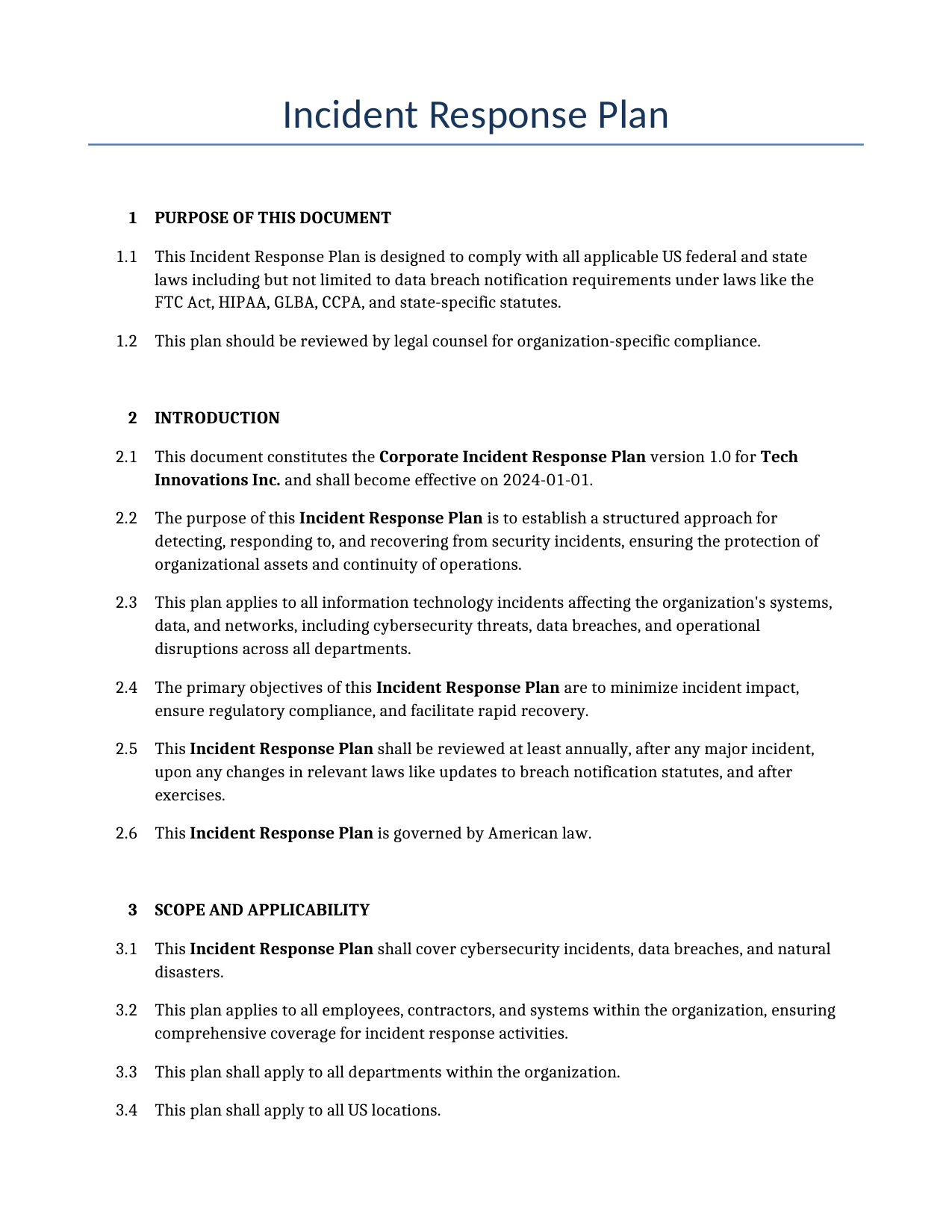
Below is a free template example of a Incident Response Plan for use in the United States generated by our AI model.
The clauses in your actual Incident Response Plan will vary from this example as they will be entirely bespoke to your requirements as set out in the questionnaire you complete.
Corporate Incident Response Plan
1PURPOSE OF THIS DOCUMENT
This Incident Response Plan is designed to comply with all applicable US federal and state laws including but not limited to data breach notification requirements under laws like the FTC Act, HIPAA, GLBA, CCPA, and state-specific statutes.
This plan should be reviewed by legal counsel for organization-specific compliance.
2INTRODUCTION
This document constitutes the Corporate Incident Response Plan version 1.0 for Tech Innovations Inc. and shall become effective on 2024-01-01.
The purpose of this Incident Response Plan is to establish a structured approach for detecting, responding to, and recovering from security incidents, ensuring the protection of organizational assets and continuity of operations.
This plan applies to all information technology incidents affecting the organization's systems, data, and networks, including cybersecurity threats, data breaches, and operational disruptions across all departments.
The primary objectives of this Incident Response Plan are to minimize incident impact, ensure regulatory compliance, and facilitate rapid recovery.
This Incident Response Plan shall be reviewed at least annually, after any major incident, upon any changes in relevant laws like updates to breach notification statutes, and after exercises.
This Incident Response Plan is governed by American law.
3SCOPE AND APPLICABILITY
This Incident Response Plan shall cover cybersecurity incidents, data breaches, and natural disasters.
This plan applies to all employees, contractors, and systems within the organization, ensuring comprehensive coverage for incident response activities.
This plan shall apply to all departments within the organization.
This plan shall apply to all US locations.
This plan shall include incidents involving third-party vendors or partners.
4ROLES AND RESPONSIBILITIES
The Cyber Incident Response Team (CIRT) shall consist of members between 6 and 15.
Johnathan Reyes shall be designated as the leader of the Cyber Incident Response Team (CIRT).
The email address of the Incident Response Team leader is johnathan.reyes@techinnovations.com.
The phone number of the Incident Response Team leader is (555) 123-4567.
The Incident Response Team Leader shall oversee incident detection, coordinate team efforts, make final decisions on response actions, report to executives, and ensure compliance with breach notification laws.
The Cyber Incident Response Team (CIRT) shall include a Technical Analyst role.
The Cyber Incident Response Team (CIRT) shall include a Communications Coordinator role.
The IT staff shall identify and isolate affected systems, perform forensic analysis, and restore operations post-incident.
The executives shall approve major response decisions, ensure resource allocation, and communicate with external stakeholders as needed.
The Cyber Incident Response Team (CIRT) shall include a Legal Counsel role for other stakeholders in the Incident Response Plan.
Sarah Thompson shall be assigned the role of Technical Lead on the Cyber Incident Response Team (CIRT).
Sarah Thompson belongs to the Information Technology department.
The primary email address for Sarah Thompson is sarah.thompson@techinnovations.com.
The primary phone number for Sarah Thompson is (555) 987-6543.
An alternate shall be designated for Sarah Thompson.
The escalation path for this role shall be set at the Senior Management level.
Michael Chen shall be the specific contact person for this escalation level.
The email address for this escalation contact is michael.chen@techinnovations.com.
The phone number for this escalation contact is (555) 456-7890.
A Data Protection Officer or Privacy Officer role shall be included if handling personal data under CCPA/HIPAA. This role shall ensure responsibilities for compliance with breach notification laws.
The next review of the Incident Response Team composition shall be scheduled for 2025-06-01. Roles must align with organizational structure and legal requirements.
5INCIDENT IDENTIFICATION AND CLASSIFICATION
The organization shall use a combination of automated monitoring, regular security audits, and employee training to report suspicious activities for detecting and identifying incidents, and this includes continuous network traffic analysis and periodic vulnerability scans to identify potential incidents early.
The detection tools to be included in the incident identification process are an Intrusion Detection System, Security Information and Event Management (SIEM), and an Employee Reporting Hotline.
The severity levels defined for classifying incidents shall be Low, Medium, High, and Critical.
Severity shall be classified based on factors such as potential impact on business operations, data sensitivity involved, number of affected users, and likelihood of escalation, for example low severity for minor policy violations, medium for localized disruptions, high for widespread system access issues, and critical for data breaches affecting customer information.
The Cyber Incident Response Team (CIRT) shall be designated for conducting initial assessments.
Initial assessments shall involve immediate isolation of affected systems, gathering of preliminary evidence, notification to key stakeholders, and a quick evaluation of scope and impact, and this shall be followed by documentation in the incident log and escalation if necessary.
The triggers to be used to initiate the initial assessment procedures shall be an automated alert from a monitoring tool, a manual report from an employee, and a third-party notification.
6NOTIFICATION PROCEDURES
Johnathan Reyes shall be the primary internal contact person who should be notified first in the event of an incident.
The email address of the primary internal contact person is johnathan.reyes@techinnovations.com.
The phone number of the primary internal contact person is (555) 123-4567.
The timeline for initial internal notifications after detecting an incident shall be 2 hours.
Internal notifications about an incident shall include the incident description, time and date of detection, initial impact assessment, and affected systems.
The external regulatory bodies to be included in the notification procedures for incidents shall be the FTC, HHS OCR, SEC (if applicable), and state Attorneys General.
The timeline for initial external notifications after incident detection shall be 72 hours or as required by specific laws like HIPAA (60 days max) or state breach laws (typically 30-60 days).
External notifications about an incident shall include the nature of the incident, number of affected individuals, types of data involved, and mitigation steps taken.
Detailed procedures for notifying affected individuals in the event of a data breach as required by US state laws and federal regulations shall be followed. The content of notices shall include a description of the breach, types of information compromised, steps individuals should take to protect themselves, contact information for the organization, and information about credit monitoring if offered. Timing shall be without unreasonable delay but no later than timelines required by law (e.g., 30-60 days depending on regulation). Methods shall include email (if consented), postal mail, or phone as appropriate.
Coordination with law enforcement shall occur when the breach involves criminal activity, with notifications to agencies such as the FBI or local authorities as needed, ensuring that such coordination does not delay required notifications beyond legal timelines.
Credit monitoring offers shall be provided to affected individuals if the breach involves sensitive data like Social Security numbers, in compliance with state laws (e.g., California, New York).
All notifications shall be documented thoroughly, including dates, methods, content sent, and responses received, for audit and compliance purposes.
The criteria to be used as triggers for escalating notifications beyond the initial contacts shall be incident severity level, number of affected individuals, and type of data compromised.
7CONTAINMENT STRATEGIES
The short-term containment strategies to immediately limit the incident's impact shall include immediately disconnecting affected systems from the network, disabling user accounts showing suspicious activity, and deploying temporary firewalls to block malicious traffic.
The long-term containment strategies to sustain containment and prevent recurrence of the incident shall include implementing enhanced monitoring systems, conducting regular security audits, and developing ongoing training programs for employees to prevent similar incidents.
The isolation techniques that the Incident Response Team shall use for containing incidents shall be network segmentation, system quarantine, and access control restrictions.
Resources shall be allocated for implementing containment strategies during an incident by allocating a dedicated budget for emergency tools and software, assigning on-call shifts for key personnel, and prioritizing resources based on incident severity to ensure rapid response.
The personnel roles to be allocated to the containment strategies in the Incident Response Plan shall be the IT Security Team, the Incident Response Coordinator, and Legal Counsel.
Specific containment strategies shall be triggered for medium severity and high severity incidents.
8ERADICATION PROCEDURES
The specific tool or software that the organization plans to use for malware removal during eradication procedures is Malwarebytes Endpoint Protection.
The IT team shall follow this step-by-step process for patching vulnerabilities identified in the incident: identify vulnerabilities using scanning tools like Nessus, prioritize patches based on severity using the CVSS score, test patches in a staging environment, deploy patches during maintenance windows using automated tools like WSUS, and verify patch application and re-scan systems.
A mandatory step in the eradication procedures for preserving forensic evidence before removal actions shall be included.
The roles within the organization to be designated as part of the eradication response team shall be IT Security Analyst, System Administrator, and Incident Response Coordinator.
The organization shall verify the integrity of backups before and after eradication procedures by performing checksum verification using MD5 hashes on backup files to ensure no corruption before eradication and by restoring a sample from the backup to a test environment and running integrity checks with tools like VeraCrypt or built-in OS utilities to confirm data wholeness after eradication.
The methods to be included for validating that the root cause has been fully eradicated shall be full system re-scan, network traffic monitoring, and forensic analysis.
Resetting all potentially compromised account credentials shall be mandated as part of the eradication procedures.
9RECOVERY AND RESTORATION
The specific procedures to be included for data recovery in the Recovery and Restoration section shall include identifying affected data sources, restoring from most recent backups using verified media, performing integrity checks on restored data, and testing functionality before full deployment.
A formal protocol for system rebuilding shall be established in the Recovery and Restoration section.
The duration for post-restoration monitoring in the Recovery and Restoration section shall be 90 days.
Backups shall be performed as part of the recovery strategy in the Recovery and Restoration section with daily incremental backups and weekly full backups.
The target Recovery Time Objective (RTO) in the Recovery and Restoration section shall be 24 hours.
Offsite backups shall be incorporated for enhanced data recovery in the Recovery and Restoration section.
The systems to be prioritized for restoration in the Recovery and Restoration section shall be critical IT infrastructure and customer-facing applications.
The specific tools to be used for monitoring reoccurrence after restoration in the Recovery and Restoration section shall be SIEM systems like Splunk, intrusion detection tools such as Snort, and continuous logging with ELK Stack.
10POST-INCIDENT REVIEW AND LESSONS LEARNED
The incident response team shall be required to conduct an after-action review after every incident.
The deadline for completing the after-action review after the incident ends shall be 30 days after incident closure.
The participants in the after-action review shall be incident response team members, department heads affected by the incident, and external consultants if applicable.
The format for the after-action review meetings shall be a virtual meeting.
The incident response team shall update the plan based on lessons learned within 14 days after the review.
The Incident Response Team Lead shall be assigned as the responsible party for updating the incident response plan after reviews.
11COMMUNICATION PLAN
The internal communication protocol to be defined for use during an incident is that during an incident all internal communications will be coordinated through the Incident Response Team (IRT) lead, team members will use a dedicated Slack channel for real-time updates and email for formal notifications, escalation to department heads will occur within 1 hour of incident detection, with mandatory daily briefings at 9 AM until resolution.
The external communication protocol to be defined for use during an incident is that external communications will be limited to pre-approved statements from the Public Relations Officer, no direct responses to inquiries without IRT approval, updates to customers and partners will be issued via official website announcements and email newsletters, with a 24-hour review period for all external messaging.
Specific media relations procedures shall be included in the communication plan.
The frequency for stakeholder updates during an incident shall be daily.
Stakeholder updates shall be delivered via secure email portal and a dedicated incident dashboard accessible through a company VPN, ensuring confidentiality and real-time access.
Protocols for legal notifications shall be included in the communication plan.
12TRAINING AND AWARENESS
The training program to be implemented for the incident response team shall consist of a comprehensive two-day workshop covering incident identification, response protocols, communication strategies, and recovery procedures, and it will include hands-on simulations, expert-led sessions, and certification for participants to ensure the team is well-equipped to handle cyber incidents effectively.
Awareness campaigns for all employees regarding incident response procedures shall be included.
Periodic drills for the incident response team shall be conducted quarterly.
The next training session shall be scheduled for 2024-03-15.
The effectiveness of the training programs shall be evaluated using post-training quizzes, participant feedback surveys, and follow-up performance assessments during drills to measure knowledge retention and practical application.
Documentation of all periodic drills, including outcomes and lessons learned, shall be required.
The groups to be targeted with the awareness campaigns shall be all employees and management and executives.
13TESTING AND EXERCISES
The types of incident response exercises to be included in the Testing and Exercises section of the Incident Response Plan shall be tabletop simulation and full-scale drill.
The frequency schedule for conducting the incident response exercises in the Testing and Exercises section shall be semi-annually.
The next incident response exercise shall be scheduled for 2024-06-15.
The specific evaluation criteria to be included for assessing the incident response exercises shall be effectiveness of communication channels, time taken to detect and respond to the simulated incident, adherence to predefined roles and responsibilities, and overall team coordination during the exercise.
A formal post-exercise debrief session shall be required for all incident response exercises.
The Incident Response Coordinator shall be designated as responsible for executing the incident response exercises.
14TOOLS AND RESOURCES
The software tools that the organization currently uses or plans to use for incident response are SIEM tools like Splunk, endpoint detection software such as CrowdStrike, forensic analysis tools including EnCase, and a ticketing system like Jira.
The hardware resources available or needed for the incident response team are dedicated incident response laptops with high-speed SSDs, secure forensic workstations, multiple external hard drives for imaging, and a mobile command center van equipped with redundant power supplies.
Cloud-based tools shall be included in the incident response resources.
The vendor categories for which contacts are needed in the incident response plan shall be a cybersecurity firm, legal counsel, and forensic experts.
The primary contact names for each selected vendor are Cybersecurity Firm: John Doe, Legal Counsel: Jane Smith, Forensic Experts: Dr. Alex Johnson.
The email address for the primary vendor contact is john.doe@cybersecfirm.com.
The phone number for the primary vendor contact is (555) 123-4567.
The tools and resources section shall be reviewed and updated quarterly.
15LEGAL AND COMPLIANCE CONSIDERATIONS
The U.S. data privacy laws that apply to the organization's operations are HIPAA, GLBA, CCPA/CPRA, and FTC Act.
The organization processes personal data of EU residents, making GDPR applicable where relevant, though primary focus is on US compliance.
The organization operates or has customers in California, New York, and other states, thus subject to state data breach notification laws (e.g., California Civil Code § 1798.82, New York General Business Law § 899-aa).
The organization is subject to sector-specific federal regulations like those from the SEC (if public company), FTC, and HHS OCR for HIPAA.
Jane Doe shall be the designated legal contact for incident reporting.
The email address of the designated legal contact for incident reporting is jane.doe@techinnovations.com.
The phone number of the designated legal contact for incident reporting is (555) 123-4567.
The organization must internally report to legal within 24 hours after incident detection. Requirements for timely breach reporting (e.g., 72 hours for certain notifications, 60 days max for HIPAA), risk assessments, and data subject notifications shall be followed in compliance with US laws.
The authorities that the organization must notify in the event of a data breach are the State Attorney General, the Department of Health and Human Services, FTC, SEC (if applicable), and other relevant bodies per state and federal laws.
The organization's document retention policy for incident records is that incident records are retained for a minimum of 7 years in a secure, encrypted digital archive, in compliance with applicable federal and state regulations, with annual reviews to ensure ongoing relevance.
The organization has cyber insurance that covers data breach response costs.
The threshold for determining when a security incident qualifies as a reportable breach is the risk of harm to individuals or as defined by specific state/federal laws.
This Incident Response Plan shall comply with the Health Insurance Portability and Accountability Act (HIPAA) Security Rule, the California Consumer Privacy Act (CCPA) of 2018 as amended by CPRA, GLBA, and all applicable state breach notification statutes.
16DOCUMENTATION AND REPORTING
The documentation policy in the Documentation and Reporting section is that all incidents must be documented thoroughly, including date, time, description, affected systems, and response actions taken, to ensure accountability and facilitate post-incident analysis.
Logging of all incidents immediately upon discovery shall be required.
Incident reports shall be generated weekly.
The procedure to be outlined for maintaining the chain of custody of incident documentation is that all documentation must be logged with timestamps, signed by the handler, stored in a secure, access-controlled system, and any transfers recorded with dates, times, and personnel involved to prevent tampering.
The documentation retention period shall be 7 years.
The roles to be authorized for submitting incident reports shall be the Incident Response Team Lead, the IT Security Officer, and the Compliance Officer.
The details to be included in the standard incident report template are the incident ID, discovery date and time, description of the incident, impact assessment, response steps taken, personnel involved, and lessons learned.
An audit trail for all documentation changes shall be maintained.
17PLAN MAINTENANCE AND REVIEW
An annual review process for the Incident Response Plan shall be established, with more frequent reviews after any major incident, at least annually, and upon any changes in relevant laws like updates to breach notification statutes.
The reviews of the Incident Response Plan shall occur at least annually or more frequently as triggered.
Johnathan Reyes shall be designated as the responsible person for conducting the reviews of the Incident Response Plan.
The email address of the responsible person for the Incident Response Plan reviews is johnathan.reyes@techinnovations.com.
A formal version control system for the Incident Response Plan shall be implemented. Triggers for ad-hoc updates shall include regulatory changes or after exercises.
The updated Incident Response Plan shall be distributed to relevant parties by email notification and through the intranet portal.
The relevant parties that should receive distributions of the Incident Response Plan are the IT Security Team, department managers, and executive leadership.
18APPENDICES
An emergency contact list shall be included in the appendices.
The name of the primary emergency contact is Johnathan Reyes.
The phone number for the primary emergency contact is (555) 123-4567.
The email address for the primary emergency contact is johnathan.reyes@techinnovations.com.
Customizable templates shall be included in the appendices.
The formats for the incident templates shall be a Word document and PDF.
Flowcharts for response procedures shall be included in the appendices.
A glossary of terms shall be included in the appendices.
References to related policies shall be included in the appendices.
19SIGNATURE SECTION
This Incident Response Plan is executed on behalf of Tech Innovations Inc. by the undersigned authorized representative as of the effective date set forth above.
By signing below the representative acknowledges that he or she has read, understands, and agrees to abide by the terms and conditions of this Incident Response Plan and that it shall be binding upon Tech Innovations Inc. in accordance with American law.
Signature: _______________________________ Date: _______________
Printed Name: _______________________________ Title: _______________
20REFERENCES
This plan aligns with NIST SP 800-61 Rev. 2 (Computer Security Incident Handling Guide), available at https://nvlpubs.nist.gov/nistpubs/SpecialPublications/NIST.SP.800-61r2.pdf. The plan follows its recommended phases: Preparation, Detection and Analysis, Containment Eradication and Recovery, and Post-Incident Activity.
FISMA (Federal Information Security Modernization Act) requires federal agencies to develop incident response capabilities; this plan incorporates similar best practices for private sector compliance.
State data breach notification laws: California (Cal. Civ. Code § 1798.82, see https://oag.ca.gov/privacy/ccpa), New York (N.Y. Gen. Bus. Law § 899-aa, see https://www.nysenate.gov/legislation/laws/GBS/899-AA), and similar statutes in all states where the organization operates. Notifications shall comply with timing (typically 30-60 days), content, and method requirements.
HIPAA (45 C.F.R. Parts 160 and 164) requires breach notifications within 60 days; this plan ensures compliance for protected health information.
GLBA (Gramm-Leach-Bliley Act) Safeguards Rule requires incident response programs for financial institutions.
CCPA/CPRA (Cal. Civ. Code §§ 1798.100 - 1798.199.100) mandates risk assessments and notifications for breaches involving personal information.
FTC Act (15 U.S.C. § 45) and related regulations require reasonable security practices and timely breach disclosures.
If applicable, SEC regulations (e.g., 17 C.F.R. § 229.1002 for cybersecurity disclosures) are considered for material incidents.
All references are cited for guidance; the plan shall be updated upon changes to these or new regulations. Hyperlinks provided for official sources where available.
21APPROVAL AND VERSION HISTORY
Version | Date | Changes | Approver | Title
1.0 | 2024-01-01 | Initial version | Johnathan Reyes | CISO
1.1 | [Future Date] | Updates for regulatory changes | [Approver Name] | Legal Counsel
Additional approvals: Signature lines for CISO, Legal Counsel, and Executive Leadership to ensure auditability as recommended by NIST and required for HIPAA compliance.
This example shows approximately 70% of a typical document and is provided for illustrative purposes only. The remaining content has been omitted.
Every document generated by Docaro is tailored to your specific circumstances, jurisdiction and the information you provide. The completed document includes all applicable clauses and provisions required for your situation.
To generate the full, personalised document, answer a short series of questions and your document will be created instantly.