
AI Generated Child Travel Consent for use in the United States
PDF & Word - 2026 Updated
Docaro Pricing
When Do You Need a Child Travel Consent in the United States?
American Legal Rules for a Child Travel Consent
Using the wrong structure for a child travel consent form may render it invalid or insufficient to satisfy international or state-specific legal requirements.
What a Proper Child Travel Consent Should Include
- Child's DetailsInclude the child's full name, date of birth, and passport number to clearly identify them.
- Travel PlansSpecify the destination, dates of travel, and full itinerary including flights and accommodations.
- Accompanying AdultsList the names and relationships of any adults traveling with the child, or note if the child is traveling alone.
- Parental ConsentState that the parents or legal guardians give permission for the child to travel.
- Emergency ContactsProvide contact information for parents, guardians, and any emergency medical contacts.
- Health InformationMention any allergies, medications, or medical conditions the child has.
- Authorization for CareAllow the accompanying adult to make decisions about the child's care during the trip if needed.
- Signatures and DatesHave both parents or guardians sign and date the document to make it official.
Generate Your Document in 4 Easy Steps
Why Use Docaro?
 United States
Free Example Child Travel Consent Template
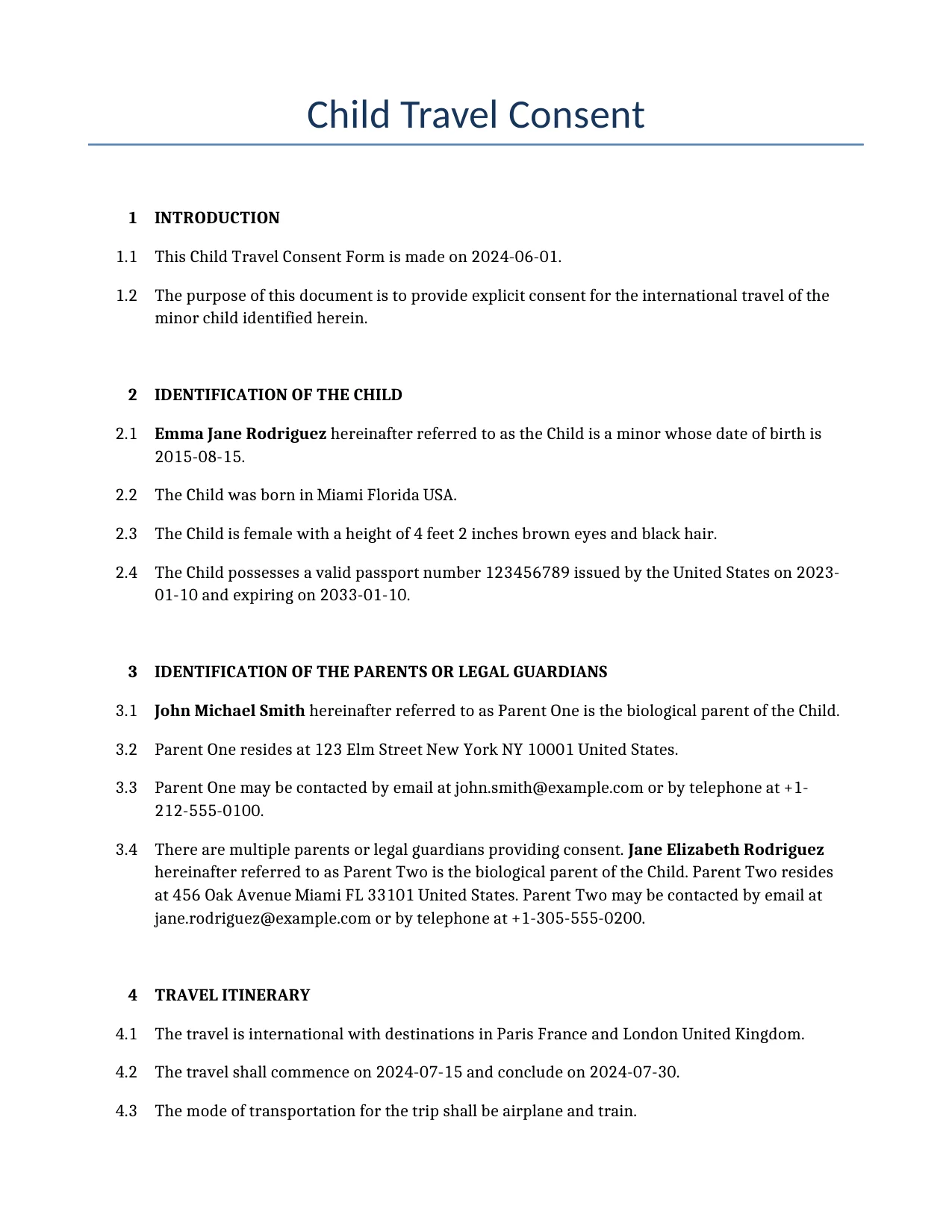
Below is a free template example of a Child Travel Consent for use in the United States generated by our AI model.
The clauses in your actual Child Travel Consent will vary from this example as they will be entirely bespoke to your requirements as set out in the questionnaire you complete.
Child Travel Consent Form
1INTRODUCTION
This Child Travel Consent Form is made on 2024-06-01.
The purpose of this document is to provide explicit consent for the international travel of the minor child identified herein.
2IDENTIFICATION OF THE CHILD
Emma Jane Rodriguez hereinafter referred to as the Child is a minor whose date of birth is 2015-08-15.
The Child was born in Miami Florida USA.
The Child is female with a height of 4 feet 2 inches brown eyes and black hair.
The Child possesses a valid passport number 123456789 issued by the United States on 2023-01-10 and expiring on 2033-01-10.
3IDENTIFICATION OF THE PARENTS OR LEGAL GUARDIANS
John Michael Smith hereinafter referred to as Parent One is the biological parent of the Child.
Parent One resides at 123 Elm Street New York NY 10001 United States.
Parent One may be contacted by email at john.smith@example.com or by telephone at +1-212-555-0100.
There are multiple parents or legal guardians providing consent. Jane Elizabeth Rodriguez hereinafter referred to as Parent Two is the biological parent of the Child. Parent Two resides at 456 Oak Avenue Miami FL 33101 United States. Parent Two may be contacted by email at jane.rodriguez@example.com or by telephone at +1-305-555-0200.
4TRAVEL ITINERARY
The travel is international with destinations in Paris France and London United Kingdom.
The travel shall commence on 2024-07-15 and conclude on 2024-07-30.
The mode of transportation for the trip shall be airplane and train.
The Child shall be accompanied by John Doe (father relationship to child date of birth 1980-05-20 passport number A1234567 contact +1-555-111-2222) and Jane Smith (aunt relationship to child date of birth 1985-11-10 passport number B7654321 contact +1-555-333-4444).
5AUTHORIZATION FOR TRAVEL
The Parent hereby grants full and unconditional consent for the Child to travel for the purpose of a family vacation to visit grandparents in Paris France and London United Kingdom.
The Parent authorizes the Child to return to the United States on a different date or with different arrangements if needed. In case of emergency requiring return the accompanying adults are authorized to arrange and consent to the Child's immediate return to the United States.
6EMERGENCY CONTACT INFORMATION
In addition to the Parents the emergency contact for the Child is Aunt Jane Smith whose telephone number is (555) 123-4567. The non-traveling parents' contact information is provided in Section 3 above.
7MEDICAL INFORMATION AND AUTHORIZATION
The Child has known medical conditions including asthma managed with an inhaler and a history of seasonal allergies.
The Child has severe allergies to peanuts and to penicillin.
The Child is currently taking an albuterol inhaler with 2 puffs as needed for asthma and a daily multivitamin with 1 tablet every morning.
The Child is covered by health insurance provided by Blue Cross Blue Shield under policy number POL123456789.
The Parent authorizes the accompanying adult to consent to emergency medical treatment for the Child.
8AUTHORIZATION FOR THE ACCOMPANYING ADULTS
The Parents hereby grant specific permission for John Doe and Jane Smith to travel internationally with the Child.
The accompanying adults are authorized to make decisions regarding the Child's welfare during travel including but not limited to accommodations transportation and daily activities.
The accompanying adults are authorized to seek and consent to any necessary medical treatment for the Child in the event of illness or emergency.
The accompanying adults are authorized to handle any necessary arrangements including changes to travel plans and to present this consent form to authorities airlines or immigration officials as required.
9CUSTODY AND LEGAL AUTHORITY
The Parents have legal custody of the Child under a joint custody arrangement pursuant to court order in Case Number FAM-2020-5678 issued by the Family Court of New York County on 2021-03-10.
There are no travel restrictions or prohibitions in the court order or any other legal documents. There are no other custody disputes or pending proceedings that would affect this consent.
The Parents affirm that they have the legal right to provide this consent and that doing so does not violate any court orders or agreements. The Parents further affirm that this consent is provided voluntarily and without coercion.
10DURATION OF CONSENT
This consent shall commence on 2024-07-01 and shall remain in effect until 2024-08-15 to allow for any travel delays or changes.
11ADDITIONAL DECLARATIONS
The Parents declare that the travel is not for the purpose of evading custody that both parents agree to the travel and that there is no intent of abduction or retention of the Child outside the United States.
The Parents affirm that the Child will be returned to the United States as scheduled on or before 2024-07-30. This consent references relevant US regulations including those from the Department of State regarding international child travel.
12GOVERNING LAW
This agreement shall be governed by and construed in accordance with American law specifically the laws of the State of New York and the State of Florida as applicable to the Parents' and Child's primary residences without regard to conflict of laws principles. This governs the interpretation and enforcement of the consent form.
13ENTIRE AGREEMENT
This document constitutes the entire agreement between the parties with respect to the subject matter hereof and supersedes all prior understandings agreements or representations whether oral or written.
14SEVERABILITY
If any provision of this Child Travel Consent Form is held to be invalid or unenforceable by a court of competent jurisdiction such invalidity or unenforceability shall not affect the remaining provisions which shall remain in full force and effect.
15NOTICES
Any notices required under this agreement shall be in writing and delivered to the addresses provided herein for the Parents or to such other address as a party may designate by written notice.
16VARIATION
No variation of this Child Travel Consent Form shall be effective unless it is in writing and signed by all parties hereto.
17ACKNOWLEDGMENT AND SWORN STATEMENT
The undersigned Parents affirm under penalty of perjury that all information provided in this Child Travel Consent Form is true and correct to the best of their knowledge. The consent is given voluntarily and the Parents have the full legal authority to grant this consent without violating any orders or laws.
18SIGNATURES
IN WITNESS WHEREOF the Parents have executed this Child Travel Consent Form as of the date first above written.
Parent One: _______________________________ Date: _______________ John Michael Smith
Parent Two: _______________________________ Date: _______________ Jane Elizabeth Rodriguez
Accompanying Adult (Optional): _______________________________ Date: _______________ John Doe
Accompanying Adult (Optional): _______________________________ Date: _______________ Jane Smith
Notary Public: _______________________________ Date: 2024-06-15 Commission Expires: _______________ The foregoing signatures were acknowledged before me on 2024-06-15. This notarization witnesses the signatures of all consenting parties.
This example shows approximately 70% of a typical document and is provided for illustrative purposes only. The remaining content has been omitted.
Every document generated by Docaro is tailored to your specific circumstances, jurisdiction and the information you provide. The completed document includes all applicable clauses and provisions required for your situation.
To generate the full, personalised document, answer a short series of questions and your document will be created instantly.