
AI Generated Content Moderation Policy for use in the United States
PDF & Word - 2026 Updated
Docaro Pricing
When Do You Need a Content Moderation Policy in the United States?
American Legal Rules for a Content Moderation Policy
Using an inappropriate structure for a moderation policy can expose the platform to legal liabilities from unenforceable or overly vague rules.
What a Proper Content Moderation Policy Should Include
- Purpose and ScopeClearly state the policy's goals, like promoting a safe online space, and define what content and platforms it applies to.
- Prohibited ContentList specific types of content that are not allowed, such as hate speech, violence, or illegal activities.
- Moderation RulesExplain the guidelines moderators follow to review and decide on content, ensuring fairness and consistency.
- User Rights and ResponsibilitiesOutline what users can expect, like appeal processes, and their duties, such as following community standards.
- Enforcement ActionsDescribe steps taken for violations, from warnings to content removal or account bans.
- Reporting MechanismsProvide easy ways for users to report problematic content and how reports are handled.
- Transparency and UpdatesCommit to sharing how decisions are made and regularly reviewing the policy to keep it current.
Generate Your Document in 4 Easy Steps
Why Use Docaro?
 United States
Free Example Content Moderation Policy Template
Below is a free template example of a Content Moderation Policy for use in the United States generated by our AI model.
The clauses in your actual Content Moderation Policy will vary from this example as they will be entirely bespoke to your requirements as set out in the questionnaire you complete.
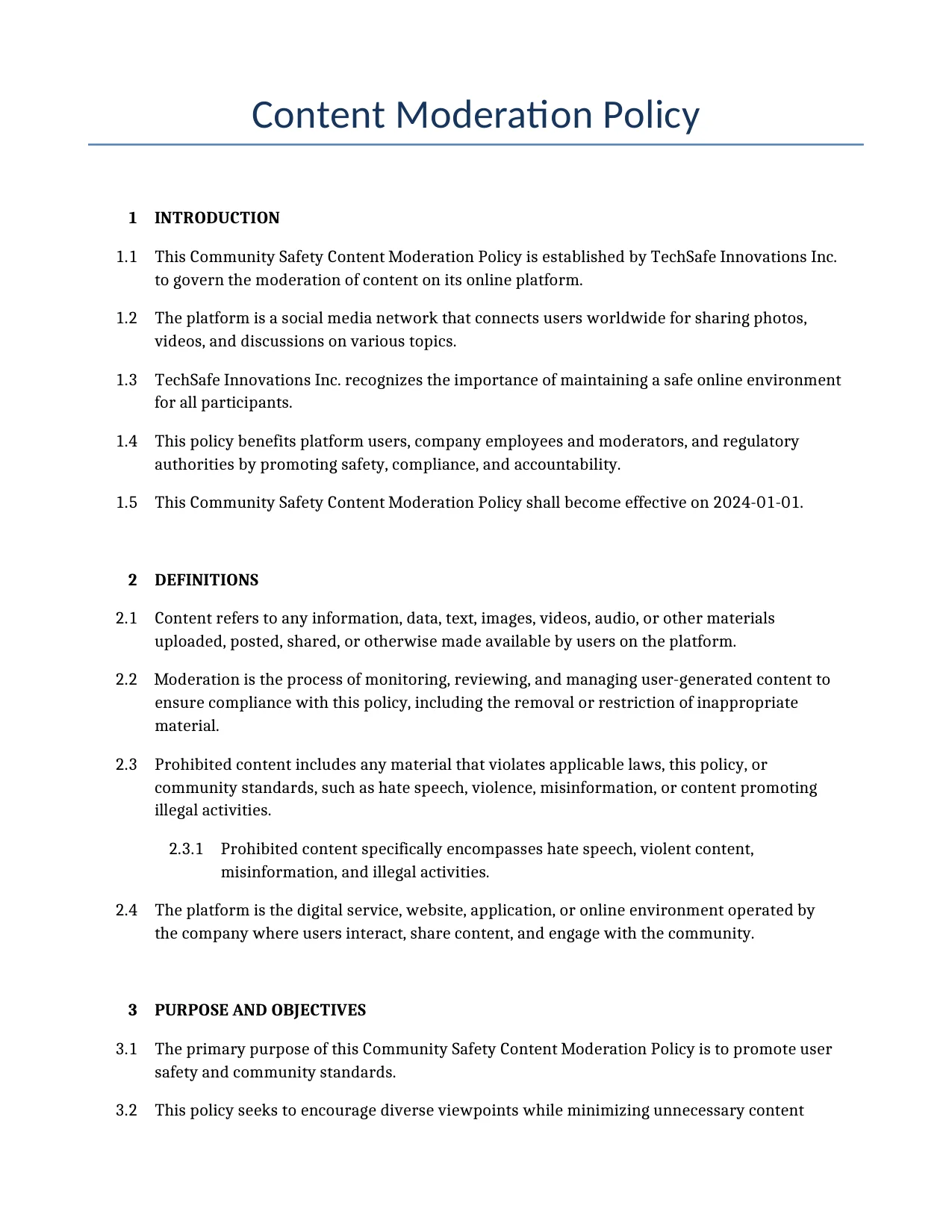
Community Safety Content Moderation Policy
1INTRODUCTION
This Community Safety Content Moderation Policy is established by TechSafe Innovations Inc. to govern the moderation of content on its online platform.
The platform is a social media network that connects users worldwide for sharing photos, videos, and discussions on various topics.
TechSafe Innovations Inc. recognizes the importance of maintaining a safe online environment for all participants.
This policy benefits platform users, company employees and moderators, and regulatory authorities by promoting safety, compliance, and accountability.
This Community Safety Content Moderation Policy shall become effective on 2024-01-01.
2DEFINITIONS
Content refers to any information, data, text, images, videos, audio, or other materials uploaded, posted, shared, or otherwise made available by users on the platform.
Moderation is the process of monitoring, reviewing, and managing user-generated content to ensure compliance with this policy, including the removal or restriction of inappropriate material.
Prohibited content includes any material that violates applicable laws, this policy, or community standards, such as hate speech, violence, misinformation, or content promoting illegal activities.
Prohibited content specifically encompasses hate speech, violent content, misinformation, and illegal activities.
The platform is the digital service, website, application, or online environment operated by the company where users interact, share content, and engage with the community.
3PURPOSE AND OBJECTIVES
The primary purpose of this Community Safety Content Moderation Policy is to promote user safety and community standards.
This policy seeks to encourage diverse viewpoints while minimizing unnecessary content removal.
This policy aims to prohibit hate speech and discrimination, prevent dissemination of illegal content, and reduce harassment and bullying.
TechSafe Innovations Inc. relies on the protections afforded under Section 230 of the Communications Decency Act in making moderation decisions.
The objectives of this policy shall be reviewed initially on 2025-06-01.
4SCOPE OF POLICY
This Community Safety Content Moderation Policy covers all user-generated posts, comments, images, videos, and live streams on the SocialConnect App and SocialConnect Website, as well as any user activities such as sharing, liking, or reporting content.
The platforms provide social networking services, including profile creation, content posting, messaging, and community building features for users to connect and share experiences.
The scope of this policy includes user-generated content, advertisements, and third-party embedded content.
This policy applies globally, with primary focus on users and services operating within the United States.
SocialConnect Inc. operates the platform covered by this Community Safety Content Moderation Policy.
5LEGAL FRAMEWORK
The platform allows users to generate and post content, such as comments, posts, or media, thereby invoking protections under Section 230 of the Communications Decency Act.
The platform does not target or knowingly allow children under the age of 13 to create accounts or interact with content.
The platform launched in the United States on 2024-01-15.
The platform operates in California, New York, and Texas, requiring reference to state-specific anti-discrimination laws.
The legal framework emphasizes protected characteristics including race and ethnicity, gender and sexual orientation, and religion in handling discriminatory content.
This Community Safety Content Moderation Policy is governed by American law, and all provisions shall be interpreted and enforced in compliance with the most up-to-date applicable federal and state legislation, including but not limited to Section 230 of the Communications Decency Act, the Digital Millennium Copyright Act, Title III of the Americans with Disabilities Act, the California Consumer Privacy Act, and the California Age-Appropriate Design Code Act.
6PROHIBITED CONTENT
TechSafe Innovations Inc. prohibits content depicting violence on the platform.
Prohibited violence content includes graphic depictions of harm, promotion of violent acts, and threats against individuals.
TechSafe Innovations Inc. strictly prohibits child exploitation material on the platform.
Harassment is defined as any unwanted conduct that violates an individual’s dignity or creates an intimidating, hostile, degrading, humiliating, or offensive environment, including but not limited to targeted bullying, stalking, or discriminatory remarks based on protected characteristics.
7PROHIBITED CONDUCT
Users are prohibited from engaging in spam on the platform.
Users are prohibited from disseminating misinformation that could incite harm, including health misinformation, violence incitement, and election fraud claims.
Users are explicitly prohibited from unauthorized data collection on the platform.
8MODERATION PRINCIPLES
The platform ensures transparency in moderation decisions by publishing detailed reports on moderation actions taken each quarter, including anonymized statistics on content removals, appeals, and reasons for decisions.
Users receive clear notifications explaining why their content was moderated, along with options to appeal.
The platform adopts standardized guidelines, automated tools integration, and regular training programs to ensure consistency in moderation decisions.
Moderation principles prioritize respect for free speech by adhering strictly to First Amendment standards, only restricting content that poses clear and imminent harm, such as direct threats or incitement to violence.
The platform aims to create a space where diverse viewpoints can be expressed freely, while educating users on the boundaries of protected speech to promote informed discourse.
The following categories of speech are explicitly protected under the moderation principles in accordance with First Amendment guidelines: political opinions, artistic and satirical content, and religious expression.
9MODERATION PROCESSES
Content will be initially triaged using a combination of automated flagging based on user reports and scheduled scans for high-risk keywords.
The moderation team uses AI classifiers and keyword filters as automated tools for content review.
All flagged content requires human review.
Content involving potential child exploitation, severe hate speech, or repeated violations by the same user will be escalated to senior moderators.
The moderation team logs all review actions for auditing.
These moderation processes shall become effective on 2024-01-01.
10AUTOMATED MODERATION TOOLS
TechSafe Innovations Inc. uses automated moderation tools such as artificial intelligence and machine learning models for initial content flagging.
The company utilizes AI-powered image and text recognition software to scan user-generated content for potential violations, integrated with machine learning models trained on diverse datasets to improve accuracy over time.
The automated tools initially flag hate speech, violence or threats, and spam or harassment.
The limitations of the automated moderation tools are explicitly disclosed herein, including risks of false positives, false negatives, and bias in detection.
All flagged content undergoes human review by trained moderators within 24 hours.
Users can appeal decisions through a dedicated portal, and logs of errors are maintained to refine the algorithms periodically.
11HUMAN MODERATION GUIDELINES
The training program for human moderators includes understanding platform guidelines, identifying hate speech and harassment, handling sensitive content like violence or nudity, legal compliance with US laws such as Section 230, and ethical decision-making.
Initial training sessions for human moderators last 8 hours.
Ongoing or refresher training is required for human moderators.
Escalation to supervisors is required for content involving potential legal violations, high-impact decisions affecting user accounts, ambiguous cases of policy violation, or any content flagged by multiple moderators.
The escalation procedures include supervisor review and legal team escalation.
Strategies for mitigating bias in human moderation decisions include regular diversity training, anonymized review processes, rotating moderator teams to avoid fatigue, and using diverse case studies in training to expose unconscious biases.
Regular audits are conducted to assess and address bias in moderation outcomes.
These human moderation guidelines shall become effective on 2024-01-01.
Human moderators follow documentation practices that include detailed notes, standardized templates, and audit logs.
12REPORTING MECHANISMS
An in-app tool is provided for users to report content violations.
Users may report violations by email to moderation@company.com.
Anonymous reporting is allowed through these mechanisms.
Receipt of reports is acknowledged within 24 hours.
Reported violations are fully addressed within 14 days.
13INVESTIGATION AND ENFORCEMENT
Investigations of reports are completed within 7 business days of receiving a report.
Automated tools are implemented for the initial screening of reports in the investigation process.
The team responsible for investigating reports includes internal moderators, legal experts, and technical specialists.
Evidence is collected during investigations by reviewing user-submitted reports, analyzing platform logs and metadata, interviewing involved parties, and gathering screenshots or archived content.
Users involved in an investigation are notified about the process and status.
Available sanctions after investigations confirm violations include content removal, account suspension, permanent ban, and warning issuance.
Users are allowed 14 days to appeal enforcement decisions.
All investigations are documented with a detailed report including the report details, evidence collected, decision rationale, and any sanctions applied, stored securely in the company’s internal database.
This investigation and enforcement section shall become effective on 2024-01-01.
14APPEALS PROCESS
Users submit appeals for moderation decisions via email or through the online form on the website.
Appeals are submitted to appeals@ourcompany.com.
When submitting an appeal, users must provide the original moderation decision ID, a detailed explanation of why the decision is believed to be incorrect, and any supporting evidence or new information.
Receipt of an appeal is acknowledged within 3 days.
A decision on the appeal is provided within 14 days.
Reviewers evaluate appeals based on policy misapplication, new evidence, or contextual error.
The number of appeals a user can submit per moderation decision is limited.
Users may not appeal the outcome of an initial appeal.
The decision of the appeals review team is final and binding, with no further internal appeals available.
Users are notified of appeal outcomes by email or user dashboard.
15CONSEQUENCES FOR VIOLATIONS
Penalties for policy violations include warning, temporary suspension, permanent ban, and content removal.
Penalties escalate based on the number of offenses and the severity of the violation.
Initial temporary suspensions last 7 days.
Provisions exist for potential legal actions against severe violators.
An appeal process is available for penalties imposed, with a review timeline.
This consequences for violations section shall become effective on 2024-01-01.
16TRANSPARENCY AND REPORTING
TechSafe Innovations Inc. commits to issuing public reports on moderation activities quarterly.
Public reports include statistics on content removals, statistics on appeals processes, and trends in violations.
The first public report shall be issued on 2024-03-31.
Public reports are published on the company website and social media.
17DATA PRIVACY AND SECURITY
User data collected during content moderation activities is retained for 90 days after the completion of the moderation process, after which it is securely deleted unless required for legal purposes.
This policy explicitly states compliance with the California Consumer Privacy Act.
Encryption is required for all user data stored during the moderation process.
Access control methods for user data in the moderation system include role-based access control, multi-factor authentication, and audit logging.
User moderation data is not shared with any third parties.
User data from content moderation is primarily stored in cloud services in the US.
This data privacy and security section shall become effective on 2024-01-01.
18THIRD-PARTY INVOLVEMENT
TechSafe Innovations Inc. establishes partnerships with external content moderators and external fact-checkers for verifying content.
Third-party partners must comply with all applicable U.S. federal and state laws, including data privacy regulations such as the California Consumer Privacy Act and the Children’s Online Privacy Protection Act.
Third-party partners are required to maintain confidentiality of user data, undergo annual audits, and indemnify the company against any breaches caused by their actions.
Provisions for shared liability between the company and third-party partners are included.
Moderate data sharing is granted to third-party partners.
19ACCESSIBILITY AND INCLUSIVITY
The moderation team receives training on accessibility standards such as WCAG guidelines.
Regular audits are scheduled to assess whether content moderation practices discriminate based on protected characteristics.
Protected characteristics explicitly included to ensure non-discrimination in moderation practices are race, color, religion, sex, national origin, age, disability, and genetic information.
The content moderation policy is committed to full compliance with WCAG 2.1 guidelines to ensure that all users with disabilities can access and interact with the platform equitably.
Inclusivity audits of moderation practices are conducted every 6 months.
The first review of this accessibility and inclusivity section shall occur by 2025-01-01.
Users can report perceived discrimination by emailing the compliance team at moderation@company.com with details of the incident, including the content ID and protected characteristic affected.
Such reports are acknowledged within 48 hours and investigated within 7 business days.
20UPDATES AND REVISIONS
The Content Moderation Policy is reviewed annually.
The next review of the Content Moderation Policy is set for 2025-01-01.
A mechanism is included for collecting user feedback on the Content Moderation Policy.
Notification procedures are established for users when the Content Moderation Policy is updated.
Users are notified of updates to the Content Moderation Policy by email alert and website posting at least 30 days in advance.
The Content Moderation Committee, led by the Compliance Officer, is responsible for conducting the reviews and updates to the Content Moderation Policy.
21CONTACT INFORMATION
Policy inquiries related to content moderation are directed to policy.inquiries@company.com or by phone at (555) 123-4567.
Complaints about content moderation decisions are sent to complaints@company.com.
General support requests related to content moderation are sent to support@company.com.
Formal correspondence on content moderation matters is mailed to 123 Main Street, Suite 100, Anytown, USA 12345.
Inquiries and complaints receive a response within 48 hours.
A separate contact is designated for escalated complaints.
This contact information section shall become effective on 2024-01-01.
22GOVERNING LAW
This Community Safety Content Moderation Policy is governed by American law.
Disputes under this policy are resolved in the state courts in Delaware.
The parties consent to the exclusive jurisdiction and venue of the state courts in Delaware for any disputes related to this Community Safety Content Moderation Policy.
23SEVERABILITY
If any provision of this entire policy is found to be invalid or unenforceable, the remaining provisions shall continue to be valid and enforceable.
24ENTIRE AGREEMENT
This Community Safety Content Moderation Policy constitutes the entire understanding between the parties regarding content moderation and supersedes any prior agreements or understandings regarding content moderation.
25DMCA COPYRIGHT TAKEDOWN PROCEDURES
Generate a new standalone section titled 'DMCA Copyright Takedown Procedures' that details the platform's process for handling DMCA notices, including requirements for valid notices, the company's response timeline, counter-notice procedures, repeat infringer policy, and explicit statement that the platform qualifies for DMCA safe harbor protections under 17 U.S.C. § 512. Ensure the text is self-contained, legally accurate for US compliance, and does not duplicate any existing policy text.
26ENHANCED CHILD PROTECTION MEASURES
Create a new section called 'Enhanced Child Protection Measures' expanding beyond COPPA age 13 to address users under 18 per California Age-Appropriate Design Code Act, including age verification methods, default privacy settings for minors, prohibitions on targeted advertising to children, data minimization for minors, and reporting mechanisms for child safety concerns. Make the content detailed, compliant with federal and state laws, and standalone without referencing or duplicating original draft text.
27EXCEPTIONS FOR NEWSWORTHINESS AND PUBLIC INTEREST
Produce a new subsection to insert after existing protected speech provisions that explicitly details exceptions for newsworthiness, public interest, artistic expression, and educational content under First Amendment standards. Include criteria for evaluation, examples of allowed content like news reporting on controversies or satirical works, and how these exceptions interact with prohibited content categories. Ensure the generated text is verbatim-ready, legally precise, and does not overlap with any current policy language.
28PROCEDURES FOR LAW ENFORCEMENT REQUESTS
Generate an entirely new section titled 'Procedures for Handling Law Enforcement Requests' that outlines detailed steps for responding to subpoenas, warrants, and emergency requests from law enforcement, including verification processes, user notification policies where permitted, data preservation protocols, and compliance with applicable US laws like the Stored Communications Act. The text must be comprehensive, self-contained, and focused solely on enhancing legal compliance without reusing any original draft content.
29DISCLAIMER OF LIABILITY FOR USER CONTENT
Create a new standalone section 'Disclaimer of Liability for User Content' that explicitly states the platform's immunity under Section 230 for user-generated content, disclaims responsibility for accuracy or legality of user posts, and includes limitations of liability for moderation actions or failures. Include references to no endorsement of user views and must be written in clear legal language compliant with US federal law without duplicating existing sections.
30DATA BREACH NOTIFICATION PROCEDURES
Develop a new section titled 'Data Breach Notification Procedures' detailing the company's obligations under CCPA and other state laws for notifying affected users, regulators, and the timeline (e.g., within 60 days), investigation steps, and mitigation measures in case of a data breach involving moderated content or user data. Ensure the prompt output is a complete, non-duplicative addition that addresses all identified compliance gaps.
31NON-DISCRIMINATION IN POLICY ENFORCEMENT
Revise and expand the existing accessibility section by generating a new subsection that explicitly mandates non-discrimination in enforcement of the policy across all protected classes under CA, NY, TX anti-discrimination statutes and federal ADA, including bias auditing frequency (at least quarterly), independent audit requirements, and remedies for biased moderation. The generated text must fix vagueness, be standalone, and integrate seamlessly without copying original wording.
32INTEGRATION WITH PLATFORM TERMS OF SERVICE
Produce a new section 'Integration with Platform Terms of Service' that describes how this Content Moderation Policy is incorporated by reference into the main Terms of Service, user consent mechanisms, conflict resolution between documents, and hyperlinks or references to ensure users are bound by both. Make it legally robust for US contract law compliance and entirely original without duplicating any draft elements.
33BIAS AUDITING AND MITIGATION FREQUENCY
Generate a revised subsection for the human moderation guidelines that specifies detailed bias auditing frequency (e.g., quarterly independent audits), metrics for measuring bias in automated and human decisions, corrective actions, and public reporting on audit results to address incompleteness under anti-discrimination laws. The text must be self-contained, fix the identified gap in specificity, and avoid any overlap with current policy language.
34REVISED DEFINITIONS FOR SPECIFICITY
Revise the entire 'Definitions' section by generating updated subsections with greater legal specificity for terms like 'hate speech', 'misinformation', 'harassment', and 'prohibited content' to meet First Amendment and state law requirements, including clear examples, exclusions for protected speech, and citations to relevant statutes. Ensure the new definitions are comprehensive, standalone prompts output, and do not reuse or duplicate any text from the original draft.
35COMPANY NAME CONSISTENCY CORRECTIONS
Create a prompt to uniformly revise all instances of company and platform names throughout the policy to consistently use 'SocialConnect Inc.' and 'SocialConnect Platform' (fixing mismatches like TechSafe or SocialConnect App), while ensuring the generated replacement text for each affected subsection maintains original meaning but achieves full consistency required for legal clarity. Output only the revised consistent versions without adding new content.
36PROTECTED SPEECH COMPLETENESS
Expand the 'Moderation Principles' section with a new subsection that comprehensively lists all protected speech categories under the First Amendment (including commercial speech where applicable, parody, and journalistic content), with explicit examples and how they override general prohibitions, to fix incomplete coverage. The generated text must be detailed for compliance, self-contained, and free of any duplication from existing policy.
37SIGNATURE
By signing below, the authorized representative of SocialConnect Inc. acknowledges and agrees to the terms of this Community Safety Content Moderation Policy.
Signature: _______________________________ Date: _______________
Printed Name: _______________________________ Title: _______________
This example shows approximately 70% of a typical document and is provided for illustrative purposes only. The remaining content has been omitted.
Every document generated by Docaro is tailored to your specific circumstances, jurisdiction and the information you provide. The completed document includes all applicable clauses and provisions required for your situation.
To generate the full, personalised document, answer a short series of questions and your document will be created instantly.