
AI Generated American Mediation Agreement
PDF & Word - 2026 Updated
Docaro Pricing
When Do You Need a Mediation Agreement in the United States?
American Legal Rules for a Mediation Agreement
Using the wrong structure for a mediation agreement can undermine its enforceability and fail to adequately protect the parties' interests.
What a Proper Mediation Agreement Should Include
- Parties InvolvedIdentify all people or groups participating in the mediation to make clear who is bound by the agreement.
- Mediator's RoleDescribe the mediator's duties as a neutral guide to help resolve the dispute without deciding it.
- Process and TimelineOutline the steps of mediation and any deadlines to ensure the process stays organized and efficient.
- Confidentiality RulesState that discussions and information shared during mediation remain private and cannot be used outside the process.
- Costs and FeesSpecify how mediation expenses, including the mediator's fees, will be divided among the parties.
- Agreement OutcomeDetail how any reached settlement will be written up and made enforceable, often as a binding contract.
- Termination OptionsExplain the ways mediation can end, such as by mutual agreement or if no resolution is reached.
- Governing LawIndicate which state's laws apply to the mediation and any resulting agreement for clarity on legal standards.
Generate Your Document in 4 Easy Steps
Why Use Docaro?
 United States
Free Example Mediation Agreement Template
Below is a free template example of a Mediation Agreement for use in the United States generated by our AI model.
The clauses in your actual Mediation Agreement will vary from this example as they will be entirely bespoke to your requirements as set out in the questionnaire you complete.
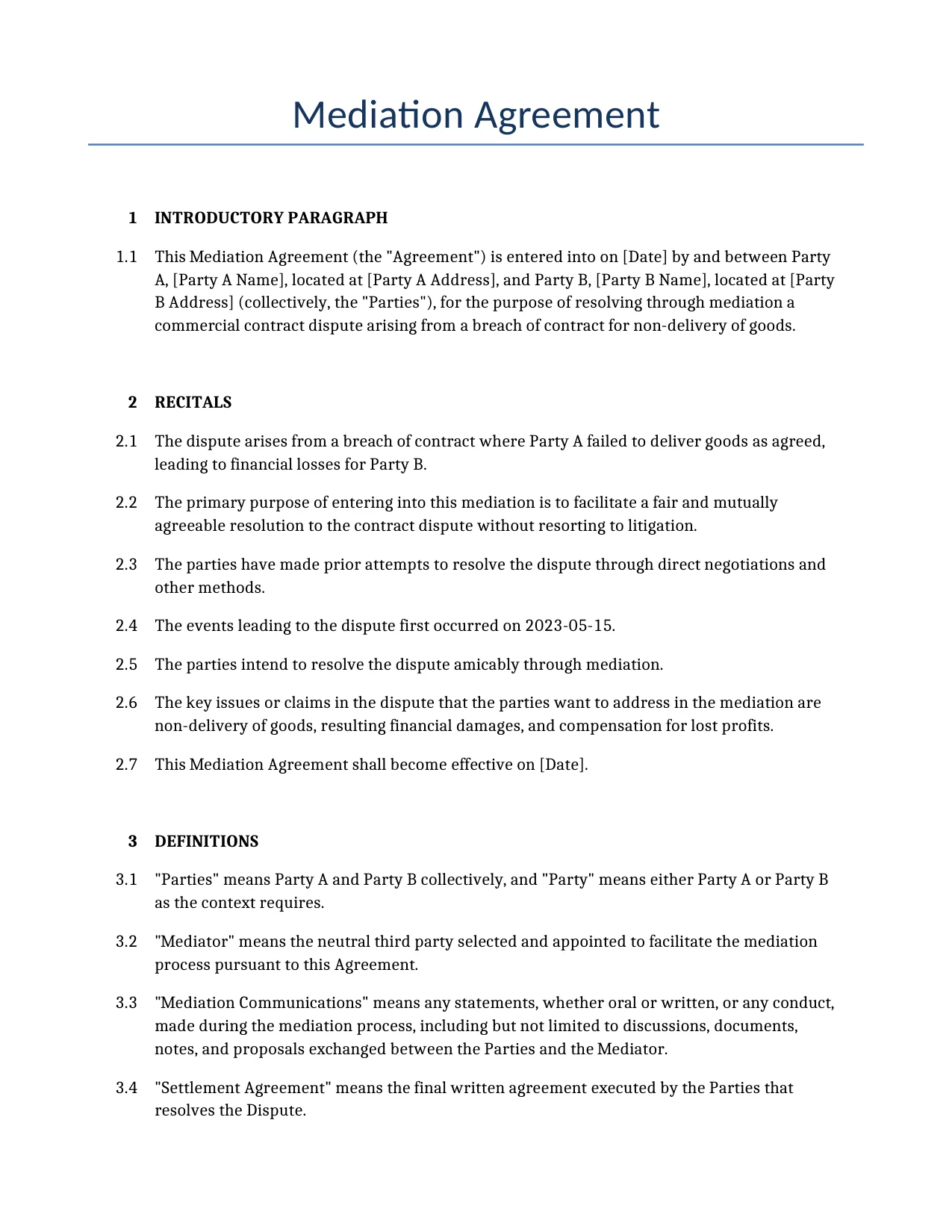
Mediation Agreement
1INTRODUCTORY PARAGRAPH
This Mediation Agreement (the "Agreement") is entered into on [Date] by and between Party A, [Party A Name], located at [Party A Address], and Party B, [Party B Name], located at [Party B Address] (collectively, the "Parties"), for the purpose of resolving through mediation a commercial contract dispute arising from a breach of contract for non-delivery of goods.
2RECITALS
The dispute arises from a breach of contract where Party A failed to deliver goods as agreed, leading to financial losses for Party B.
The primary purpose of entering into this mediation is to facilitate a fair and mutually agreeable resolution to the contract dispute without resorting to litigation.
The parties have made prior attempts to resolve the dispute through direct negotiations and other methods.
The events leading to the dispute first occurred on 2023-05-15.
The parties intend to resolve the dispute amicably through mediation.
The key issues or claims in the dispute that the parties want to address in the mediation are non-delivery of goods, resulting financial damages, and compensation for lost profits.
This Mediation Agreement shall become effective on [Date].
3DEFINITIONS
"Parties" means Party A and Party B collectively, and "Party" means either Party A or Party B as the context requires.
"Mediator" means the neutral third party selected and appointed to facilitate the mediation process pursuant to this Agreement.
"Mediation Communications" means any statements, whether oral or written, or any conduct, made during the mediation process, including but not limited to discussions, documents, notes, and proposals exchanged between the Parties and the Mediator.
"Settlement Agreement" means the final written agreement executed by the Parties that resolves the Dispute.
"Dispute" means the commercial contract dispute between the Parties arising from Party A\’s alleged breach by non-delivery of goods as described in the Recitals.
4MEDIATOR SELECTION AND APPOINTMENT
The mediator shall be selected by mutual agreement of the Parties. If the Parties cannot agree on a mediator within 14 days of the effective date of this Agreement, the mediator shall be appointed by the American Arbitration Association (AAA) pursuant to its Commercial Mediation Procedures.
The mediator must be a certified neutral with at least 10 years of experience in commercial contract mediation and hold a law degree from an accredited U.S. institution.
The mediator shall disclose any potential conflicts of interest prior to appointment.
If no preferred mediator is agreed upon, the mediator shall be selected by the American Arbitration Association (AAA) as the appointing authority pursuant to its rules.
The selected mediator shall confirm their acceptance of the appointment in writing to both Parties prior to the commencement of the mediation process.
5MEDIATION PROCESS
The initial mediation session shall last 2 hours.
The maximum number of mediation sessions allowed is 5.
The mediation process shall start by [Date].
The parties prefer that the mediation sessions be conducted in virtual format.
Each party makes full commitment to attend all scheduled mediation sessions.
Caucuses or separate sessions shall be allowed during mediation.
Subsequent mediation sessions shall be scheduled by mutual agreement of the Parties and the Mediator, taking into account the availability of all participants and the progress made in prior sessions.
During mediation sessions, the Parties shall act in good faith, participate respectfully, avoid interruptions, and follow any procedural rules established by the Mediator.
At the conclusion of each session, the Mediator shall document any agreements reached, progress made, or outstanding issues in a written summary to be provided to both Parties, without binding either Party unless incorporated into a final Settlement Agreement.
6CONFIDENTIALITY
All mediation communications shall be kept strictly confidential, except as provided in this Section or as required by law.
Each party agrees to maintain the confidentiality of all communications, documents, and information shared during the mediation.
Exceptions to confidentiality include legally required disclosures (such as under court order or subpoena), disclosures necessary to prevent imminent harm or threats of violence, disclosures to enforce or confirm a Settlement Agreement, and disclosures to legal or financial advisors bound by similar confidentiality obligations.
Confidentiality obligations shall begin on the effective date of this Agreement and shall last indefinitely after the mediation concludes.
The confidentiality provisions are enforceable in court and are intended to be consistent with the Uniform Mediation Act as adopted in California and other applicable laws.
The scope of confidentiality that applies to the mediation process is all communications and documents, but does not extend to the final signed Settlement Agreement itself, which may be disclosed as necessary for enforcement.
All parties shall be bound by a confidentiality obligation regarding the mediation.
7PRIVILEGE
Mediation communications shall be protected under the Uniform Mediation Act, California Evidence Code \§\§ 1115-1128, and Federal Rule of Evidence 408, and shall be inadmissible in any subsequent judicial or arbitral proceeding except as otherwise provided by law.
The parties acknowledge that mediation privileges may have limitations, such as exceptions for fraud, duress, or threats of violence, under applicable U.S. and California laws.
The Mediator shall not be called as a witness in any subsequent proceeding concerning the Dispute or the mediation, and the Parties agree not to subpoena or compel the Mediator to produce records or testify regarding Mediation Communications.
This privilege and protection survives termination of the mediation and any subsequent litigation.
8COSTS AND FEES
The mediator\’s fees shall be shared equally (50/50) between the Parties.
The hourly rate for the mediator\’s fees is $250.
Each Party shall be responsible for its own legal fees, costs, and expenses incurred in connection with the mediation.
The Parties shall each deposit an equal share of the estimated mediator fees and administrative costs with the Mediator or the appointing authority (AAA) prior to the commencement of the first mediation session. Any unused portion of the deposit shall be refunded proportionally at the conclusion of the mediation.
All costs and fees shall be paid within 30 days of receipt of an invoice from the Mediator. In the event one Party fails to pay its share, the other Party may advance the unpaid amount, which shall then become due and payable by the non-paying Party, with the non-paying Party responsible for any additional collection costs.
9MEDIATION FEES AND EXPENSES
In addition to mediator fees, the Parties shall equally share any venue costs (if in-person sessions are used), reasonable travel expenses of the Mediator, and other out-of-pocket expenses approved in advance by both Parties.
If one Party fails to pay its share of any fees or expenses, the mediation may be suspended until payment is made, and the non-paying Party shall be responsible for any resulting delay or additional costs.
10TERMINATION OF MEDIATION
Either Party may terminate the mediation at any time by providing 5 business days\’ written notice to the other Party and the Mediator.
Notice of termination shall be provided in writing via email or certified mail to the addresses specified in the Notices section.
The mediation may also be terminated by mutual written agreement of the Parties, declaration of impasse by the Mediator, or expiration of any agreed time limit.
Upon termination, any partial agreements or commitments made during mediation are non-binding unless incorporated into a signed Settlement Agreement. Confidentiality and privilege provisions survive termination.
After termination, the Parties may pursue litigation or other remedies, subject to the no-admission-of-liability provision.
11AGREEMENT TO MEDIATE
Party A, [Party A Name], and Party B, [Party B Name], commit to participating in the mediation process in good faith, with an open mind and a sincere effort to resolve the Dispute amicably.
The Parties acknowledge that the mediation process is non-binding until a Settlement Agreement is reached and signed in writing. This Agreement to mediate is binding with respect to confidentiality, privilege, and related obligations.
12REPRESENTATION
Party A is represented by an attorney in this mediation.
Party B [is/is not] represented by an attorney in this mediation.
Attorneys, if participating, shall play an advisory and review role in the mediation process.
Each Party is advised to seek independent legal counsel regarding this Agreement and the mediation process. By signing this Agreement, each Party confirms it has had the opportunity to consult with counsel of its choice.
13AUTHORITY TO SETTLE
Each Party represents that the individual signing this Agreement and participating in the mediation on its behalf has full authority to settle the Dispute on behalf of that Party, or will have a representative with such authority present at all mediation sessions.
If a representative is acting under a power of attorney or similar authority, a copy of the authorizing document shall be provided to the Mediator and the other Party prior to the first session.
14SETTLEMENT AGREEMENT
If the Parties reach a resolution, it shall be documented in a written Settlement Agreement prepared by the Mediator or the Parties\’ counsel, containing all material terms.
Placeholders for specific settlement terms: [e.g., Payment of $[Amount] by Party A to Party B by [Date]; Dismissal of claims; Other terms to be negotiated].
The Settlement Agreement shall be signed by both Parties and, if applicable, their counsel. It may include provisions for confidentiality of its terms and mutual non-disparagement.
The Settlement Agreement shall become effective upon execution by both Parties.
15RELEASE AND COVENANT NOT TO SUE
Upon execution of the final Settlement Agreement, each Party, on behalf of itself and its successors and assigns, hereby releases and forever discharges the other Party from any and all claims, demands, liabilities, or causes of action arising out of or related to the Dispute, except for obligations created by the Settlement Agreement itself.
Each Party covenants not to sue or commence any action or proceeding against the other Party with respect to the released claims. This release and covenant shall survive termination of the mediation or this Agreement.
16NO ADMISSION OF LIABILITY
Participation in this mediation does not constitute an admission of liability by either Party.
The scope of the no admission of liability clause covers participation, statements, and any proposals made during the mediation.
This provision applies symmetrically to both Party A and Party B and explicitly survives termination of the mediation or this Agreement and any subsequent litigation.
17GOVERNING LAW
This Mediation Agreement and all matters arising out of or relating to it shall be governed by the laws of the State of California without regard to its conflict of laws principles.
The Parties agree that this Agreement is consistent with the California Evidence Code \§\§ 1115-1128, the Uniform Mediation Act, and other applicable U.S. and California mediation statutes.
18DISPUTE RESOLUTION
Any disputes arising from or relating to this Mediation Agreement (other than disputes regarding the underlying Dispute or enforcement of a signed Settlement Agreement) shall first attempt resolution through negotiation, followed by court proceedings if necessary.
The Parties agree that any post-mediation disputes about the interpretation or enforcement of this Agreement or a Settlement Agreement shall be resolved in the state or federal courts located in Los Angeles County, California, which shall have exclusive jurisdiction and venue. The prevailing party in any such action shall be entitled to recover its reasonable attorneys\’ fees and costs.
19COMPLIANCE WITH APPLICABLE LAW
This Mediation Agreement shall comply with the Alternative Dispute Resolution Act of 1998, California Evidence Code \§\§ 1115-1128, and all other applicable federal and state laws.
All provisions of this Mediation Agreement are intended to be consistent with the requirements of U.S. and California law, including but not limited to the foregoing statutes and regulations as most recently amended.
20ENTIRE AGREEMENT
This Mediation Agreement constitutes the entire understanding between the parties and supersedes all prior agreements, whether written or oral, regarding the matters covered herein.
This Mediation Agreement can only be modified in writing signed by both parties.
21SEVERABILITY
If any provision of this Mediation Agreement is held to be invalid or unenforceable, the remaining provisions shall remain in full force and effect.
The laws of the State of California shall govern the severability provision in this Mediation Agreement.
22WAIVER
The failure of any party to enforce any provision of this Mediation Agreement shall not constitute a waiver of that party\’s right to enforce such provision or any other provision in the future.
23AMENDMENTS
Any changes to this Mediation Agreement must be made in writing.
Any written changes to this Mediation Agreement must be signed by all parties.
24NOTICES
The preferred method for receiving formal notices under this Mediation Agreement is email.
The address that should be used for delivering formal notices by mail under this Mediation Agreement is the address provided for each Party in the introductory paragraph or such other address as a Party may designate by notice.
The methods of delivery for formal notices consented to under this Mediation Agreement are certified mail, email, and overnight courier.
Notices shall be deemed delivered three days after mailing under this Mediation Agreement.
25COUNTERPARTS
This Mediation Agreement may be executed in multiple counterparts, each of which shall be deemed an original.
The counterparts may be executed using electronic signatures.
26ASSIGNMENT
The assignment of rights and obligations under this Mediation Agreement is prohibited without the prior written consent of the other Party.
27FORCE MAJEURE
Neither party shall be liable for any delay or failure to perform its obligations under this Mediation Agreement if such delay or failure is caused by natural disasters, acts of war or terrorism, pandemics or epidemics, or other events beyond the reasonable control of the affected party.
The affected party shall provide prompt notice of any force majeure event to the other party.
The affected party shall make reasonable efforts to mitigate the effects of any force majeure event.
28SIGNATURES
IN WITNESS WHEREOF, the parties have executed this Mediation Agreement as of the date first above written.
Party A: _______________________________ Date: _______________
Party B: _______________________________ Date: _______________
Mediator: _______________________________ Date: _______________
29EXHIBITS
Exhibit A: Detailed Settlement Terms (to be completed if agreement is reached).
Exhibit B: Mediator\’s Resume and Qualifications.
Exhibit C: Power of Attorney or Authorization Documents (if applicable).
This example shows approximately 70% of a typical document and is provided for illustrative purposes only. The remaining content has been omitted.
Every document generated by Docaro is tailored to your specific circumstances, jurisdiction and the information you provide. The completed document includes all applicable clauses and provisions required for your situation.
To generate the full, personalised document, answer a short series of questions and your document will be created instantly.