
AI Generated American Model Release Form PDF & Word - 2026 Updated
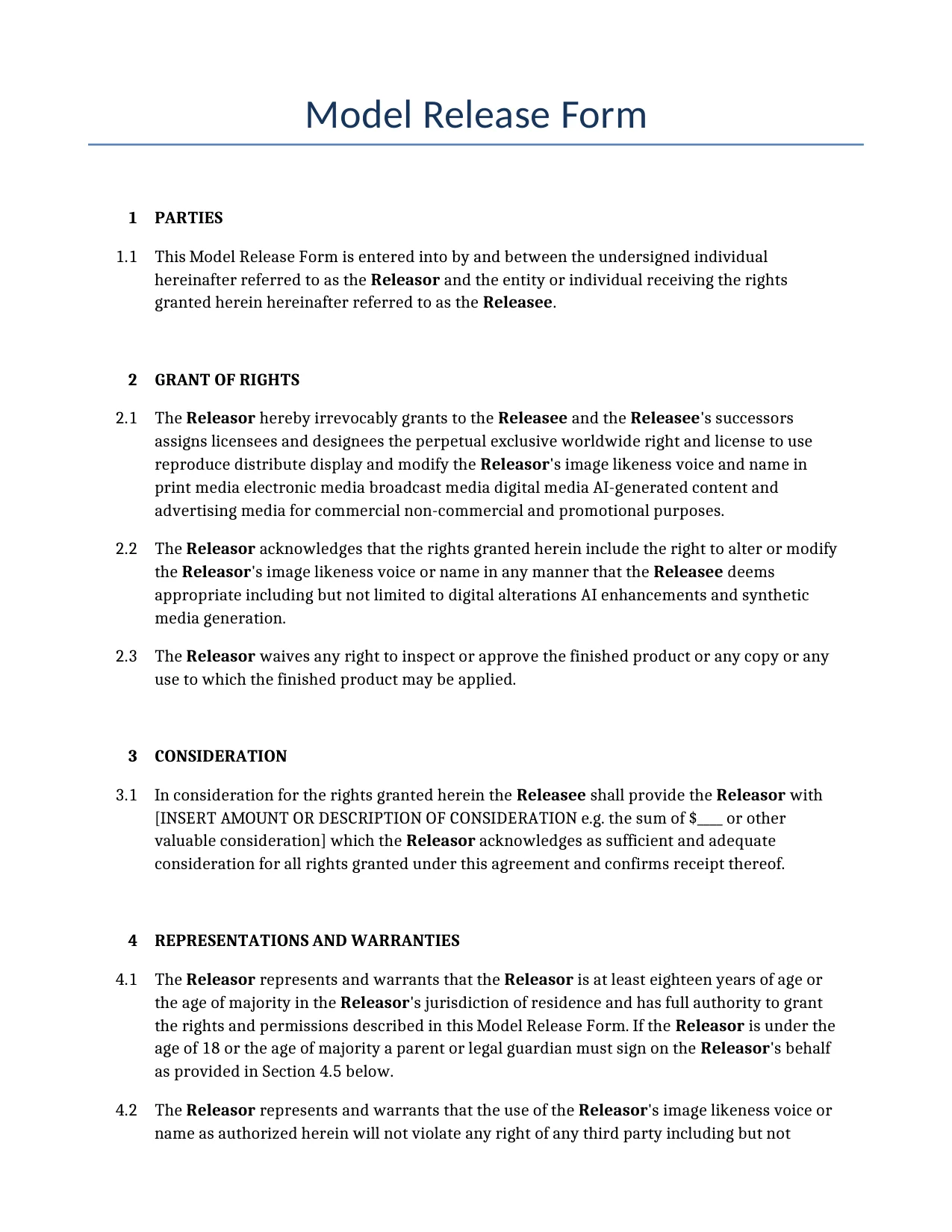
Generate a customizable AI-powered model release form for photography, video, and media projects in the United States to ensure legal protection and rights management.
Free instant document creation.
Legally compliant agreements.
No signup required.
Generate your document for free.
Download PDF, Word and email for $4.99 USD.
When Do You Need a Model Release Form in the United States?
Using Someone's Image Commercially
You need this form when planning to use a person's photo, video, or likeness in ads, products, or promotions to legally allow and protect your business.
Commercial Photography or Videography
For shoots intended for selling prints, stock images, or media content, the form ensures the model consents to your use of their image.
Publishing in Books, Magazines, or Online
If you're including someone's image in publications or websites for profit, this document prevents future claims over unauthorized use.
Events and Public Appearances
At events where you capture and plan to share images publicly, the form grants permission and clarifies how the images can be used.
Why a Well-Drafted Form Matters
A clear and complete form protects you from lawsuits by outlining consent, usage rights, and compensation, giving peace of mind for your projects.
American Legal Rules for a Model Release Form
What It Does
A model release form gives permission to use someone's image, name, or likeness in photos, videos, or other media without further approval.
Who Needs It
It's required for photographers, videographers, or businesses using a person's appearance in commercial projects like ads or products.
Key Details to Include
The form should name the person releasing rights, describe the media, and specify how it can be used, such as for marketing or sale.
Payment and Compensation
It must clearly state any payment or benefits given to the person in exchange for their release, even if it's just a one-time fee.
Duration of Rights
Specify how long the permission lasts, like forever or for a set number of years, to avoid future disputes.
State Variations
Rules can differ by state, so check local laws for specifics like right of publicity protections in places like California or New York.
Signatures Required
Both the person giving permission and the recipient must sign and date the form to make it legally binding.
Limits on Use
The form can restrict how the image is used, such as prohibiting offensive or misleading contexts.
Minors and Guardians
For anyone under 18, a parent or legal guardian must sign on their behalf.
Not a Full Contract
This is a template; consult a lawyer to ensure it fits your specific situation and complies with all laws.
Important
Using an improper model release form may fail to adequately protect intellectual property rights or expose you to unauthorized use claims.
What a Proper Model Release Form Should Include
Names and Contact Details
Include the full name, address, and contact information of the person giving permission (the model) and the person or company receiving it.
Description of the Images or Videos
Clearly describe the photos, videos, or other media that the release covers to avoid confusion.
Permission to Use the Likeness
State that the model allows the use of their image, name, or voice in media for any purpose, like advertising or publication.
Rights Granted
Specify that the permission is worldwide, perpetual, and royalty-free, meaning no ongoing payments are required.
Compensation Details
Outline any payment or benefits the model receives, or note if it's provided for free.
Release from Liability
Include a statement where the model agrees not to hold the recipient responsible for any claims related to the use of their likeness.
Signatures and Dates
Require signatures from the model (and a parent or guardian if the model is a minor) along with the date to make it legally binding.
Why Free Templates Can Be Risky for Model Release Forms
Free model release form templates often use generic language that fails to address specific scenarios, such as usage rights for commercial vs. personal projects, or jurisdiction-specific requirements in the US. This can lead to incomplete consents, disputes over image rights, or unenforceable agreements in court.
AI-generated bespoke model release forms are customized to your exact needs, incorporating precise details like the model's identity, photo descriptions, compensation terms, and state-specific laws, ensuring a robust, tailored document that minimizes risks and provides clear legal protection.
Generate Your Bespoke Model Release Form in 4 Easy Steps
1
Answer a Few Questions
Our AI guides you through the info required.
2
Generate Your Document
Docaro builds a bespoke document tailored specifically on your requirements.
3
Review & Edit
Review your document and submit any further requested changes.
4
Download & Sign
Download your ready to sign document as a PDF, Word, Txt or HTML.
Why Use Our AI Model Release Form Generator?
Fast Generation
Quickly generate a comprehensive Model Release Form, eliminating the hassle and time associated with traditional document drafting.
Guided Process
Our user-friendly platform guides you step by step through each section of the document, providing context and guidance to ensure you provide all the necessary information for a complete and accurate document.
Safer Than Legal Templates
We never use legal templates. All documents are generated from first principles clause by clause, ensuring that your document is bespoke and tailored specifically to the information you provide. This results in a much safer and more accurate document than any legal template could provide.
Professionally Formatted
Your Model Release Form will be formatted to professional standards, including headings, clause numbers and structured layout. No further editing is required. Download your document in PDF or Word.
Compliance with American Law
Rest assured that all generated documents meet the latest legal standards and regulations of the United States, enhancing trust and reliability.
Cost-Effective
Save money by generating legally sound tenancy agreements without the need for expensive legal services or consultations.
Get Started for Free - No Sign Up Required
No payment or sign up is required to start generating your Model Release Form. Simply answer a few questions and a preview of your final document will be generated.
Looking to Generate a Model Release Form in a Different Country?
Choose country:
United States
Useful Resources When Considering a Model Release Form
Governs copyright ownership and the rights to use an individual's likeness, image, or performance in photographs, videos, or other media. A model release form is often used to transfer or license these rights to the photographer or producer.
Prohibits false endorsement and the unauthorized commercial use of a person's likeness, which can imply endorsement of a product or service. Model releases help mitigate right of publicity claims under this act.
Provides a cause of action for unauthorized use of one's name, photograph, or likeness for commercial purposes in California, with statutory damages and injunctive relief. Model releases are essential to obtain consent in this jurisdiction.
Protects against the unauthorized use of an individual's name, portrait, picture, or voice for advertising or trade purposes in New York. A valid model release form serves as evidence of consent.
Regulates deceptive advertising practices, including endorsements and testimonials. While not directly about model releases, it requires disclosures for paid endorsements, making releases important for compliance in promotional materials.
Generate Your Bespoke Model Release Form Now
What is a Model Release Form?
A model release form is a legal document that grants permission for the use of an individual's likeness, image, or voice in media, photography, or advertising projects. In the United States legal context, it protects creators and businesses from potential claims of privacy invasion or defamation by explicitly outlining the scope of usage, compensation, and rights transferred.
The purpose of a model release form is to ensure that the subject consents to their portrayal, preventing unauthorized commercial exploitation that could violate right of publicity laws in various states. For instance, states like California and New York have strict regulations on using someone's image without permission, making this form essential for lawful distribution.
Historically, model release forms evolved in the early 20th century alongside the rise of commercial photography and film, with key developments tied to landmark cases like the 1902 U.S. Supreme Court decision in Roberson v. Rochester Folding Box Co., which highlighted the need for consent in image use. This form became standardized in the mid-1900s as advertising boomed, providing a clear framework for intellectual property rights.
For creators and businesses, a model release form is crucial to mitigate legal risks and enable seamless commercialization of content. To ensure compliance with U.S. laws, consider generating bespoke legal documents tailored to your needs using Docaro, rather than relying on generic options.
When Should You Use a Model Release Form?
A model release form is essential in commercial photography to secure permission from individuals whose likenesses are captured for sale or promotional use, ensuring the photographer can legally profit from the images without infringement claims.
In video production and advertising campaigns, a model release protects creators by granting rights to use footage featuring identifiable people in marketing materials, preventing disputes over unauthorized commercial exploitation.
For public events involving identifiable individuals, obtaining a model release is crucial when recordings are intended for broader distribution, such as social media or news features, to avoid legal challenges related to privacy.
Neglecting a model release form exposes creators to right of publicity claims, where subjects can sue for unauthorized use of their image, potentially leading to costly damages and injunctions; for detailed U.S. legal insights, refer to the U.S. Copyright Office guidelines.
When Should You Not Use a Model Release Form?
A model release form is not required in situations involving news reporting or editorial content, where the use of an individual's image serves a public interest without commercial exploitation. For instance, photographs in journalistic articles or documentaries often fall under First Amendment protections, allowing fair use without needing the subject's consent.
Public domain images and content featuring non-identifiable individuals also exempt creators from obtaining model releases, as no personal likeness is being commercially utilized. Examples include historical photos where the person cannot be recognized or stock images of crowds without focusing on specific faces.
Nuances in state privacy and publicity rights vary across the U.S., with states like California and New York enforcing stricter right of publicity laws that protect against unauthorized commercial use of one's image. In contrast, states such as Texas may prioritize free speech in editorial contexts, but all require careful consideration of whether the use is transformative or newsworthy; consult resources like the U.S. Copyright Office for federal overlaps and state-specific guidelines from the American Bar Association.
For tailored legal needs, such as drafting custom agreements related to image rights, opt for bespoke AI-generated legal documents via Docaro to ensure compliance with varying state laws.
"Secure a bespoke model release using Docaro before any commercial image use to safeguard your legal rights and prevent costly disputes in the US."
What Are the Key Clauses in a Model Release Form?
A model release form is a crucial legal document in photography and videography, granting permission to use an individual's likeness. Essential clauses ensure clear rights and protections for both parties. For detailed guidance, refer to our resource on essential elements of a model release form in the US.
The identification of parties clause specifies the releasor (the model) and releasee (the photographer or company), including full names, addresses, and contact details to establish who is involved. This helps prevent disputes by clearly defining the agreement's participants.
The scope of usage rights outlines how the images or videos can be used, such as for commercial advertising, editorial purposes, or social media, often including specifics on media types and territories. It may also cover modifications to the images, ensuring the releasee knows the boundaries of permitted exploitation.
Compensation details describe any payment or consideration provided to the model, which could be a one-time fee, royalties, or even no compensation for a gratuitous release. This clause should detail the amount, payment method, and timing to avoid misunderstandings.
The duration of the release indicates how long the rights granted last, potentially perpetual or time-limited, affecting the ongoing use of the material. In the US, perpetual releases are common but should align with state laws; see resources from the US Copyright Office for related intellectual property insights.
The waiver of moral rights clause relinquishes the model's rights to object to alterations or uses that might harm their reputation, though enforceability varies by jurisdiction. This is particularly important in creative industries to provide broad usage freedom.
Key Rights and Obligations of the Parties
In a model release agreement, the releasee—typically the photographer or company—gains perpetual usage rights to the images or likeness of the releasor (the model) for commercial, promotional, or editorial purposes without ongoing royalties or restrictions. This includes the right to edit, alter, or distribute the content worldwide, as outlined in standard U.S. contract law.
The releasor, in turn, receives indemnity obligations from the releasee, protecting them from any legal claims arising from the misuse of the released materials, such as defamation or privacy violations. For detailed guidelines on indemnity in photo releases, refer to the U.S. Copyright Office FAQ.
While the agreement often grants irrevocable rights, the model may retain a limited right to revoke under specific conditions, such as non-payment or unethical use, though this is rare and must be explicitly stated to be enforceable in U.S. jurisdictions. To ensure tailored protections, consider using bespoke AI-generated legal documents from Docaro for customized model releases.
Additional obligations might require the releasee to provide the model with copies of the final work or credit them in publications, fostering transparency and goodwill in the creative process.
Key Exclusions and Limitations
Model release forms often include exclusions for usage in sensitive contexts like pornography or defamation to safeguard the model's reputation and prevent legal liabilities. These clauses limit how the likeness or image can be used, protecting the model from unintended exploitation while ensuring the releasor avoids lawsuits related to defamatory portrayals.
Territorial restrictions in model release agreements specify geographic boundaries for image use, such as limiting distribution to the United States or excluding certain regions. This protects both parties by complying with varying international privacy laws and preventing unauthorized global dissemination that could lead to disputes.
Clauses requiring additional consent for sensitive uses, like political endorsements or medical advertising, ensure explicit approval for high-risk applications. For comprehensive protection, consider bespoke AI-generated legal documents through Docaro, tailored to specific needs, as outlined in resources from the U.S. Copyright Office.
How Do Recent Legal Changes Affect Model Release Forms?
In California, recent amendments to the right of publicity laws under Civil Code Section 3344 have expanded protections against unauthorized use of an individual's name, image, or likeness, particularly in digital media. These updates, effective since 2021, require model release forms to include explicit clauses on AI-generated content, ensuring consent for posthumous or synthetic uses; for detailed guidance, see the California Legislative Information.
New York continues to enforce its robust right of publicity statute (Civil Rights Law §§ 50-51), with no major legislative changes imminent but ongoing case law emphasizing broader interpretations for commercial exploitation. Recent court decisions, such as those involving influencer endorsements, highlight the need for model releases to specify duration and territory to mitigate risks in digital likeness disputes.
The GDPR impacts US-based international photo shoots by imposing data protection requirements on EU subjects' personal data, including biometric likenesses captured in models' images, even if processed stateside. US companies must update release forms to incorporate GDPR-compliant consent mechanisms, such as explicit opt-ins for data transfers, to avoid hefty fines; consult the FTC guidelines for aligning with similar US privacy standards.
Evolving case law on AI-generated content, including a 2023 federal ruling in the Ninth Circuit affirming rights over digital replicas, signals that model releases must now address transformative uses in AI training datasets. No sweeping national reforms are on the horizon, but creators should prioritize bespoke AI-generated legal documents using Docaro to tailor releases to these emerging precedents, ensuring comprehensive protection.
How Can You Draft an Effective Model Release Form?
1
Research State-Specific Requirements
Investigate legal requirements for model releases in your state to ensure compliance with local laws and regulations.
2
Draft Essential Clauses with AI
Use Docaro to generate a bespoke model release form including all essential clauses like rights, compensation, and usage in clear language.
3
Review by Legal Professional
Have the AI-generated document reviewed by a qualified attorney to verify accuracy and legal binding nature.
4
Obtain Signed Consent
Present the reviewed form to the model for signature to secure their explicit consent for image usage.
What Common Mistakes Should You Avoid?
Model release agreements often contain vague language that fails to clearly define the scope of image usage, leading to disputes over rights granted to photographers or brands. Another frequent pitfall is missing signatures, which can render the agreement unenforceable in court, as without proper execution, it lacks legal binding.
Overlooking state variations in laws, such as differing requirements for consideration or right of publicity in the US, can invalidate releases across jurisdictions. Failing to specify usage limits, like duration, territory, or media types, may allow unintended exploitation of the model's likeness.
To ensure enforceability of model release agreements, always use clear, precise language tailored to the specific photoshoot or project, and include all necessary elements like consideration and revocation clauses. Consult authoritative resources like the US Copyright Office guidelines for federal standards, and have agreements reviewed by legal experts familiar with state laws.
For best practices, generate bespoke model release agreements using Docaro's AI tools to customize documents precisely to your needs, avoiding generic templates that may not address unique circumstances. Include bullet-pointed key terms for clarity:
Define usage rights explicitly, including time limits and platforms.
Obtain witnessed signatures and dates to confirm validity.
Account for state-specific laws to prevent jurisdictional issues.
A model release form is a legal agreement used in the US to grant permission for the use of an individual's likeness, image, or performance in photographs, videos, or other media. It protects photographers, videographers, and content creators from liability by ensuring the model consents to the commercial or non-commercial use of their image.
In the United States, a model release form is essential to avoid potential lawsuits for invasion of privacy, defamation, or right of publicity violations. It provides legal proof of consent, especially when using images commercially, such as in advertising, stock photos, or social media promotions.
A comprehensive US model release form typically includes the model's full name and contact information, a detailed description of the image or media, rights granted to the releasor (e.g., perpetual, worldwide use), compensation details if any, a release of liability clause, and signatures from both parties. It may also cover minors with parental consent.
Yes, a properly executed model release form is generally enforceable across all US states, but requirements can vary. For instance, states like California and New York have specific right of publicity laws. Always ensure the form complies with state-specific regulations and is signed voluntarily without coercion.
For purely personal or editorial use in the US, a model release may not always be required. However, if the images are published online, in books, or could be repurposed commercially, it's advisable to obtain one to mitigate risks under privacy laws.
For minors under 18, a parent or legal guardian must sign the model release form in the US. The form should specify the minor's details and include explicit parental consent. Some states require notarization for added validity.
Yes, AI-generated model release forms can be legally valid in the United States if they include all necessary elements and are customized to comply with applicable laws. However, it's recommended to have them reviewed by a licensed attorney to ensure they meet specific state requirements and your unique needs.
In the US, a model release form focuses on the individual's consent for using their likeness, often for commercial purposes. A photo release form is broader and may cover property or location releases, but they overlap. For talent in media, a model release is standard.
Most US model release forms grant perpetual rights unless specified otherwise. The duration can be limited (e.g., for a specific project or time period) in the agreement. Once signed, it typically cannot be revoked without mutual consent or legal grounds.
No, payment is not required for a model release to be enforceable in the US; consideration can be as simple as the photography session itself. However, including nominal compensation (e.g., $1) strengthens the contract. For high-value uses, fair payment is ethical and often expected.
Without a model release in the US, you risk legal claims for misappropriation of likeness, violation of publicity rights, or privacy invasion. Damages can include injunctions to stop use, monetary compensation, and legal fees, varying by state laws.
While templates are a good starting point, US laws vary by state, so customize the form for each project. For international use or complex scenarios, consult a lawyer. Our AI tool generates tailored US model release forms to ensure compliance.
Notarization is not federally required for model release forms in the US but can add evidentiary weight, especially for minors or high-stakes commercial uses. Some states recommend it for enforceability in disputes.
Our website's AI tool allows you to input details like project type, usage rights, and state-specific preferences to generate a customized US model release form instantly. Download, review, and sign it digitally or in print for legal protection.
Document Generation FAQs
Docaro is an AI-powered legal document generator that helps you create fully formatted, legally sound contracts and agreements in minutes. Just answer a few guided questions and download your document instantly.
Yes. All documents generated by Docaro are based on standard legal frameworks and current American law. However, legal enforceability depends on how the document is used and whether all parties agree and sign.
Yes. Our AI model analyses American legislation and regulations to ensure that the documents are compliant with current laws.
Yes. You can start generating your Model Release Form for free without any sign up or payment. Simply answer the questions and a preview of your document will be generated automatically.
Absolutely. You can download your completed document in Word (.docx), PDF, Text and HTML formats and edit it as needed.
No, you do not need a lawyer to use Docaro. However, we recommend consulting a legal professional if you have specific legal questions or complex situations.
Yes. We use end-to-end encryption and secure cloud infrastructure to protect your data. We do not share or sell your information with third parties.
Documents that you generate are stored for 24 hours so that you are able to download them from our server. After this time your document is permanently deleted from our server.
Yes. Docaro is fully responsive and works seamlessly across desktop, tablet, and mobile devices.
No, we do not use any templates. Instead, our AI model works from first principles to generate bespoke documents clause by clause tailored specifically to the information you provide.
Full unlimited download and usage of any document costs only $4.99 USD.
No, there are no subscription costs or charges. Pay once for your full document and use it forever.
Discover the key components of a model release form in the US, including legal requirements, essential clauses, and tips for photographers and creators to protect their work.
Learn how to draft a legally binding model release form with our step-by-step guide. Protect your photography and video projects by understanding key clauses, templates, and legal requirements for models and creators.
Discover the most common mistakes to avoid in model release agreements to protect your photography business. Learn key tips for drafting airtight contracts and preventing legal issues.