
AI Generated Diversity, Equity, and Inclusion Policy for use in the United States
PDF & Word - 2026 Updated
Docaro Pricing
When do you need a Diversity, Equity, and Inclusion Policy in the United States?
American Legal Rules for a Diversity, Equity, and Inclusion Policy
Failing to tailor the DEI policy to your organization's specific industry, size, and legal obligations may result in non-compliance with applicable federal and state regulations.
What a Proper Diversity, Equity, and Inclusion Policy Should Include
- Commitment StatementA clear pledge from leadership to foster an inclusive workplace where everyone feels valued and respected.
- Non-Discrimination RuleA promise not to treat people unfairly based on race, gender, age, disability, or other personal traits.
- Equal OpportunityEnsuring all employees have fair access to jobs, promotions, and training regardless of background.
- Accommodation SupportProviding reasonable adjustments for employees with disabilities or specific needs to help them succeed.
- Inclusive CulturePromoting a welcoming environment through training, team activities, and open communication.
- Reporting MechanismA safe way for employees to report bias or unfair treatment without fear of retaliation.
- Accountability MeasuresTracking progress on DEI goals and holding leaders responsible for creating positive change.
Generate Your Document in 4 Easy Steps
Why Use Docaro?
 United States
Free Example Diversity, Equity, and Inclusion Policy Template
Below is a free template example of a Diversity, Equity, and Inclusion Policy for use in the United States generated by our AI model.
The clauses in your actual Diversity, Equity, and Inclusion Policy will vary from this example as they will be entirely bespoke to your requirements as set out in the questionnaire you complete.
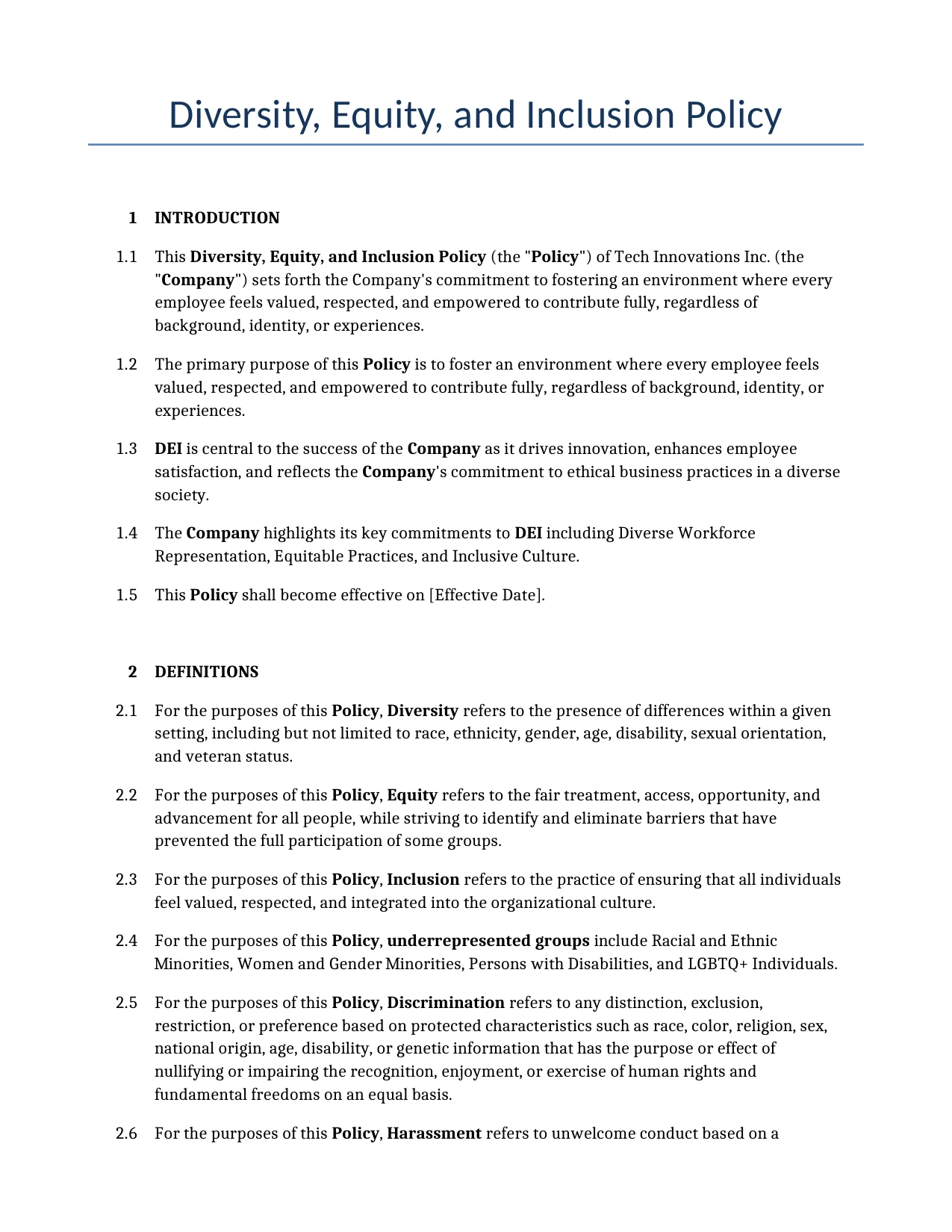
Diversity, Equity, and Inclusion Policy
1INTRODUCTION
This Diversity, Equity, and Inclusion Policy (the "Policy") of Tech Innovations Inc. (the "Company") sets forth the Company's commitment to fostering an environment where every employee feels valued, respected, and empowered to contribute fully, regardless of background, identity, or experiences.
The primary purpose of this Policy is to foster an environment where every employee feels valued, respected, and empowered to contribute fully, regardless of background, identity, or experiences.
DEI is central to the success of the Company as it drives innovation, enhances employee satisfaction, and reflects the Company's commitment to ethical business practices in a diverse society.
The Company highlights its key commitments to DEI including Diverse Workforce Representation, Equitable Practices, and Inclusive Culture.
This Policy shall become effective on [Effective Date].
2DEFINITIONS
For the purposes of this Policy, Diversity refers to the presence of differences within a given setting, including but not limited to race, ethnicity, gender, age, disability, sexual orientation, and veteran status.
For the purposes of this Policy, Equity refers to the fair treatment, access, opportunity, and advancement for all people, while striving to identify and eliminate barriers that have prevented the full participation of some groups.
For the purposes of this Policy, Inclusion refers to the practice of ensuring that all individuals feel valued, respected, and integrated into the organizational culture.
For the purposes of this Policy, underrepresented groups include Racial and Ethnic Minorities, Women and Gender Minorities, Persons with Disabilities, and LGBTQ+ Individuals.
For the purposes of this Policy, Discrimination refers to any distinction, exclusion, restriction, or preference based on protected characteristics such as race, color, religion, sex, national origin, age, disability, or genetic information that has the purpose or effect of nullifying or impairing the recognition, enjoyment, or exercise of human rights and fundamental freedoms on an equal basis.
For the purposes of this Policy, Harassment refers to unwelcome conduct based on a protected characteristic that is so severe or pervasive that it creates an intimidating, hostile, or abusive work environment or unreasonably interferes with an individual's work performance.
For the purposes of this Policy, Protected Characteristics are those categories protected under federal, state, or local law, including but not limited to race, color, religion, sex (including pregnancy, childbirth, and related medical conditions), national origin, age (40 and over), disability, genetic information, sexual orientation, gender identity, veteran status, and any other characteristic protected by applicable law, in accordance with EEOC guidelines and relevant statutes.
For the purposes of this Policy, Retaliation is any adverse action taken against an individual because they have engaged in protected activity, such as reporting discrimination, participating in an investigation, or requesting an accommodation. This includes actions like termination, demotion, harassment, or any other negative treatment that would dissuade a reasonable person from making a complaint, consistent with EEOC standards.
For the purposes of this Policy, Reasonable Accommodation refers to a modification or adjustment to a job, work environment, or application process that enables a qualified individual with a disability to perform essential job functions or enjoy equal employment opportunities, or accommodations for sincerely held religious beliefs or practices, unless doing so would cause undue hardship. This aligns with the ADA and Title VII standards, involving an interactive process between the employer and employee.
3SCOPE AND APPLICABILITY
This Policy applies to all employees of the Company, including full-time, part-time, temporary, and remote workers.
This Policy applies to all contractors of the Company.
This Policy applies to all volunteers of the Company.
This Policy applies to all board members of the Company.
This Policy applies to applicants, interns, and visitors where relevant for anti-discrimination purposes and shall be governed by and construed in accordance with the laws of the United States and the applicable laws of the states in which the Company operates.
4POLICY STATEMENT
The core mission of the Company is to innovate sustainable solutions that empower communities worldwide, fostering growth through collaboration and ethical practices.
Diversity in this Policy is defined broadly to include race, ethnicity, gender, age, disability, sexual orientation, and veteran status.
The Company commits to Equity by providing fair treatment and access to opportunities for all employees.
The Company commits to Inclusion by ensuring that all employees feel valued and integrated into the workplace.
Leadership of the Company demonstrates a strong commitment by actively championing and modeling DEI behaviors.
This Policy Statement shall become effective on [Effective Date].
5COMMITMENT TO CONTINUOUS IMPROVEMENT
The Company is committed to the ongoing assessment and enhancement of its DEI efforts to ensure they remain effective and aligned with best practices.
The Company will regularly benchmark its DEI initiatives against industry standards and solicit feedback from employees through surveys, focus groups, and other mechanisms.
Based on this feedback and analysis, the Company will update its DEI strategies as needed to promote continuous improvement and measurable progress.
This section shall become effective on [Effective Date].
6NON-DISCRIMINATION AND ANTI-HARASSMENT
The Company prohibits discrimination and harassment based on the protected characteristics of Race, Color, Religion, Sex, National Origin, Age, and Disability in compliance with the Civil Rights Act of 1964, the Age Discrimination in Employment Act of 1967 (ADEA), the Americans with Disabilities Act of 1990 (ADA), the Pregnancy Discrimination Act of 1978, and the Genetic Information Nondiscrimination Act of 2008 (GINA).
The Company includes references to state-specific protected characteristics beyond federal requirements in this Policy. The Company will comply with additional state and local protections, which may include characteristics such as marital status, political affiliation, or other categories that vary by jurisdiction. The Company commits to consulting applicable local laws to ensure full compliance.
This Policy explicitly covers all employees, including part-time, temporary, and remote workers.
The prohibitions in this Policy extend to third parties such as contractors, vendors, or clients interacting with the Company.
The Company prohibits discrimination based on pregnancy, childbirth, or related medical conditions in accordance with the Pregnant Workers Fairness Act (PWFA) and the PUMP for Nursing Mothers Act. This includes providing reasonable accommodations for such conditions unless they cause undue hardship.
Employees may report discrimination or harassment to the HR Department, an Anonymous Hotline, or a Direct Supervisor.
The Company maintains a strong prohibition against retaliation for reporting or participating in investigations of discrimination or harassment.
7LEGAL COMPLIANCE
This Policy is intended to comply with all applicable federal, state, and local laws, including but not limited to Title VII of the Civil Rights Act of 1964, the Fair Labor Standards Act (to the extent applicable), Executive Order 11246 (for federal contractors), the Americans with Disabilities Act (ADA), the Age Discrimination in Employment Act (ADEA), and other relevant statutes.
The Company will update this Policy as necessary to reflect changes in laws and regulations.
This section shall become effective on [Effective Date].
8EQUAL EMPLOYMENT OPPORTUNITY
The Company affirms that it prohibits discrimination based on protected characteristics in all aspects of employment.
The Company explicitly lists the prohibited bases for discrimination as Race and Color, Religion, Sex and Gender Identity, National Origin, Age, Disability, Genetic Information, and Citizenship Status.
The Company is committed to providing equal employment opportunities to all qualified individuals without regard to race, color, religion, sex, national origin, age, disability, or any other protected characteristic.
The Company strives to create an inclusive workplace where every employee can thrive.
9ACCOMMODATION FOR DISABILITIES AND RELIGIOUS BELIEFS
Employees may submit accommodation requests in writing via email to hr@company.com or verbally during a meeting with their supervisor. The Company will engage in an interactive process with the employee to determine appropriate accommodations, in alignment with ADA and Title VII standards.
The Human Resources Department is designated as the responsible department for receiving accommodation requests.
The Company will not require medical certification or religious statements beyond what is necessary and will not make unnecessary medical inquiries, consistent with legal standards.
The Company mandates an interactive process for discussing accommodation requests with employees and will provide timely responses in accordance with applicable law.
Examples of reasonable accommodations may include modified work schedules, adjusted workstations, or reassignment of non-essential functions, depending on the individual circumstances.
The Company assures confidentiality of all accommodation request information.
Undue hardship will be assessed based on significant difficulty or expense, considering the Company's size, financial resources, and the impact on operations.
This accommodation policy shall become effective on [Effective Date].
10DEI GOALS AND OBJECTIVES
The Company is committed to increasing the representation of underrepresented groups in leadership positions through lawful, merit-based strategies that foster a more diverse and innovative organizational culture. These goals are aspirational, do not create quotas, and will not result in reverse discrimination or preferential treatment that violates US anti-discrimination laws.
All employment decisions, including hiring, promotion, and compensation, will be based on merit, qualifications, and business needs, with safeguards to prevent any form of discrimination.
The Company focuses on Women, Racial and Ethnic Minorities, and LGBTQ+ Individuals for increasing representation through inclusive practices.
The Company outlines strategies for promoting equity including implementing bias training for hiring managers, establishing mentorship programs for underrepresented employees, and conducting regular pay equity analyses.
The Company requires regular equity audits for compensation and promotions.
The Company implements initiatives for enhancing inclusion including launching employee resource groups, providing inclusive leadership training, and creating safe spaces for open discussions on diversity issues.
The Company shall review and update the DEI goals and objectives by [Review Date].
The Company uses Employee Demographics Surveys, Retention Rates by Group, and Promotion and Pay Equity Data as metrics for measuring the success of DEI goals. These goals are intended to promote diversity while ensuring compliance with all anti-discrimination laws and do not guarantee specific outcomes for individuals.
11RECRUITMENT AND HIRING PRACTICES
The Company includes specific guidelines on unbiased recruitment practices in this Policy.
The Company specifies measures for equal access to promotions in this Policy.
The Company uses Regular Pay Audits and Transparent Pay Scales as tools or methods for ensuring compensation equity.
The Company addresses fair and non-discriminatory termination procedures in this Policy.
The Company partners with diverse professional organizations, attends job fairs targeted at underrepresented groups, and uses targeted advertising on platforms that reach minority candidates to build a diverse applicant pool as strategies for diverse sourcing in recruitment.
The Company enables blind resume screening to remove identifying information during the initial review process.
Interview panels shall have a Diverse Gender Mix, Racial and Ethnic Diversity, and Cross-Departmental Members to ensure diversity and reduce bias.
The Company requires the use of structured interview questions for all hiring processes.
All hiring managers and interviewers undergo annual unconscious bias training, which includes workshops on recognizing implicit biases, case studies, and role-playing exercises to practice fair evaluation techniques.
These recruitment and hiring practices shall be implemented on [Effective Date].
The Company tracks Diverse Applicant Pool Percentage, Offer Acceptance Rates by Demographic, and Time to Hire for Diverse Candidates as metrics for inclusive hiring processes.
12TRAINING AND EDUCATION
The Company mandates DEI training programs for all employees in this Policy.
The Company includes unconscious bias training as part of the mandated DEI programs.
The Company includes cultural competency training in the DEI programs.
The Company includes inclusive leadership training specifically for managers and executives.
The Company conducts the DEI training programs for employees annually.
The initial implementation of the DEI training programs shall occur on [Effective Date].
The Company uses Online Modules and Virtual Live Sessions as methods for delivering the DEI training programs.
The Company conducts EEO training annually.
13EMPLOYEE RESOURCE GROUPS (ERGS)
The Company explicitly supports the formation of Employee Resource Groups (ERGs) in this Policy.
The Company provides financial assistance or funding for ERG activities.
The Company supports Racial and Ethnic Minorities, LGBTQ+ Individuals, and Women and Gender Minorities through ERGs in this Policy.
ERGs must submit a formal charter outlining their purpose, goals, and membership criteria before approval.
The Company permits Educational Workshops, Networking Events, and Community Outreach as types of activities for ERGs under this Policy.
Membership in ERGs is open to all employees who identify with the group's focus or are allies supporting the group's mission, with no restrictions based on tenure or position.
14PERFORMANCE EVALUATION AND COMPENSATION
The Company incorporates specific DEI criteria into the performance evaluation process for employees.
The types of DEI criteria included in performance reviews are Diversity in Hiring Recommendations, Equity in Decision Making, and Inclusion Training Participation.
The Company incorporates DEI criteria in performance reviews during annually and mid-year reviews.
The Company explicitly ensures equitable pay practices across all employee levels.
The Company conducts regular pay audits every 12 months.
The pay audits cover All Employee Levels, Gender-Based Analysis, and Race and Ethnicity Review for equitable practices.
Upon identifying pay inequities, the HR team will conduct a thorough review, adjust salaries to ensure equity within 30 days, provide training to managers, and monitor progress quarterly.
15LEADERSHIP AND ACCOUNTABILITY
The CEO is responsible for promoting DEI initiatives throughout the Company.
The Board of Directors has oversight responsibility for reviewing and approving DEI policies.
The Company includes Representation Diversity and Training Completion Rates as DEI metrics in executive performance evaluations.
Senior leadership will champion DEI by integrating it into strategic planning, fostering an inclusive culture, and ensuring accountability through regular reporting.
Leadership shall conduct formal DEI progress reviews 4 times per year.
DEI performance metrics shall directly influence executive compensation decisions.
16REPORTING, INVESTIGATION, AND RESOLUTION PROCEDURES
Employees can report DEI-related concerns or violations through the HR department via email, in-person meetings, phone calls, an anonymous hotline, or an online portal for secure and anonymous submissions.
The Company explicitly states a policy prohibiting retaliation against individuals who report DEI concerns or violations in good faith. Retaliation will result in disciplinary action, up to and including termination of employment, depending on the severity of the violation. The Company strictly prohibits any form of retaliation against individuals who report discrimination or participate in investigations.
The Company initiates investigations of reported DEI concerns or complaints within 5 business days and aims to complete them within 30 days, unless circumstances require an extension. The HR Director or designated investigator (which may include an External Investigator for complex cases) will serve as the primary investigator.
The Company requires strict confidentiality for all parties involved in the reporting, investigation, and resolution process. The investigator will gather evidence by interviewing relevant parties, reviewing documents such as emails and records, and collecting any physical or digital materials pertinent to the complaint, ensuring all steps are documented.
Resolution options for addressing confirmed issues may include Mandatory Training, Mediation Session, Disciplinary Action (such as Verbal Warning, Suspension Without Pay, or Termination of Employment for major violations), or other appropriate measures. Minor violations may result in a Verbal Warning or Mandatory Training, while major violations may result in Suspension Without Pay or Termination of Employment.
The Company includes an appeal process for investigation outcomes or resolutions in this Policy. The Human Resources Department will oversee enforcement of the Diversity, Equity, and Inclusion Policy.
This section shall become effective on [Effective Date].
17MONITORING AND REPORTING
The Company prepares and publishes annual reports on DEI progress.
The Company tracks specific diversity metrics such as representation by gender, race, and ethnicity.
The Company includes Gender, Race and Ethnicity, and Age as categories of diversity metrics in the monitoring process.
The Company issues DEI progress reports every 12 months.
The Company conducts regular compliance audits for DEI policy adherence.
The Company conducts DEI compliance audits annually.
18DATA PRIVACY AND CONFIDENTIALITY
The Company is committed to protecting the privacy and confidentiality of all DEI-related data, including demographics, metrics, accommodation requests, and medical information collected under this Policy.
All such data will be handled securely, with access limited to authorized personnel, and used only for legitimate DEI and compliance purposes. The Company will obtain appropriate consent where required and comply with applicable privacy regulations, including the Health Insurance Portability and Accountability Act (HIPAA) for protected health information and state laws such as the California Consumer Privacy Act (CCPA).
Employees' personal information will not be disclosed without authorization, except as required by law or for legitimate business purposes.
This section shall become effective on [Effective Date].
19PARTNERSHIPS AND COMMUNITY ENGAGEMENT
The Company includes a commitment in this Policy to engage with diverse suppliers to advance equity externally.
The Company partners with community organizations focused on diversity and equity initiatives.
The Company prioritizes Minority-Owned Businesses, Women-Owned Businesses, and LGBTQ+-Owned Businesses as categories of diverse suppliers in its partnerships.
The Company aims to partner with local nonprofits focused on racial equity, women's empowerment programs, and LGBTQ+ advocacy groups to support educational workshops and mentorship opportunities in underserved communities.
The proposed start date for implementing the partnerships and community engagement initiatives is [Effective Date].
The Company uses Number of Partnerships Formed, Dollars Spent with Diverse Suppliers, and Community Impact Reports as metrics to measure the success of its partnerships and community engagement.
The Company requires an annual review of the partnerships and community engagement efforts.
20ACKNOWLEDGMENT
The acknowledgment section requires an electronic or physical signature from employees.
Employees must explicitly confirm their understanding of the Policy in addition to acknowledging receipt.
Employees must provide acknowledgment of the Diversity, Equity, and Inclusion Policy both annually and upon updates.
The effective date for the Diversity, Equity, and Inclusion Policy, after which acknowledgments will be required, is [Effective Date].
Employees who fail to provide timely acknowledgment of the Diversity, Equity, and Inclusion Policy shall receive a Written Warning.
21CONTACT INFORMATION
The designated Diversity, Equity, and Inclusion Officer is Dr. Maria Gonzalez.
The professional email address for the DEI Officer is maria.gonzalez@company.com.
The direct phone number for the DEI Officer is (555) 123-4567.
The primary HR contact for DEI support is John Smith.
The professional email address for the HR contact handling DEI is john.smith@company.com.
The direct phone number for the HR contact on DEI matters is (555) 987-6543.
Key resources available for further DEI information or support include the Internal DEI Portal at https://dei.company.com, the Employee Handbook Section 5: Equity Guidelines, and the Annual DEI Training Modules available via HR portal.
The contact information for DEI officers and HR is publicly disclosed in this Policy document.
22DISCLAIMERS
This Policy is not a contract of employment, does not create any new legal rights, and does not alter the at-will employment relationship where applicable. The Company reserves the right to modify, amend, or discontinue this Policy at any time, with or without notice. This Policy is intended to provide guidance and promote compliance with applicable laws but does not guarantee specific outcomes or create enforceable obligations beyond those required by law.
This section shall become effective on [Effective Date].
23SIGNATURE SECTION
By signing below, the employee acknowledges receipt and understanding of this Diversity, Equity, and Inclusion Policy and agrees to abide by its terms.
Employee Name: _______________________________
Employee Signature: _______________________________ Date: _______________
On behalf of Tech Innovations Inc.: _______________________________ Date: _______________
This example shows approximately 70% of a typical document and is provided for illustrative purposes only. The remaining content has been omitted.
Every document generated by Docaro is tailored to your specific circumstances, jurisdiction and the information you provide. The completed document includes all applicable clauses and provisions required for your situation.
To generate the full, personalised document, answer a short series of questions and your document will be created instantly.