
AI Generated American Business Purchase Agreement
PDF & Word - 2026 Updated
Docaro Pricing
When Do You Need an Asset Purchase Agreement in the United States?
American Legal Rules for an Asset Purchase Agreement
Using the wrong structure for a business sale agreement can expose you to unintended tax liabilities or regulatory violations.
What a Proper Asset Purchase Agreement Should Include
- Parties InvolvedClearly identifies the buyer and seller, including their full legal names and addresses.
- Assets Being SoldLists all items being transferred, such as equipment, inventory, or intellectual property.
- Purchase Price and Payment TermsSpecifies the total amount and how and when payments will be made.
- Representations and WarrantiesStates facts that both parties guarantee about the business and assets to build trust.
- Conditions to ClosingOutlines requirements that must be met before the deal is finalized.
- Closing ProceduresDetails the steps and timeline for completing the transaction.
- IndemnificationProtects parties by agreeing to cover losses from breaches or misrepresentations.
- Non-Compete and ConfidentialityRestricts the seller from competing and keeps sensitive information private.
- Governing LawSpecifies which state's laws apply to the agreement.
- SignaturesRequires signatures from authorized representatives to make the agreement binding.
Generate Your Document in 4 Easy Steps
Why Use Docaro?
 United States
Free Example Asset Purchase Agreement Template
Below is a free template example of a Asset Purchase Agreement for use in the United States generated by our AI model.
The clauses in your actual Asset Purchase Agreement will vary from this example as they will be entirely bespoke to your requirements as set out in the questionnaire you complete.
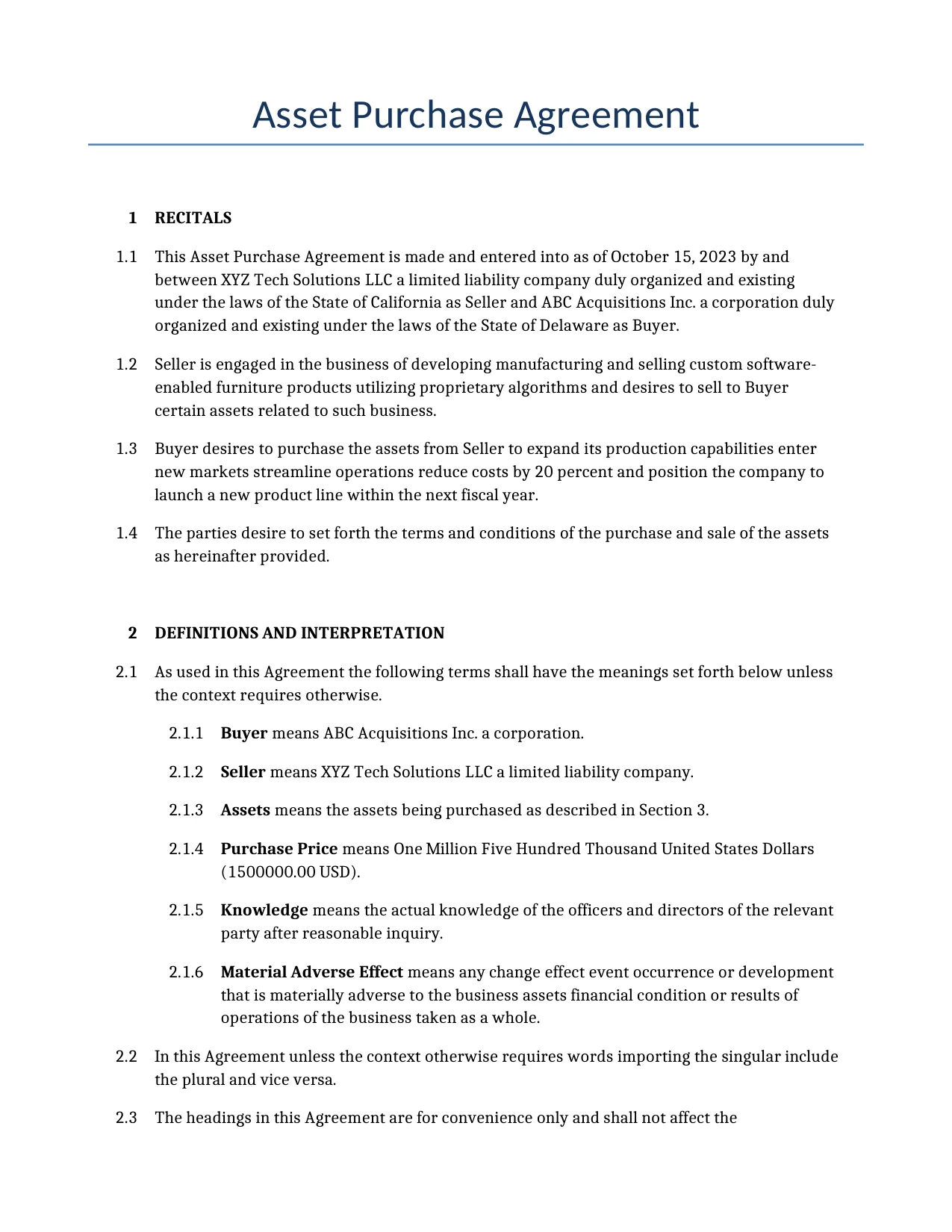
Asset Purchase Agreement
1RECITALS
This Asset Purchase Agreement is made and entered into as of October 15, 2023 by and between XYZ Tech Solutions LLC a limited liability company duly organized and existing under the laws of the State of California as Seller and ABC Acquisitions Inc. a corporation duly organized and existing under the laws of the State of Delaware as Buyer.
Seller is engaged in the business of developing manufacturing and selling custom software-enabled furniture products utilizing proprietary algorithms and desires to sell to Buyer certain assets related to such business.
Buyer desires to purchase the assets from Seller to expand its production capabilities enter new markets streamline operations reduce costs by 20 percent and position the company to launch a new product line within the next fiscal year.
The parties desire to set forth the terms and conditions of the purchase and sale of the assets as hereinafter provided.
2DEFINITIONS AND INTERPRETATION
As used in this Agreement the following terms shall have the meanings set forth below unless the context requires otherwise.
Buyer means ABC Acquisitions Inc. a corporation.
Seller means XYZ Tech Solutions LLC a limited liability company.
Assets means the assets being purchased as described in Section 3.
Purchase Price means One Million Five Hundred Thousand United States Dollars (1500000.00 USD).
Knowledge means the actual knowledge of the officers and directors of the relevant party after reasonable inquiry.
Material Adverse Effect means any change effect event occurrence or development that is materially adverse to the business assets financial condition or results of operations of the business taken as a whole.
In this Agreement unless the context otherwise requires words importing the singular include the plural and vice versa.
The headings in this Agreement are for convenience only and shall not affect the interpretation of this Agreement.
3PURCHASE AND SALE OF ASSETS
Subject to the terms and conditions of this Agreement Seller shall sell transfer convey assign and deliver to Buyer and Buyer shall purchase and acquire from Seller at the Closing all of Seller's right title and interest in and to the Assets free and clear of all liens and encumbrances except for the Assumed Liabilities.
The Assets include all patents for software algorithms (including U.S. Patent No. 12345678) the registered trademark TechInnovate (Registration No. 5678901) and all associated goodwill source code for software products used in the custom furniture manufacturing business computer equipment including laptops servers and peripherals inventory of raw materials and finished goods valued at approximately 50000.00 United States Dollars customer lists and databases all contracts and agreements related to the business and all other tangible and intangible assets used in the business.
The Assets exclude real property assets all outstanding accounts payable incurred prior to the closing date any environmental remediation costs related to historical site contamination all contractual obligations under leases that expired before the transaction date all tax liabilities of Seller all employee-related liabilities such as accrued wages or benefits and any unrelated software licenses.
The Assets shall be valued as of the Closing Date.
4PURCHASE PRICE AND PAYMENT TERMS
The Purchase Price for the Assets shall be One Million Five Hundred Thousand United States Dollars (1500000.00 USD).
Buyer shall pay the Purchase Price to Seller by lump sum cash via wire transfer at Closing subject to adjustment based on a working capital adjustment mechanism as set forth on Schedule 4.2.
The Purchase Price shall be allocated among the Assets for tax purposes in accordance with Section 1060 of the Internal Revenue Code and the regulations thereunder as determined by fair market value and as set forth on Schedule 4.3.
5ASSUMED LIABILITIES
Buyer shall assume and agree to pay perform and discharge when due only the following Assumed Liabilities: (i) all obligations under the contracts listed on Schedule 5.1 that are active and in good standing and arise after the Closing Date and (ii) all liabilities arising in the ordinary course after the Closing Date related to the ownership and operation of the Assets.
The assumption of the Assumed Liabilities by Buyer requires consent from certain third parties which Seller shall use commercially reasonable efforts (as defined below) to obtain prior to Closing. Commercially reasonable efforts means the reasonable efforts that a prudent person would undertake in similar circumstances.
Buyer shall not assume any secured liabilities from Seller.
6EXCLUDED LIABILITIES
Except for the Assumed Liabilities Buyer shall not assume or be liable for any other liabilities or obligations of Seller of any kind or nature whatsoever including but not limited to all outstanding accounts payable incurred prior to the closing date any environmental remediation costs related to historical site contamination all contractual obligations under leases that expired before the transaction date all tax liabilities of Seller all employee-related liabilities such as accrued wages or benefits and all liabilities arising on or before the Closing Date. For the avoidance of doubt no liabilities arising after the Closing Date shall be treated as Excluded Liabilities.
All such Excluded Liabilities shall remain the sole responsibility of Seller and Seller shall pay perform and discharge all Excluded Liabilities when due.
7CLOSING
The closing of the transactions contemplated by this Agreement (the Closing) shall take place electronically on January 15 2024 or on such other date as the parties may mutually agree (the Closing Date). The parties may agree in writing to extend the Closing Date by up to thirty (30) days if any conditions precedent remain unsatisfied.
At the Closing Buyer shall deliver to Seller an executed bill of sale the Purchase Price payment via wire transfer and an officer's certificate certifying compliance with the terms of this Agreement.
At the Closing Seller shall deliver to Buyer an executed assignment and assumption agreement transfer documents for the Assets and lien release statements.
The Closing shall be simultaneous for all aspects of the transaction.
The parties shall fulfill all post-closing obligations as set forth in this Agreement including but not limited to the transfer of permits records and any other necessary actions.
8REPRESENTATIONS AND WARRANTIES OF SELLER
Seller represents and warrants to Buyer that Seller is a limited liability company duly organized validly existing and in good standing under the laws of the State of California.
Seller has obtained all necessary corporate authorizations to execute and perform under this Agreement.
The execution of this Agreement by Seller will not conflict with any existing contracts or obligations of Seller.
Seller is not currently involved in any litigation claims or proceedings related to the Assets or business operations except as disclosed on Schedule 8.4.
No governmental consents or approvals are required for Seller to transfer the Assets under this Agreement except as disclosed on Schedule 8.5.
Seller has good and marketable title to all the Assets being sold free and clear of any liens or encumbrances except for the Assumed Liabilities.
The Assets are sufficient for Buyer to continue the business operations without material interruption.
Seller owns or has valid rights to all intellectual property used in the business operations and there are no infringements except as disclosed on Schedule 8.8.
Seller maintains employee benefit plans that cover employees involved with the Assets and is in compliance with all applicable laws including ERISA and the WARN Act.
The most recent financial statements for the business operations related to the Assets are dated September 30 2023 and the book value of the Assets as of that date is Seven Hundred Fifty Thousand United States Dollars (750000.00 USD) and are attached as Schedule 8.10.
There have been no material adverse changes in the business operations or Assets since September 30 2023.
Seller is in compliance with all applicable tax laws related to the Assets and business operations and has filed all required tax returns.
Seller's use of the Assets complies with all applicable environmental laws and regulations except as disclosed on Schedule 8.13. To the extent any furniture manufacturing processes involve chemicals Seller has obtained all required permits.
The Assets are covered under a comprehensive property and casualty insurance policy with ABC Insurance Company providing One Million United States Dollars (1000000.00 USD) in coverage for equipment and inventory against theft damage and liability and a general business liability policy of Two Million United States Dollars (2000000.00 USD) per occurrence with all policies current through at least thirty (30) days after the anticipated Closing Date and no outstanding claims.
Seller is in compliance with all applicable anti-bribery and anti-corruption laws including the U.S. Foreign Corrupt Practices Act.
Seller is in compliance with all applicable export control laws and regulations with respect to the Intellectual Property Assets.
Seller is solvent and the transactions contemplated herein will not constitute a fraudulent conveyance under the U.S. Bankruptcy Code or applicable state law.
9REPRESENTATIONS AND WARRANTIES OF BUYER
Buyer represents and warrants to Seller that Buyer is a corporation duly organized validly existing and in good standing under the laws of the State of Delaware and in all other jurisdictions where it conducts business.
Buyer has the full power and authority to own its properties and conduct its business as currently operated.
Buyer has duly authorized the execution delivery and performance of this Agreement.
The execution and performance of this Agreement by Buyer will not violate its organizational documents any laws or existing contracts.
Buyer has all necessary consents approvals and authorizations required for this transaction and there are no pending notices to third parties.
Buyer is not involved in any litigation arbitration or governmental proceedings that could impair its ability to consummate this transaction.
Buyer is in compliance with all applicable laws regulations and orders relevant to its business and this transaction.
Buyer has secured all necessary financing to pay the Purchase Price and complete the transaction with no contingencies that could prevent Closing.
Buyer intends to use the purchased Assets solely for lawful business purposes and not for any illegal activities.
10COVENANTS OF SELLER
Seller covenants that it shall maintain the Assets in their current condition until Closing and operate the business in the ordinary course until Closing.
Seller may take actions for routine maintenance emergency repairs payroll and vendor payments without Buyer's consent during the pre-closing period.
Seller shall provide Buyer with access to information and facilities until Closing.
Seller shall notify Buyer of any material adverse events occurring after the date of this Agreement.
Seller shall comply with all applicable bulk sales laws or obtain waivers therefrom under the Uniform Commercial Code Article 6 as applicable in the relevant jurisdictions.
11COVENANTS OF BUYER
Buyer covenants that it shall use the purchased Assets only for lawful purposes and in compliance with all applicable laws.
Buyer shall cooperate with Seller in post-closing matters such as transferring permits or records.
Buyer shall execute any further documents or actions necessary to consummate the transaction post-Closing.
12CONDITIONS PRECEDENT TO BUYER'S OBLIGATIONS
The obligations of Buyer to consummate the transactions contemplated by this Agreement are subject to the satisfaction or waiver on or prior to the Closing Date of the following conditions precedent: (i) obtaining necessary consents (ii) no material adverse change (iii) accuracy of representations and warranties of Seller being true and correct as of the Closing Date (iv) no material adverse effect on the business since the date of this Agreement (v) receipt of legal opinion letters from Seller's counsel (vi) Seller obtaining all required consents from third parties (vii) no injunctions orders or legal proceedings preventing the Closing and (viii) title to the Assets being clear and marketable.
If the conditions precedent are not satisfied by the outside date this Agreement may be terminated as provided in Section 16.
13CONDITIONS PRECEDENT TO SELLER'S OBLIGATIONS
The obligations of Seller to consummate the transactions contemplated by this Agreement are subject to the satisfaction or waiver on or prior to the Closing Date of the following conditions precedent: (i) the representations and warranties of Buyer remaining true and correct as of the Closing Date (ii) receipt of the full Purchase Price and (iii) no injunctions orders or legal proceedings preventing the Closing.
14INDEMNIFICATION
Seller shall indemnify Buyer against any losses arising from breaches of representations warranties or covenants subject to the limitations set forth herein.
The survival period for representations and warranties shall be as follows: (i) fundamental representations (organization authority title IP tax solvency) survive indefinitely or until the applicable statute of limitations (ii) all other representations and warranties survive for eighteen (18) months after the Closing Date and (iii) covenants survive for the period specified therein or until fully performed. The indemnification obligations shall survive in accordance with the foregoing survival periods.
Indemnification Procedures: (a) The indemnified party shall give prompt written notice to the indemnifying party of any claim (b) the indemnifying party shall have the right to assume the defense of any third-party claim with counsel reasonably satisfactory to the indemnified party (c) the indemnified party shall cooperate in the defense (d) no settlement shall be made without the consent of the indemnified party (which shall not be unreasonably withheld) and (e) the indemnified party shall mitigate its losses. Insurance proceeds shall offset any indemnifiable losses net of recovery costs. The basket shall be one percent (1\%) of the Purchase Price (i.e. $15,000) with claims exceeding the de minimis threshold of $5,000 aggregating to exceed the basket before recovery (except for fundamental representations fraud or intentional misconduct). The maximum cap on Seller's indemnification liability shall be the Purchase Price ($1,500,000) except that the cap shall not apply to fundamental representations warranties fraud or intentional misconduct.
15TERMINATION
This Agreement may be terminated at any time before Closing by mutual written consent of Buyer and Seller.
Buyer may terminate this Agreement if Seller commits a material breach of its representations warranties or covenants if Seller's representations and warranties are not true and correct as of the Closing Date or if the conditions precedent to Buyer's obligations are not satisfied by the outside date.
Seller may terminate this Agreement if Buyer commits a material breach of its representations warranties or covenants if Buyer's representations and warranties are not true and correct as of the Closing Date or if the conditions precedent to Seller's obligations are not satisfied by the outside date.
Either party may terminate this Agreement if the conditions precedent to Closing are not satisfied by the outside date or if consummating the transaction would violate applicable law.
A party shall provide thirty (30) days' notice before terminating due to breach or failure of conditions. Upon termination no party shall have any further liability except for willful breaches occurring prior to termination.
16CONFIDENTIALITY
Confidential Information means any information disclosed by one party to the other in connection with this Agreement that is designated as confidential or that reasonably should be understood to be confidential given the nature of the information and the circumstances of disclosure.
Buyer may disclose Confidential Information to its legal advisors regulatory requirements and financing sources provided that such recipients are bound by confidentiality obligations at least as restrictive as those herein.
Seller may disclose Confidential Information to its legal advisors employees and agents provided that such recipients are bound by confidentiality obligations at least as restrictive as those herein.
The confidentiality obligations shall survive for five (5) years after Closing or if later until the information no longer constitutes a trade secret under applicable law.
The parties shall be entitled to injunctive relief and indemnification for breaches of confidentiality. Exceptions to confidentiality include disclosures required by law court order or regulatory authority (with prior notice to the other party to the extent practicable).
17NON-COMPETITION AND NON-SOLICITATION
In consideration of the Purchase Price and the other terms of this Agreement and as a material inducement to Buyer to enter into this Agreement Seller agrees that for a period of three (3) years after the Closing Date it shall not directly or indirectly engage in the development manufacturing or sale of custom software-enabled furniture products or related software algorithms or source code within the states of California only (to the extent permitted by California Business and Professions Code Section 16601 as this is a sale of business). The geographic scope is limited to the jurisdictions in which the business operated prior to Closing.
Seller agrees that for a period of three (3) years after the Closing Date it shall not solicit employees or customers of the business except for general non-targeted advertising.
The restrictions shall not apply to passive investments by Seller constituting less than five percent (5\%) of any publicly traded company. The parties agree that these restrictions are reasonable in duration geography and scope and are necessary to protect the goodwill being acquired.
18TAXES
The Purchase Price shall be allocated among the Assets for tax purposes based on fair market value in accordance with Section 1060 of the Internal Revenue Code as mutually agreed and set forth on Schedule 4.3. The parties shall file IRS Form 8594 consistently with such allocation.
All real and personal property taxes and similar ad valorem taxes shall be prorated between Buyer and Seller as of the Closing Date on a per diem basis. For straddle periods taxes shall be allocated based on the portion of the period before and after the Closing Date.
Seller shall indemnify Buyer for all taxes related to the Assets for all pre-closing tax periods including any taxes arising from the consummation of the transactions contemplated hereby.
Seller shall be responsible for preparing tax returns related to the Assets for periods ending on or before the Closing Date. Buyer shall prepare returns for post-closing periods.
There are no known tax disputes audits or controversies involving the Assets except as disclosed on Schedule 18.5.
Transfer taxes such as sales tax arising from the asset purchase shall be shared equally between Buyer and Seller. Each party shall be responsible for its own income taxes.
19EMPLOYEE MATTERS
Buyer shall offer employment to those employees listed on Schedule 19.1 effective as of the Closing Date. Buyer shall be responsible for any liabilities related to such transferred employees arising after the Closing Date including compliance with COBRA for any post-closing qualifying events.
Seller shall be responsible for providing any required notices and severance under the WARN Act or applicable state laws for any plant closings or mass layoffs occurring on or prior to the Closing Date. Seller shall retain all liabilities for accrued wages benefits and other employee liabilities for periods prior to the Closing Date.
Buyer may require non-compete or non-solicitation agreements for key transferring employees to the extent permitted by applicable law.
There are no known or pending employee claims lawsuits or disputes except as disclosed on Schedule 19.4.
The transfer of employee records is fully compliant with all applicable laws including employee data privacy laws such as the California Consumer Privacy Act (CCPA) if applicable.
20INTELLECTUAL PROPERTY
Seller shall transfer all intellectual property rights to Buyer including U.S. Patent No. 12345678 for a software algorithm the registered trademark TechInnovate (Registration No. 5678901) copyrights in the source code for the company's flagship software product used in custom furniture manufacturing and certain trade secrets related to proprietary processes. All such IP is listed in detail on Schedule 20.1.
Seller warrants that it owns all intellectual property assets free of liens or encumbrances and that all registrations are valid and enforceable.
Seller shall indemnify Buyer against intellectual property infringement claims related to pre-closing periods.
There are no ongoing or threatened litigations or disputes related to the intellectual property assets except as disclosed on Schedule 20.4.
21BULK SALES LAWS COMPLIANCE
The parties acknowledge that the sale of the Assets may be subject to applicable bulk sales transfer or bulk transfer laws. Seller shall comply with all such laws in all applicable jurisdictions or obtain waivers or consents from relevant creditors. Buyer and Seller agree to cooperate in providing any notices required under the Uniform Commercial Code Article 6 or analogous state laws. Any liabilities arising from non-compliance with bulk sales laws shall be treated as Excluded Liabilities of Seller.
22NO THIRD-PARTY BENEFICIARIES
This Agreement is for the sole benefit of the parties hereto and their respective successors and permitted assigns and nothing herein express or implied shall give or be construed to give any other person any legal or equitable right remedy or claim hereunder.
23PUBLIC ANNOUNCEMENTS
Neither party shall make any public announcement or press release regarding this Agreement or the transactions contemplated hereby without the prior written consent of the other party (which shall not be unreasonably withheld) except as required by applicable law or stock exchange rules (in which case the announcing party shall use reasonable efforts to consult with the other party prior to such announcement).
24FURTHER ASSURANCES
Each party agrees to execute and deliver such further documents and instruments and to take such further actions as may be reasonably necessary to carry out the provisions and purposes of this Agreement.
25RISK OF LOSS
Until the Closing all risk of loss or damage to the Assets from fire casualty or other cause shall remain with Seller. If any material loss occurs prior to Closing Buyer may terminate this Agreement or proceed to Closing and receive any insurance proceeds related to such loss.
26INSURANCE
Seller shall maintain in full force and effect all insurance policies related to the Assets until the Closing Date. Buyer shall be responsible for obtaining its own insurance coverage effective as of the Closing Date.
27BROKERS AND FINDERS FEES
Each party represents and warrants that it has not engaged any broker finder or intermediary in connection with the transactions contemplated by this Agreement except as disclosed on Schedule 27.1. Each party shall indemnify the other against any claims for brokerage commissions or finders fees arising from its own actions.
28SPECIFIC PERFORMANCE
The parties agree that irreparable damage would occur if any provision of this Agreement were not performed in accordance with its specific terms. Accordingly the parties shall be entitled to specific performance of the terms hereof in addition to any other remedy at law or in equity without the necessity of posting a bond or other security.
29FORCE MAJEURE
Neither party shall be liable for any failure or delay in performance under this Agreement (other than payment obligations) to the extent such failure or delay is due to a Force Majeure Event which means any act of God war riot insurrection pandemic earthquake flood or other natural disaster provided that the affected party gives prompt notice to the other party and uses commercially reasonable efforts to resume performance as soon as possible.
30GOVERNING LAW AND JURISDICTION
This Agreement shall be governed by and construed in accordance with the laws of the State of Delaware without regard to its conflict of laws principles. Any disputes arising out of or relating to this Agreement shall be resolved exclusively in the state or federal courts located in Wilmington Delaware and the parties hereby consent to the personal jurisdiction and venue of such courts and waive any objection thereto. The parties waive any right to a jury trial for disputes under this Agreement. The prevailing party in any dispute shall be entitled to recover its attorneys' fees and costs. The dispute resolution provisions shall be effective upon execution of this Agreement.
31ASSIGNMENT AND DELEGATION
This Agreement may not be assigned by either party without the prior written consent of the other party except that Buyer may assign its rights and delegate its duties without consent to any affiliate or to any successor by merger consolidation or sale of all or substantially all of its assets. Any attempted assignment in violation hereof shall be null and void. This Agreement shall be binding upon and inure to the benefit of the parties and their respective successors and permitted assigns.
32ENTIRE AGREEMENT AND AMENDMENT
This Agreement together with the Schedules and Exhibits attached hereto constitutes the entire understanding between the parties and supersedes all prior agreements understandings or representations oral or written. Each party acknowledges that it has not relied on any representations or warranties other than those expressly set forth herein.
All amendments to this Agreement must be in writing and signed by both Buyer and Seller. No oral amendments or modifications shall be effective.
33SEVERABILITY
If any provision of this Agreement is held to be invalid or unenforceable the remaining provisions shall remain in full force and effect. The parties agree to negotiate in good faith to modify this Agreement to effect the original intent of the parties as closely as possible.
34WAIVER
The failure of Buyer or Seller to enforce any provision of this Agreement shall not constitute a waiver of such provision or any other provision. Any waiver must be in writing and signed by the waiving party.
35NOTICES
All notices under this Agreement shall be in writing and delivered by hand delivery certified mail overnight courier or email (with confirmation of receipt) to the following addresses: Buyer at 123 Main Street Suite 400 Anytown CA 90210 Attention: John Doe CEO with a copy to Buyer's counsel at [Counsel Address] and Seller at 456 Oak Avenue New York NY 10001 Attention: Jane Smith General Counsel with a copy to Seller's counsel at [Counsel Address].
Notices shall be deemed received upon delivery or if by mail three (3) days after mailing.
36COUNTERPARTS AND ELECTRONIC SIGNATURES
This Agreement may be executed in counterparts each of which shall be deemed an original and all of which together shall constitute one and the same instrument. Delivery of an executed counterpart by PDF email or other electronic means (including DocuSign) shall be deemed delivery of an original and shall be effective under the Electronic Signatures in Global and National Commerce Act (ESIGN Act) and applicable state laws.
37EXPENSES
Each party shall bear its own expenses in connection with the negotiation preparation and execution of this Agreement and the consummation of the transactions contemplated hereby including attorney fees. Notwithstanding the foregoing any fees for drafting the initial purchase agreement draft shall be borne by Buyer up to Five Thousand United States Dollars (5000.00 USD).
38SCHEDULES AND EXHIBITS
The following schedules and exhibits are attached hereto (or delivered herewith) and incorporated by reference into this Agreement and shall be deemed a part hereof as if fully set forth herein: (i) Schedule 3.2 - Detailed List of Assets with Allocated Values (ii) Schedule 4.2 - Working Capital Adjustment Mechanism (iii) Schedule 4.3 - Purchase Price Allocation (iv) Schedule 5.1 - List of Assumed Contracts (v) Schedule 8.4 - Litigation Disclosures (vi) Schedule 8.5 - Required Consents (vii) Schedule 8.8 - Intellectual Property Disclosures (viii) Schedule 8.10 - Financial Statements (ix) Schedule 8.13 - Environmental Disclosures (x) Schedule 19.1 - List of Transferring Employees (xi) Schedule 19.4 - Employee Claims Disclosures (xii) Schedule 20.1 - Intellectual Property Registrations and Details (xiii) Exhibit A - Form of Bill of Sale (xiv) Exhibit B - Form of Assignment and Assumption Agreement (xv) Exhibit C - Form of Intellectual Property Assignment. The Schedules and Exhibits are integral parts of this Agreement. The parties acknowledge that the Schedules have been prepared with reasonable care and are not stored solely in cloud storage but delivered as attachments or separate agreed documents.
39SIGNATURES
IN WITNESS WHEREOF the parties have executed this Agreement as of the date first above written.
SELLER: XYZ Tech Solutions LLC By: ______________________________ Name: Title: Date:
BUYER: ABC Acquisitions Inc. By: ______________________________ Name: Title: Date:
This example shows approximately 70% of a typical document and is provided for illustrative purposes only. The remaining content has been omitted.
Every document generated by Docaro is tailored to your specific circumstances, jurisdiction and the information you provide. The completed document includes all applicable clauses and provisions required for your situation.
To generate the full, personalised document, answer a short series of questions and your document will be created instantly.