
AI Generated Job Description for use in the United States
PDF & Word - 2026 Updated
Docaro Pricing
When Do You Need a Job Description in the United States?
American Legal Rules for a Job Description
Using the wrong structure for a job description can lead to unintended legal liabilities or compliance issues under US employment laws.
What a Proper Job Description Should Include
- Job TitleClearly state the position's name to attract the right candidates.
- Company OverviewBriefly describe your organization to give context about the workplace.
- Key ResponsibilitiesList the main daily tasks and duties the role involves.
- Required QualificationsOutline essential education, experience, and skills needed for the job.
- Preferred SkillsMention any additional abilities that would make a candidate stand out.
- Work EnvironmentDescribe the team, location, and any special conditions like remote work.
- Compensation and BenefitsProvide an overview of salary range and perks to set expectations.
- How to ApplyExplain the application process and what to submit.
Generate Your Document in 4 Easy Steps
Why Use Docaro?
 United States
Free Example Job Description Template
Below is a free template example of a Job Description for use in the United States generated by our AI model.
The clauses in your actual Job Description will vary from this example as they will be entirely bespoke to your requirements as set out in the questionnaire you complete.
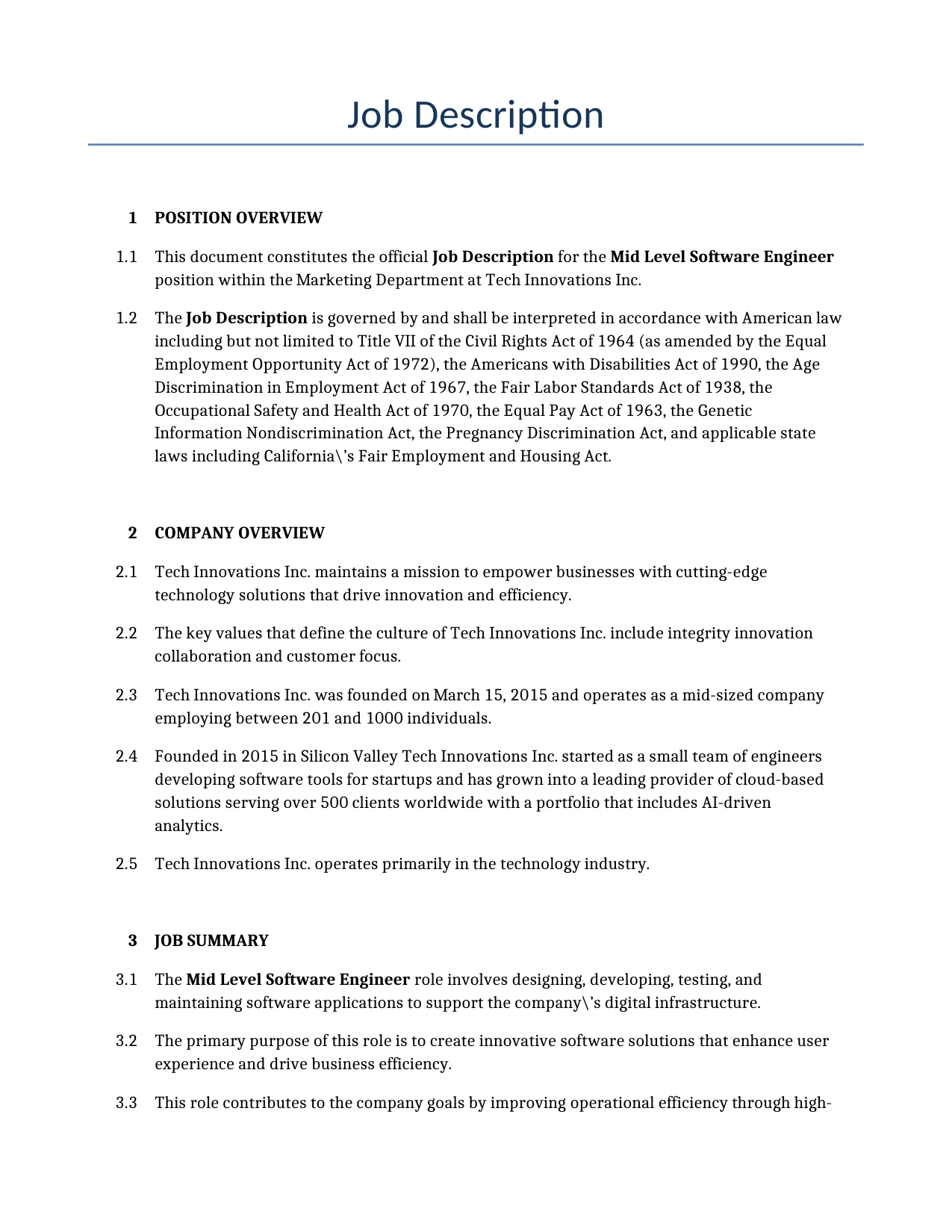
Job Description
1POSITION OVERVIEW
This document constitutes the official Job Description for the Mid Level Software Engineer position within the Marketing Department at Tech Innovations Inc.
The Job Description is governed by and shall be interpreted in accordance with American law including but not limited to Title VII of the Civil Rights Act of 1964 (as amended by the Equal Employment Opportunity Act of 1972), the Americans with Disabilities Act of 1990, the Age Discrimination in Employment Act of 1967, the Fair Labor Standards Act of 1938, the Occupational Safety and Health Act of 1970, the Equal Pay Act of 1963, the Genetic Information Nondiscrimination Act, the Pregnancy Discrimination Act, and applicable state laws including California\’s Fair Employment and Housing Act.
2COMPANY OVERVIEW
Tech Innovations Inc. maintains a mission to empower businesses with cutting-edge technology solutions that drive innovation and efficiency.
The key values that define the culture of Tech Innovations Inc. include integrity innovation collaboration and customer focus.
Tech Innovations Inc. was founded on March 15, 2015 and operates as a mid-sized company employing between 201 and 1000 individuals.
Founded in 2015 in Silicon Valley Tech Innovations Inc. started as a small team of engineers developing software tools for startups and has grown into a leading provider of cloud-based solutions serving over 500 clients worldwide with a portfolio that includes AI-driven analytics.
Tech Innovations Inc. operates primarily in the technology industry.
3JOB SUMMARY
The Mid Level Software Engineer role involves designing, developing, testing, and maintaining software applications to support the company\’s digital infrastructure.
The primary purpose of this role is to create innovative software solutions that enhance user experience and drive business efficiency.
This role contributes to the company goals by improving operational efficiency through high-quality software development.
The position is classified as exempt under the Fair Labor Standards Act of 1938 and is therefore not eligible for overtime pay.
4REPORTING STRUCTURE
The Mid Level Software Engineer reports directly to the Senior Engineering Manager within the Marketing Department\’s Engineering team.
This position has no direct reports and collaborates with cross-functional teams including product managers, designers, and other engineers as part of an agile development process.
5ESSENTIAL FUNCTIONS
The following are essential functions of the Mid Level Software Engineer position, listed in order of importance. These functions are aligned with business necessity as they are fundamental to developing and maintaining the software applications critical to the company\’s marketing technology infrastructure. The employee must be able to perform these essential functions with or without reasonable accommodation.
Design, code, test, debug, and maintain software applications using languages such as Java, Python, and SQL, and frameworks such as React and Spring (most important).
Collaborate with cross-functional teams including product managers and designers to gather requirements and implement features following agile methodologies.
Participate in code reviews, agile ceremonies (such as daily stand-ups, sprint planning, and retrospectives), and contribute to continuous improvement of development processes.
Utilize version control systems like Git and work with cloud platforms such as AWS or Azure to deploy and manage applications.
Debug and resolve software issues, optimize application performance, and ensure code quality and security standards are met.
The following are marginal functions: occasional assistance with non-core administrative tasks not directly related to software development.
6ESSENTIAL DUTIES AND RESPONSIBILITIES
The Mid Level Software Engineer shall design, develop, test, and maintain software applications to support marketing technology initiatives.
The primary objective of the Mid Level Software Engineer is to deliver high-quality, scalable software solutions that enhance system reliability and user experience.
The Mid Level Software Engineer shall not exercise supervisory responsibilities over other employees.
On a daily basis the Mid Level Software Engineer shall write and review code, participate in team meetings, debug issues, and update technical documentation.
The Mid Level Software Engineer shall on a regular basis contribute to sprint deliverables, conduct peer code reviews, and integrate software components with marketing platforms.
The Mid Level Software Engineer shall exercise decision-making authority at a medium level within established technical guidelines.
Travel shall not constitute an essential duty of the Mid Level Software Engineer but may occur occasionally.
Success in the Mid Level Software Engineer position shall be defined by the timely delivery of high-quality software features, reduction in bug rates, positive contributions to team velocity, and achievement of sprint goals.
7REQUIRED SKILLS
The Mid Level Software Engineer must possess the following technical skills: proficiency in Java and/or Python, SQL for database interactions, React or similar frontend frameworks, Spring or equivalent backend frameworks, Git for version control, and experience with cloud platforms such as AWS or Azure.
The Mid Level Software Engineer must demonstrate soft skills in communication, problem-solving, and team collaboration at an intermediate to advanced level.
The Mid Level Software Engineer must possess a minimum of 3-5 years of hands-on software development experience in a professional environment.
8PREFERRED QUALIFICATIONS
Preferred qualifications for the Mid Level Software Engineer position include experience with agile methodologies, knowledge of marketing technology platforms, familiarity with CI/CD pipelines, and any additional skills, experience, or attributes that would enhance a candidate\’s ability to perform the essential duties beyond the minimum requirements stated herein.
9EDUCATION AND EXPERIENCE
The Mid Level Software Engineer must possess at minimum a bachelor\’s degree in computer science, software engineering, or a related field.
Equivalent work experience may substitute for the formal education requirement for the Mid Level Software Engineer position.
The Mid Level Software Engineer must possess a minimum of 3-5 years of relevant professional experience in software development. These requirements are based on the skills and experience necessary for the role and do not discriminate based on age or other protected categories.
10PHYSICAL DEMANDS
The Mid Level Software Engineer must be able to perform the essential functions of the position with or without reasonable accommodation in compliance with the Americans with Disabilities Act of 1990.
The Mid Level Software Engineer must be able to sit for extended periods, use a computer keyboard and mouse, view and read computer screens, and engage in verbal and written communication as required to perform essential job functions.
The Mid Level Software Engineer must be able to engage in occasional light lifting of office materials under 15 pounds as required to perform essential job functions.
The Mid Level Software Engineer must be able to engage in occasional travel as required to perform essential job functions.
11WORK ENVIRONMENT
The work of the Mid Level Software Engineer is primarily performed in an office-based, remote, or hybrid setting depending on company policy.
The typical work setting for the Mid Level Software Engineer is a modern office environment equipped with ergonomic workstations, collaborative meeting rooms, and access to necessary office supplies where employees will interact with team members in a professional setting. Remote options may include working from home with reliable internet.
The work environment for the Mid Level Software Engineer is primarily sedentary but may include periods of movement within the office or during travel.
The work environment for the Mid Level Software Engineer does not include hazardous conditions in compliance with the Occupational Safety and Health Act of 1970.
The Mid Level Software Engineer position may require irregular or extended working hours on occasion for project deadlines or deployments, consistent with its FLSA exempt status. Mandatory overtime is not required.
12TRAVEL REQUIREMENTS
Travel for the Mid Level Software Engineer shall constitute up to 20\% of the role and may include occasional trips (1-2 times per quarter, typically 2-4 days in duration) for team meetings, client visits, or industry conferences to support software integration and collaboration. This is not an essential function. Reasonable accommodations will be made for disabilities affecting travel ability in compliance with the Americans with Disabilities Act of 1990.
13COMPENSATION AND BENEFITS
The salary range for the Mid Level Software Engineer position is $75,000-$95,000 base pay for the Silicon Valley location (accounting for local cost of living). This range complies with the Equal Pay Act and actual compensation may vary based on experience, skills, performance, and location.
The Mid Level Software Engineer shall be eligible for a performance-based bonus.
Tech Innovations Inc. shall offer medical insurance, dental insurance, and vision insurance to the Mid Level Software Engineer, with eligibility beginning after 30 days of employment.
Tech Innovations Inc. shall offer a retirement savings plan such as a 401(k) to the Mid Level Software Engineer.
Tech Innovations Inc. shall provide paid time off including 15 days of PTO per year (accruing at 1.25 days per month), sick leave, personal days, and holidays to the Mid Level Software Engineer.
Tech Innovations Inc. shall offer stock options or equity incentives to the Mid Level Software Engineer.
14EQUAL EMPLOYMENT OPPORTUNITY STATEMENT
Tech Innovations Inc. is committed to providing equal employment opportunities to all qualified individuals without regard to race, color, religion, sex (including pregnancy), national origin, age, disability, genetic information, sexual orientation, gender identity, veteran status, or any other protected status in full compliance with Title VII of the Civil Rights Act of 1964, the Americans with Disabilities Act of 1990, the Age Discrimination in Employment Act of 1967, the Equal Pay Act of 1963, the Genetic Information Nondiscrimination Act, the Pregnancy Discrimination Act, California\’s Fair Employment and Housing Act, and all other applicable federal, state, and local laws.
Tech Innovations Inc. does not discriminate based on race, color, religion, sex, national origin, age, disability, or any other protected category. The company will provide reasonable accommodations for qualified individuals with disabilities to perform essential functions.
15APPLICATION INSTRUCTIONS
To apply for this position applicants must submit a resume, a cover letter, and a list of three professional references with all documents in PDF format and must include a brief statement explaining interest in the role.
Incomplete submissions will not be considered for the Mid Level Software Engineer position.
Applications for the Mid Level Software Engineer position may be submitted via the online portal or by email.
Applicants may direct questions or submissions to hr@company.com.
All applications for the Mid Level Software Engineer position must be received by December 31, 2024.
16CONTACT INFORMATION
For questions about the Mid Level Software Engineer position or the application process applicants should contact Jane Smith, Human Resources Manager at jane.smith@company.com or (555) 123-4567.
The mailing address for Tech Innovations Inc. is 123 Innovation Drive, Suite 100, Silicon Valley, CA 94043.
17ACCEPTANCE AND ACKNOWLEDGMENT
The parties acknowledge that this Job Description accurately reflects the essential functions of the position, is not exhaustive, and that duties may change over time. Reasonable accommodations may be made to enable individuals with disabilities to perform these essential functions in compliance with the Americans with Disabilities Act of 1990.
This Job Description does not constitute an employment contract, does not alter the at-will nature of employment with Tech Innovations Inc., and the company reserves the right to modify it at any time.
18SIGNATURES
Employer: Tech Innovations Inc. By: _______________________________ Name: Jane Smith Title: Human Resources Manager Date: ________________
Employee: _______________________________ Name: ________________ Title: Mid Level Software Engineer Date: ________________
This example shows approximately 70% of a typical document and is provided for illustrative purposes only. The remaining content has been omitted.
Every document generated by Docaro is tailored to your specific circumstances, jurisdiction and the information you provide. The completed document includes all applicable clauses and provisions required for your situation.
To generate the full, personalised document, answer a short series of questions and your document will be created instantly.