
AI Generated American Complaint
PDF & Word - 2026 Updated
Docaro Pricing
When Do You Need a Complaint Letter in the United States?
American Legal Rules for a Complaint Letter
Using the wrong structure for a complaint letter can undermine its legal enforceability or lead to procedural dismissals in court.
What a Proper Complaint Should Include
- Your InformationInclude your full name, contact details, and address to clearly identify who is making the complaint.
- The Other Party's InformationProvide the name, address, and any relevant details about the person or company you're complaining against.
- Clear Description of the ProblemExplain what happened in simple terms, including key dates, events, and how it affected you.
- Evidence or Supporting FactsList any proof like receipts, emails, or witness statements that back up your side of the story.
- What You Want as a ResolutionState specifically what you're asking for, such as a refund, repair, or apology, to resolve the issue.
- Deadline for ResponseSet a reasonable time frame, like 14 days, for the other party to reply or take action.
Generate Your Document in 4 Easy Steps
Why Use Docaro?
 United States
Free Example Complaint Template
Below is a free template example of a Complaint for use in the United States generated by our AI model.
The clauses in your actual Complaint will vary from this example as they will be entirely bespoke to your requirements as set out in the questionnaire you complete.
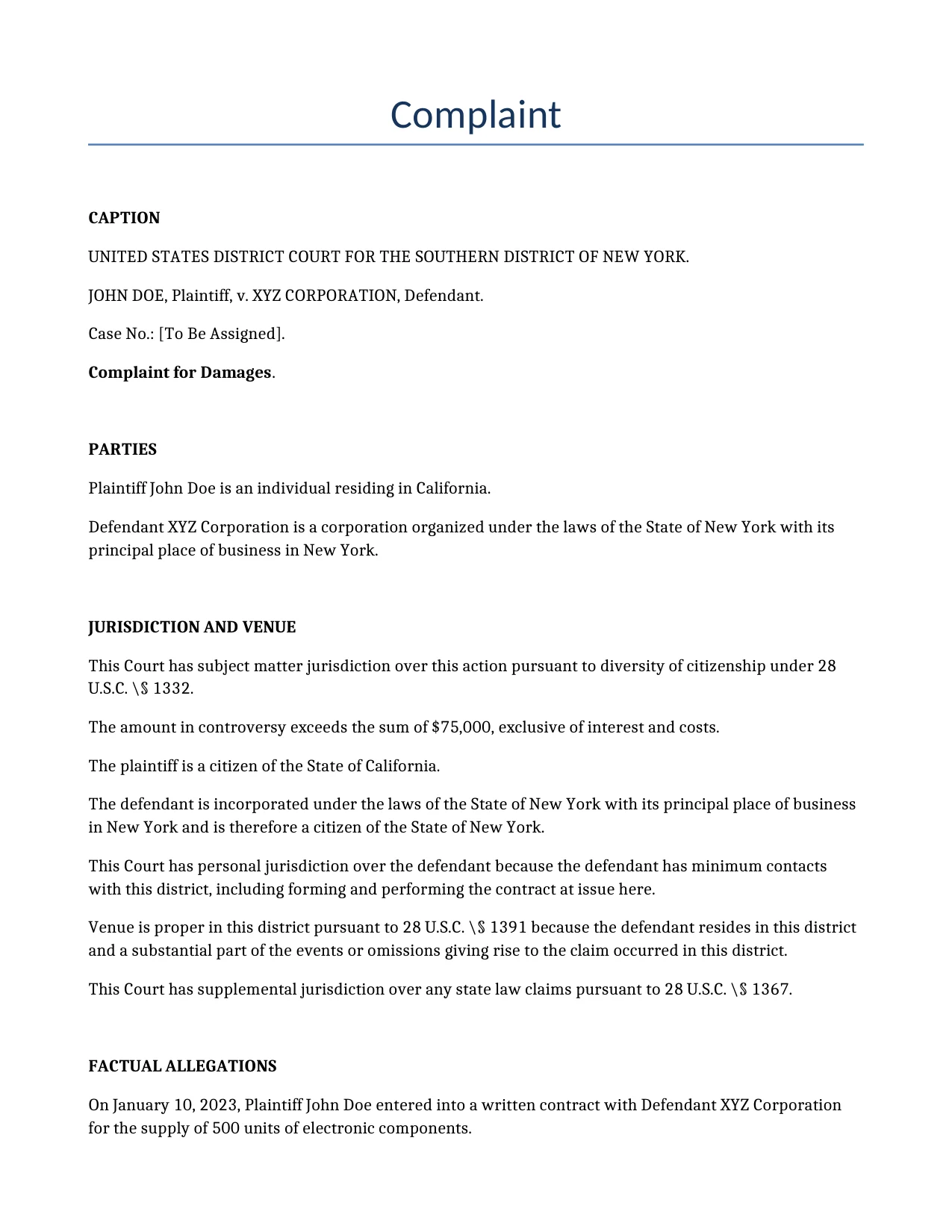
Complaint for Damages
CAPTION
UNITED STATES DISTRICT COURT FOR THE SOUTHERN DISTRICT OF NEW YORK.
JOHN DOE, Plaintiff, v. XYZ CORPORATION, Defendant.
Case No.: [To Be Assigned].
Complaint for Damages.
PARTIES
Plaintiff John Doe is an individual residing in California.
Defendant XYZ Corporation is a corporation organized under the laws of the State of New York with its principal place of business in New York.
JURISDICTION AND VENUE
This Court has subject matter jurisdiction over this action pursuant to diversity of citizenship under 28 U.S.C. \§ 1332.
The amount in controversy exceeds the sum of $75,000, exclusive of interest and costs.
The plaintiff is a citizen of the State of California.
The defendant is incorporated under the laws of the State of New York with its principal place of business in New York and is therefore a citizen of the State of New York.
This Court has personal jurisdiction over the defendant because the defendant has minimum contacts with this district, including forming and performing the contract at issue here.
Venue is proper in this district pursuant to 28 U.S.C. \§ 1391 because the defendant resides in this district and a substantial part of the events or omissions giving rise to the claim occurred in this district.
This Court has supplemental jurisdiction over any state law claims pursuant to 28 U.S.C. \§ 1367.
FACTUAL ALLEGATIONS
On January 10, 2023, Plaintiff John Doe entered into a written contract with Defendant XYZ Corporation for the supply of 500 units of electronic components.
The contract required Defendant to deliver the 500 units of electronic components to Plaintiff\’s warehouse by March 15, 2023.
At the time of signing, Defendant assured timely delivery based on its inventory levels and the agreement included penalty clauses for delays.
On March 15, 2023, Defendant failed to deliver the 500 units of electronic components as required by the contract.
On March 20, 2023, Plaintiff sent a formal notice of breach to Defendant demanding immediate fulfillment or payment of the contractual penalties.
On April 5, 2023, Defendant responded claiming supply chain issues but provided no resolution, alternative delivery date, or payment of penalties.
As a direct result of the non-delivery, Plaintiff suffered production delays in its manufacturing line and lost revenue exceeding $100,000.
FIRST CAUSE OF ACTION: BREACH OF CONTRACT
Plaintiff incorporates by reference all preceding paragraphs as though fully set forth herein.
This Court has diversity jurisdiction over this claim pursuant to 28 U.S.C. \§ 1332. New York substantive law applies to this contract claim because the contract was formed and was to be performed in substantial part in New York.
On January 10, 2023, Plaintiff and Defendant entered into a valid and enforceable contract whereby Defendant agreed to supply and deliver 500 units of electronic components to Plaintiff by March 15, 2023.
Plaintiff performed all of its obligations under the contract, including payment.
Defendant breached the contract by failing to deliver the 500 units by March 15, 2023, and by failing to honor the contractual penalty clauses.
As a direct and proximate result of Defendant\’s breach, Plaintiff has suffered damages including lost revenue from production delays in an amount to be proven at trial but exceeding $100,000.
Plaintiff seeks compensatory damages, attorneys\’ fees if provided by contract or law, and such other relief as the Court deems proper.
SECOND CAUSE OF ACTION: NEGLIGENCE
Plaintiff incorporates by reference all preceding paragraphs as though fully set forth herein.
This Court has diversity jurisdiction over this claim pursuant to 28 U.S.C. \§ 1332. California substantive law applies to this tort claim because Plaintiff resides in California and suffered harm there.
Defendant owed Plaintiff a legal duty arising from their contractual relationship and under common law to timely deliver the electronic components or provide adequate notice and remedies for any delay.
Defendant breached this duty by failing to deliver the components by the contract deadline of March 15, 2023, failing to honor the penalty clauses, and failing to provide any reasonable resolution after Plaintiff\’s notice of breach on March 20, 2023.
Defendant\’s breach was the direct and proximate cause of Plaintiff\’s production delays and lost revenue.
As a result, Plaintiff has suffered damages in an amount exceeding $100,000.
Plaintiff seeks compensatory damages for the Second Cause of Action.
THIRD CAUSE OF ACTION: FRAUD
Plaintiff incorporates by reference all preceding paragraphs as though fully set forth herein.
This Court has diversity jurisdiction over this claim pursuant to 28 U.S.C. \§ 1332. California substantive law applies to this tort claim because Plaintiff resides in California and suffered harm there.
On or about January 10, 2023, in communications leading to the contract, Defendant\’s authorized representatives falsely represented to Plaintiff that Defendant had sufficient inventory to deliver the 500 units of electronic components by March 15, 2023, and that no supply chain issues would interfere.
These representations were false; Defendant knew at the time that its assurances were untrue and that it could not meet the delivery deadline.
Defendant made these representations with the intent to deceive Plaintiff and induce Plaintiff to enter into the contract and make payment.
Plaintiff justifiably relied on Defendant\’s representations in entering the contract.
As a direct and proximate result of Defendant\’s fraud, Plaintiff has suffered damages including lost revenue from production delays in an amount exceeding $100,000.
Plaintiff seeks compensatory damages, punitive damages, and such other relief as the Court deems proper for the Third Cause of Action.
PRAYER FOR RELIEF
WHEREFORE, Plaintiff prays for judgment against Defendant as follows:
For compensatory damages on the First Cause of Action in an amount exceeding $100,000 according to proof at trial;
For compensatory damages on the Second Cause of Action in an amount exceeding $100,000 according to proof at trial;
For compensatory damages on the Third Cause of Action in an amount exceeding $100,000 according to proof at trial;
For punitive damages on the Third Cause of Action in an amount sufficient to punish and deter according to proof at trial;
For attorneys\’ fees as provided by contract or law;
For costs of suit;
For prejudgment and post-judgment interest at the legal rate;
For such other and further relief as the Court deems just and proper.
DEMAND FOR JURY TRIAL
Plaintiff demands a trial by jury on all issues so triable.
SIGNATURE SECTION
Dated: October 15, 2023
Respectfully submitted,
By: _______________________________
John Doe, Plaintiff pro se
This example shows approximately 70% of a typical document and is provided for illustrative purposes only. The remaining content has been omitted.
Every document generated by Docaro is tailored to your specific circumstances, jurisdiction and the information you provide. The completed document includes all applicable clauses and provisions required for your situation.
To generate the full, personalised document, answer a short series of questions and your document will be created instantly.