
AI Generated American Mutual Release Agreement
PDF & Word - 2026 Updated
Docaro Pricing
When Do You Need a Mutual Release Agreement in the United States?
American Legal Rules for a Mutual Release Agreement
Using the wrong type of release agreement may fail to fully protect parties from future claims or liabilities.
What a Proper Mutual Release Agreement Should Include
- Parties InvolvedClearly identify the full names and contact details of all people or companies agreeing to the release.
- What’s Being ReleasedDescribe the specific claims, disputes, or issues that both sides are letting go of to avoid future arguments.
- Promises to FollowState that each party agrees not to pursue any related legal actions against the other in the future.
- Payment or CompensationDetail any money or benefits exchanged as part of settling the matter, if applicable.
- Confidentiality RuleRequire both parties to keep the agreement and its details private to protect sensitive information.
- How to End DisputesOutline steps for resolving any disagreements about the agreement, like mediation or court.
- Signatures and DateInclude spaces for both parties to sign and date the document to make it official.
Generate Your Document in 4 Easy Steps
Why Use Docaro?
 United States
Free Example Mutual Release Agreement Template
Below is a free template example of a Mutual Release Agreement for use in the United States generated by our AI model.
The clauses in your actual Mutual Release Agreement will vary from this example as they will be entirely bespoke to your requirements as set out in the questionnaire you complete.
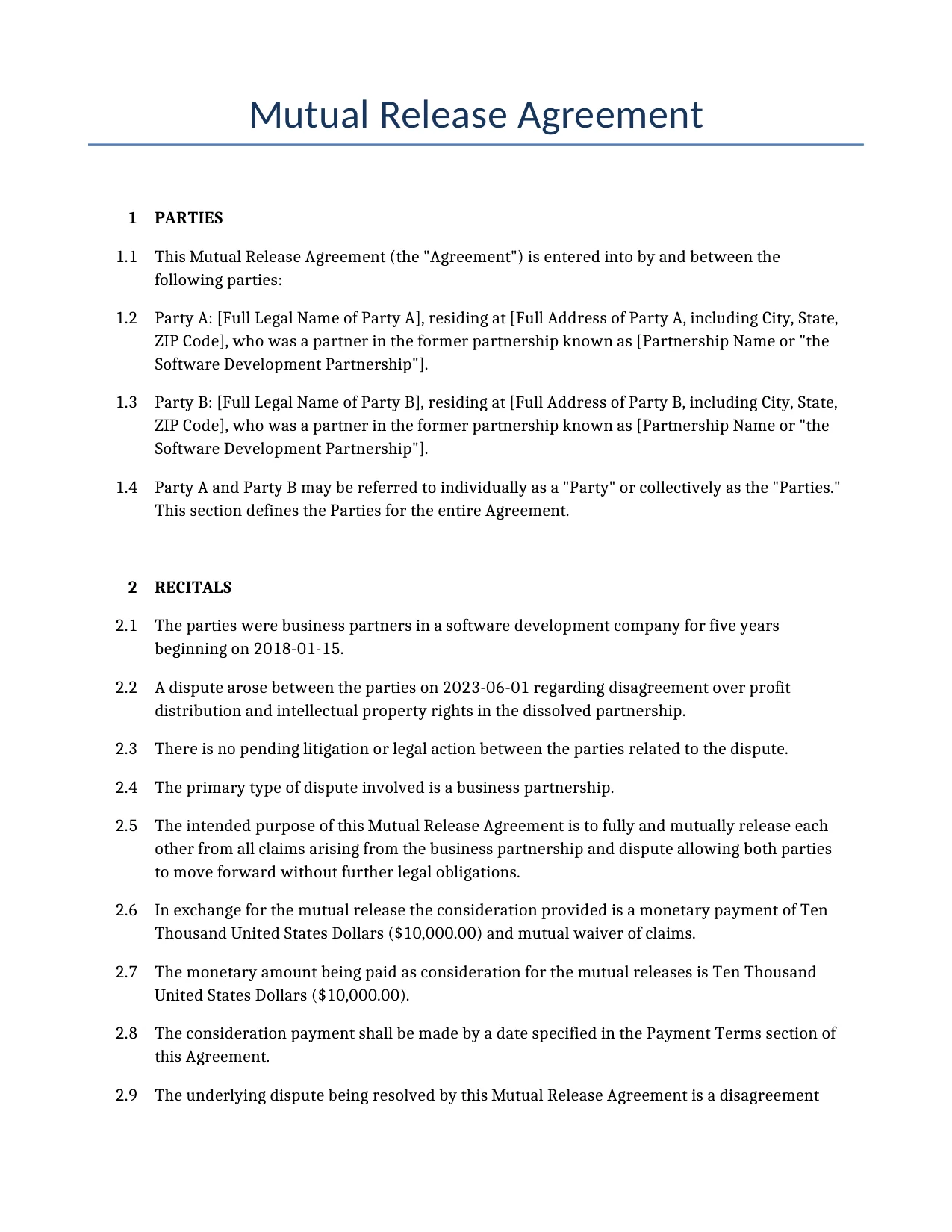
Mutual Release Agreement
1PARTIES
This Mutual Release Agreement (the "Agreement") is entered into by and between the following parties:
Party A: [Full Legal Name of Party A], residing at [Full Address of Party A, including City, State, ZIP Code], who was a partner in the former partnership known as [Partnership Name or "the Software Development Partnership"].
Party B: [Full Legal Name of Party B], residing at [Full Address of Party B, including City, State, ZIP Code], who was a partner in the former partnership known as [Partnership Name or "the Software Development Partnership"].
Party A and Party B may be referred to individually as a "Party" or collectively as the "Parties." This section defines the Parties for the entire Agreement.
2RECITALS
The parties were business partners in a software development company for five years beginning on 2018-01-15.
A dispute arose between the parties on 2023-06-01 regarding disagreement over profit distribution and intellectual property rights in the dissolved partnership.
There is no pending litigation or legal action between the parties related to the dispute.
The primary type of dispute involved is a business partnership.
The intended purpose of this Mutual Release Agreement is to fully and mutually release each other from all claims arising from the business partnership and dispute allowing both parties to move forward without further legal obligations.
In exchange for the mutual release the consideration provided is a monetary payment of Ten Thousand United States Dollars ($10,000.00) and mutual waiver of claims.
The monetary amount being paid as consideration for the mutual releases is Ten Thousand United States Dollars ($10,000.00).
The consideration payment shall be made by a date specified in the Payment Terms section of this Agreement.
The underlying dispute being resolved by this Mutual Release Agreement is a disagreement over profit distribution and intellectual property rights in the dissolved partnership.
The Parties have each had the opportunity to consult with independent legal counsel before signing this Agreement and are entering into this Agreement voluntarily.
This Agreement is supported by adequate consideration, including but not limited to the mutual releases and the payment described herein.
3MUTUAL RELEASES
Each Party hereby releases and forever discharges the other Party and its respective successors, assigns, heirs, executors, administrators, and representatives from any and all claims, demands, actions, causes of action, liabilities, damages, costs, expenses, and obligations of any nature whatsoever, whether known or unknown, suspected or unsuspected, that arise out of or relate to the business partnership, its formation, operation, dissolution, profit distributions, intellectual property rights, or any other matters from its inception on 2018-01-15 through the Effective Date of this Agreement. This release includes but is not limited to any claims related to unpaid invoices from joint projects conducted between 2020 and 2023.
Each Party expressly waives and relinquishes all rights and benefits afforded by California Civil Code Section 1542, which provides: "A general release does not extend to claims that the creditor or releasing party does not know or suspect to exist in his or her favor at the time of executing the release and that, if known by him or her, would have materially affected his or her settlement with the debtor or released party." Each Party acknowledges that it may later discover facts different from or in addition to those it now knows or believes to be true but nevertheless agrees that the release set forth in this Agreement shall remain in effect in all respects notwithstanding the discovery of such different or additional facts. Each Party assumes the risk of such unknown claims.
The scope of the released claims in this Mutual Release Agreement includes known and unknown claims.
The mutual release explicitly includes both known and unknown claims.
The mutual release covers all claims, demands, actions, and liabilities up to the Effective Date of the Agreement.
The Effective Date for the mutual release is the date this Agreement is executed by both Parties.
There are no other known claims outside the specified matters that should be addressed in the mutual release.
4REPRESENTATIONS AND WARRANTIES
Each party represents and warrants that it has full authority to enter into this Mutual Release Agreement.
Each party represents and warrants that it has not assigned transferred or otherwise conveyed any claims rights or interests that are being released under this Mutual Release Agreement to any third party.
Each party represents and warrants that it is releasing all known claims against the other party in this Mutual Release Agreement.
Each party represents and warrants that it is releasing all unknown claims against the other party in this Mutual Release Agreement.
The scope of claims included in the representations and warranties for this Mutual Release Agreement includes claims arising before the effective date and claims related to the specific dispute.
There is no pending litigation or administrative proceeding related to the claims being released in this Mutual Release Agreement.
5PAYMENT TERMS
In consideration for the mutual releases provided herein, Party B shall pay to Party A the sum of Ten Thousand United States Dollars ($10,000.00).
Payment shall be made by wire transfer to an account designated by Party A or by certified check, and shall be due no later than [Specified Due Date, e.g., 30 days after the Effective Date].
The payment is non-refundable under any circumstances.
Each Party shall be solely responsible for any tax obligations arising from the payment or the transactions contemplated by this Agreement. No Party shall have any liability for the tax obligations of the other Party.
6COVENANT NOT TO SUE
Each Party covenants not to sue the other Party with respect to any of the released claims. This covenant not to sue is mutual, applying to both Parties equally. This covenant survives indefinitely and applies to claims in any jurisdiction.
The duration for which the covenant not to sue shall remain in effect is indefinite.
There are no exceptions to the covenant not to sue.
The jurisdiction that shall govern the enforcement of the covenant not to sue is the State of California.
7CONFIDENTIALITY
Each party agrees to keep the terms of this Mutual Release Agreement the related negotiations and the dispute details confidential except as required by law.
The scope of confidentiality covers the terms of the agreement related negotiations and dispute details.
Permitted disclosures are allowed if required by law to legal advisors or with prior consent.
The duration for the confidentiality obligations shall be indefinite.
8NO ADMISSION OF LIABILITY
This Mutual Release Agreement does not constitute an admission of liability or wrongdoing by any party with respect to negligence and wrongdoing or breach of contract and this provision applies equally to all parties without exceptions.
9NO THIRD-PARTY BENEFICIARIES
This Agreement is for the sole benefit of the Parties hereto and their respective successors and permitted assigns. Nothing in this Agreement, express or implied, is intended to or shall confer upon any other person or entity any legal or equitable right, benefit, or remedy of any nature whatsoever under or by reason of this Agreement.
10GOVERNING LAW
This Mutual Release Agreement shall be governed by and construed in accordance with the laws of the State of California without regard to that state's conflicts of law principles. Any disputes not subject to arbitration shall be resolved exclusively in the state or federal courts located in California.
11ATTORNEYS' FEES
In any action or proceeding to enforce or interpret this Agreement, the prevailing party shall be entitled to recover its reasonable attorneys' fees and costs from the other party.
12DISPUTE RESOLUTION
Any disputes arising from this Mutual Release Agreement shall be resolved by arbitration.
The arbitration shall be conducted by the American Arbitration Association.
The arbitration shall be governed by the laws of the State of California.
The arbitration process shall be binding on both parties.
13SEVERABILITY
If any provision of this Mutual Release Agreement is found to be invalid or unenforceable the remaining provisions shall continue in full force and effect and the severability clause applies to the entire agreement.
14ENTIRE AGREEMENT
This Agreement, including all exhibits and any written amendments, constitutes the entire understanding and agreement between the Parties with respect to the subject matter hereof and supersedes all prior or contemporaneous agreements, understandings, representations, and warranties, whether written or oral, relating to the subject matter. There are no other agreements between the Parties relating to the subject matter of this Agreement.
15AMENDMENTS
This Mutual Release Agreement can only be modified in writing and any amendments must be in writing and signed by both the releasing party and the released party.
16WAIVER
The failure of either party to enforce any provision of this Mutual Release Agreement shall not constitute a waiver of that or any other provision and the waiver clause applies mutually to both parties.
17NOTICES
All notices under this Mutual Release Agreement shall be sent to Party A at 123 Main Street Apt 4B New York NY 10001 and to Party B at 456 Oak Avenue Suite 200 Los Angeles CA 90210.
Permitted methods of delivery for notices to Party A are certified mail email and overnight courier.
Permitted methods of delivery for notices to Party B are personal delivery certified mail and fax.
A copy of every notice shall be sent to each party's attorney.
Mailed notices shall be deemed received after 3 days.
18ASSIGNMENT
Neither party may assign its rights or delegate its duties under this Mutual Release Agreement without the prior written consent of the other party and both rights and obligations are prohibited from assignment without consent.
This Mutual Release Agreement shall be binding upon and inure to the benefit of the parties and their respective successors and assigns.
19COUNTERPARTS
This Mutual Release Agreement may be executed in multiple counterparts each of which shall be deemed an original and all of which together shall constitute one and the same instrument.
Electronic signatures shall be permitted and shall have the same effect as original signatures.
20COMPLIANCE WITH SPECIFIC STATUTES
This Mutual Release Agreement is intended to comply with the provisions of California Civil Code Section 1542, and to the extent applicable, the Federal Rules of Civil Procedure, the Uniform Mediation Act, and other relevant statutes under United States and California law. References to the Uniform Commercial Code, FLSA, and ADEA have been removed as they are not applicable to this business partnership dissolution dispute.
With respect to California Civil Code Section 1542, each Party expressly waives and relinquishes all rights and benefits afforded by Section 1542. Each Party acknowledges that it may later discover facts different from or in addition to those it now knows or believes to be true but nevertheless agrees that the release set forth in this Agreement shall remain in effect in all respects notwithstanding the discovery of such different or additional facts. Each Party assumes the risk of such unknown claims and understands that this waiver is a material part of the consideration for this Agreement.
21EFFECTIVE DATE
This Mutual Release Agreement shall become effective upon execution by both Parties (the "Effective Date"). All references to dates in the recitals, releases, and other provisions shall be consistent with this Effective Date. Any prior date references are superseded by this provision.
22ACKNOWLEDGMENT OF INDEPENDENT LEGAL ADVICE
Each Party acknowledges that it has been advised to seek independent legal counsel regarding this Agreement, has had the opportunity to consult with counsel of its choice, has either done so or voluntarily waived such right, and is signing this Agreement freely and voluntarily with full understanding of its terms and legal effect.
23SURVIVAL
The provisions of this Agreement that by their nature are intended to survive termination or expiration of this Agreement, including but not limited to the Mutual Releases, Covenant Not to Sue, Confidentiality, No Admission of Liability, No Third-Party Beneficiaries, Attorneys' Fees, Governing Law, and Acknowledgment of Independent Legal Advice, shall survive indefinitely.
24SIGNATURE PAGE
IN WITNESS WHEREOF the parties have executed this Mutual Release Agreement as of the date first above written.
Party A: _______________________________ Date: _______________
Party B: _______________________________ Date: _______________
This example shows approximately 70% of a typical document and is provided for illustrative purposes only. The remaining content has been omitted.
Every document generated by Docaro is tailored to your specific circumstances, jurisdiction and the information you provide. The completed document includes all applicable clauses and provisions required for your situation.
To generate the full, personalised document, answer a short series of questions and your document will be created instantly.