Docaro

AI Generated Exit Interview Questionnaire for use in the United States
PDF & Word - 2026 Updated

A photorealistic image depicting a professional exit interview scene in a modern corporate office in the United States. An adult employee in business attire is seated across from an HR manager at a conference table, engaged in a thoughtful conversation, symbolizing the purpose of an exit interview questionnaire to gather feedback from departing staff. The atmosphere is professional and reflective, with no children present.
Streamline your employee offboarding process with our AI-generated exit interview questionnaire, designed specifically for US businesses to gather valuable insights on employee turnover and improve retention strategies.
Free instant document creation.
Compliant with United States law.
No sign up or monthly subscription.

Docaro Pricing

Basic
Free
Document Generation
No Sign Up
No Subscription
Download Watermarked PDF
Premium
$4.99 USD
Document Generation
No Sign Up
No Subscription
Download Clean PDF
Download Microsoft Word
Download HTML
Download Text
Email Document
Generate your document for free. Only pay if you like the result and need an un-watermarked version.

When Do You Need an Exit Interview Questionnaire in the United States?

  • Employee Departure
    Use it when an employee is leaving your company to gather their final thoughts on their experience.
  • Voluntary Resignations
    It's especially useful for employees who choose to leave, as it helps uncover reasons behind their decision.
  • Layoffs or Terminations
    Even in cases of involuntary exits, it can provide insights into potential issues during their time with the company.
  • Feedback Collection
    It allows you to collect honest feedback on company culture, management, and job satisfaction.
  • Improvement Opportunities
    A well-drafted questionnaire identifies areas for improvement to retain future talent and boost morale.
  • Legal Protection
    It helps document the exit process clearly, reducing misunderstandings and potential disputes.

American Legal Rules for an Exit Interview Questionnaire

  • No Legal Requirement
    Employers are not required by law to conduct exit interviews or use questionnaires.
  • Voluntary Participation
    Employees can choose to participate or skip the exit interview without facing penalties.
  • Privacy Protections
    Responses should be kept confidential to protect the former employee's privacy.
  • Avoid Discrimination
    Questions must not target protected traits like race, gender, or age to prevent legal issues.
  • Truthful Responses
    Employees should answer honestly, but responses cannot be used to harm them legally.
  • Record Keeping
    Companies should store responses securely and only use them to improve the workplace.
  • State Variations
    Some states may have extra rules, so check local laws for specific requirements.
Important

Using the wrong structure for an exit interview questionnaire can inadvertently create legal liabilities or undermine its effectiveness in gathering candid feedback.

What a Proper Exit Interview Questionnaire Should Include

  • Welcome and Purpose
    Start with a friendly greeting that explains the goal of the interview to gather honest feedback and improve the workplace.
  • Reasons for Leaving
    Ask about the main factors behind the employee's decision to leave, such as job satisfaction or career growth.
  • Work Environment Feedback
    Include questions on the company culture, team dynamics, and overall work-life balance experienced.
  • Suggestions for Improvement
    Invite open-ended input on ways the organization can enhance policies, processes, or support for employees.
  • Confidentiality Assurance
    Clearly state that responses will be kept private to encourage truthful answers without fear of repercussions.
  • Contact Information Option
    Provide space for the employee to share if they'd like to stay in touch or receive updates from the company.

Why Free Templates Can Be Risky for Exit Interview Questionnaires

Free templates for exit interview questionnaires often come with hidden pitfalls that can expose your company to unnecessary risks. These generic forms may not comply with current employment laws, leading to incomplete data collection or even legal vulnerabilities. They frequently lack customization to your organization's specific culture, policies, or industry needs, resulting in irrelevant questions that fail to uncover valuable insights from departing employees. Moreover, outdated or poorly worded templates can introduce biases, misinterpret responses, or overlook key areas like employee satisfaction and retention drivers, ultimately undermining the effectiveness of your HR processes.

Opt for AI-generated bespoke exit interview questionnaires tailored precisely to your company's requirements. This advanced approach ensures every question is relevant, legally sound, and aligned with your unique business context, maximizing the depth and accuracy of feedback. AI customization delivers professional, up-to-date documents that capture nuanced insights efficiently, empowering your HR team to make informed decisions that enhance retention and organizational improvement without the guesswork of generic options.

Generate Your Bespoke Exit Interview Questionnaire in 4 Easy Steps

1
Answer a Few Questions
Our AI guides you through the info required.
2
Generate Your Document
Docaro builds a bespoke document tailored specifically on your requirements.
3
Review & Edit
Review your document and submit any further requested changes.
4
Download & Sign
Download your ready to sign document as a PDF, Microsoft Word, Txt or HTML.

Why Use Our AI Exit Interview Questionnaire Generator?

Fast Generation
Quickly generate a comprehensive Exit Interview Questionnaire, eliminating the hassle and time associated with traditional document drafting.
Guided Process
Our user-friendly platform guides you step by step through each section of the document, providing context and guidance to ensure you provide all the necessary information for a complete and accurate Exit Interview Questionnaire.
Safer Than Legal Templates
We never use legal templates. All documents are generated from first principles clause by clause, ensuring that your document is bespoke and tailored specifically to the information you provide. This results in a much safer and more accurate document than any legal template could provide.
Professionally Formatted
Your Exit Interview Questionnaire will be formatted to professional standards, including headings, clause numbers and structured layout. No further editing is required. Download your document in PDF, Microsoft Word, TXT or HTML.
Compliance with American Law
Rest assured that all generated documents meet the latest legal standards and regulations of the United States, enhancing trust and reliability.
Cost-Effective
Save money by generating legally sound Exit Interview Questionnaire without the need for expensive legal services or consultations.
Get Started for Free - No Sign Up or Monthly Subscription Required
No payment or sign up is required to start generating your Exit Interview Questionnaire. Generate and download a watermarked version of your document for free. Pay only if you want to remove the watermark and gain full access to your document. No monthly subscriptions or hidden fees. Pay once and use your document forever.
Need to Generate a Exit Interview Questionnaire in a Different Country?
Choose country:

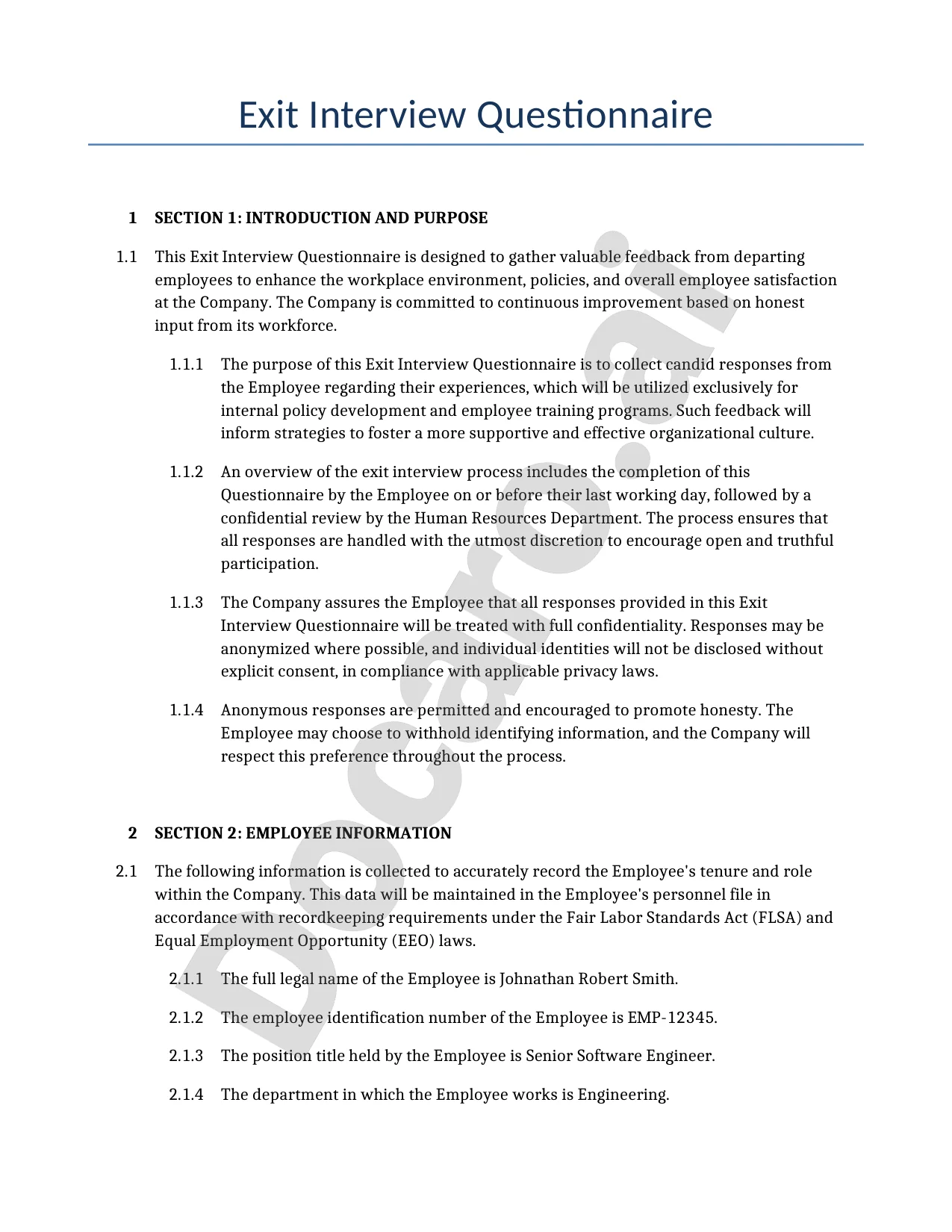
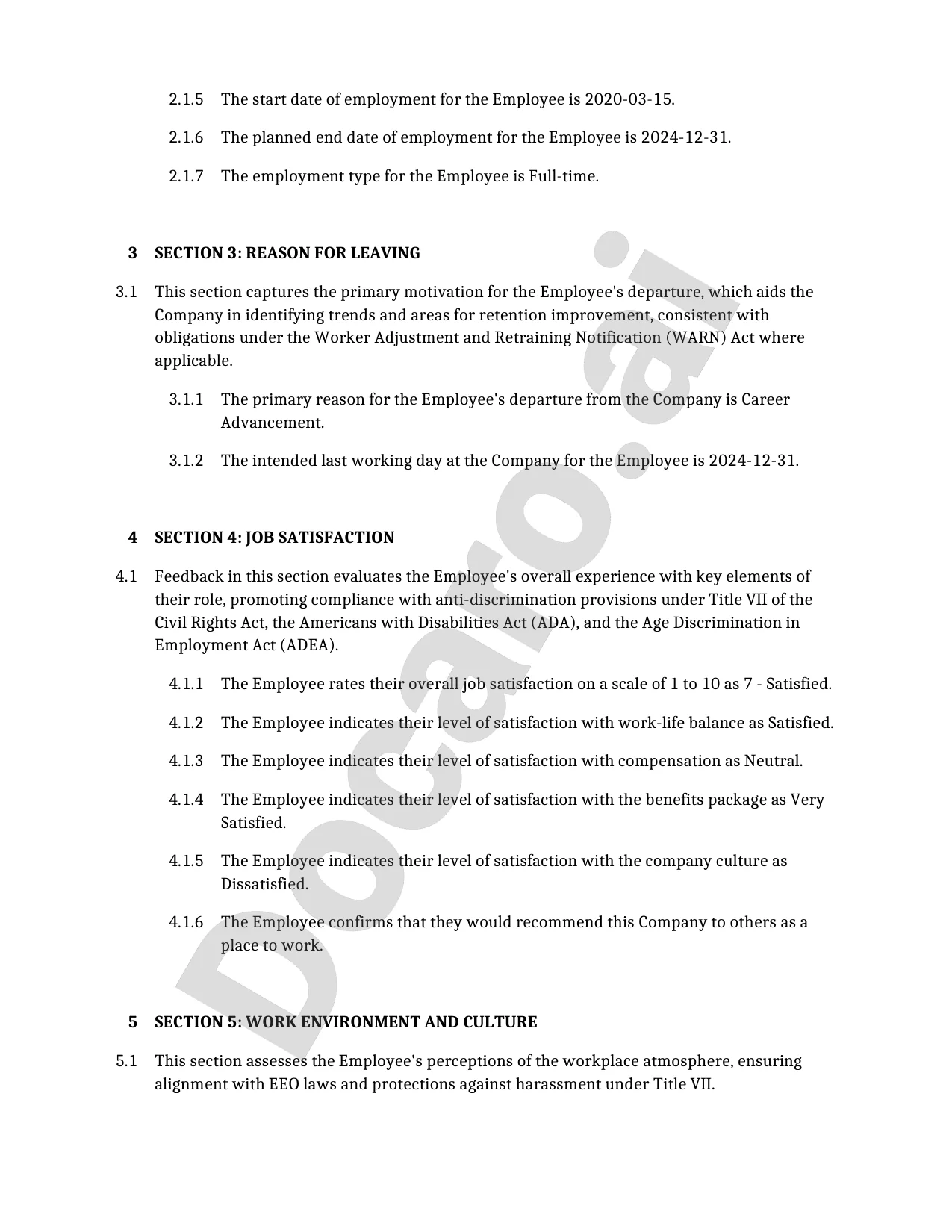
Free Example Exit Interview Questionnaire Template

Below is a free template example of a Exit Interview Questionnaire for use in the United States generated by our AI model.

The clauses in your actual Exit Interview Questionnaire will vary from this example as they will be entirely bespoke to your requirements as set out in the questionnaire you complete.
Page 1

United States Compliance Legislation

Your AI Generated Exit Interview Questionnaire will be checked for compliance against the following legislation and regulations:
Governs wage and hour standards, including requirements for final paychecks which may be discussed in exit interviews to ensure compliance with timely payment upon termination.
Requires employers to provide 60 days' advance notice of plant closings or mass layoffs; exit interviews may involve disclosures related to these events to inform departing employees of benefits or rights.
Protects employees' rights to discuss wages, hours, and working conditions; exit questionnaires must avoid questions that could be seen as interfering with these rights or soliciting information about union activities.
Prohibit discrimination based on race, color, religion, sex, national origin, disability, or age; exit interviews and questionnaires should be designed to prevent retaliation or bias in gathering feedback on workplace issues.
Requires final wages to be paid immediately upon termination; exit questionnaires in California must align with state-specific timing and documentation rules for wage disputes.
Part of the Fair Employment and Housing Act (FEHA), prohibiting employment discrimination; exit interviews must be conducted neutrally to avoid claims of retaliation.

What is an Exit Interview Questionnaire in the United States?

An exit interview questionnaire is a structured form used by companies to collect written feedback from departing employees, focusing on their experiences and reasons for leaving. In corporate settings in the US, its primary purpose is to identify patterns in employee turnover, improve workplace culture, and enhance retention strategies for future hires.

Unlike a standard exit interview, which typically involves a face-to-face or virtual conversation with HR, the questionnaire offers anonymity and convenience, allowing employees to respond at their own pace without direct interaction. This format often includes targeted questions on job satisfaction, management support, and company policies, making it a valuable tool for gathering employee feedback upon departure.

Organizations can use insights from these questionnaires to address systemic issues, such as inadequate training or poor work-life balance, as recommended by resources from the Society for Human Resource Management (SHRM). For creating customized exit interview questionnaires, consider bespoke AI-generated corporate documents using Docaro to ensure they align precisely with your company's needs.

When Should You Use an Exit Interview Questionnaire?

An exit interview questionnaire is a vital tool in US corporate HR practices for gathering insights from departing employees during voluntary resignations. Companies use it to understand reasons for leaving, such as better opportunities or workplace dissatisfaction, helping improve retention strategies.

For involuntary terminations, including layoffs or performance-based dismissals, the questionnaire provides anonymous feedback on management and company culture without risking retaliation. This practice, common in firms like Google and Microsoft, aids in refining policies to prevent future issues, as outlined in guidelines from the Society for Human Resource Management.

Best practices recommend customizing exit interview questionnaires using bespoke AI-generated corporate documents via Docaro for tailored, compliant forms. This ensures relevance to specific organizational needs while maintaining confidentiality and legal standards in the US.

When Should You Avoid Using It?

In cases of immediate firings for cause, such as gross misconduct or theft, an exit interview questionnaire should not be used. This avoids giving the employee an opportunity to provide potentially inflammatory responses that could complicate disciplinary actions or future legal claims.

During ongoing legal disputes or investigations involving the terminating employee, skipping the exit interview questionnaire is advisable to prevent any statements from being used as evidence against the employer. Consult resources like the EEOC guidelines for handling terminations amid discrimination claims in the US.

For sensitive terminations related to harassment, whistleblowing, or high-risk liabilities, employers should forgo the questionnaire to minimize exposure to lawsuits. Instead, opt for bespoke AI-generated corporate documents using Docaro to ensure tailored, risk-averse documentation.

"Conduct exit interviews 1-2 weeks after an employee's last day to capture fresh, candid feedback while minimizing legal risks from ongoing employment ties—always consult legal counsel for tailored approaches," says HR expert Dr. Elena Vasquez. For bespoke, AI-generated corporate documents like customized exit interview forms, use Docaro to ensure compliance and relevance.

What Are the Key Clauses in an Exit Interview Questionnaire?

An exit interview questionnaire in the US typically begins with a confidentiality agreement clause, ensuring that employees' responses remain private and protected under laws like the Title VII of the Civil Rights Act. This clause reassures departing employees that their feedback won't be used against them or shared without consent, promoting honest input while complying with federal privacy standards.

The core of the questionnaire includes feedback sections on reasons for leaving, where employees rate and describe factors such as work environment, management support, and compensation using open-ended questions. These sections help employers identify patterns in turnover, aligned with US employment law requirements to avoid discrimination claims under the Fair Labor Standards Act.

Satisfaction ratings form another essential clause, often presented as Likert-scale questions covering job fulfillment, company culture, and benefits to quantify employee sentiment. This structured format aids in data analysis for HR improvements, ensuring adherence to equal employment opportunity guidelines from the EEOC.

Additional clauses may cover future contact permissions and non-disparagement agreements, tailored to state-specific laws like those in California under the Labor Code. For customized exit interview questionnaires, consider using Docaro to generate bespoke AI-driven corporate documents that fit your organization's needs without relying on generic templates.

What Rights and Obligations Do Parties Have with These Documents?

Departing employees in the US are entitled to key privacy protections under federal laws like HIPAA, which safeguards health information from unauthorized disclosure by employers. Employers must ensure that personnel files and medical records are handled confidentially during exit processes, preventing any breach that could lead to discrimination or harm.

State regulations often supplement federal laws, providing additional employee privacy rights such as restrictions on accessing personal data post-departure. For instance, California's privacy laws require employers to notify former employees of data handling practices, ensuring compliance to avoid legal penalties.

Employers have obligations to respond fairly to reference requests or exit interviews without bias, as mandated by laws like the Fair Credit Reporting Act for background checks. Retaliation against departing employees for exercising rights, such as filing complaints, is prohibited under the National Labor Relations Act, promoting a non-adversarial separation.

For tailored corporate documents related to employee departures, consider using bespoke AI-generated solutions from Docaro to ensure compliance with US employment laws. Resources like the EEOC website offer authoritative guidance on anti-retaliation protections for departing workers.

Are There Key Exclusions in Exit Interview Questionnaires?

When developing AI systems or corporate documents in the US, it's essential to incorporate relevant exclusions to comply with EEOC guidelines. These exclusions prevent inquiries into protected characteristics such as race, color, religion, sex, national origin, age, disability, or genetic information, ensuring no discriminatory practices occur during hiring or interactions.

Sensitive topics like political affiliations, marital status, or personal beliefs should also be excluded to mitigate risks of discrimination claims. For instance, AI tools must avoid generating content that could inadvertently bias outcomes based on these areas, promoting fairness and legal adherence.

To create compliant materials, opt for bespoke AI-generated corporate documents using Docaro, which tailors exclusions precisely to US regulations. Consult authoritative resources like the EEOC website for detailed enforcement guidance on avoiding prohibited questions in employment contexts.

How Do Recent Legal Changes Affect Exit Interview Questionnaires?

The EEOC has recently updated its guidelines on workplace harassment and retaliation prevention, which directly influence exit interview questionnaires by requiring employers to ensure questions do not inadvertently solicit information that could expose the company to discrimination claims. These changes, effective from mid-2023, emphasize collecting feedback in a way that protects employee privacy while promoting inclusive practices, as detailed on the EEOC official website.

Regarding state privacy laws, California's CPRA amendments to the CCPA, implemented in 2023, mandate stricter data handling for personal information gathered during exit interviews, including employee consent for data retention and usage. Employers must now update questionnaires to comply with these privacy protections, avoiding broad data collection that could violate resident rights, with further enforcement details available from the California Attorney General's CCPA page.

Upcoming federal legislation, such as proposed expansions to the Equal Pay Act, may soon require exit interviews to include pay equity questions, impacting how HR designs these tools to mitigate bias risks. For tailored compliance, consider using Docaro to generate bespoke AI-powered corporate documents that adapt to these evolving US employment laws.

How Can You Get Started with Creating an Exit Interview Questionnaire?

1
Consult Legal Experts
Engage legal experts to identify compliance requirements for exit interviews, ensuring adherence to US employment laws and data privacy regulations.
2
Design Questionnaire with Docaro
Use Docaro to generate a bespoke exit interview questionnaire tailored to your company needs, incorporating legal insights for effectiveness.
3
Integrate with HR Software
Link the Docaro-generated questionnaire to your HR software for seamless data collection, analysis, and secure storage.
4
Implement and Train Staff
Roll out the questionnaire in exit processes, train HR team on usage, and monitor feedback for continuous improvement.

Where Can You Find More Resources on Exit Interviews?

To deepen your understanding of exit interview best practices in the United States, explore these complementary resources tailored for HR professionals focused on employee retention.

For custom exit interview questionnaires, consider generating bespoke documents using Docaro's AI tools to fit your organization's unique needs.

Exit Interview Questionnaire FAQs

An exit interview questionnaire is a structured set of questions used by companies in the United States to gather feedback from departing employees. It helps identify reasons for leaving, areas for improvement, and insights to enhance employee retention and workplace satisfaction.

Document Generation FAQs

Docaro is an AI-powered legal and corporate document generator that helps you create fully formatted, legally sound contracts and agreements in minutes. Just answer a few guided questions and download your document instantly.
You Might Also Be Interested In
A Document Provided By Employers Outlining Company Policies, Procedures, Employee Rights, And Expectations To Inform And Guide The Workforce.
A Formal Document Outlining Expected Behaviors, Ethical Standards, And Rules For Individuals Or Organizations To Ensure Integrity And Compliance.
A Corporate Document Outlining Commitments To Fostering Diverse Workplaces, Ensuring Equitable Opportunities, And Promoting Inclusive Practices.
A Corporate Document Outlining Guidelines, Eligibility, And Procedures For Employees Working Remotely Or In A Hybrid Model Combining Office And Remote Work.
A Corporate Document Outlining Rules For The Acceptable Use Of IT Resources To Ensure Security, Compliance, And Proper Conduct.
A Corporate Policy That Outlines How Long To Keep Records And Data, Ensuring Compliance With Legal Requirements And Efficient Management.
A Corporate Policy Outlining Procedures For Employees To Report Illegal Or Unethical Activities Anonymously And Without Retaliation.
A Corporate Policy Outlining Procedures For Handling Employee Misconduct And Resolving Workplace Complaints.
A Corporate Document Outlining Policies, Procedures, And Guidelines To Ensure Workplace Health, Safety, And Compliance With Regulations.
A Document Outlining The Responsibilities, Duties, And Requirements Of A Specific Job Position.
A Performance Improvement Plan (PIP) Is A Formal Document Used By Employers In The US To Outline An Employee's Performance Issues, Set Improvement Goals, And Specify A Timeline For Remediation, Often As A Precursor To Potential Termination.
A Corporate Document Outlining The Principles And Objectives Guiding An Organization's Employee Compensation Practices.
A Memo Outlining Reasons And Evidence For Recommending An Employee's Promotion.
A Documented Set Of Instructions Detailing The Steps Required To Perform A Routine Operation Or Process Consistently And Efficiently.
A Document Outlining Procedures For Detecting, Responding To, And Recovering From Security Incidents In An Organization.
A Strategic Document Outlining Procedures To Ensure Business Operations Continue During And After Disruptions, Including Recovery From Disasters.
A Formal Corporate Document Outlining Rules, Procedures, And Responsibilities For Protecting An Organization's Information Systems And Data From Cyber Threats.
A Corporate Document Outlining Procedures, Standards, And Guidelines To Ensure Product Or Service Quality.
A Corporate Document Outlining A Company's Performance And Initiatives In Environmental, Social, And Governance Areas To Demonstrate Sustainability And Ethical Practices.

Related Articles

A photorealistic image of a professional adult employee in a modern office setting, thoughtfully reflecting on their work experience as they prepare to leave the company, symbolizing the purpose of an exit interview.
Discover the top 10 questions to include in your exit interview questionnaire. Learn how to gather valuable feedback from departing employees to improve retention and company culture.
A photorealistic image depicting an adult professional in a modern office setting, engaged in a thoughtful exit interview conversation with a colleague, symbolizing the transition and feedback process in employment.
Learn how to conduct effective exit interviews in the United States with our comprehensive guide. Discover best practices, legal considerations, and tips to gain valuable insights from departing employees and improve retention.
A photorealistic image depicting a diverse group of professional adults in a modern office setting, engaged in a constructive conversation around a table, symbolizing employee feedback and retention discussions, with warm lighting and natural expressions of openness and collaboration. No children are present.
Discover the key benefits of using exit interview questionnaires to boost employee retention. Learn how structured feedback from departing staff can reduce turnover and improve workplace culture.