
AI Generated American Founders' Agreement
PDF & Word - 2026 Updated
Docaro Pricing
When Do You Need a Founders' Agreement in the United States?
American Legal Rules for a Founders' Agreement
Selecting an inappropriate structure for a founders' agreement can lead to unenforceable provisions or disputes over equity and control.
What a Proper Founders' Agreement Should Include
- Roles and ResponsibilitiesClearly define what each founder will do in the company to avoid confusion and ensure everyone contributes effectively.
- Equity OwnershipSpecify how much ownership each founder gets, including shares or percentages, to reflect their contributions and commitments.
- Vesting ScheduleSet a timeline for founders to earn their full ownership, like over four years, so they stay committed long-term.
- Decision-Making ProcessOutline how major decisions will be made, such as voting rules, to keep the team aligned and prevent deadlocks.
- Intellectual Property RightsState that all ideas and inventions created by founders belong to the company, protecting its assets from the start.
- Confidentiality ObligationsRequire founders to keep company secrets private, even after leaving, to safeguard sensitive information.
- Non-Compete and Non-Solicit ClausesLimit founders from starting rival businesses or poaching team members for a set period, to protect the company's growth.
- Exit ProvisionsDescribe what happens if a founder leaves, including how their shares are handled, to ensure a smooth transition.
- Dispute ResolutionInclude steps for resolving disagreements, like mediation, to handle conflicts without harming the business.
- Governing LawSpecify which state's laws apply to the agreement, providing clarity on legal matters in the US.
Generate Your Document in 4 Easy Steps
Why Use Docaro?
 United States
Free Example Founders' Agreement Template
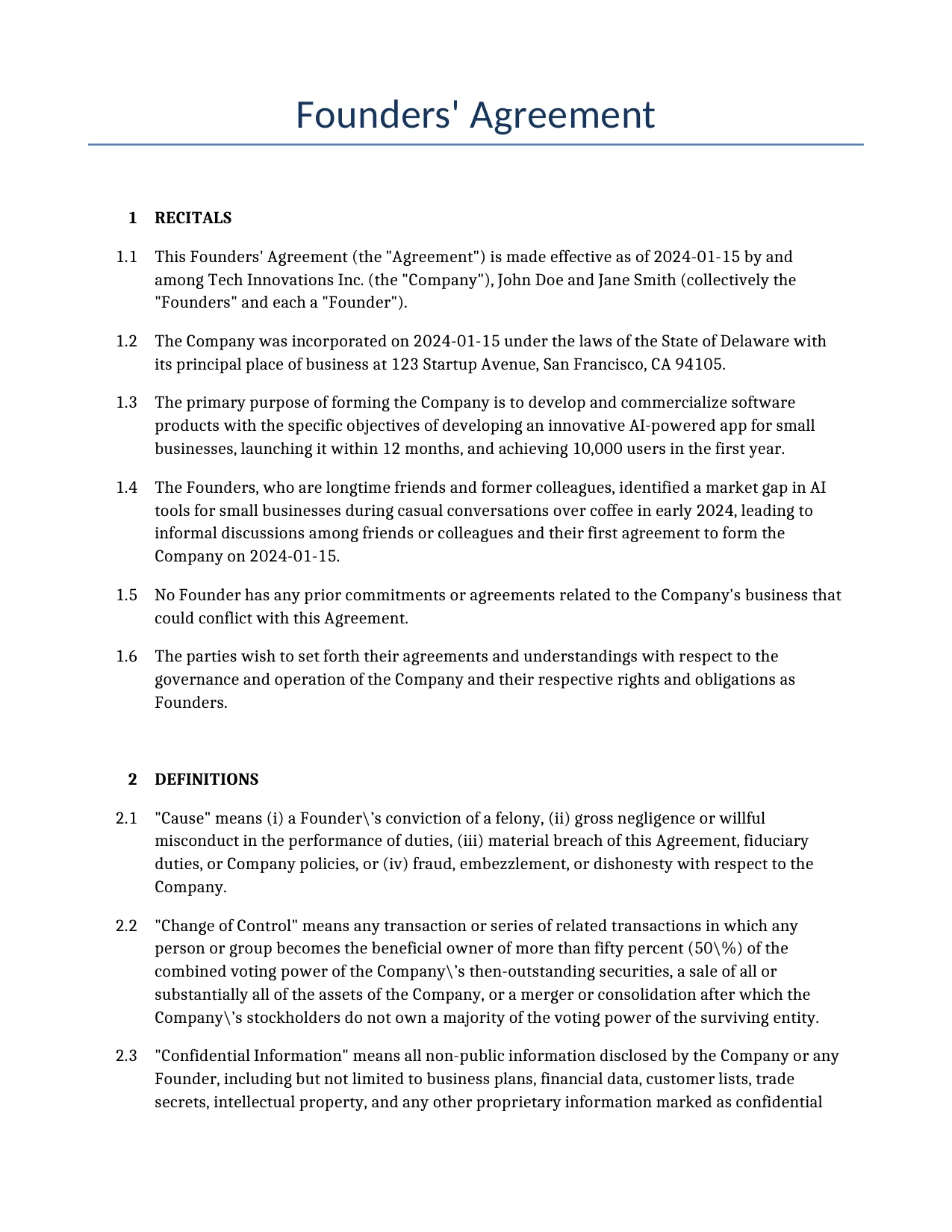
Below is a free template example of a Founders' Agreement for use in the United States generated by our AI model.
The clauses in your actual Founders' Agreement will vary from this example as they will be entirely bespoke to your requirements as set out in the questionnaire you complete.
Founders' Agreement
1RECITALS
This Founders' Agreement (the "Agreement") is made effective as of 2024-01-15 by and among Tech Innovations Inc. (the "Company"), John Doe and Jane Smith (collectively the "Founders" and each a "Founder").
The Company was incorporated on 2024-01-15 under the laws of the State of Delaware with its principal place of business at 123 Startup Avenue, San Francisco, CA 94105.
The primary purpose of forming the Company is to develop and commercialize software products with the specific objectives of developing an innovative AI-powered app for small businesses, launching it within 12 months, and achieving 10,000 users in the first year.
The Founders, who are longtime friends and former colleagues, identified a market gap in AI tools for small businesses during casual conversations over coffee in early 2024, leading to informal discussions among friends or colleagues and their first agreement to form the Company on 2024-01-15.
No Founder has any prior commitments or agreements related to the Company's business that could conflict with this Agreement.
The parties wish to set forth their agreements and understandings with respect to the governance and operation of the Company and their respective rights and obligations as Founders.
2DEFINITIONS
"Cause" means (i) a Founder\’s conviction of a felony, (ii) gross negligence or willful misconduct in the performance of duties, (iii) material breach of this Agreement, fiduciary duties, or Company policies, or (iv) fraud, embezzlement, or dishonesty with respect to the Company.
"Change of Control" means any transaction or series of related transactions in which any person or group becomes the beneficial owner of more than fifty percent (50\%) of the combined voting power of the Company\’s then-outstanding securities, a sale of all or substantially all of the assets of the Company, or a merger or consolidation after which the Company\’s stockholders do not own a majority of the voting power of the surviving entity.
"Confidential Information" means all non-public information disclosed by the Company or any Founder, including but not limited to business plans, financial data, customer lists, trade secrets, intellectual property, and any other proprietary information marked as confidential or which should reasonably be understood to be confidential.
"Intellectual Property" means all patents and inventions (whether or not patentable), copyrights, trademarks, trade secrets, know-how, software, works of authorship, and all other intellectual property rights, including all work-for-hire creations under U.S. copyright law.
"Termination" means the cessation of a Founder\’s service to the Company as an employee, officer, director, or consultant, whether by resignation, termination with or without Cause, or otherwise.
"Vesting Schedule" means the four-year vesting schedule with a one-year cliff described in Section 5 of this Agreement.
3FORMATION OF THE COMPANY
The Company was incorporated in the State of Delaware on 2024-01-15 under the Delaware General Corporation Law ("DGCL").
John Doe shall be designated as the registered agent for the Company with a physical address at 123 Main Street, Wilmington, DE 19801.
The Company shall be formed and operated in compliance with the DGCL, the Securities Act of 1933, the Securities Exchange Act of 1934, the Internal Revenue Code Section 83, the Internal Revenue Code Section 409A, and all other applicable provisions of U.S. federal and state law. This Agreement is not a substitute for the Company\’s Certificate of Incorporation, Bylaws, or any separate stockholders\’ agreement; in the event of any conflict between this Agreement and the Company\’s formation documents, the formation documents shall control. Provisions regarding vesting, IP assignment, and governance in this Agreement should be mirrored, as appropriate, in the Certificate of Incorporation or Bylaws.
4OWNERSHIP AND CAPITALIZATION
The total amount of initial capital to be contributed to the Company is $50,000.
The Company shall authorize the issuance of 10,000,000 shares of Common Stock with no par value.
John Doe shall contribute $30,000 in cash and shall receive 6,000,000 shares of Common Stock (60\% ownership).
Jane Smith shall contribute services valued at $20,000 and shall receive 4,000,000 shares of Common Stock (40\% ownership).
In exchange for the foregoing contributions, the Company shall issue the shares described above to the Founders pursuant to Section 152 and other applicable provisions of the DGCL. Stock certificates (or book-entry notations) shall be issued, and the shares shall be subject to the vesting provisions set forth in this Agreement, a separate Restricted Stock Purchase Agreement, and compliance with Internal Revenue Code Sections 83 and 409A. The Founders\’ ownership interests shall be subject to the vesting provisions set forth in this Agreement.
5EQUITY VESTING SCHEDULE
The Founders shall be subject to a four-year vesting schedule with a one-year cliff for their shares, with a vesting commencement date of 2024-01-15. The shares shall vest as to 25\% on the one-year anniversary of the vesting commencement date and as to the remaining shares in 36 equal monthly installments thereafter, subject to the Founder\’s continued service to the Company.
Unvested shares shall be subject to repurchase by the Company at a price of $0.0001 per share upon a Founder\’s Termination. This Agreement includes reverse vesting mechanics to the extent any shares are issued without vesting restrictions initially. Vesting shall accelerate upon a Change of Control as provided in a separate Restricted Stock Purchase Agreement or the Company\’s equity incentive plan.
Vesting shall not accelerate upon Termination without Cause unless otherwise approved by the Board of Directors or provided in a separate agreement. All vesting provisions shall be compliant with Internal Revenue Code Sections 83 and 409A. The detailed 409A-compliant vesting terms (including the repurchase right, acceleration provisions, and tax treatment) shall be set forth in a separate Restricted Stock Purchase Agreement to be executed by each Founder and the Company.
6ROLES AND RESPONSIBILITIES
John Doe shall serve as Chief Executive Officer (CEO) of the Company and shall be responsible for overseeing overall company strategy, leading business development, and managing the executive team. John Doe shall commit to full-time involvement in the Company.
Jane Smith shall serve as Chief Technology Officer (CTO) of the Company and shall be responsible for leading product development, managing the engineering team, and overseeing technical architecture. Jane Smith shall commit to full-time involvement in the Company.
The roles and responsibilities of the Founders may be amended as the Company grows in accordance with the amendment provisions of this Agreement. Each Founder shall also enter into a separate at-will employment agreement with the Company that will govern the terms of employment; in the event of any conflict between this Agreement and the employment agreements, the employment agreements shall control with respect to employment matters.
7GOVERNANCE AND DECISION-MAKING
The Company shall have a Board of Directors that shall be elected in accordance with the DGCL, the Certificate of Incorporation, and the Bylaws. The initial Board of Directors shall consist of three (3) directors: John Doe, Jane Smith, and one independent director to be mutually agreed upon by the Founders. The Board shall start with founder control and may be expanded as the Company raises capital or grows.
Board decisions shall require the approval of a majority of directors present at a meeting with a quorum (a majority of directors). Certain major decisions (including issuing new equity, amending the Bylaws, entering into contracts over $100,000, hiring or firing key executives, and approving mergers or acquisitions) shall require the approval of at least 66 2/3\% of the Board or such higher threshold as may be required under the DGCL or the Company\’s formation documents.
John Doe shall have veto rights over the major decisions listed above for so long as he remains a stockholder and director, to the extent consistent with the DGCL. Any disputes among the Founders regarding roles shall be resolved first by mediation by a neutral third-party, followed by binding arbitration in Delaware if necessary. The Board shall hold meetings at least quarterly.
8INTELLECTUAL PROPERTY ASSIGNMENT
Each Founder hereby assigns to the Company all right, title, and interest in and to any and all Intellectual Property created, conceived, or reduced to practice by such Founder in connection with the Company, whether before or after the date of this Agreement. This assignment is intended to be effective as of 2024-01-15 and includes a present-tense assignment ("hereby assigns") of all such IP, including all work-for-hire creations under U.S. copyright law, and is made in compliance with U.S. copyright and patent laws.
Each Founder shall execute a separate assignment of inventions and IP agreement in a form satisfactory to the Company to further document and perfect the Company\’s ownership. Each Founder confirms that he or she has no prior inventions or intellectual property created before joining the Company that relate to the Company\’s business other than as expressly disclosed in writing to the Company.
Each Founder agrees to assign all future Intellectual Property created during their involvement with the Company and shall execute all documents and take all actions necessary to perfect the Company\’s ownership of such Intellectual Property in compliance with applicable U.S. law. This provision shall be mirrored in the Company\’s employee proprietary information and inventions agreements.
9CONFIDENTIALITY OBLIGATIONS
Each Founder agrees to maintain the confidentiality of all Confidential Information and shall not disclose it to any third party without the prior written consent of the Company. Standard exceptions to the confidentiality obligations shall apply for information already known to the public through no fault of the receiving party, information independently developed, or information lawfully received from a third party.
The confidentiality obligations shall last indefinitely. Each Founder shall be subject to a non-solicitation obligation preventing such Founder from soliciting employees or customers for 24 months after Termination.
In the event of a breach of confidentiality obligations, the Company shall be entitled to seek injunctive relief, monetary damages, and attorney fees.
10NON-COMPETITION AND NON-SOLICITATION
Each Founder agrees not to solicit employees or customers of the Company for a period of 24 months after Termination. The non-solicitation restrictions shall apply equally to all Founders.
With respect to any non-competition covenant, such covenant shall be enforceable only to the extent permitted by applicable law. If a Founder is based in California, the non-compete shall be limited to the extent enforceable under California Business & Professions Code \§ 16600 (generally void except in connection with the sale of a business). The geographic scope shall be limited to those states or regions where the Company actively conducts business and the Founder had material involvement. This Agreement shall be construed to reform any unenforceable provision to the maximum extent permitted by law, including under the laws of the State of Delaware for non-California Founders. The restrictions contained in this section shall be enforceable to the maximum extent permitted under applicable law.
11COMPENSATION AND BENEFITS
John Doe shall receive an annual base salary of $180,000. Jane Smith shall receive an annual base salary of $160,000. Salaries shall be subject to periodic review and adjustment by the Board of Directors. Founders shall be eligible for such bonus plans, equity grants beyond the initial ownership described in Section 4, and employee benefits as the Board may approve.
The Company shall withhold all applicable federal, state, and local taxes and make such deductions and remittances as required by law. Each Founder\’s employment shall be at-will and may be terminated by either party at any time, with or without cause or notice. The Company shall maintain a formal policy for reimbursing Founder business expenses, with submissions and processing to occur on a monthly basis.
The parties acknowledge that this Agreement is not an employment agreement; each Founder shall enter into a separate at-will employment agreement with the Company. In the event of any conflict between this Agreement and the employment agreements, the employment agreements shall control with respect to employment, compensation, and benefits matters.
12TRANSFER RESTRICTIONS AND BUY-SELL AGREEMENT
No Founder may transfer any equity interests without first offering such interests to the Company and the other Founders pursuant to a right of first refusal ("ROFR") and providing 30 days\’ notice. The Company and other Founders shall have co-sale (tag-along) rights allowing them to participate in any sale to a third party on a pro-rata basis. Transfers shall require prior Board approval (which may be withheld in the Board\’s sole discretion) except for permitted transfers to immediate family members or trusts for estate planning purposes, subject to the transferee agreeing in writing to be bound by this Agreement.
The Company shall have the right to repurchase a Founder\’s shares upon Termination (whether voluntary or involuntary) at a price equal to (i) the lesser of fair market value or the original purchase price per share if Termination is for Cause or voluntary resignation without Good Reason, or (ii) fair market value if Termination is without Cause or for Good Reason. Fair market value shall be determined by an independent appraiser mutually selected by the parties or, if no agreement, by an appraiser appointed by the Delaware Court of Chancery. Payment shall be made in a lump sum or in installments over 12 months, as determined by the Board.
The buy-sell provisions shall also be triggered by the death, permanent disability, or material breach of this Agreement by a Founder. The remaining Founders shall have a right of first refusal to match any external offers. This Agreement includes drag-along rights whereby, in a sale of the Company approved by the Board and holders of a majority of shares, all stockholders shall be required to sell their shares on the same terms, subject to customary exceptions and compliance with securities laws (including Rule 701 where applicable). All transfers of interests shall comply with the Securities Act of 1933, the Securities Exchange Act of 1934, and all other applicable provisions of U.S. law.
13TERMINATION AND WITHDRAWAL
A Founder may resign or be terminated as an at-will employee. This Agreement distinguishes between a Founder\’s roles as stockholder, officer/director, and at-will employee. Termination as an employee does not automatically constitute removal as an officer or director; such removal shall be governed by the Bylaws, DGCL, and any separate agreements.
"Cause" shall have the meaning set forth in the Definitions section. Upon Termination for Cause or voluntary resignation, the Company shall have the right to repurchase the Founder\’s unvested shares at nominal cost ($0.0001 per share) and vested shares at fair market value or book value (as determined by the Board). Upon Termination without Cause, the Company shall have the right to repurchase unvested shares at nominal cost, while vested shares may be subject to a right of first refusal. Any accelerated vesting or severance shall require a general release of claims in a form satisfactory to the Company.
Confidentiality obligations and the non-solicitation covenant shall survive any Termination or withdrawal. No garden leave provision shall apply unless set forth in a separate employment agreement.
14EMPLOYMENT MATTERS
Each Founder\’s employment with the Company shall be at-will. Termination procedures, notice periods (if any), severance (if any), and other employment terms shall be governed by separate employment agreements to be entered into between the Company and each Founder. The Founders\’ Agreement and the employment agreements are intended to be complementary; however, in the event of any conflict, the employment agreements shall control solely with respect to employment terms, while this Agreement shall control with respect to equity, IP, transfer restrictions, and governance matters.
The Company shall comply with all applicable immigration laws, including verification of employment eligibility via Form I-9.
15DISPUTE RESOLUTION
Any disputes among the Founders shall first be subject to mediation and then to binding arbitration if mediation is unsuccessful. The dispute resolution process shall be governed by the laws of the State of Delaware and all proceedings shall be kept confidential. The parties agree that any disputes arising under this Agreement shall be resolved exclusively in the courts of the State of Delaware (or federal courts located therein) in the event arbitration is unavailable.
16INDEMNIFICATION
The Company shall indemnify each Founder for actions taken in their official capacity as an officer or director provided such actions meet the standard under the DGCL (good faith, reasonable belief that actions were in the best interests of the Company, and no reasonable cause to believe conduct was unlawful in any criminal proceeding). Indemnification shall cover third-party claims, derivative actions, and regulatory investigations to the fullest extent permitted by the DGCL.
The Company shall advance legal expenses to Founders prior to final resolution of any claim, subject to an undertaking to repay if it is ultimately determined that indemnification is not permitted. The indemnification provided in this Agreement shall be in addition to, rather than in lieu of, any directors and officers (D&O) insurance coverage. These indemnification rights shall be mirrored in the Company\’s Bylaws or a separate indemnification agreement.
17REPRESENTATIONS AND WARRANTIES
Each Founder represents and warrants that: (i) such Founder has full authority to enter into this Agreement; (ii) this Agreement does not conflict with any prior agreements, including any employment, confidentiality, or IP agreements with former employers; (iii) such Founder owns all right, title, and interest in any IP contributed to the Company free of any liens or claims; (iv) such Founder is a U.S. citizen or legal resident authorized to work in the United States and will comply with all immigration laws; (v) such Founder has no felony convictions or pending criminal charges that could affect service to the Company; (vi) such Founder is not currently involved in any litigation or disputes that could materially affect the Company; and (vii) all representations and warranties are true and complete to the best of such Founder\’s knowledge.
Each Founder acknowledges that the Company is entering into this Agreement in reliance upon these representations and warranties. These representations and warranties shall survive the execution of this Agreement and the issuance of shares for a period of two (2) years.
18ENTIRE AGREEMENT
This Agreement constitutes the entire understanding between the parties and supersedes all prior agreements or understandings between the Founders. Modifications to this Agreement may be made only by written amendment executed by all parties.
19AMENDMENT AND WAIVER
This Agreement may be amended only by the unanimous written consent of all Founders and the Company, subject to any additional requirements under the DGCL or the Company\’s Certificate of Incorporation or Bylaws. All waivers of provisions must be in writing. A specific waiver of any provision shall not imply a waiver of any other provision.
20SEVERABILITY
If any provision of this Agreement is held to be invalid or unenforceable, the remaining provisions shall remain in full force and effect. The parties agree to attempt to reform any invalid provision to reflect the original intent as closely as possible. The severability provisions shall be interpreted under the laws of the State of Delaware.
21GOVERNING LAW
This Agreement shall be governed by and construed in accordance with the laws of the State of Delaware without regard to its conflict of laws principles. For California-based Founders, non-compete and employment matters shall be interpreted consistent with California law to the extent required for enforceability.
22NOTICES
All notices under this Agreement shall be in writing and may be delivered by personal delivery, certified mail, or email to the address specified for each party including 123 Founder Street, Startup City, CA 90210. Notices sent by mail shall be deemed received three business days after mailing. Electronic notices shall be effective upon transmission provided confirmation of receipt is obtained.
23ASSIGNMENT
Neither this Agreement nor any rights or obligations hereunder may be assigned by any party without the prior written consent of the other parties, except in connection with a Change of Control or permitted transfer of shares under Section 12.
24COUNTERPARTS
This Agreement may be executed in multiple counterparts, each of which shall be deemed an original, but all of which together shall constitute one and the same instrument. Delivery of an executed counterpart by facsimile or electronic transmission shall be effective as delivery of a manually executed counterpart.
25MISCELLANEOUS
This Agreement is not intended to confer any rights or remedies upon any person or entity other than the parties hereto and their respective successors and permitted assigns (no third-party beneficiaries clause).
Neither party shall be liable for any delay or failure to perform due to causes beyond its reasonable control, including acts of God, war, terrorism, pandemics, or governmental orders (force majeure).
Each Founder shall bear his or her own costs and expenses (including legal fees) incurred in connection with the drafting and negotiation of this Agreement and related formation documents.
The parties shall execute such further documents and take such further actions as may be reasonably necessary to carry out the purposes of this Agreement (further assurances clause).
The parties agree that monetary damages may be insufficient for breach of this Agreement and that specific performance and injunctive relief shall be available as remedies in addition to any other remedies at law or in equity.
26SIGNATURE SECTION
IN WITNESS WHEREOF, the parties have executed this Agreement as of the date first above written.
Tech Innovations Inc.: _______________________________ By: John Doe, Chief Executive Officer Date: _______________
John Doe: _______________________________ Date: _______________
Jane Smith: _______________________________ Date: _______________
This example shows approximately 70% of a typical document and is provided for illustrative purposes only. The remaining content has been omitted.
Every document generated by Docaro is tailored to your specific circumstances, jurisdiction and the information you provide. The completed document includes all applicable clauses and provisions required for your situation.
To generate the full, personalised document, answer a short series of questions and your document will be created instantly.