
AI Generated Compensation Philosophy Statement for use in the United States
PDF & Word - 2026 Updated
Docaro Pricing
When Do You Need a Compensation Philosophy Statement in the United States?
American Legal Rules for a Compensation Philosophy Statement
Using an inappropriate structure for a compensation philosophy statement may lead to misalignment with regulatory requirements or internal governance standards.
What a Proper Compensation Philosophy Statement Should Include
- Purpose of CompensationClearly state the goals of your compensation program, such as attracting, motivating, and retaining talented employees.
- Approach to PayDescribe how pay will be set, whether competitive with market rates, internal equity, or a mix of both.
- Total Rewards OverviewOutline the full package including base salary, bonuses, benefits, and other incentives to support employee well-being.
- Pay for PerformanceExplain how compensation ties to individual, team, and company performance to drive results.
- Market PositioningSpecify where your pay levels aim to sit relative to industry peers, like at the median or top quartile.
- Equity and FairnessCommit to fair pay practices that value diversity, inclusion, and equal opportunities for all employees.
- Governance and ReviewDetail how the compensation program will be overseen, updated, and communicated to ensure ongoing relevance.
Generate Your Document in 4 Easy Steps
Why Use Docaro?
 United States
Free Example Compensation Philosophy Statement Template
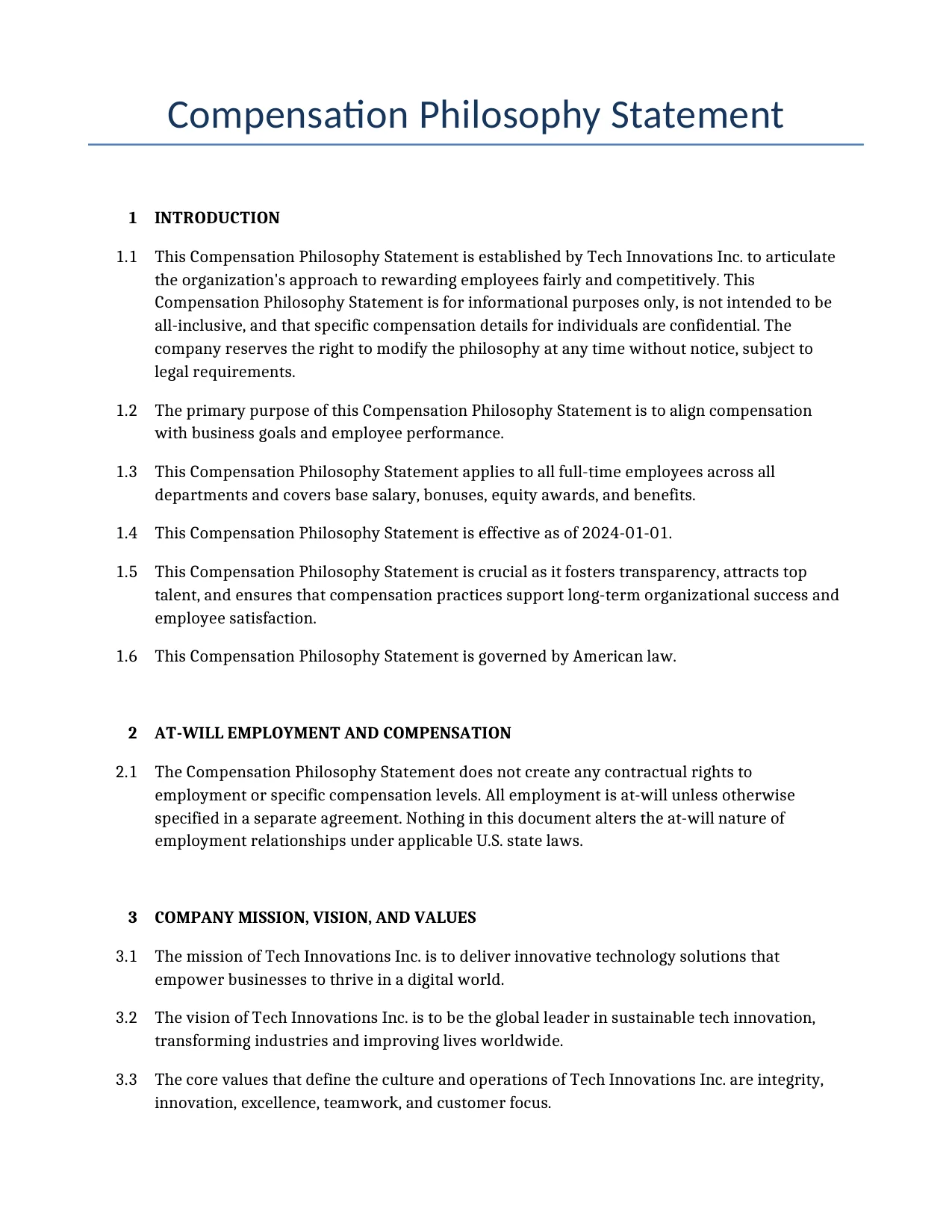
Below is a free template example of a Compensation Philosophy Statement for use in the United States generated by our AI model.
The clauses in your actual Compensation Philosophy Statement will vary from this example as they will be entirely bespoke to your requirements as set out in the questionnaire you complete.
Compensation Philosophy Statement
1INTRODUCTION
This Compensation Philosophy Statement is established by Tech Innovations Inc. to articulate the organization's approach to rewarding employees fairly and competitively. This Compensation Philosophy Statement is for informational purposes only, is not intended to be all-inclusive, and that specific compensation details for individuals are confidential. The company reserves the right to modify the philosophy at any time without notice, subject to legal requirements.
The primary purpose of this Compensation Philosophy Statement is to align compensation with business goals and employee performance.
This Compensation Philosophy Statement applies to all full-time employees across all departments and covers base salary, bonuses, equity awards, and benefits.
This Compensation Philosophy Statement is effective as of 2024-01-01.
This Compensation Philosophy Statement is crucial as it fosters transparency, attracts top talent, and ensures that compensation practices support long-term organizational success and employee satisfaction.
This Compensation Philosophy Statement is governed by American law.
2AT-WILL EMPLOYMENT AND COMPENSATION
The Compensation Philosophy Statement does not create any contractual rights to employment or specific compensation levels. All employment is at-will unless otherwise specified in a separate agreement. Nothing in this document alters the at-will nature of employment relationships under applicable U.S. state laws.
3COMPANY MISSION, VISION, AND VALUES
The mission of Tech Innovations Inc. is to deliver innovative technology solutions that empower businesses to thrive in a digital world.
The vision of Tech Innovations Inc. is to be the global leader in sustainable tech innovation, transforming industries and improving lives worldwide.
The core values that define the culture and operations of Tech Innovations Inc. are integrity, innovation, excellence, teamwork, and customer focus.
The compensation philosophy of Tech Innovations Inc. is guided by principles of fairness, competitiveness, and performance alignment, ensuring that rewards reflect contributions to business success while promoting equity across all levels.
The compensation philosophy of Tech Innovations Inc. supports the mission by incentivizing employees to innovate and deliver high-impact solutions through performance-based bonuses and equity grants that align personal success with company goals.
The compensation philosophy of Tech Innovations Inc. supports the vision by offering competitive salaries and long-term incentives that attract top talent committed to sustainable innovation, fostering a culture of continuous improvement and global leadership.
The compensation philosophy of Tech Innovations Inc. reinforces core values like integrity and teamwork through transparent pay structures, recognition programs for collaborative efforts, and inclusive benefits that promote diversity and excellence.
4STRATEGIC OBJECTIVES
The key long-term strategic goals of Tech Innovations Inc. over the next five years include expanding into new international markets, achieving 20 percent annual revenue growth through innovation in sustainable products, and building a diverse and inclusive workforce to drive operational excellence.
The compensation strategies of Tech Innovations Inc. align with these long-term goals by incorporating performance-based incentives tied to revenue growth targets, equity grants that reward long-term contributions to market expansion, and comprehensive benefits packages that support employee well-being and retention to foster innovation.
The compensation strategies of Tech Innovations Inc. emphasize elements that promote company growth as a strategic objective.
Talent retention is assigned high priority in the strategic objectives of Tech Innovations Inc.
5MARKET POSITIONING
Tech Innovations Inc. takes a premium approach for positioning compensation relative to market benchmarks.
The rationale for the premium market positioning approach of Tech Innovations Inc. is to attract and retain top-tier talent in a highly competitive industry by offering premium compensation packages, which aligns with the strategy to position the organization as a leader in innovation and employee satisfaction, ensuring the ability to draw from the best candidates globally while fostering long-term loyalty and high performance.
Tech Innovations Inc. uses industry specific reports, peer company proxies, and custom consultant analyses for market compensation benchmarks.
Tech Innovations Inc. targets the 75th percentile relative to market benchmarks for compensation positioning.
6TOTAL COMPENSATION COMPONENTS
Base salary at Tech Innovations Inc. is determined through a combination of market benchmarking, individual performance evaluations, and internal equity assessments to ensure competitive and fair compensation.
Base salaries at Tech Innovations Inc. are reviewed for adjustments annually.
Short-term incentives are included as a component of total compensation at Tech Innovations Inc.
Long-term incentives are included as a component of total compensation at Tech Innovations Inc.
Benefits are included as a component of total compensation at Tech Innovations Inc. Benefits comply with the Affordable Care Act (ACA), ERISA for retirement plans, and FMLA for leave policies. The company conducts non-discrimination testing for benefits plans and fulfills any applicable reporting requirements like Form 5500 filings.
7PAY FOR PERFORMANCE PHILOSOPHY
Tech Innovations Inc. is firmly committed to a pay-for-performance philosophy that directly ties employee compensation to measurable performance outcomes at individual, team, and company-wide levels, fostering a culture of accountability and excellence. Performance metrics and evaluation processes are designed to be objective, non-discriminatory, and compliant with laws prohibiting discrimination based on protected characteristics. The company avoids practices that could be seen as encouraging undue risk-taking in violation of SEC rules or other regulations.
Individual performance outcomes are included as a key factor in linking compensation at Tech Innovations Inc.
Team performance outcomes are included as a key factor in linking compensation at Tech Innovations Inc.
Organizational performance outcomes are included as a key factor in linking compensation at Tech Innovations Inc.
Performance is measured annually for compensation linkage purposes at Tech Innovations Inc.
Financial metrics, operational metrics, and customer metrics are emphasized in the pay for performance philosophy of Tech Innovations Inc.
8INTERNAL EQUITY AND PAY STRUCTURE
Tech Innovations Inc. implements a formal job evaluation method using the point factor method to assess the relative value of roles for internal equity.
Tech Innovations Inc. establishes a grading system to structure pay bands across different roles.
Tech Innovations Inc. conducts regular equity audits annually to review pay fairness across roles.
Tech Innovations Inc. conducts pay equity audits by first gathering comprehensive compensation data for all employees, including base salary, bonuses, and benefits.
Tech Innovations Inc. then analyzes this data using statistical methods to identify any disparities based on gender, race, or other protected characteristics, controlling for factors like job role, experience, and performance.
If discrepancies are found at Tech Innovations Inc., action plans are developed to address them, such as salary adjustments, and findings are reported to senior leadership for transparency and accountability.
9EXTERNAL COMPETITIVENESS AND BENCHMARKING
Tech Innovations Inc. conducts the market analysis for external competitiveness annually.
Tech Innovations Inc. uses an industry-based peers method for selecting peer groups in the benchmarking process and includes a custom list of specific peer companies.
Tech Innovations Inc. uses commercial surveys such as those from Mercer and Willis Towers Watson as well as public disclosures such as proxy statements for conducting the market analysis.
Tech Innovations Inc. allocates an annual budget of 50000 for external benchmarking and market analysis activities.
The compensation at Tech Innovations Inc. is positioned at the 75th percentile which is above the median.
Tech Innovations Inc. includes provisions for annual adjustments to compensation based on benchmarking results.
10EQUITY COMPENSATION
Equity compensation is included in the compensation philosophy of Tech Innovations Inc.
The types of equity awards used in the compensation program of Tech Innovations Inc. are stock options, restricted stock units, and performance shares.
The equity compensation program of Tech Innovations Inc. aims to align employee interests with long-term company performance and shareholder value, with key features including a mix of stock options, restricted stock units, and performance shares, with vesting tied to continued service and achievement of strategic goals.
A hybrid vesting schedule is applied to the equity awards at Tech Innovations Inc.
The standard vesting period at Tech Innovations Inc. spans four years, with vesting occurring every 12 months.
Equity awards represent 30.5 percent of total compensation for target participants at Tech Innovations Inc.
Vesting is accelerated upon a change in control event at Tech Innovations Inc.
11EXECUTIVE COMPENSATION
Base salaries for senior executives at Tech Innovations Inc. are determined through a combination of market benchmarking against peer companies, individual performance evaluations, and the executive's role responsibilities and experience.
An annual incentive plan is included as part of executive compensation at Tech Innovations Inc.
Long-term incentives are included in the executive compensation structure at Tech Innovations Inc.
Clawback provisions are enabled for executive compensation at Tech Innovations Inc.
The compensation committee provides full oversight for executive pay decisions at Tech Innovations Inc.
Peer group benchmarking is used for setting executive compensation levels at Tech Innovations Inc.
12DIVERSITY, EQUITY, AND INCLUSION IN COMPENSATION
Tech Innovations Inc. conducts regular pay equity analyses annually to identify and address any disparities in compensation based on gender, race and ethnicity, age, and disability status. The company is committed to conducting regular pay equity audits that comply with EEOC guidelines, addressing any identified disparities promptly, and providing training on unconscious bias in compensation decisions. If applicable, the company complies with Executive Order 11246 for federal contractors. The company prohibits retaliation against employees who discuss their compensation as protected under the National Labor Relations Act (NLRA) and other laws.
Tech Innovations Inc. promotes diversity, equity, and inclusion through transparent salary bands based on role and experience, unbiased performance evaluations, and targeted training programs for underrepresented groups to ensure equitable advancement opportunities.
13LEGAL COMPLIANCE
Tech Innovations Inc. is committed to full legal compliance in all compensation practices. This includes adherence to the Fair Labor Standards Act (FLSA) for wage and overtime requirements, the Equal Pay Act for gender-based pay equity, Title VII of the Civil Rights Act for non-discrimination in compensation, the Age Discrimination in Employment Act (ADEA), the Americans with Disabilities Act (ADA), the Lilly Ledbetter Fair Pay Act, and any applicable state-specific laws such as California's Fair Pay Act or New York's Equal Pay Law. Compensation practices will be regularly reviewed for compliance with these laws and the company maintains records as required.
14COMPLIANCE AND GOVERNANCE
Tech Innovations Inc. is registered with the SEC, and Item 402 Proxy Disclosure and Say-on-Pay Rules apply to its compensation practices.
Tech Innovations Inc. acknowledges the 1 million dollar tax deductibility limit under Internal Revenue Code Section 162(m) for executive compensation and adheres to Section 409A Deferred Compensation and Section 162(m) Deductibility Limits in compensation design.
The board of directors of Tech Innovations Inc. oversees the compensation philosophy and practices.
Tech Innovations Inc. ensures governance oversight in compensation decisions through regular reviews by the Compensation Committee of the Board, independent consultant advice, and alignment with shareholder interests via annual advisory votes.
Tech Innovations Inc. has a clawback policy for incentive compensation and follows the NYSE Listed Company Manual and Sarbanes-Oxley Act Provisions for corporate governance standards related to compensation.
This Compensation Philosophy Statement is governed by American law, including compliance with Regulation S-K and Internal Revenue Code Section 162(m).
Data Privacy and Security in Compensation Practices: The company complies with the California Consumer Privacy Act (CCPA) or other state privacy laws if applicable, the General Data Protection Regulation (GDPR) for any EU employees, and follows best practices for protecting sensitive employee compensation data from breaches.
15SEVERANCE AND CHANGE IN CONTROL POLICIES
Tech Innovations Inc. provides severance benefits in alignment with the overall compensation philosophy to support fair treatment during transitions. Severance is typically calculated based on length of service, role level, and other factors such as a formula of two weeks of base pay per year of service up to a maximum of 26 weeks, or as specified in individual agreements. In cases of change in control, enhanced benefits may include accelerated equity vesting. These policies comply with the Worker Adjustment and Retraining Notification (WARN) Act for mass layoffs and COBRA for continuation of health benefits.
16RISK MANAGEMENT IN COMPENSATION
An incentive plan is included as part of the compensation programs at Tech Innovations Inc.
The risk mitigation measures implemented in the compensation programs at Tech Innovations Inc. are clawback provisions, performance metrics diversification, and caps on incentive payouts.
Tech Innovations Inc. conducts annual risk assessments for its compensation programs.
Incentive plans at Tech Innovations Inc. will emphasize long-term performance metrics aligned with sustainable business growth, incorporate balanced financial and non-financial goals to prevent short-termism, and include rigorous review processes to ensure designs do not encourage excessive risk.
The Compensation Committee and the full board of directors are involved in overseeing compensation risk management at Tech Innovations Inc.
17EMPLOYEE COMMUNICATION AND TRANSPARENCY
Compensation information is communicated to employees at Tech Innovations Inc. annually during performance reviews, with quarterly updates on any changes.
The methods used for communicating compensation information to employees at Tech Innovations Inc. are an annual total rewards statement and an internal newsletter or email.
A high level of detail is provided in compensation communications to employees at Tech Innovations Inc., including base salary ranges, bonus structures, and total compensation breakdowns, while respecting individual privacy.
The compensation communications at Tech Innovations Inc. target all full-time employees and new hires during onboarding.
18REVIEW AND AMENDMENT PROCESS
The periodic review of the compensation philosophy at Tech Innovations Inc. occurs annually, with the next review set for 2024-12-31.
Specific trigger events prompt an unscheduled review of the compensation philosophy at Tech Innovations Inc.
The Compensation Committee is designated as the lead for conducting the periodic review of the compensation philosophy at Tech Innovations Inc.
The review at Tech Innovations Inc. involves gathering input from key stakeholders, analyzing market data on compensation trends, assessing internal pay equity, and evaluating alignment with organizational goals, after which a report is prepared summarizing findings and recommendations.
The Board of Directors at Tech Innovations Inc. reviews proposed amendments from the Compensation Committee, discusses potential impacts on the organization, votes on approval, and ensures compliance with legal and regulatory requirements before finalizing any changes.
The Board of Directors has the final approval authority for updates and amendments to the compensation philosophy at Tech Innovations Inc.
All reviews and amendments to the compensation philosophy at Tech Innovations Inc. are documented.
19EFFECTIVE DATE AND APPROVAL
This Compensation Philosophy Statement is effective as of 2024-01-01.
This Compensation Philosophy Statement is approved by the Board of Directors and the Compensation Committee. The document has been reviewed and approved by legal counsel to ensure compliance with all applicable federal, state, and local employment laws. Placeholder for date of legal review: ________________.
20DEFINITIONS AND INTERPRETATIONS
'Total compensation' refers to the complete package of base salary, short-term and long-term incentives, benefits, and other rewards provided to employees. 'Performance metrics' are the specific, measurable criteria used to evaluate employee, team, or organizational achievements. 'Internal equity' means the fairness of pay relationships among different roles and employees within the company based on factors like responsibility, skills, and experience. 'Market benchmarks' are compensation data from comparable companies used to gauge competitiveness. In case of any conflict with applicable law, the law will prevail. This document is to be interpreted under U.S. federal and state laws, with Delaware as the primary jurisdiction if the company is incorporated there.
21SIGNATURE SECTION
IN WITNESS WHEREOF, the parties have executed this Compensation Philosophy Statement as of the effective date first above written.
Tech Innovations Inc.: _______________________________ Date: _______________
By: [Authorized Signatory Name and Title]
This example shows approximately 70% of a typical document and is provided for illustrative purposes only. The remaining content has been omitted.
Every document generated by Docaro is tailored to your specific circumstances, jurisdiction and the information you provide. The completed document includes all applicable clauses and provisions required for your situation.
To generate the full, personalised document, answer a short series of questions and your document will be created instantly.