Docaro

AI Generated American Room Rental Agreement - 2026 Updated

A welcoming and modern shared living space in the United States, featuring roommates relaxing in a cozy living room with comfortable furniture, houseplants, and natural light streaming through large windows, symbolizing the harmonious agreement in room rentals.
Discover how AI technology can effortlessly create detailed room rental agreements tailored for the United States.
Free instant document creation.
Legally compliant agreements.
No signup required.
Generate your document for free.
Download PDF, Word and email for $9.99 USD.

Generate Your Room Rental Agreement in 4 Easy Steps

1
Answer a Few Questions
Our AI guides you through the info required.
2
Generate Your Document
Docaro builds the document based on your requirements.
3
Review & Edit
Review your document and submit any further requested changes.
4
Download & Sign
Download your ready to sign document as a PDF, Word, Txt or HTML.

Why Use Our AI Room Rental Agreement Generator?

Fast Generation
Quickly generate a comprehensive Room Rental Agreement, eliminating the hassle and time associated with traditional document drafting.
Guided Process
Our user-friendly platform simplifies the document creation process, enabling you to complete agreements with just a few clicks.
Professionally Formatted Document
Your Room Rental Agreement will be formatted to professional standards, including headings, clause numbers and structured layout. No further editing is required.
High Accuracy
Our AI ensures high accuracy by using advanced algorithms to craft agreements that perfectly cater to your specific requirements.
Compliance with American Law
Rest assured that all generated documents meet the latest legal standards and regulations of the United States, enhancing trust and reliability.
Cost-Effective
Save money by generating legally sound tenancy agreements without the need for expensive legal services or consultations.
Get Started for Free - No Sign Up Required
No payment or sign up is required to start generating your Room Rental Agreement. Simply answer a few questions and a preview of your final document will be generated.
Looking to Generate a Room Rental Agreement in a Different Country?
Choose a different country:

Compliance Legislation

Your AI Generated Room Rental Agreement will be checked for compliance against the following legislation and regulations:
A model law adopted in various states to standardize rights and obligations in residential rental agreements, covering aspects like security deposits, evictions, and habitability.
Prohibits discrimination in housing based on race, color, religion, sex, national origin, familial status, or disability in rental agreements and housing practices.
Requires disclosure of finance charges and terms for any credit extended in connection with a room rental, such as if payments are financed.
Regulates settlement processes and prohibits kickbacks in real estate transactions, applicable if the room rental involves settlement services.
Requires disclosure of known lead-based paint hazards in pre-1978 housing rentals, including room rentals.
Varies by state; governs residential tenancy agreements, including room rentals, covering rent, deposits, repairs, and eviction procedures. Example from California.

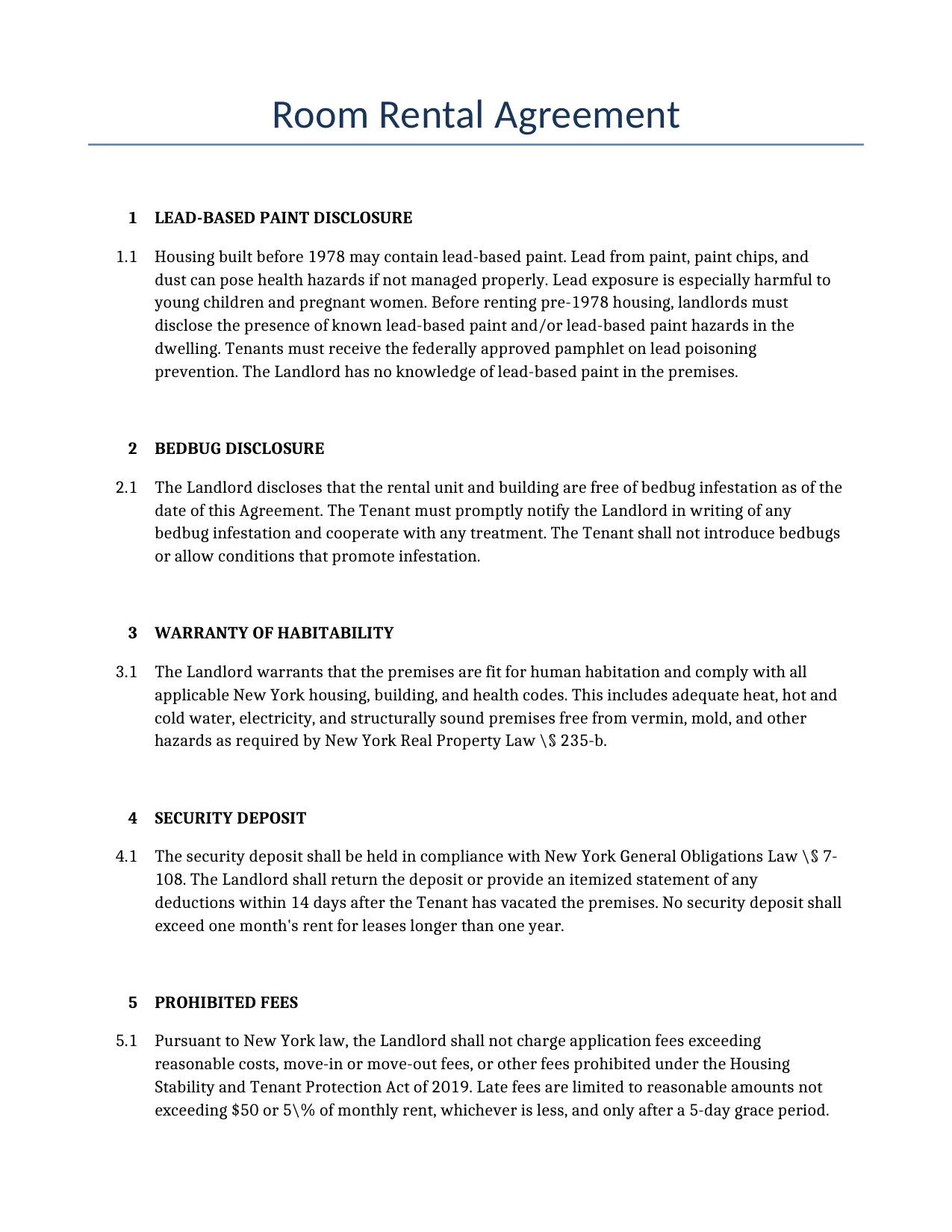
Example Room Rental Agreement

Below is an example of a Room Rental Agreement generated by our AI model. The clauses in your Room Rental Agreement will vary from this example as they will be entirely bespoke to your requirements as set out in the questionnaire you complete.
Page 1

What is a Room Rental Agreement in the United States?

A room rental agreement is a legal contract that outlines the terms for renting a single room within a shared property, such as a house or apartment, where the landlord or a primary tenant sublets the space to another individual. Its primary purpose is to protect both the renter and the property owner by specifying details like rent amount, payment schedules, house rules, and duration of the tenancy, ensuring clarity and reducing disputes in roommate situations. This document is essential for establishing legal rights and responsibilities in shared living arrangements, often used in urban areas with high housing costs.

Unlike a full lease agreement, which grants exclusive control over an entire property to the tenant, a room rental agreement focuses on shared spaces and limits the renter's access to only their designated room while imposing rules for common areas like the kitchen or bathroom. Full leases typically involve longer terms and more comprehensive property maintenance obligations, whereas room agreements are often shorter and more flexible, accommodating transient living like for students or young professionals. This distinction helps prevent misunderstandings in multi-occupant homes, making room rentals a popular affordable housing option.

Room rental agreements are generally applicable across all US states, though specifics can vary based on local landlord-tenant laws, such as notice periods for eviction or security deposit regulations. For authoritative guidance, consult resources like the U.S. Department of Housing and Urban Development (HUD) or state-specific attorney general websites. To ensure compliance, it's advisable to have the agreement reviewed by a legal professional familiar with your state's rental laws, promoting secure and fair room rental practices nationwide.

Professional signing rental agreement

When Should You Use a Room Rental Agreement?

A room rental agreement is particularly appropriate for short-term room rentals in shared homes, where individuals seek flexible housing options like students or young professionals moving to a new city. In the US, this setup allows tenants to rent a single room while sharing common areas, providing affordability amid rising housing costs. Landlords benefit by generating steady income from unused space without the commitment of a full lease, as outlined in resources from the U.S. Department of Housing and Urban Development.

Subletting arrangements also make a room rental agreement essential, enabling current tenants to rent out their room temporarily while away for work or travel, common in urban areas like New York or San Francisco. This protects both parties by clarifying responsibilities for rent payments and maintenance, reducing disputes in informal housing situations. Tenants gain security through defined terms, while landlords maintain control over their property, supported by state-specific laws detailed on sites like Nolo's legal encyclopedia.

In informal housing situations, such as renting a room from friends or family, a simple room rental agreement formalizes the arrangement to avoid misunderstandings over utilities or house rules. It offers legal recourse if issues arise, benefiting tenants with clear rights and landlords with documented consent. This is especially useful in the US rental market, where such agreements can prevent evictions or financial losses, as recommended by the Rocket Lawyer platform for customizable templates.

Key handover in rental process

When Should You Avoid Using a Room Rental Agreement?

A room rental agreement is typically ideal for short-term sublets or shared living arrangements where one roommate rents a single room in an existing household. However, it should not be used for long-term full-property rentals, such as when a landlord leases an entire apartment or house to a tenant for an extended period like a year or more. In these cases, a comprehensive lease agreement is necessary to outline detailed terms including rent escalations, maintenance responsibilities, and eviction procedures, ensuring both parties are protected under standard rental laws.

Similarly, room rental agreements are inappropriate for commercial spaces, where businesses lease offices, retail areas, or warehouses for operations. Commercial rentals demand specialized contracts that address zoning regulations, liability insurance, and business-specific clauses not covered in simple room rentals. Misusing a room agreement here could lead to disputes over permitted uses or inadequate protections against property damage from business activities.

Moreover, avoid room rental agreements when state laws require a formal lease, such as in jurisdictions mandating written leases for rentals exceeding 30 days or involving security deposits. For instance, states like California require formal leases for tenancies over one year to comply with habitability standards. The legal risks of misuse include unenforceability in court, potential fines for non-compliance, or vulnerability to tenant rights violations, as highlighted by resources from the U.S. Department of Housing and Urban Development. To mitigate these, always consult local real estate laws or a legal professional before drafting any rental document.

What Are the Key Rights and Obligations of Parties in a Room Rental Agreement?

In a US room rental agreement, tenants' primary obligations include paying rent on time, typically monthly, and adhering to the terms outlined in the lease, such as not subletting without permission. Landlords must provide a habitable living space, covering maintenance responsibilities like repairs for plumbing, heating, and structural issues, while tenants handle minor upkeep like cleaning their room. These duties can vary by state; for instance, California requires landlords to maintain common areas, whereas Texas emphasizes tenant responsibility for utilities unless specified otherwise. For detailed state-specific laws, refer to Nolo's Landlord-Tenant Law Guide.

Privacy rights for tenants protect against unreasonable landlord entries, often requiring at least 24 hours' notice for non-emergency access, ensuring personal space in shared rentals. Eviction procedures demand landlords follow legal processes, such as serving notices for non-payment and obtaining court orders, prohibiting self-help evictions like changing locks. State variations are significant; New York mandates a strict judicial process, while some southern states allow faster timelines for cause evictions. Bullet-point summaries of key rights include:

  • Rent payment: Due on agreed dates, with late fees possible but capped in states like Illinois.
  • Maintenance: Landlords fix major issues; tenants report problems promptly.
  • Privacy: No warrantless searches; reasonable notice for inspections.
  • Eviction: Court-supervised, with tenant defenses like habitability breaches.
Consult HUD's Tenant Rights for federal overviews.

Reviewing US legal rental clauses

What Are the Essential Clauses to Include in a Room Rental Agreement?

A room rental agreement is a crucial document for tenants and landlords in the US, outlining key terms to prevent disputes. The most important clauses include the rent amount and due dates, which specify the monthly payment and when it's due, often on the first of the month. Security deposit terms detail the amount, usually one to two months' rent, and conditions for its return, such as deductions for damages. For more details on essential clauses in a room rental agreement US, see this guide.

House rules form another vital section, covering shared living expectations like quiet hours, guest policies, and cleaning responsibilities to maintain harmony. Termination conditions explain how either party can end the agreement, including notice periods (typically 30 days) and reasons for early termination like non-payment. These clauses ensure clarity in room rental agreements; for authoritative advice, refer to the Nolo resource on leases.

Understanding these clauses helps protect both parties' rights under US housing laws. Always customize the agreement to local regulations for a valid room rental contract. Bullet-point summaries can aid quick reference:

  • Rent Amount: Fixed monthly fee, e.g., $800.
  • Due Date: Specify exact day and late fees.
  • Security Deposit: Refundable with itemized deductions.
  • House Rules: No smoking, pet restrictions.
  • Termination: 30-day notice required.

Are There Key Exclusions or Limitations in Room Rental Agreements?

Room rental agreements often include specific exclusions to clarify what the contract does not cover, helping both landlords and tenants avoid misunderstandings. For instance, these agreements typically exclude liabilities for shared common areas, meaning the landlord may not be responsible for injuries or damages occurring in hallways, kitchens, or laundry rooms unless explicitly stated. Additionally, room rental contracts do not inherently provide discrimination protections, as these are governed by broader housing laws rather than the agreement itself.

Common exclusions in room rental agreements also extend to unspoken limitations, such as pet policies or subletting rights, which might not be detailed unless specified. Tenants should review the agreement for clauses that limit responsibility for maintenance in shared spaces, potentially shifting burdens to roommates. To ensure comprehensive coverage, it's essential to consult local laws for any implied rights or restrictions not outlined in the contract.

For authoritative guidance on room rental exclusions and local regulations, refer to resources like the U.S. Department of Housing and Urban Development (HUD) for federal tenant rights or your state's housing authority website. Always seek legal advice to navigate these complexities and protect your interests in rental agreements. Bullet-point summaries of key exclusions can aid clarity:

  • Shared common areas: No liability for communal space accidents unless specified.
  • Discrimination protections: Handled by anti-discrimination laws, not the rental contract.
  • Unspoken limitations: Check local statutes for implied rules on utilities or repairs.

How Do State-Specific Variations Affect Room Rental Agreements?

Room rental agreements in the US can vary significantly by state due to differing landlord-tenant laws, affecting aspects like notice periods, security deposit limits, and habitability standards. For instance, notice periods for ending a room rental lease might require 30 days in California but up to 60 days in New York for month-to-month tenancies. These variations ensure that state-specific room rental agreements comply with local regulations, protecting both renters and landlords.

Security deposit limits also differ; states like Delaware cap them at one month's rent, while others such as Florida allow up to two months, influencing the financial commitments in room rental contracts. Habitability standards mandate that rental rooms meet basic safety and maintenance requirements, with states like Illinois enforcing strict codes on essentials like heat and plumbing. For detailed US state room rental laws, explore state-specific room rental agreements to tailor your agreement appropriately.

To deepen understanding, refer to authoritative sources like the U.S. Department of Housing and Urban Development (HUD) for federal overviews, though state laws take precedence. Using bullet points can clarify key differences:

  • Notice Periods: Range from 7 to 60 days depending on the state and tenancy type.
  • Security Deposits: Limited to 1-2 months' rent in most states, with return timelines varying.
  • Habitability Standards: Require safe, livable conditions, enforced variably by state housing codes.

What Recent or Upcoming Legal Changes Impact Room Rental Agreements?

In the wake of the COVID-19 pandemic, several states have grappled with the expiration of eviction moratoriums, leading to anticipated legal developments in room rental agreements across the US. For instance, as of 2023, federal eviction protections have largely ended, but states like California and New York have extended local moratoriums or introduced streamlined processes for emergency rentals. These changes imply that room renters must now prepare for quicker eviction proceedings, emphasizing the need for clear lease terms to avoid disputes.

Fair housing laws continue to evolve, with the U.S. Department of Housing and Urban Development (HUD) issuing guidance in 2023 to address discrimination in shared housing, including room rentals. This includes prohibitions on bias based on source of income, such as rental assistance vouchers, affecting how landlords screen tenants. Users should consult resources like HUD's Fair Housing page to ensure compliance, as violations can lead to significant fines and legal challenges.

Rent control regulations are seeing pushback and reforms, particularly in cities like San Francisco, where Proposition M in 2022 aimed to expand protections for smaller rental units, including rooms. However, ongoing court challenges and state-level preemption laws in places like Texas limit widespread adoption. For users, this means varying affordability in room rentals by location, with implications for budgeting and negotiating rent stabilization clauses in agreements.

"Landlords must customize room rental agreements to align with the latest federal and state regulations, such as fair housing laws and recent updates to eviction protections, to mitigate legal risks and ensure enforceability." - Dr. Elena Ramirez, Professor of Real Estate Law, Harvard Law School

How Can You Legally Enforce a Room Rental Agreement in the US?

Enforcing a room rental agreement begins with clearly documenting all terms in a written contract, including rent amounts, payment due dates, and house rules, to establish a strong legal foundation. If a tenant violates the agreement, such as late payments or property damage, start by sending a formal written notice outlining the issue and requesting resolution within a specified timeframe, often 3 to 7 days depending on local laws. For detailed enforcement guidance, refer to our resource at enforce room rental agreement legally US, which covers state-specific procedures.

Handling disputes in room rental agreements involves open communication first; attempt mediation through local tenant-landlord boards or community services to resolve conflicts amicably without escalation. If disputes persist, such as over security deposits or unauthorized subletting, document all interactions and evidence to support your case. For authoritative advice, consult resources like the U.S. Prepare by gathering your rental agreement, notices, and proof of damages, then follow your local court's filing process, which is straightforward and cost-effective. Seek legal help from an attorney if the dispute involves complex eviction laws or amounts exceeding small claims limits; organizations like Legal Aid Society offer free or low-cost assistance to enhance your understanding of room rental enforcement rights.

1
Research State Laws
Review local landlord-tenant laws and regulations for room rentals to ensure compliance with state-specific requirements on deposits, notices, and tenant rights.
2
Draft and Customize Agreement
Use a template to create a basic room rental agreement, customizing clauses for rent amount, duration, utilities, house rules, and responsibilities.
3
Review with Professional
Consult a lawyer or legal expert to review the agreement for accuracy, fairness, and adherence to researched laws before finalizing.
4
Obtain Signatures
Have both landlord and tenant sign the agreement in the presence of witnesses if required, then provide copies to all parties.

Room Rental Agreement FAQs

A room rental agreement is a legal contract between a landlord or primary tenant and a subtenant renting a specific room in a shared living space. It outlines terms like rent, utilities, house rules, and duration, commonly used in the US for roommates or boarders to protect both parties' rights.

Document Generation FAQs

Docaro is an AI-powered legal document generator that helps you create fully formatted, legally sound contracts and agreements in minutes. Just answer a few guided questions and download your document instantly.
You Might Also Be Interested In
Residential Rental Agreement
House Share Agreement
End Of Tenancy Notice
Rent Increase Notice
Lodger Agreement

Related Articles

A welcoming and modern shared living space in a US home, showing a cozy room with comfortable furniture, natural light from a window, and subtle elements suggesting roommates coexisting harmoniously, like shared amenities or a friendly atmosphere, evoking trust and security in rental arrangements without displaying any legal documents.
Discover the key clauses to include in a US room rental agreement to protect landlords and tenants. Learn about rent, security deposits, utilities, and more for a solid lease.
A welcoming shared living space in a modern American apartment, showing a cozy bedroom with a neatly made bed, a small desk, and natural light from a window overlooking a cityscape, symbolizing comfortable room rental living without focusing on documents.
Learn how to legally draft a room rental agreement in the United States with our comprehensive guide. Discover essential clauses, state-specific requirements, and tips to protect tenants and landlords.
A welcoming and modern shared living space in the US, featuring two roommates shaking hands in a cozy living room with comfortable furniture, houseplants, and a window showing a suburban view, symbolizing a harmonious room rental agreement.
Discover the must-have clauses for a room rental agreement in the US, including rent, security deposits, and tenant rights. Protect yourself with our expert guide to fair housing.
A diverse group of roommates in a cozy modern apartment, smiling and discussing terms over coffee at a kitchen table, with maps of US states subtly in the background to represent state-specific variations in room rental agreements.
Discover how room rental agreements differ across US states. Learn about state-specific laws, clauses, and requirements to ensure your rental contract is compliant and effective.
A diverse group of roommates happily sharing a modern living space in the US, with elements like a welcome sign, keys, and a map of the United States in the background, symbolizing legal room rental agreements and harmonious cohabitation across the country.
Learn how to legally enforce a room rental agreement across the United States. Discover state-specific laws, eviction processes, and tips for landlords and tenants to protect your rights.