
AI Generated American Software as a Service (SaaS) Subscription Agreement
PDF & Word - 2026 Updated
Docaro Pricing
When do you need a Software as a Service (SaaS) Subscription Agreement in the United States?
American Legal Rules for a Software as a Service (SaaS) Subscription Agreement
Using the wrong structure for a SaaS subscription agreement can expose providers to unintended liabilities under software licensing and data protection laws.
What a Proper Software as a Service (SaaS) Subscription Agreement Should Include
- Parties InvolvedIdentify the service provider and the customer, including their contact details and roles in the agreement.
- Service DescriptionClearly outline what the SaaS product is, its features, and how it will be delivered to the customer.
- Subscription TermsSpecify the length of the subscription, renewal options, and conditions for early termination.
- Payment DetailsDetail the fees, billing schedule, accepted payment methods, and any late payment penalties.
- User Rights and LimitsExplain what the customer can do with the service, including any restrictions on usage or number of users.
- Data HandlingDescribe how customer data will be collected, stored, protected, and used by the provider.
- Support and MaintenanceOutline the level of customer support provided and any planned downtime for updates or maintenance.
- Warranties and DisclaimersState any guarantees about the service's performance and limit the provider's liability for issues.
- Termination RulesDefine reasons for ending the agreement, notice periods, and what happens to data afterward.
- Governing LawIndicate which U.S. state's laws apply to the agreement and how disputes will be resolved.
Generate Your Document in 4 Easy Steps
Why Use Docaro?
 United States
Free Example Software as a Service (SaaS) Subscription Agreement Template
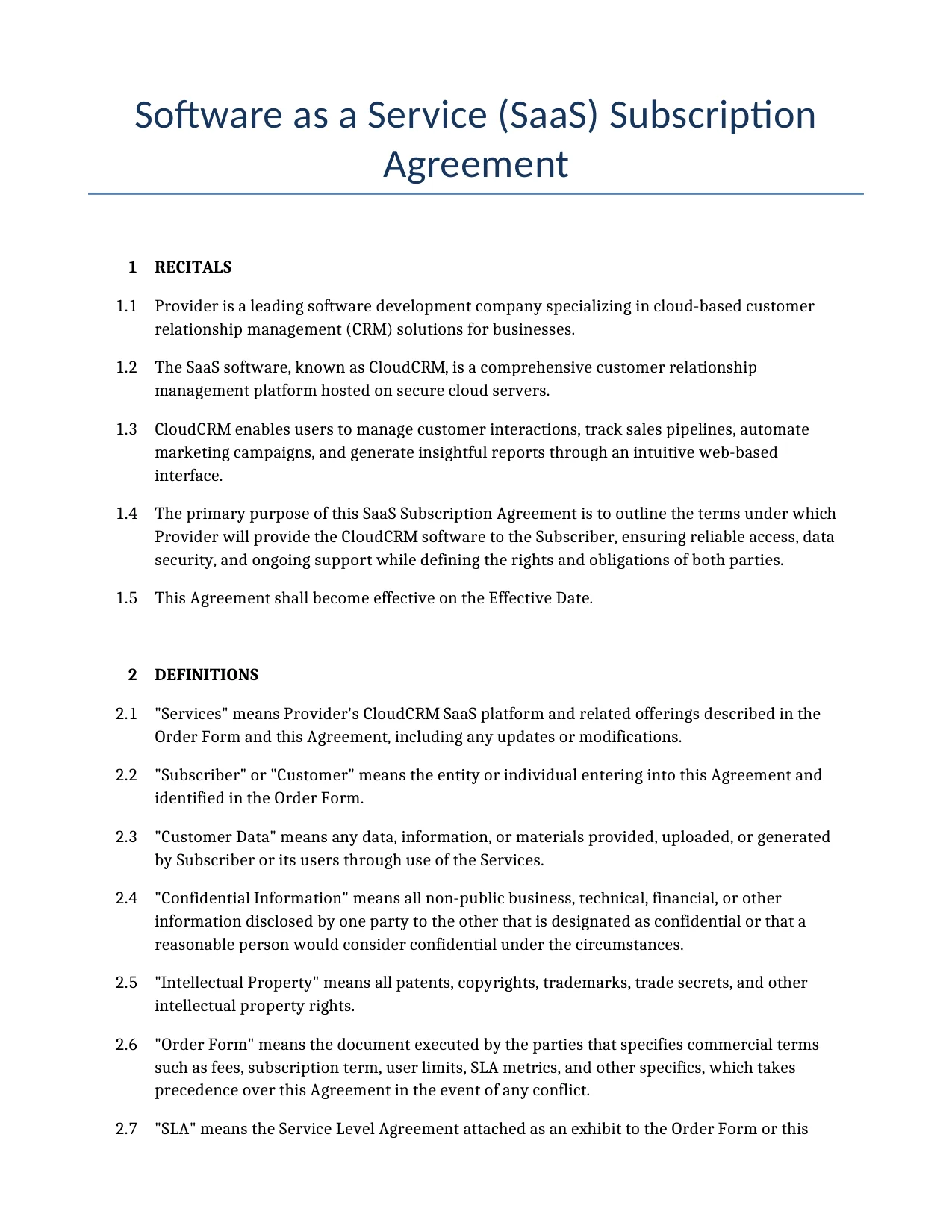
Below is a free template example of a Software as a Service (SaaS) Subscription Agreement for use in the United States generated by our AI model.
The clauses in your actual Software as a Service (SaaS) Subscription Agreement will vary from this example as they will be entirely bespoke to your requirements as set out in the questionnaire you complete.
Software as a Service (SaaS) Subscription Agreement
1RECITALS
Provider is a leading software development company specializing in cloud-based customer relationship management (CRM) solutions for businesses.
The SaaS software, known as CloudCRM, is a comprehensive customer relationship management platform hosted on secure cloud servers.
CloudCRM enables users to manage customer interactions, track sales pipelines, automate marketing campaigns, and generate insightful reports through an intuitive web-based interface.
The primary purpose of this SaaS Subscription Agreement is to outline the terms under which Provider will provide the CloudCRM software to the Subscriber, ensuring reliable access, data security, and ongoing support while defining the rights and obligations of both parties.
This Agreement shall become effective on the Effective Date.
2DEFINITIONS
"Services" means Provider's CloudCRM SaaS platform and related offerings described in the Order Form and this Agreement, including any updates or modifications.
"Subscriber" or "Customer" means the entity or individual entering into this Agreement and identified in the Order Form.
"Customer Data" means any data, information, or materials provided, uploaded, or generated by Subscriber or its users through use of the Services.
"Confidential Information" means all non-public business, technical, financial, or other information disclosed by one party to the other that is designated as confidential or that a reasonable person would consider confidential under the circumstances.
"Intellectual Property" means all patents, copyrights, trademarks, trade secrets, and other intellectual property rights.
"Order Form" means the document executed by the parties that specifies commercial terms such as fees, subscription term, user limits, SLA metrics, and other specifics, which takes precedence over this Agreement in the event of any conflict.
"SLA" means the Service Level Agreement attached as an exhibit to the Order Form or this Agreement, detailing uptime guarantees and remedies.
"Effective Date" means the date this Agreement is executed by both parties or as otherwise specified in the Order Form.
"Provider" means the company providing the CloudCRM Services under this Agreement.
Other capitalized terms used throughout this Agreement shall have the meanings ascribed to them in context or as reasonably inferred for legal precision and clarity.
3ORDER FORM
The parties shall execute one or more Order Forms that specify the commercial terms applicable to Subscriber's purchase of the Services, including but not limited to fees, subscription term, number of authorized users, SLA commitments, and any additional services.
Each Order Form is incorporated into and forms part of this Agreement. In the event of any conflict between an Order Form and this Agreement, the Order Form shall govern with respect to the specific terms in conflict.
See Exhibit A (Order Form Template) for a sample format detailing specific fees, users, term, and SLA metrics.
4SUBSCRIPTION SERVICES
Provider shall provide Subscriber with access to the CloudCRM SaaS platform pursuant to the terms of this Agreement and the applicable Order Form.
The Services include the features and functionality described in the Order Form and documentation, such as contact management, sales pipeline tracking, automated email campaigns, analytics dashboards, and integrations with third-party tools.
Subscriber shall access the Services via a supported web browser. The subscription permits the number of users specified in the Order Form.
The Services shall include data storage up to the limits specified in the Order Form and the SLA.
Provider shall provide customer support as described in the SLA and Order Form.
5ACCESS CREDENTIALS
Subscriber is responsible for maintaining the confidentiality of its account access credentials, including usernames and passwords for all authorized users.
Subscriber shall ensure that all users comply with this Agreement. Subscriber is responsible for all activities conducted under its account.
Subscriber shall promptly notify Provider of any unauthorized access or suspected security breach involving its access credentials.
Provider may suspend access to any user account suspected of violating this Agreement or posing a security risk.
6LICENSE GRANT
Subject to the terms and conditions of this Agreement and the applicable Order Form, Provider grants Subscriber a limited, non-exclusive, non-transferable, revocable right to access and use the Services solely for Subscriber's internal business purposes during the Subscription Term.
The number of authorized users shall not exceed the limits set forth in the Order Form. Worldwide use is permitted to the extent not restricted by applicable export controls or sanctions.
Subscriber shall not sublicense, reverse engineer, modify, or use the Services for any illegal activities or in excess of the usage limits in the Order Form. This right is not a license to the underlying software except as necessary to access the hosted Services.
7SUBSCRIPTION TERM AND RENEWAL
The initial Subscription Term shall be as specified in the Order Form. Unless otherwise stated in the Order Form, the term shall be twelve (12) months.
The subscription shall automatically renew for successive terms equal to the initial term unless either party provides written notice of non-renewal at least thirty (30) days prior to the end of the then-current term. Provider shall provide notice of any renewal consistent with applicable laws, including California's auto-renewal statutes where applicable.
Pricing for renewal terms shall be as set forth in the Order Form or as notified by Provider at least sixty (60) days prior to renewal. Subscriber may elect not to renew if it objects to a price increase.
Either party may terminate this Agreement for convenience only if expressly permitted in the Order Form. Either party may terminate for material breach as set forth in the Termination section.
8FEES AND PAYMENT TERMS
Subscriber shall pay all fees specified in the Order Form. Fees are based on the Services purchased and not on actual usage unless otherwise specified.
Provider shall invoice Subscriber in accordance with the Order Form (monthly, annually, or as specified). Invoices shall be sent electronically to the billing contact designated by Subscriber. Subscriber shall be deemed to have accepted an invoice if it does not object in writing within ten (10) business days of receipt.
Payments are due within thirty (30) days of the invoice date. Provider may suspend the Services for non-payment upon ten (10) days' written notice if fees remain unpaid.
All fees are exclusive of taxes. Subscriber shall pay all applicable sales, use, value-added, or other taxes, excluding only taxes on Provider's net income. Subscriber shall indemnify Provider for any taxes paid on Subscriber's behalf.
Late payments shall accrue interest at the lesser of 1.5% per month or the maximum rate permitted under applicable usury laws. Provider may increase prices upon notice as set forth in the Order Form or this Agreement, with Subscriber having the right to terminate if it does not accept the increase.
Payments shall be made via credit card, ACH, or other methods specified in the Order Form. All payments are non-refundable except as expressly provided herein.
9CUSTOMER DATA
Subscriber retains all ownership rights in Customer Data. Subscriber grants Provider a limited, non-exclusive, royalty-free license to access, use, copy, transmit, and display Customer Data solely as necessary to provide, maintain, and improve the Services, including for analytics and machine learning to enhance CloudCRM, during the term of this Agreement. This license terminates upon termination of this Agreement except as needed for post-termination obligations.
Subscriber represents that it has obtained all necessary consents, authorizations, and rights to provide Customer Data to Provider, including any required opt-in consents under applicable laws such as the CAN-SPAM Act, CCPA/CPRA, and GDPR (where applicable). Subscriber shall handle all data subject requests (access, deletion, correction) and inform Provider as needed for assistance.
Provider shall delete or return Customer Data upon termination as set forth in the Effects of Termination section, unless retention is required by law.
10DATA SECURITY AND PRIVACY
Provider shall maintain appropriate administrative, physical, and technical safeguards to protect the security, confidentiality, and integrity of Customer Data, consistent with industry standards, SOC 2, ISO 27001, and applicable laws including CCPA/CPRA and GDPR (where EU personal data is processed).
In the event of a Security Incident involving Customer Data, Provider shall notify Subscriber without undue delay and no later than 48 hours after discovery, provide details of the incident, and cooperate in any investigation or remediation. Provider shall maintain a data breach response plan.
The parties shall comply with the Data Processing Addendum attached as Exhibit B, which is incorporated herein and addresses data subject rights, subprocessors, data transfers, and compliance with CCPA/CPRA, GDPR, and other privacy laws. There is no data localization requirement unless specified in the Order Form.
Subscriber is responsible for its own compliance with applicable privacy laws in its use of the Services, including obtaining consents and providing notices to data subjects.
11INTELLECTUAL PROPERTY RIGHTS
Provider retains all right, title, and interest in and to the Services, CloudCRM platform, underlying software, documentation, and all Intellectual Property rights therein. No rights are granted except as expressly set forth herein.
Subscriber retains all right, title, and interest in Customer Data and any data or content it uploads or generates. Provider may use de-identified and aggregated data derived from Customer Data for improving its services.
Provider grants Subscriber a limited right to use Provider's trademarks solely in connection with permitted use of the Services. Subscriber grants Provider a limited license to use its trademarks for providing the Services and as permitted in the Publicity Rights section.
Any suggestions, feedback, or improvements provided by Subscriber regarding the Services shall be owned by Provider.
12SERVICE LEVEL AGREEMENT
Provider shall make the Services available with a monthly uptime percentage of at least 99.9% (the "Service Commitment"), excluding scheduled maintenance and force majeure events, as measured in accordance with the SLA.
If Provider fails to meet the Service Commitment, Subscriber shall be eligible for service credits as specified in the SLA. Service credits are Subscriber's sole and exclusive remedy for any breach of the SLA, unless the failure is due to Provider's gross negligence or willful misconduct.
The SLA is attached as an exhibit to the Order Form and details calculation methods, credit amounts, claim procedures, and exclusions.
13WARRANTIES AND DISCLAIMERS
Each party represents and warrants that it has the legal power and authority to enter into this Agreement.
Provider warrants that (i) it will provide the Services in a professional manner consistent with industry standards; (ii) the Services will substantially conform to the documentation; and (iii) it will use commercially reasonable efforts to ensure the Services are free of viruses and harmful code at delivery.
EXCEPT AS EXPRESSLY PROVIDED HEREIN, THE SERVICES ARE PROVIDED "AS IS" AND "AS AVAILABLE." PROVIDER DISCLAIMS ALL OTHER WARRANTIES, EXPRESS OR IMPLIED, INCLUDING BUT NOT LIMITED TO IMPLIED WARRANTIES OF MERCHANTABILITY, FITNESS FOR A PARTICULAR PURPOSE, TITLE, AND NON-INFRINGEMENT. PROVIDER DOES NOT WARRANT THAT THE SERVICES WILL BE UNINTERRUPTED, ERROR-FREE, OR COMPLETELY SECURE.
Subscriber warrants that its use of the Services will comply with this Agreement, all applicable laws (including anti-spam laws such as CAN-SPAM), and the Acceptable Use Policy.
14INDEMNIFICATION
Each party shall indemnify, defend, and hold harmless the other party, its affiliates, officers, directors, employees, and agents from and against any third-party claims, losses, damages, liabilities, and expenses (including reasonable attorneys' fees) arising from (i) the indemnifying party's breach of this Agreement; (ii) infringement of third-party Intellectual Property rights; or (iii) gross negligence or willful misconduct.
The indemnified party shall provide prompt written notice of any claim. The indemnifying party shall have the right to assume control of the defense and settlement, provided that the indemnified party may participate at its own expense and that no settlement shall impose liability on the indemnified party without its consent (not to be unreasonably withheld).
Indemnification obligations are subject to the mutual limitation of liability provisions below but shall not be limited for IP infringement, data breaches, or gross negligence/willful misconduct.
15LIMITATION OF LIABILITY
NEITHER PARTY SHALL BE LIABLE FOR INDIRECT, INCIDENTAL, SPECIAL, CONSEQUENTIAL, PUNITIVE, OR EXEMPLARY DAMAGES, INCLUDING BUT NOT LIMITED TO LOSS OF PROFITS, DATA, GOODWILL, OR BUSINESS INTERRUPTION, EVEN IF ADVISED OF THE POSSIBILITY OF SUCH DAMAGES.
EACH PARTY'S AGGREGATE LIABILITY UNDER THIS AGREEMENT SHALL NOT EXCEED THE TOTAL AMOUNTS PAID OR PAYABLE BY SUBSCRIBER TO PROVIDER DURING THE TWELVE (12) MONTHS PRECEDING THE CLAIM. THIS CAP SHALL APPLY MUTUALLY BUT SHALL NOT APPLY TO (I) INDEMNIFICATION OBLIGATIONS FOR IP INFRINGEMENT OR DATA BREACHES; (II) GROSS NEGLIGENCE OR WILLFUL MISCONDUCT; (III) BREACH OF CONFIDENTIALITY; OR (IV) SUBSCRIBER'S PAYMENT OBLIGATIONS.
Each party has a duty to mitigate damages. This limitation of liability is a fundamental basis of the bargain between the parties and shall survive termination.
16ANTI-CORRUPTION AND COMPLIANCE
Each party represents and warrants that it shall comply with all applicable anti-bribery and anti-corruption laws, including the U.S. Foreign Corrupt Practices Act. Neither party has made or will make any improper payments or offers in connection with this Agreement.
Each party shall comply with all applicable laws in performing its obligations under this Agreement, including export control, sanctions, and data protection laws.
17TERMINATION
Either party may terminate this Agreement or any Order Form (i) for material breach by the other party if the breach is not cured within thirty (30) days after written notice (or ten (10) days for non-payment); or (ii) immediately upon notice if the other party becomes insolvent, bankrupt, or ceases business operations.
Termination for convenience is not permitted unless expressly allowed in the Order Form. Upon termination for cause by Subscriber, Provider shall provide a pro-rata refund of any prepaid fees for the unused portion of the term. No refunds are provided for termination by Provider for cause.
Provider may suspend Services immediately for violations of the Acceptable Use Policy, security risks, or non-payment as set forth herein. Suspended accounts shall have an appeal process by contacting Provider in writing.
18EFFECTS OF TERMINATION
Upon termination or expiration, Subscriber shall immediately cease use of the Services, pay all outstanding fees, and return or destroy Provider's Confidential Information.
Provider shall provide Subscriber with access to export its Customer Data in a standard machine-readable format (such as CSV or JSON) for thirty (30) days following termination. Provider shall delete all Customer Data after such period, except as required by law. Provider shall provide reasonable transition assistance upon request at then-current rates.
The following provisions shall survive termination or expiration: Fees and Payment Terms, Customer Data, Intellectual Property Rights, Confidentiality, Indemnification, Limitation of Liability, Governing Law, Dispute Resolution, Class Action Waiver and Jury Trial Waiver, and any other provisions that by their nature should survive.
19SUPPORT AND MAINTENANCE
Provider shall provide support and maintenance as described in the SLA and Order Form, including response times and maintenance windows. Updates shall generally be provided without additional charge.
20ACCEPTABLE USE POLICY
Subscriber shall not, and shall not permit users to: (i) use the Services for illegal activities, spam, or in violation of CAN-SPAM or other anti-spam laws; (ii) upload content that infringes third-party rights, is defamatory, or harmful; (iii) introduce viruses, malware, or attempt unauthorized access; (iv) scrape, data mine, or excessively burden the Services; (v) generate or distribute AI-generated content in violation of applicable laws or ethical standards; or (vi) engage in any activity that interferes with the Services or other users.
Violations may result in immediate suspension or termination of access. Subscriber may appeal any suspension by providing written notice to Provider explaining the basis for the appeal. Provider shall respond promptly.
This Acceptable Use Policy may be updated by Provider upon notice to Subscriber. Continued use after notice constitutes acceptance.
21INSURANCE REQUIREMENTS
Each party shall maintain, at its own expense, appropriate insurance coverage including commercial general liability, professional liability, and cyber liability insurance with limits reasonable for its business and the risks under this Agreement. Upon request, a party shall provide certificates of insurance to the other party.
22AUDIT RIGHTS
Upon reasonable advance written notice and no more than once per calendar year, Subscriber may audit Provider's compliance with this Agreement, data security, and privacy obligations at Subscriber's expense. Audits shall be conducted during normal business hours and shall not unreasonably interfere with Provider's operations. Provider may require a nondisclosure agreement prior to providing access to sensitive information.
23PUBLICITY RIGHTS
Neither party may issue press releases or public statements regarding this Agreement or use the other's name, trademarks, or logos without the other's prior written consent, except as required by law. Each party may use the other's name in customer lists or case studies with prior approval, which shall not be unreasonably withheld.
24EXPORT CONTROLS
The Services and related technology are subject to U.S. export control laws, including the Export Administration Regulations (EAR), International Traffic in Arms Regulations (ITAR) if applicable, and regulations administered by the Office of Foreign Assets Control (OFAC). Subscriber shall comply with all such laws.
Subscriber represents that it and its users are not on any U.S. government denied party list and shall not use or export the Services to embargoed countries or prohibited persons without required licenses.
25CONFIDENTIALITY
Each party shall maintain the confidentiality of the other's Confidential Information and use it solely for purposes of this Agreement. Obligations shall survive for five (5) years after termination (indefinitely for trade secrets). Upon termination, the receiving party shall return or destroy Confidential Information.
Exceptions include information that is publicly known without breach, independently developed, or required to be disclosed by law (with notice to the disclosing party where permitted).
26FORCE MAJEURE
Neither party shall be liable for delays or failures to perform due to events beyond its reasonable control, including acts of God, pandemics, cyber attacks, or governmental actions. The affected party shall notify the other promptly and use reasonable efforts to mitigate the impact. If the event continues for more than thirty (30) days, either party may terminate this Agreement upon written notice.
27GOVERNING LAW
This Agreement shall be governed by and construed in accordance with the laws of the State of Delaware, without regard to its conflict of laws principles. The United Nations Convention on Contracts for the International Sale of Goods shall not apply. Electronic signatures shall be valid and binding to the same extent as original signatures under the E-SIGN Act and UETA.
Any legal action not subject to arbitration shall be brought exclusively in the state or federal courts located in Delaware, and the parties consent to personal jurisdiction and venue therein.
28DISPUTE RESOLUTION
Any dispute, claim, or controversy arising out of or relating to this Agreement (except for claims seeking injunctive relief or intellectual property enforcement) shall be resolved by binding arbitration administered by the American Arbitration Association (AAA) under its Commercial Arbitration Rules. The arbitration shall be conducted by a single arbitrator selected in accordance with AAA rules, in Wilmington, Delaware. The prevailing party shall be entitled to recover its reasonable attorneys' fees and costs. The arbitrator's award shall be final and binding, and judgment may be entered in any court of competent jurisdiction. Arbitration proceedings shall be confidential.
29CLASS ACTION WAIVER AND JURY TRIAL WAIVER
To the fullest extent permitted by law and consistent with the Federal Arbitration Act, the parties agree that any disputes shall be resolved on an individual basis only. Neither party shall have the right to participate in a class action, class arbitration, or representative action. EACH PARTY IRREVOCABLY WAIVES ANY RIGHT TO A JURY TRIAL IN ANY LEGAL PROCEEDING ARISING OUT OF OR RELATED TO THIS AGREEMENT.
30NO PARTNERSHIP
The parties are independent contractors. Nothing in this Agreement creates a partnership, joint venture, agency, or employment relationship. Neither party has authority to bind the other.
31ASSIGNMENT
Neither party may assign this Agreement without the other party's prior written consent, except that Provider may assign to an affiliate or successor in connection with a merger, acquisition, or sale of all or substantially all of its assets without consent. Any unauthorized assignment shall be null and void. This Agreement shall bind and inure to the benefit of permitted successors and assigns.
32ENTIRE AGREEMENT
This Agreement, including the Order Form, SLA, Data Processing Addendum, and any exhibits, constitutes the entire agreement between the parties and supersedes all prior agreements, understandings, or representations, whether written or oral. In the event of conflict, the Order Form governs over this Agreement, and this Agreement governs over any exhibits except the Data Processing Addendum which shall prevail on privacy matters.
33SEVERABILITY
If any provision of this Agreement is held invalid or unenforceable, the remaining provisions shall remain in full force and effect. The invalid provision shall be reformed to the minimum extent necessary to make it enforceable.
34WAIVER
No waiver of any breach shall constitute a waiver of any prior, concurrent, or subsequent breach. All waivers must be in writing and signed by the waiving party. Remedies are cumulative.
35NOTICES
All notices shall be in writing and delivered by certified mail, overnight courier, or email (with confirmation of receipt) to the addresses specified in the Order Form or as updated by a party. Notices shall be effective upon receipt.
36AMENDMENTS
This Agreement may be amended only by a written instrument signed by both parties or as otherwise expressly permitted herein. Electronic signatures are acceptable.
37THIRD-PARTY BENEFICIARIES
This Agreement is for the sole benefit of the parties and their permitted successors and assigns. Nothing herein confers any rights upon any other person or entity.
38MISCELLANEOUS
This Agreement may be executed in counterparts, including electronically, each of which is an original and together constitute one instrument. Headings are for convenience only.
This Agreement has been reviewed by counsel for both parties or each had the opportunity to do so. No presumption of construction against the drafter shall apply.
39SIGNATURE SECTION
IN WITNESS WHEREOF, the parties have executed this Software as a Service (SaaS) Subscription Agreement as of the Effective Date first above written.
Provider (TechSolutions Inc.): _______________________________ Date: _______________
By: ___________________________________________ Title: ________________ Address: 123 Main Street, Suite 100, Anytown, CA 90210
Subscriber (Full Legal Name): ____________________________________ Date: _______________
By: ___________________________________________ Title: ________________ Address: [Subscriber Address]
This Agreement includes the following exhibits which are incorporated by reference: Exhibit A (Order Form), Exhibit B (Data Processing Addendum), and the SLA.
This example shows approximately 70% of a typical document and is provided for illustrative purposes only. The remaining content has been omitted.
Every document generated by Docaro is tailored to your specific circumstances, jurisdiction and the information you provide. The completed document includes all applicable clauses and provisions required for your situation.
To generate the full, personalised document, answer a short series of questions and your document will be created instantly.