
AI Generated American Corporate Bylaws
PDF & Word - 2026 Updated
Docaro Pricing
When Do You Need Corporate Bylaws in the United States?
Key American Legal Rules for Corporate Bylaws
Using the wrong corporate structure or bylaws template can expose the company to unintended liabilities or regulatory non-compliance.
What Proper Corporate Bylaws Should Include
- Company BasicsDetails the company's name, purpose, main office location, and how it will be managed.
- Share StructureDescribes the types and classes of shares the company can issue and how they are handled.
- Board of DirectorsOutlines how directors are elected, their powers, meetings, and removal process.
- Officer RolesDefines the positions like president and secretary, their duties, and how they are appointed.
- Shareholder MeetingsSets rules for calling meetings, voting on issues, and what constitutes a quorum.
- Director MeetingsExplains how board meetings are held, notice requirements, and decision-making processes.
- CommitteesAllows the board to create committees and assigns their specific responsibilities.
- Stock CertificatesCovers the issuance, transfer, and records of company shares.
- Key RecordsRequires keeping important documents like meeting minutes and shareholder lists.
- Changes to BylawsSpecifies who can amend the bylaws and the process for doing so.
Generate Your Document in 4 Easy Steps
Why Use Docaro?
 United States
Free Example Corporate Bylaws Template
Below is a free template example of a Corporate Bylaws for use in the United States generated by our AI model.
The clauses in your actual Corporate Bylaws will vary from this example as they will be entirely bespoke to your requirements as set out in the questionnaire you complete.
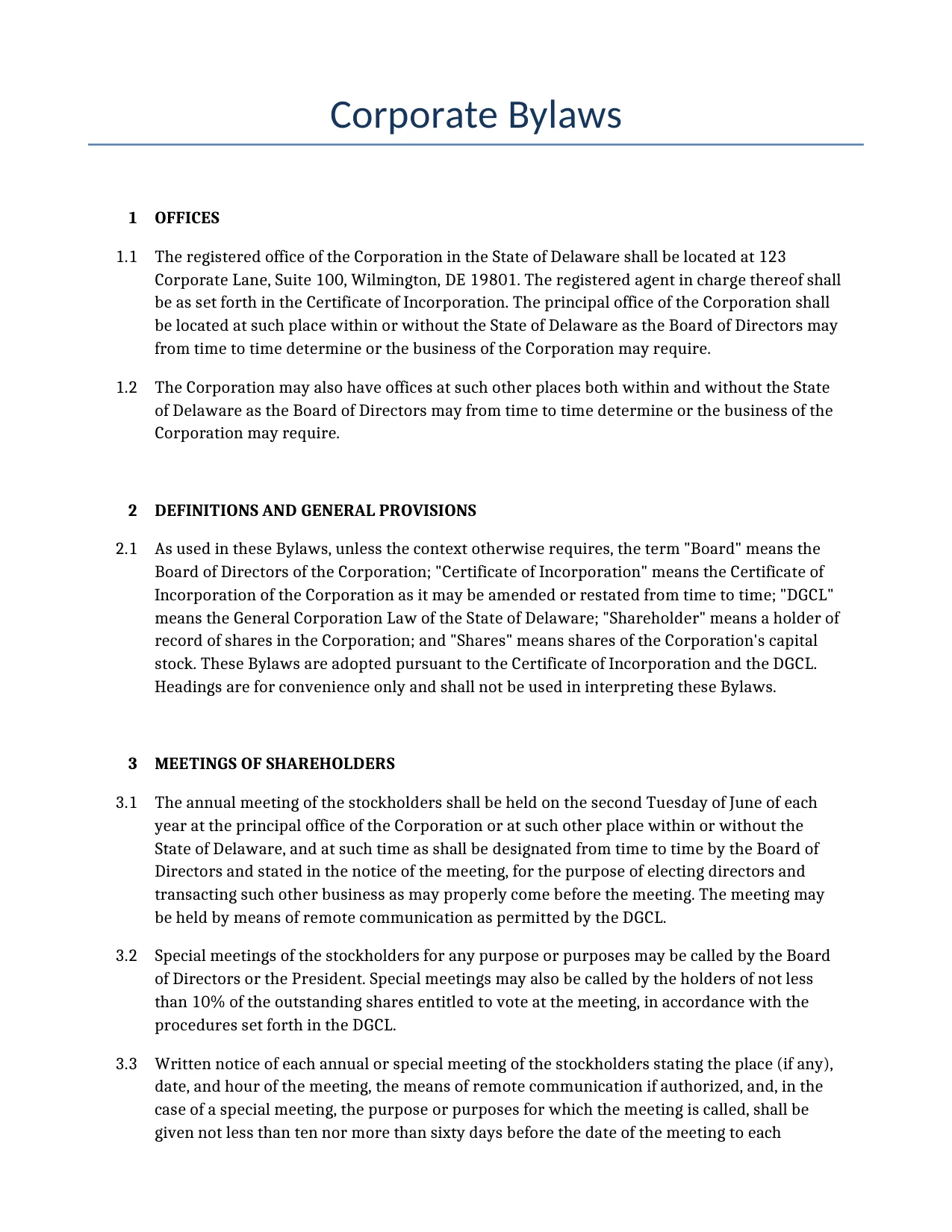
Bylaws of Example Corporation
1OFFICES
The registered office of the Corporation in the State of Delaware shall be located at 123 Corporate Lane, Suite 100, Wilmington, DE 19801. The registered agent in charge thereof shall be as set forth in the Certificate of Incorporation. The principal office of the Corporation shall be located at such place within or without the State of Delaware as the Board of Directors may from time to time determine or the business of the Corporation may require.
The Corporation may also have offices at such other places both within and without the State of Delaware as the Board of Directors may from time to time determine or the business of the Corporation may require.
2DEFINITIONS AND GENERAL PROVISIONS
As used in these Bylaws, unless the context otherwise requires, the term "Board" means the Board of Directors of the Corporation; "Certificate of Incorporation" means the Certificate of Incorporation of the Corporation as it may be amended or restated from time to time; "DGCL" means the General Corporation Law of the State of Delaware; "Shareholder" means a holder of record of shares in the Corporation; and "Shares" means shares of the Corporation's capital stock. These Bylaws are adopted pursuant to the Certificate of Incorporation and the DGCL. Headings are for convenience only and shall not be used in interpreting these Bylaws.
3MEETINGS OF SHAREHOLDERS
The annual meeting of the stockholders shall be held on the second Tuesday of June of each year at the principal office of the Corporation or at such other place within or without the State of Delaware, and at such time as shall be designated from time to time by the Board of Directors and stated in the notice of the meeting, for the purpose of electing directors and transacting such other business as may properly come before the meeting. The meeting may be held by means of remote communication as permitted by the DGCL.
Special meetings of the stockholders for any purpose or purposes may be called by the Board of Directors or the President. Special meetings may also be called by the holders of not less than 10% of the outstanding shares entitled to vote at the meeting, in accordance with the procedures set forth in the DGCL.
Written notice of each annual or special meeting of the stockholders stating the place (if any), date, and hour of the meeting, the means of remote communication if authorized, and, in the case of a special meeting, the purpose or purposes for which the meeting is called, shall be given not less than ten nor more than sixty days before the date of the meeting to each stockholder entitled to vote at such meeting. A record date for determining stockholders entitled to notice of and to vote at a meeting shall be fixed by the Board in accordance with the DGCL.
The Corporation shall prepare, at least ten days before every meeting of stockholders, a complete list of stockholders entitled to vote at the meeting, arranged in alphabetical order and showing the address of each stockholder and the number of shares registered in the name of each stockholder. Such list shall be open to the examination of any stockholder for any purpose germane to the meeting.
The holders of a majority of the shares of stock issued and outstanding and entitled to vote, present in person or represented by proxy, shall constitute a quorum for the transaction of business at any meeting of the stockholders. If a quorum is not present, the meeting may be adjourned from time to time until a quorum is present.
Each stockholder entitled to vote shall be entitled to one vote for each share of stock held by such stockholder on all matters submitted to a vote of the stockholders, unless otherwise provided in the Certificate of Incorporation. There shall be no cumulative voting for the election of directors.
Directors shall be elected by a plurality of the votes of the shares present in person or represented by proxy at the meeting and entitled to vote on the election of directors. Any other matter shall be approved by the affirmative vote of the majority of shares present in person or represented by proxy at the meeting and entitled to vote on the subject matter, unless the matter is one upon which a different vote is required by express provision of the DGCL, the Certificate of Incorporation, or these Bylaws.
An inspector of elections shall be appointed by the Board or the chairperson of the meeting to act at each meeting of stockholders in accordance with the DGCL.
Any action required or permitted to be taken at any annual or special meeting of the stockholders may be taken without a meeting, without prior notice, and without a vote if a consent or consents in writing, setting forth the action so taken, shall be signed by the holders of outstanding stock having not less than the minimum number of votes that would be necessary to authorize or take such action at a meeting at which all shares entitled to vote thereon were present and voted. Such consents shall be delivered in accordance with the DGCL.
4DIRECTORS
The number of directors which shall constitute the whole Board shall be not less than three nor more than nine. The number of directors shall be fixed from time to time exclusively by the Board of Directors pursuant to a resolution adopted by a majority of the whole Board.
Directors need not be stockholders. Each director shall hold office until the next annual meeting of stockholders and until his or her successor is elected and qualified, or until his or her earlier death, resignation, or removal. Any director may resign at any time upon notice to the Corporation.
Any vacancy on the Board, including those resulting from an increase in the number of directors, may be filled by a majority of the directors then in office, even if less than a quorum, or by a sole remaining director, in accordance with the DGCL. Any director elected to fill a vacancy shall hold office for the remainder of the full term of the director whose vacancy was filled.
Any director or the entire Board may be removed, with or without cause, by the holders of a majority of the shares then entitled to vote at an election of directors, in accordance with the DGCL.
The powers and duties of the Board of Directors include the management of the business and affairs of the Corporation in accordance with the DGCL. Directors shall act in good faith, in a manner they reasonably believe to be in the best interests of the Corporation, and with the care that an ordinarily prudent person in a like position would exercise under similar circumstances (fiduciary duties of care and loyalty).
The annual meeting of the Board of Directors shall be held immediately following the annual meeting of stockholders, at the same place (if any), or via remote communication as permitted by the DGCL, without notice other than by these Bylaws.
Special meetings of the Board of Directors may be called by the Chairperson or President or by any two or more directors on two days' notice to each director, either personally, by mail, by email, or by any other means permitted by the DGCL.
A majority of the directors then in office shall constitute a quorum for the transaction of business at any meeting of the Board of Directors. The vote of a majority of the directors present at a meeting at which a quorum is present shall be the act of the Board of Directors, unless the DGCL, the Certificate of Incorporation, or these Bylaws require a greater vote.
The Board of Directors may authorize the payment of compensation to directors for their services as directors. The Board may also approve compensation for officers and employees of the Corporation.
The Board of Directors may designate one or more committees, each committee to consist of one or more of the directors of the Corporation. Each committee shall have and may exercise such powers as the Board of Directors may determine and specify in the resolution designating such committee, subject to the limitations of the DGCL.
5OFFICERS
The officers of the Corporation shall be a President, a Secretary, a Treasurer, and such additional officers (including one or more Vice Presidents) as may be elected or appointed by the Board of Directors from time to time. Any two or more offices may be held by the same person, except the offices of President and Secretary.
The officers of the Corporation shall be elected annually by the Board of Directors at the first meeting of the Board following the annual meeting of stockholders. The initial election of officers after adoption of these Bylaws shall occur on or about the date of adoption.
Any officer elected or appointed by the Board of Directors may be removed at any time by the Board of Directors with or without cause. Any vacancy occurring in any office may be filled by the Board.
The President shall be the chief executive officer of the Corporation, shall preside at all meetings of the stockholders and the Board of Directors (unless otherwise provided by the Board), shall have general and active management of the business of the Corporation, and shall see that all orders and resolutions of the Board of Directors are carried into effect.
The Secretary shall attend all meetings of the stockholders and the Board of Directors, shall record all votes and minutes of such meetings, shall maintain the corporate records and stock ledger, shall give notices required by these Bylaws or by law, shall certify documents, and shall perform such other duties as may be prescribed by the Board of Directors or the President.
The Treasurer shall have custody of the corporate funds and securities, shall keep full and accurate accounts of receipts and disbursements, shall deposit moneys and other valuables in the name and to the credit of the Corporation, and shall perform such other duties as may be prescribed by the Board of Directors or the President.
The officers shall receive such compensation as may be authorized by the Board of Directors.
6SHARES OF STOCK
The total number of authorized shares of the Corporation shall be 1,000,000 shares of common stock with a par value of $0.01 per share. The Corporation shall have a single class of shares unless otherwise provided in the Certificate of Incorporation. All shares shall be of the same class and have the same rights, preferences, and limitations.
The Corporation may issue shares in book-entry form without physical certificates. If certificates are issued, they shall be in the form prescribed by the Board and the DGCL.
Transfers of shares shall be made on the stock transfer books of the Corporation. The Board may establish procedures for transfer of shares, including requirements for endorsement and delivery of certificates (if any) or transfer instructions in book-entry systems. The shares may be subject to transfer restrictions as set forth in any stockholders agreement or as otherwise determined by the Board and permitted by the DGCL.
The stock records of the Corporation shall be maintained at the principal office of the Corporation or at the office of the Corporation's transfer agent, if any. Stockholders shall have the right to inspect records as provided in Section 220 of the DGCL.
7DIVIDENDS AND DISTRIBUTIONS
The Board of Directors may declare and pay dividends upon the shares of the Corporation's capital stock, subject to the provisions of the DGCL, the Certificate of Incorporation, and any restrictions in any agreements to which the Corporation is a party.
8INDEMNIFICATION AND ADVANCEMENT OF EXPENSES
The Corporation shall indemnify its directors and officers to the fullest extent permitted by DGCL Section 145 against liabilities, expenses, and costs incurred in their official capacities. The Corporation may indemnify other employees and agents to the extent permitted by the DGCL.
The Corporation shall advance expenses (including attorneys' fees) to directors and officers who are parties to proceedings in advance of the final disposition, upon receipt of an undertaking by or on behalf of the director or officer to repay such amount if it shall ultimately be determined that such person is not entitled to indemnification.
The rights to indemnification and advancement provided in this Article shall not be deemed exclusive of any other rights to which those seeking indemnification or advancement may be entitled under any bylaw, agreement, vote of stockholders or disinterested directors, or otherwise, and shall continue as to a person who has ceased to be a director or officer and shall inure to the benefit of the heirs, executors, and administrators of such a person. The Corporation may maintain insurance for this purpose. These provisions are intended to comply with DGCL Sections 145 and 102(b)(7).
9FISCAL YEAR
The fiscal year of the Corporation shall end on December 31 of each year.
10CORPORATE SEAL
The Corporation may have a corporate seal which shall have inscribed thereon the name of the Corporation, the year of its organization, and the words "Corporate Seal" and "Delaware".
The corporate seal may be used by causing it or a facsimile thereof to be impressed or affixed or in any other manner reproduced.
The use of the corporate seal is not required for the validity of any corporate document.
The President or the Secretary is authorized to affix the corporate seal to documents.
11AMENDMENT OF BYLAWS
These Bylaws may be altered, amended, or repealed and new Bylaws may be adopted by the affirmative vote of the holders of a majority of the shares then entitled to vote at any regular or special meeting of the stockholders, or by the Board of Directors in accordance with the DGCL and the Certificate of Incorporation. If the Certificate of Incorporation so provides, any Bylaw adopted by the stockholders may be amended or repealed only by the stockholders. These Bylaws may not be amended by the Board alone if such action would be inconsistent with the DGCL or the Certificate of Incorporation.
12AMENDMENTS TO CERTIFICATE OF INCORPORATION
The Certificate of Incorporation may be amended in accordance with the provisions of the DGCL. Any amendment that requires stockholder approval shall be approved at a meeting of stockholders by the vote required under the DGCL and the Certificate of Incorporation.
13DISSOLUTION
The Corporation may be dissolved in accordance with the provisions of the DGCL. Dissolution shall require approval by the Board of Directors and the stockholders as provided in the DGCL.
14CONFLICT OF INTEREST
No contract or transaction between the Corporation and one or more of its directors or officers, or between the Corporation and any other corporation, partnership, association, or other organization in which one or more of its directors or officers are directors or officers or have a financial interest, shall be void or voidable solely for this reason, if it is fair to the Corporation and approved in accordance with DGCL Section 144.
15ELECTRONIC COMMUNICATIONS AND REMOTE MEETINGS
Any notice, consent, waiver, or other communication required or permitted under these Bylaws or the DGCL may be delivered by electronic transmission in accordance with the DGCL. Meetings of stockholders, the Board, and committees may be held by means of remote communication to the extent permitted by the DGCL, and participants shall be deemed present in person for quorum and voting purposes.
16LOANS TO OFFICERS
The Corporation may lend money to, guarantee any obligation of, or otherwise assist any officer or other employee of the Corporation or its subsidiaries, including officers who are directors, to the extent permitted by the DGCL and with the approval of the Board of Directors.
17RATIFICATION
Any act or omission by the Corporation, its directors, or officers that would otherwise require stockholder approval may be ratified by the stockholders in accordance with the DGCL.
18FORUM SELECTION
Unless the Corporation consents in writing to the selection of an alternative forum, the Court of Chancery of the State of Delaware (or, if the Court of Chancery does not have jurisdiction, the federal district court for the District of Delaware) shall, to the fullest extent permitted by law, be the sole and exclusive forum for (i) any derivative action or proceeding brought on behalf of the Corporation, (ii) any action asserting a claim of breach of a fiduciary duty owed by any director, officer, or other employee of the Corporation to the Corporation or its stockholders, (iii) any action asserting a claim arising pursuant to any provision of the DGCL, the Certificate of Incorporation, or these Bylaws, or (iv) any action asserting a claim governed by the internal affairs doctrine.
19MISCELLANEOUS PROVISIONS
Notices to the Corporation shall be delivered to 123 Corporate Lane, Suite 100, Wilmington, DE 19801 by mail, email, or personal delivery. Notices to stockholders shall be given in accordance with the DGCL and these Bylaws.
Any waiver of any requirement in these Bylaws must be in writing and signed by the party to be charged.
These Bylaws shall be governed by and construed in accordance with the DGCL.
If any provision of these Bylaws is held to be invalid or unenforceable, the remaining provisions shall remain in full force and effect. This severability clause shall be construed as broadly as permitted by law.
These Bylaws shall become effective on the date of adoption by the Board of Directors and approval by the incorporator or initial stockholders.
20INTERPRETATION AND DEFINITIONS
In addition to the definitions in Section 2, as used herein, unless the context otherwise requires, the term "including" means including without limitation. All references to sections are to sections of these Bylaws unless otherwise specified. These Bylaws shall be interpreted in a manner consistent with the Certificate of Incorporation and the DGCL. In the event of any inconsistency, the Certificate of Incorporation and the DGCL shall control.
21SIGNATURE SECTION
IN WITNESS WHEREOF, the undersigned has executed these Bylaws as of the date first above written.
By: _______________________________ Name: Title: Date: ________________
This example shows approximately 70% of a typical document and is provided for illustrative purposes only. The remaining content has been omitted.
Every document generated by Docaro is tailored to your specific circumstances, jurisdiction and the information you provide. The completed document includes all applicable clauses and provisions required for your situation.
To generate the full, personalised document, answer a short series of questions and your document will be created instantly.