
AI Generated Business Continuity and Disaster Recovery Plan for use in the United States
PDF & Word - 2026 Updated
Docaro Pricing
When Do You Need a Business Continuity and Disaster Recovery Plan in the United States?
American Legal Rules for a Business Continuity and Disaster Recovery Plan
Failing to tailor the business continuity and disaster recovery plan to your organization's specific industry, size, and regulatory requirements can lead to ineffective crisis response and compliance failures.
What a Proper Business Continuity and Disaster Recovery Plan Should Include
- Introduction and ScopeThis section outlines the plan's purpose, the organization's key operations it covers, and who is responsible for its execution.
- Risk AssessmentIdentify potential threats like natural disasters or cyber attacks and evaluate their impact on business functions.
- Business Impact AnalysisAnalyze how disruptions affect critical processes and determine recovery priorities based on potential losses.
- Recovery StrategiesDetail methods to resume operations, such as backup systems, alternate sites, or manual workarounds.
- Roles and ResponsibilitiesAssign specific duties to team members and departments for managing and implementing the plan during a crisis.
- Communication PlanEstablish protocols for notifying employees, customers, and authorities during and after an incident.
- Resource RequirementsList essential resources like technology, personnel, and supplies needed to support recovery efforts.
- Testing and MaintenanceSchedule regular drills to test the plan's effectiveness and update it based on changes or lessons learned.
- Training ProgramProvide ongoing education to ensure all staff understand their roles and can respond effectively to disruptions.
- Plan Activation and ReviewDefine triggers for activating the plan and procedures for post-incident review to improve future responses.
Generate Your Document in 4 Easy Steps
Why Use Docaro?
 United States
Free Example Business Continuity and Disaster Recovery Plan Template
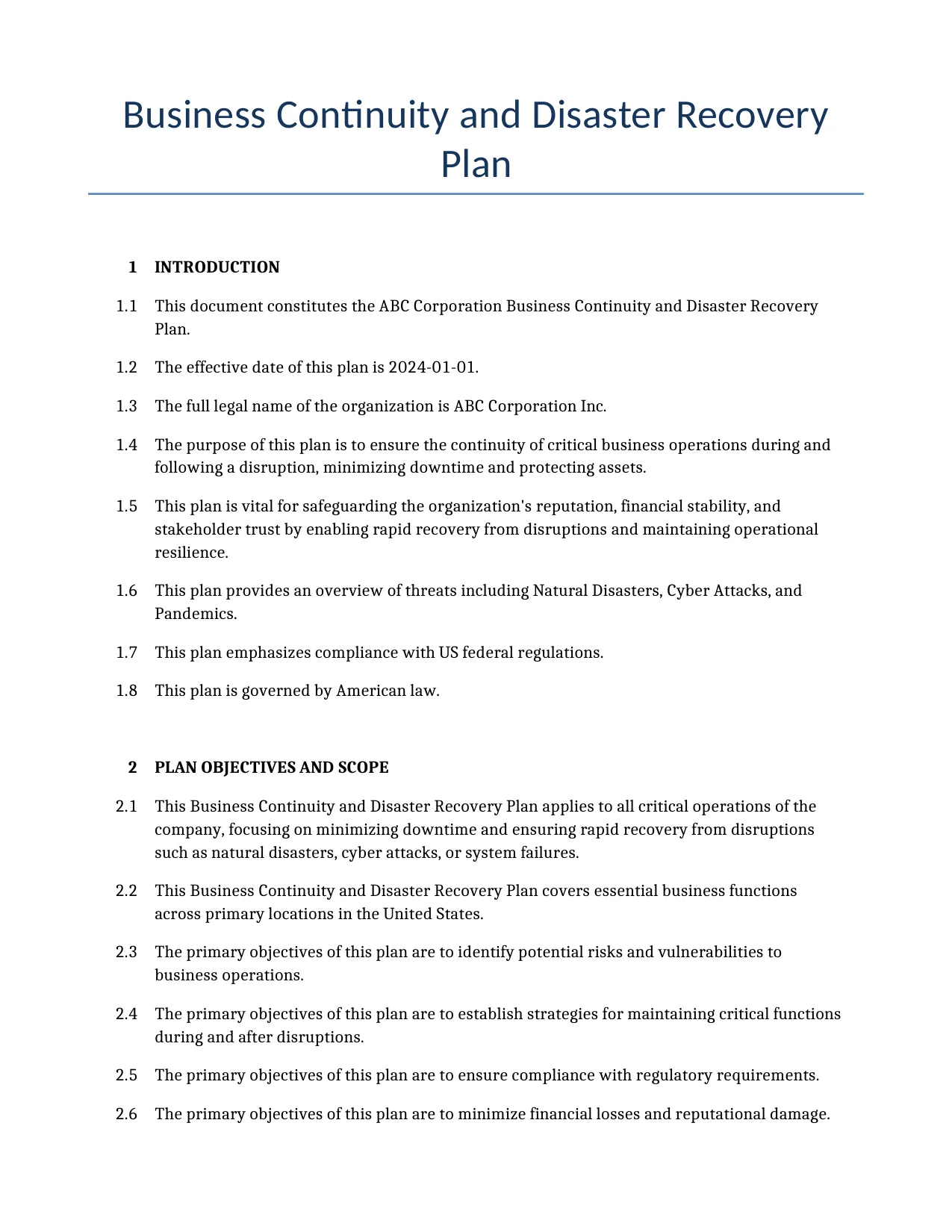
Below is a free template example of a Business Continuity and Disaster Recovery Plan for use in the United States generated by our AI model.
The clauses in your actual Business Continuity and Disaster Recovery Plan will vary from this example as they will be entirely bespoke to your requirements as set out in the questionnaire you complete.
ABC Corporation Business Continuity and Disaster Recovery Plan
1INTRODUCTION
This document constitutes the ABC Corporation Business Continuity and Disaster Recovery Plan.
The effective date of this plan is 2024-01-01.
The full legal name of the organization is ABC Corporation Inc.
The purpose of this plan is to ensure the continuity of critical business operations during and following a disruption, minimizing downtime and protecting assets.
This plan is vital for safeguarding the organization's reputation, financial stability, and stakeholder trust by enabling rapid recovery from disruptions and maintaining operational resilience.
This plan provides an overview of threats including Natural Disasters, Cyber Attacks, and Pandemics.
This plan emphasizes compliance with US federal regulations.
This plan is governed by American law.
2PLAN OBJECTIVES AND SCOPE
This Business Continuity and Disaster Recovery Plan applies to all critical operations of the company, focusing on minimizing downtime and ensuring rapid recovery from disruptions such as natural disasters, cyber attacks, or system failures.
This Business Continuity and Disaster Recovery Plan covers essential business functions across primary locations in the United States.
The primary objectives of this plan are to identify potential risks and vulnerabilities to business operations.
The primary objectives of this plan are to establish strategies for maintaining critical functions during and after disruptions.
The primary objectives of this plan are to ensure compliance with regulatory requirements.
The primary objectives of this plan are to minimize financial losses and reputational damage.
The primary objectives of this plan are to facilitate regular testing and updates to the plan for ongoing effectiveness.
This plan includes the Finance Department, IT Department, and Operations within its scope.
This plan covers the key business processes of Data Backup and Recovery, Financial Transactions, and Customer Service Operations.
This plan includes the Headquarters, Data Center, and Regional Offices within its scope.
This plan explicitly excludes non-critical areas from its scope.
3DEFINITIONS AND ACRONYMS
Business Continuity Plan (BCP) is defined as a comprehensive strategy and set of procedures designed to ensure that critical business functions can continue during and after a disruption, minimizing downtime and financial loss.
Disaster Recovery (DR) is defined as the process of restoring IT systems, data, and infrastructure to operational status following a disruptive event.
Recovery Time Objective (RTO) is defined as the maximum acceptable amount of time to restore a system or process after a disruption.
Recovery Point Objective (RPO) is defined as the maximum acceptable amount of data loss measured in time before a disruption.
Maximum Tolerable Downtime (MTD) is defined as the total amount of time a business process can be disrupted before it results in significant harm to the organization.
Business Impact Analysis (BIA) is defined as the process of identifying critical business functions and assessing the potential impacts of disruptions.
Incident Response is defined as the structured approach to addressing and managing the aftermath of a security breach or cyberattack.
Crisis Management is defined as the process by which an organization deals with a major unpredictable event that threatens to harm the organization, its stakeholders, or the general public.
HIPAA (Health Insurance Portability and Accountability Act) is defined as a US federal law that protects sensitive patient health information from being disclosed without the patient’s consent or knowledge.
CCPA (California Consumer Privacy Act) is defined as a state statute intended to enhance privacy rights and consumer protection for residents of California.
NIST (National Institute of Standards and Technology) is defined as a US non-regulatory federal agency that develops standards and guidelines, including those for cybersecurity and contingency planning.
ISO (International Organization for Standardization) is defined as an international standard-setting body; ISO 22301 specifically provides requirements for business continuity management systems.
FISMA (Federal Information Security Modernization Act) is defined as US legislation that defines a comprehensive framework to protect government information, operations, and assets against natural or man-made threats.
4ROLES AND RESPONSIBILITIES
John Doe is designated as the owner of the Business Continuity Plan.
John Doe shall oversee the development, maintenance, and periodic review of the Business Continuity Plan.
John Doe shall ensure compliance with regulatory requirements.
John Doe shall coordinate training and awareness programs for all employees.
Jane Smith is appointed as the leader of the Disaster Recovery Team.
Jane Smith shall lead the activation of the Disaster Recovery Plan during incidents.
Jane Smith shall coordinate recovery efforts for IT systems and infrastructure.
Jane Smith shall report progress to senior management and ensure timely restoration of critical operations.
The Crisis Management Team shall include members from Executive Leadership, IT Department, Human Resources, Legal Department, and Operations.
The Crisis Management Team shall assess the impact of crises on business operations.
The Crisis Management Team shall make strategic decisions on resource allocation.
The Crisis Management Team shall liaise with external stakeholders such as emergency services and regulators.
The Crisis Management Team shall oversee the overall response and recovery strategy.
Business Unit Managers shall have defined roles in continuity efforts.
A dedicated role for coordinating internal and external communications during a disaster is established and assigned to Public Relations.
The Communication Coordinator shall develop and disseminate timely internal communications to employees.
The Communication Coordinator shall manage external messaging to media, customers, and partners.
The Communication Coordinator shall ensure all communications align with company policies and legal guidelines.
5RISK ASSESSMENT AND BUSINESS IMPACT ANALYSIS
The company employs a structured risk assessment methodology that includes reviewing internal processes, analyzing external threats such as natural disasters and cyber attacks, and consulting with department heads to identify vulnerabilities in operations.
The company employs the techniques of SWOT Analysis, Brainstorming Sessions, and Historical Incident Review to identify risks.
The company conducts a formal risk assessment review at least annually.
The maximum number of hours the company can tolerate downtime for critical systems is 4.0.
The critical business functions for the company that require prioritization in the Business Impact Analysis are Customer Service Operations, Financial Transactions Processing, and Data Center Operations.
The Business Impact Analysis methodology involves identifying key business processes, evaluating their dependencies, quantifying potential financial and operational impacts of disruptions, and ranking them based on recovery time objectives.
The last full risk assessment was conducted on 2023-06-15.
The company uses a 1 to 5 Numerical Scale to assess the likelihood of risks occurring.
The risk assessment includes risks from third-party vendors or partners.
The company assesses impact based on financial loss, reputational damage, regulatory compliance violations, and operational disruption duration.
The business functions considered critical for maintaining operations during a disruption are IT Systems and Data Management, Financial Operations, and Supply Chain and Logistics.
Risk Register (aligned with NIST SP 800-34 guidelines): The following sample risk register lists identified risks with likelihood (1-5 scale), impact (1-5 scale), risk score (likelihood x impact), mitigation strategies, assigned owners, and controls.
Risk: Natural Disaster (e.g., Hurricane) - Likelihood: 2, Impact: 5, Score: 10, Mitigation: Alternate site activation and data backups, Owner: BCP Coordinator, Controls: Redundant systems and annual drills.
Risk: Cyber Attack (e.g., Ransomware) - Likelihood: 4, Impact: 5, Score: 20, Mitigation: Incident response plan, regular backups, and employee training, Owner: IT Director, Controls: Firewalls, endpoint detection, and offline backups.
Risk: Pandemic/Health Emergency - Likelihood: 3, Impact: 4, Score: 12, Mitigation: Remote work enablement, cross-training, and CDC-aligned policies, Owner: HR Director, Controls: Sick leave policies and remote access infrastructure.
Risk: Supply Chain Failure - Likelihood: 3, Impact: 4, Score: 12, Mitigation: Vendor diversification and inventory buffers, Owner: Operations Manager, Controls: SLAs with vendors and alternative suppliers.
6BUSINESS CONTINUITY STRATEGIES
For the customer service function, the company has a cloud-based ticketing system that allows remote access.
For IT operations, the company uses backup servers in a secondary data center.
Manufacturing processes can switch to manual workflows with pre-stocked materials if automated systems fail.
The company will use Redundant Systems and Backup Sites for allocating resources to support continuity of critical functions.
The company has the capability to enable remote work for critical functions during a disruption.
The maximum tolerable downtime in hours for the most critical business function is 4.
The annual budget amount the company plans to allocate for implementing business continuity strategies is 150000.0.
The key vendors or partners involved in the recovery strategies are John Doe as IT Infrastructure Provider for Cloud Services, Jane Smith as Logistics Partner for Supply Chain Backup, and Acme Tech Solutions as Data Recovery Specialist for Backup and Restore Services.
The primary communication strategy the company will use to coordinate during a disruption is Email and Secure Messaging Platforms along with Cloud-Based Collaboration Tools.
The company has insurance policies specifically covering business interruptions and disasters.
Vital records management includes secure storage and backup of critical documents (both physical and electronic) with access procedures defined for recovery teams. Alternate work locations are designated for all departments: Headquarters staff to Regional Office B, Data Center staff to Warm Site at 123 Recovery Lane.
Full vendor SLAs require 99.9% uptime for critical services with penalties for non-compliance; budget breakdown allocates 40% to IT infrastructure, 30% to training, 20% to testing, and 10% to insurance premiums. This aligns with ISO 22301 principles for resource provision and continual improvement.
Pandemic-specific strategies include scaling remote work capabilities for 100% of non-clinical staff, implementing workforce continuity measures such as cross-training for key roles, flexible sick leave policies per OSHA guidelines, and coordination with CDC recommendations for health screenings and social distancing in facilities.
7DISASTER RECOVERY PROCEDURES
The maximum acceptable downtime for critical IT systems before recovery is completed is 4 hours.
The maximum tolerable period in which data might be lost due to a disaster is 1 hour.
The company maintains offsite backups of its critical data and systems.
The procedures specifically address Natural Disasters, Cyber Attacks, and Power Outages.
The primary recovery site is located at 123 Recovery Lane, Austin, TX 78701.
The last test of the data backup and recovery processes was performed on 2023-06-15.
The company performs full backups of critical systems every 7 days.
The IT recovery team includes the roles of IT Director, Systems Administrator, Data Recovery Specialist, and Security Officer.
The primary communication method or tool to use during recovery operations is Secure Slack channels and encrypted email.
The company schedules annual drills to test the disaster recovery procedures.
8DETAILED RECOVERY AND ACTIVATION PROCEDURES
Scenario 1: Ransomware Recovery - Step-by-step checklist: 1. Detection - Security team identifies ransomware via monitoring tools (responsibility: Security Officer). Decision: Isolate affected systems? (Yes - proceed; No - escalate to Incident Response). 2. Containment - Disconnect infected systems from network (responsibility: IT Director). 3. Assessment - Determine scope using forensics (responsibility: Data Recovery Specialist). 4. Recovery - Restore from offline backups ensuring no malware (responsibility: Systems Administrator, target within RTO of 4 hours). 5. Eradication and Validation - Scan and test restored systems (responsibility: All team). 6. Post-recovery - Update incident log and conduct review.
Scenario 2: Hurricane Evacuation - Step-by-step checklist: 1. Warning - Monitor National Weather Service alerts (responsibility: BCP Coordinator). Decision tree: Category 3+ and within 100 miles? (Yes - activate; No - monitor). 2. Activation - Notify all staff via emergency system (responsibility: Communication Coordinator). 3. Evacuation - Secure physical sites, move to alternate warm site (responsibility: Operations Manager). 4. Remote Operations - Switch to cloud systems and remote work (responsibility: IT Team). 5. Recovery - Return when safe per local authorities, restore on-site systems (responsibility: Full Recovery Team). Includes flowchart reference in Appendix C.
9INCIDENT RESPONSE PLAN
The types of incidents that could disrupt operations are cybersecurity breaches, natural disasters such as floods or earthquakes, power outages, and supply chain disruptions.
The company has tools or systems in place for detecting incidents.
The methods for detecting incidents are Automated Monitoring and Manual Reporting.
The Incident Coordinator leads the response efforts and coordinates team actions.
The Technical Lead handles technical aspects of the incident.
The Communication Officer manages internal and external communications.
The Documentation Specialist records all actions and decisions.
The maximum response time in minutes that the team should aim to initiate action after detection is 30.
The communication protocols the team shall follow during an incident are Phone Tree System, Dedicated Incident Chat, and External Stakeholder Notification.
If the incident cannot be contained within 2 hours, the team shall notify senior management and activate the crisis management team.
For high-impact events, the team shall contact external experts or authorities immediately.
The plan includes a mandatory post-incident review process.
Recovery efforts for different business functions shall be prioritized with Critical Functions First.
10COMMUNICATION PLAN
During disruptions, the company will use a combination of email alerts for immediate notifications to all employees, followed by conference calls for department heads and the emergency response team to coordinate actions.
During disruptions, the company will utilize its internal collaboration platform for real-time updates and status reporting.
For external communications, the company prioritizes transparency and timeliness by issuing press releases through its PR team for public-facing updates.
The company will maintain direct lines with key partners via dedicated phone lines and a customer portal for status updates, ensuring compliance with any regulatory reporting requirements.
The communication section includes a specific media relations plan.
Notifications under the communication plan are triggered by Natural Disasters, Cyber Incidents, and Supply Chain Disruptions.
The step-by-step notification procedures for internal stakeholders are that the incident is detected by the monitoring team.
The emergency response team is notified via automated alert system within 15 minutes.
The team leader assesses the situation and activates the communication chain.
Email and SMS notifications are sent to executive leadership and department heads.
A follow-up all-hands conference call is scheduled within 30 minutes to brief all employees.
The step-by-step notification procedures for external stakeholders are that upon incident confirmation, the PR team prepares a holding statement.
Key customers and vendors are notified via personalized emails or calls within 1 hour.
Regulatory agencies are informed as per legal requirements, typically within 24 hours.
A public press release is issued if the disruption affects service availability.
Ongoing updates are provided through the company website and social media channels.
The contact list includes the categories of internal contacts consisting of Executive Leadership, Department Heads, and Emergency Response Team.
The contact list includes the categories of external contacts consisting of Key Customers, Vendors and Suppliers, Regulatory Agencies, and Legal Counsel.
Emergency Notification Templates: 1. Employee Notification Template: 'Dear Team, We are experiencing [Incident Type]. Please follow these instructions: [Details]. Stay safe. Updates will follow. - Communication Coordinator'. 2. Press Release Template: 'ABC Corporation Statement on [Incident]: We are actively addressing the situation to minimize impact. Our priority is [Patient/Customer Safety]. For more info contact PR at [Phone].'
Detailed Contact List (with alternates and placeholders): Internal - CEO: John CEO (555-111-1111, alternate: Jane AltCEO 555-111-1112); IT Director: Bob IT (555-222-2222, alternate: Alice ITAlt 555-222-2223); HR Director: Sue HR (555-333-3333). External - Primary Vendor: VendorCorp (555-444-4444, alternate contact: BackupVendor 555-444-4445); Legal Counsel: LawFirm LLP (555-555-5555); Regulatory (HHS): 1-800-XXX-XXXX. All contacts updated quarterly per US laws on timely notifications.
11RESOURCE REQUIREMENTS
John Doe is a key personnel member required for business continuity in the role of IT Director.
John Doe has a designated backup.
The number of essential personnel required for recovery operations is 15.
A critical piece of equipment needed for continuity is a primary data center server rack with redundant power supplies.
The estimated cost to recover or replace this equipment is 25000.0.
This equipment has Full Redundancy.
The number of critical pieces of equipment required overall is 8.
The address of an alternate facility for operations is 123 Recovery Lane, Backup City, CA 90210.
The alternate facility lease includes contingency provisions for disasters.
The alternate facility is a Warm Site.
CloudBackup Inc. is a third-party service provider required for recovery.
CloudBackup Inc. offers cloud-based data backup and restoration services with 24/7 support.
This third-party provider's Business Continuity Plan aligns with the organization's plan.
The number of third-party providers essential for the plan is 3.
Supply chain risk management includes assessing vendor BCP alignment and including force majeure clauses. Data privacy integration ensures all resources comply with HIPAA security rules for protected health information (PHI).
12PLAN ACTIVATION AND IMPLEMENTATION
The plan will be activated in the event of a natural disaster such as a hurricane or earthquake causing significant operational disruption, cyber attacks resulting in data loss or system downtime exceeding 2 hours, or any incident that impacts more than 50 percent of critical business functions.
The CEO, CIO, and BCP Coordinator are authorized to activate the Business Continuity and Disaster Recovery Plan.
The detailed steps for the escalation procedures are an initial assessment by the incident response team to determine the scope and impact.
If the incident cannot be resolved within 30 minutes, the incident response team shall notify the BCP Coordinator.
The BCP Coordinator evaluates and, if necessary, escalates to the CIO within the next 15 minutes.
For company-wide impacts, the CIO notifies the CEO for final activation approval.
All steps and communications shall be documented in the incident log.
Notifications shall be sent within 15 minutes during escalation procedures.
Upon activation, the initial response actions shall include Assess Incident Severity, Notify Key Stakeholders, and Activate Backup Systems.
The notification contact list is located in Appendix A of the Business Continuity and Disaster Recovery Plan, which includes emergency contacts for key personnel, vendors, and regulatory bodies.
13RECOVERY TIME OBJECTIVES AND RECOVERY POINT OBJECTIVES
The critical systems for the business that require defined Recovery Time Objectives and Recovery Point Objectives are Customer Database, Financial Processing System, and Website Hosting.
The Customer Database manages customer information and supports sales and support operations.
The Financial Processing System handles invoicing, payments, and financial reporting.
The Website Hosting hosts the company website for online sales and customer engagement.
The desired Recovery Time Objective in hours for the selected critical systems and processes is 4.
The desired Recovery Point Objective in minutes for the selected critical systems and processes is 15.
The defined Recovery Time Objectives and Recovery Point Objectives align with the overall business continuity strategy.
The priority level assigned to the recovery of these critical systems and processes is High Priority.
14TRAINING AND AWARENESS PROGRAM
The training program is designed to educate all employees on the key elements of the Business Continuity and Disaster Recovery Plan, ensuring they understand their roles during disruptions and can respond effectively to maintain operations.
The methods to be used for training employees on the plan are in-person workshops, online modules, and simulations and drills.
The frequency of training sessions is every 6 months.
The date for the next training session is 2024-06-01.
Awareness initiatives focus on regular communication to keep employees informed about updates to the plan, potential risks, and best practices for preparedness, fostering a culture of resilience across the organization.
The methods for awareness initiatives are email newsletters, intranet postings, and posters and signage.
The frequency of awareness initiatives is every 3 months.
Jane Smith, HR Director is designated as the responsible person for overseeing the training program.
John Doe, Communications Manager is designated as the responsible person for the awareness initiatives.
The employee groups targeted by the training and awareness program are all employees, IT and operations staff, and new hires.
Pandemic-specific training includes modules on remote work best practices, CDC/OSHA guidelines for workplace health emergencies, cross-training for workforce continuity, and simulation exercises for scaling operations during health crises.
15TESTING, MAINTENANCE, AND REVIEW
The plan includes procedures for testing the Business Continuity and Disaster Recovery Plan through simulations and exercises.
Testing exercises for the plan are scheduled semi-annually.
The types of testing exercises included in the plan are tabletop simulations, walkthrough exercises, and full-scale drills.
The detailed procedures for conducting these testing exercises are to notify all participants at least two weeks in advance.
Roles and responsibilities shall be assigned.
The disaster scenario shall be simulated in a controlled environment.
Recovery steps as outlined in the plan shall be executed.
All actions and outcomes shall be documented.
A debriefing session shall be conducted immediately after.
A review and debrief session is required after each testing exercise to identify improvements.
The schedule for updating and maintaining the plan is annually.
The date for the next full review of the plan is 2024-12-31.
The Business Continuity Manager and IT Director are designated as responsible for plan maintenance and updates.
The triggers for initiating plan updates are significant organizational changes, lessons learned from incidents, changes in technology or vendors, and annual reviews.
Specific success criteria for tests: 90% of participants demonstrate understanding of roles; recovery achieved within defined RTO/RPO in 80% of simulations; all critical systems restored without data loss exceeding RPO.
Post-test reporting template: Executive Summary, Objectives, Scenario, Participants, Outcomes vs Success Criteria, Lessons Learned, Improvement Actions, Responsible Parties, Due Dates.
Metrics for plan effectiveness include: Percentage of tests meeting RTO (target >95%), Incident resolution time, Employee training completion rate (>98%), and Post-incident downtime minimization.
Version control log: Version | Date | Author | Changes | Approver. Example: 1.0 | 2024-01-01 | BCP Owner | Initial draft | CEO.
Schedule for full plan audits: Annual comprehensive audit by Q4, with bi-annual internal reviews. Next audit due 2024-11-15.
16CRISIS MANAGEMENT AND DECISION-MAKING
The name of the crisis management team is the Emergency Response Team.
The key roles or individuals included as members of the crisis management team are the CEO or Executive Leadership, Operations Manager, IT Director, and Finance Director.
The CEO is designated as the primary decision-maker during a crisis.
A backup decision-maker is designated in case the primary is unavailable.
The levels of decision-making authority established for the crisis management team are Strategic Decisions, Operational Decisions, and Financial Approvals.
The threshold amount set for financial approvals without higher escalation is 50000.
The crisis management team will hold daily briefings with department heads from operations, IT, and finance to ensure alignment on response actions, resource allocation, and status updates, using a centralized communication platform for real-time information sharing.
The plan includes specific protocols for coordinating with external agencies like emergency services or regulators.
The triggers defined for escalating a situation to the full crisis management team are Duration of Disruption, Financial Impact, and Safety Risks.
Within 72 hours of crisis resolution, the company shall convene a debrief meeting with the crisis team and affected departments to review timelines, decisions made, outcomes, and lessons learned.
Findings shall be documented in a report and the Business Continuity and Disaster Recovery plan shall be updated accordingly.
17LEGAL, REGULATORY, AND COMPLIANCE CONSIDERATIONS
The primary industry in which the business operates is Healthcare.
The U.S. data protection laws that apply to the business operations are California Consumer Privacy Act (CCPA) and Health Insurance Portability and Accountability Act (HIPAA).
The industry standards the business needs to comply with in its business continuity planning are ISO 22301 (Business Continuity Management) and NIST SP 800-34 (Contingency Planning Guide).
The business does not fall under the Sarbanes-Oxley Act (SOX) requirements for financial reporting and internal controls.
The business has an existing data breach notification plan that complies with applicable U.S. laws.
The key regulatory reporting obligations for the business in the event of a disaster are State Attorney General Notifications and Federal Agency Reports such as to the FTC or HHS.
This plan is compliant with the National Institute of Standards and Technology Special Publication 800-34.
This plan is governed by American law.
HIPAA-Specific Continuity Measures: Ensure all backups of PHI are encrypted (AES-256); maintain access controls per HIPAA Security Rule during recovery; conduct risk analysis for ePHI as part of BIA; test failover systems for availability. In event of breach during disaster, notify affected individuals within 60 days per HIPAA, coordinate with legal counsel for all notifications, and report to HHS Office for Civil Rights as required.
Breach Notification Timelines and Coordination: For California residents under CCPA and state data breach laws, notify without unreasonable delay and no later than 45 days if >500 residents affected. Coordinate all legal aspects with General Counsel. If financial operations are material, although not fully under SOX, ensure internal controls for financial data recovery to prevent material weaknesses.
References to state-specific laws: In addition to federal (HIPAA, FISMA for any federal contracts), comply with state variations such as California Civil Code 1798.82 for breach notifications, New York SHIELD Act if applicable, and other state AG reporting. Supply chain risks assessed for vendor HIPAA Business Associate Agreements (BAAs).
18APPENDICES AND SUPPORTING DOCUMENTS
The appendices include a section for vendor contacts in the contact directory.
The primary vendor contact is John Smith with phone number (555) 123-4567 and email address john.smith@vendorcompany.com.
The internal employee in the contact directory is Jane Doe with phone number (555) 987-6543 and email address jane.doe@company.com.
The appendices include the templates of Incident Report Template and Communication Plan Template.
The appendices include the checklist categories of Pre-Disaster Preparation Checklist and Post-Recovery Validation Checklist.
The appendices include detailed recovery procedures.
The specific recovery procedure included is Data Center Backup Restoration with a target number of hours for recovery of 4.
Appendix A: Full Contact Directory and Emergency Notification Templates (see Section 10 additions for details).
Appendix B: Risk Register Table (detailed in section 5.12).
Appendix C: Diagrams and Maps - Facility evacuation maps, network architecture diagrams for recovery, alternate site locations map for US operations.
Appendix D: Insurance Details - Policy numbers for Business Interruption Insurance (Policy #BI-ABC123, coverage $5M), Cyber Liability Insurance (Policy #CL-DEF456, coverage $10M), and Property Insurance. Claims process: Notify carrier within 24 hours of incident.
Appendix E: Glossary Expansion and References - Full list of terms from section 3 plus supply chain risk management (defined as identification and mitigation of risks from vendors), pandemic planning per CDC/OSHA.
19SIGNATURE SECTION
This Business Continuity and Disaster Recovery Plan is executed by the authorized representatives of ABC Corporation Inc. on the dates indicated below.
ABC Corporation Inc. Signature: _______________________________ Date: _______________ Printed Name: _______________________________ Title: _______________________________
This plan is governed by American law.
Approver 1 - CEO: Signature: ________________ Date: _____ Name: John CEO Title: Chief Executive Officer
Approver 2 - Legal Counsel: Signature: ________________ Date: _____ Name: Jane Legal Title: General Counsel
Approver 3 - BCP Owner: Signature: ________________ Date: _____ Name: John Doe Title: BCP Coordinator
20DOCUMENT HISTORY AND VERSION CONTROL
This section tracks all revisions to the plan for compliance and audit purposes.
Version Control Table: Version | Revision Date | Author | Description of Changes | Approval Signature. 1.0 | 2024-01-01 | BCP Team | Initial creation and approval | CEO, Legal, BCP Owner. 1.1 | 2024-06-01 | BCP Coordinator | Added HIPAA details, risk register, pandemic strategies per review | CEO, Legal, BCP Owner.
This example shows approximately 70% of a typical document and is provided for illustrative purposes only. The remaining content has been omitted.
Every document generated by Docaro is tailored to your specific circumstances, jurisdiction and the information you provide. The completed document includes all applicable clauses and provisions required for your situation.
To generate the full, personalised document, answer a short series of questions and your document will be created instantly.